Dynamo Frank
By Alan di Perna
Guitar World, 2003 December
Visionary composer, genius guitarist and hilariously acerbic social critic FRANK ZAPPA continues to be an indisputable force, one decade after his death. In a special 10th anniversary tribute, Guitar World presents the one and only Grand Wazoo in his own words.
WHAT WOULD Frank Zappa say if he were alive today? What would he say about being recontextualized, in recent years, as some kind of "jam band" phenomenon? What would he say about the 2000 "election" of Bush II? The "liberation" of Iraq? Clear Channel's growing monopoly over the airwaves? The shrinking of the record biz? Our fucked economy? For anyone at all familiar with Zappa, it's a safe bet that his take on all these issues would have us peeing our pants with laughter while simultaneously savoring the increasingly rare sound of a public figure speaking the truth.
It's hard to fathom that a full 10 years have gone by since Zappa passed away, succumbing to prostate cancer at age 52 on December 4, 1993. Because he was so hardworking and prolific during his lifetime, we've been continually blessed with posthumous releases of brand-new Zappa music during the decade that he's been gone. But what we've been sadly deprived of is the benefit of Frank's intelligent, highly original take on the phenomenon we call reality, and his tireless crusading against stupidity in all its infinite manifestations. No wonder the world is in such a sorry mess.
Frank Zappa was one of the smartest people ever to play rock and roll, and one of the most influential musicians of the 20th century. First emerging in 1966 as the leader of the Mothers of Invention, he stood out as a fiercely iconoclastic and innovative artist in what was arguably rock's most wildly creative era. The very term and concept "to freak out" entered the English language and worldwide collective consciousness via Zappa and the Mothers' 1966 debut album, Freak Out! Raunchier than the Stones, more experimental than the Beatles, more dangerous than the Velvet Underground, uglier than sin, Zappa and his hirsute cohorts blended populist forms such as doo-wop and blues with highbrow art tactics like Dadaism and musique concrte [the art of capturing and manipulating raw sounds on tape – GW Ed.], dramatically expanding rock's musical lexicon. Early Mothers of invention albums lambasted the mainstream American society of the Sixties, with its racial tensions, imperialist aggression (the Vietnam War was raging), sexual hang-ups and boozy hypocrisy. But Zappa was equally hard on the emerging Sixties counterculture, suggesting that maybe hippies weren't any brighter than their parents. Resolutely drug-free all his life, a clearheaded champion of independent thinking, Zappa never joined anyone's movement, party or fashion parade.
As the Sixties bled into the Seventies, it became increasingly clear that Zappa was far more than the proprietor of rock's strangest freak circus. A serious disciple of the 20th century composers Edgard Varèse, Anton Webern and Igor Stravinsky, Zappa brought his own considerable compositional prowess to the fore on soundtrack albums like Uncle Meat (1969) and 200 Motels (1971). At the same time, he established himself as a guitar hero par excellence via solo discs like Hot Rats (1969). He was one of the most accomplished and distinctive guitar soloists that rock has ever produced – a player who possessed an equally brilliant command of 20th century avant-garde modalities and the lowdown, greasy blues.
Several generations of rock musicians have learned to count weird time signatures by listening to Frank Zappa records. But he also cultivated a bizarre and controversial brand of gross-out humor that made Zappa standards like "Don't Eat the Yellow Snow" and "Dinah-Moe Humm" concert favorites for fans who wouldn't know an ostinato from horseradish. Zappa's perversely fecund imagination extended beyond music into other media, such as film. Long before the MTV era, Frank was experimenting with cutting-edge video techniques, searching for a visual equivalent to his music's cut-and-paste, dream-logic discontinuity in cult movie faves like the aforementioned Uncle Meat, 200 Motels and Baby Snakes (1979).
Long before Courtney Love and others started the current campaign for artists' rights, Zappa was battling against corporate control of music, splitting acrimoniously with Warner Bros. in 1977, and setting up his own Barking Pumpkin record label and merchandising operation in 1980. This was long before the internet made it easy for artists to reach the public directly. One of the first things Zappa did was release 1981's Shut Up 'n Play Yer Guitar series, three albums consisting of nothing but guitar solos, culled mainly from live concerts. Meanwhile, Zappa's orchestral and chamber compositions began to be performed and recorded with increasing frequency by such prestigious ensembles as the London Philharmonic, Los Angeles Philharmonic, Aspen Wind Quintet and Ensemble Modern. Indeed, the Eighties saw an avalanche of Zappa releases in an abundance of styles and formats – concert albums and pristine studio discs featuring the work of noted players like guitarists Steve Vai and Adrian Belew and drummers Terry Bozzio and Vinnie Colaiuta.
For Zappa, music was not a career but a calling. He possessed a work ethic unlike anything that exists in current music. And while we'll never know precisely what Frank would have said about today's issues, we do have the following interview from 1988. Never before published in full, it was originally conducted for a brief prose piece in Musician magazine. What's most remarkable about this document is Zappa's uncanny prescience. Many of his comments about American society and the music business sound like they could have come out of this week's Billboard or New York Times.
The interview took place at a time when Zappa had redirected his attention to playing the electric guitar, following a four-year period devoted almost exclusively to the Synclavier, an early digital workstation. His Guitar album, a continuation of the "all guitar solos, all the time" format of the Shut Up 'n Play series, had just been released, giving guitar lovers everywhere ample cause for celebration.
I spoke with Frank at his home on Woodrow Wilson Drive, just off L.A.'s storied Laurel Canyon Boulevard. There, a path bordered with dense greenery led to the entrance of Zappa's home studio, the Utility Muffin Research Kitchen, located on the ground floor of the house. A door opened into the studio's lounge and video room, which was bestrewn with an amazing collection of Zappa memorabilia and other bric-a-brac. A large, Day-Glo yellow shark (later immortalized on the orchestral album of the same name) rested against the brick wall, which also contained a video screen. Food and Wine magazine and other periodicals covered a large end table and part of the leather sofa next to it, in the center of the room. There was a grand piano behind the sofa and a rocking chair to the right. The room was littered with photographs, stereo components and – most of all – videocassettes in every conceivable format, lined up on the floor, the walls ... everyplace. The cassette boxes were all neatly labeled "Baby Snakes," "Dub Room Special," etc.
In short, the scene was quintessential Frank, with its sense of methodical, highly productive work taking place amid gypsy domestic disarray. And this is arguably what was at the heart of all Zappa's best work – the confluence of his obsessively organized habit of mind with the messy, chance occurrences of his immediate situation. Frank loved to conduct chaos – carefully orchestrating random noises, belches, rude jokes and the stoned ruminations of band members into Dadaist constructs of beguiling fascination.
In 1988, when the following interview took place, Bush the First was just coming into power, hair metal and bland pop ballads ruled the charts, the economy was tanking and Zappa had recently emerged as an eloquent defender of our Constitutional right to free speech in the Congressional "porn rock" hearings that had followed in the wake of a concerted effort by the religious right to censor and suppress rock music. That was the year Zappa retired from touring, disgruntled by interband feuding that broke out during his final outing, the Broadway the Hard Way tour. In '88, Frank was still two years away from being diagnosed with the illness that would take his life in '93. But one would never have guessed Zappa had just five years to live. Barefoot, dressed in a bright yellow shirt and black running pants, he looked trim and fit. Never a lover of the rock press, Zappa was nonetheless cordial and generally patient in answering the journalistic queries posed for him.
* * * * *
GUITAR WORLD When you first started releasing albums comprised exclusively of guitar solos, with Shut Up 'n' Play Yer Guitar in '81, did the idea give you any trouble? Didn't it seem kind of like taking all the sex scenes out of a good novel or film and stringing them all together?
FRANK ZAPPA Well, in a way, yeah. But I think that's what the market really wanted. For a guy who really likes guitar solos and doesn't need an excuse to have a guitar solo, here it is – boom. And there have been enough customers for these albums over the years to prove that those listeners exist out there.
GW So it doesn't bother you that people are taking a sort of one-dimensional interest in your music? It's kind of a prurient interest at that, just focusing on the guitar solos and ignoring the rest of the composition.
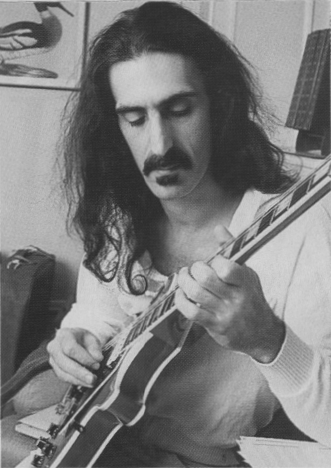 ZAPPA I don't find that especially objectionable. In a way, it's niche marketing. I've constructed it for those people who want that. Also, the solos themselves are constructed in such a way that they're like little set pieces. They have melodies, development sections and recapitulations, just like compositions. See, the way I think of a guitar solo is as an instant composition. You have a certain amount of time in which you're going to be making up a piece of music, and you hope that the people who are working with you onstage are also interested in inventing music on the spot. When it works, which is not very often, that's one of the reasons why I'm glad I have a recording truck. You can snag it. Because it's gone after that. That's the only time it exists.
GW Unlike other forms of composition you do – on the Synclavier or with manuscript paper – a live guitar solo gives you the advantage, or disadvantage, or instantaneous feedback from the audience.
ZAPPA I don't even know the audience is there. It's nice if they are, but I'm paying attention to the instrument.
GW But in other ways, one always thinks of you as an artist with a real firm grasp on who his audience is and who will be interested in what. Do you do marketing surveys?
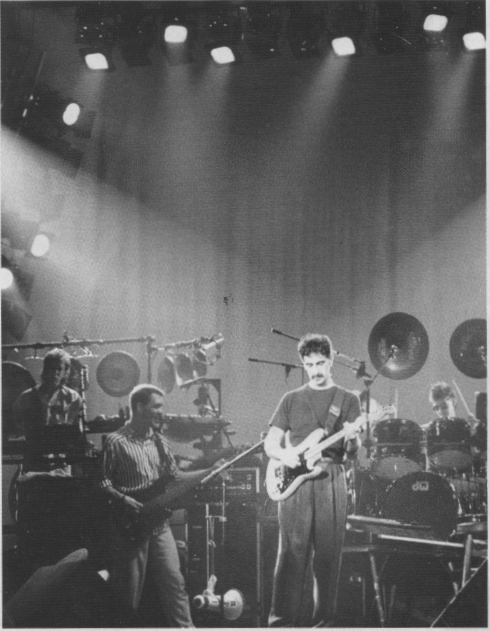 ZAPPA No, I don't do marketing surveys. Come on, do I look like a yupster? What I do is this: When we're on the road, there are kids who come to the concerts and follow us from town to town. And if we see some of those same faces when we arrive at a venue in the afternoon for soundcheck, we bring them in and they sit in on the soundcheck. And you know, I talk to these people. They're always very explicit about what they like and what they don't like on the albums. So that's the closest I would come to a marketing survey. I mean, nobody's going to tell me what to do and what not to do. But at least I have some information that I'm basing my decisions on. And they're nice kids, too.
GW I just noticed that you have a tendency to localize what you do to certain segments of the audience.
ZAPPA Well, there's no one ideal listener out there who likes the orchestra music and the guitar music and "Dinah-Moe Humm" and the whole thing. That's why sometimes there will be an orchestra album, and the people who like the guitar stuff can't stand that. And then a guitar album comes out and the people who liked the orchestra album can't stand that. You know they're all my friends in their own way, so why not accommodate their interests?
GW What about targeting the "youth market"?
ZAPPA Well, the problem with the youth market is the fact that they go to U.S. schools. And the United States' school system has been turned into a kind of assembly line for really ignorant little consumer clones. I was lucky. I got out of school back when they were still teaching kids to read and write. The market you're talking about now is basically people who can't spell, can't count, don't know anything about economics and think the most important thing in the world is dressing properly and having a party. So your guess is as good as mine as to what sort of music will fulfill the emotional needs of those people. I just think they've been cheated by the government. They're talking about yet another budget cut for education. And things are ugly enough already.
GW So I suppose they'll just buy into whatever type of music is advertised best.
 ZAPPA Yeah, well, what they're being taught in school is how to respond to advertising. The enemy of advertising is logic. Anybody with logic or common sense has got to look at what you see on television and say, "This is bullshit." But nobody is providing these kids with the criteria by which to judge between anything with any quality, or even to help them spot bullshit. They just don't know. They come into the whole thing completely unprepared for the tricks that are being played on them by the car companies and everybody else. They're just being used. It's really not fair.
GW You're one of the few guitarists who really use the low strings to their full potential. You do a lot of really rich harmonic things on the low strings. What's involved in getting those sort of tones?
ZAPPA What you do is touch your [low] E string right at the G fret, and away you go. There are four or five harmonics in that little range between the F fret and the G sharp fret – different points in there will give you some strange things. And the same thing will happen on the A string, and all your other wrapped strings. You get ... stuff.
GW So many rock guitarists seem more concerned with squealing on the high strings.
ZAPPA Well, I think most guitarists have a tendency to play in the same way they talk. And since I'm not much of a squealer – I happen to be a baritone kind of guy-to play on the low strings is a little more in phase with my reality.
GW You often pick way up by the neck. Why?
Well, there are a couple of reasons for that. If you rest your palm on the Floyd Rose, it puts the strings out of tune. And I like to have some support for my right hand, so the easiest way to do it is to move farther up toward the neck and rest your hand there. That way, you keep your hand off the bridge tailpiece and you get better intonation. To me, the most hateful thing about the Floyd Rose is the fact that, when you bend a high string, everything else on the guitar travels out of tune. So if you've got any other strings ringing when you bend up the pitch, you get stuff that you don't want. So to use that instrument you have to learn a whole new hand position technique to try and obliterate the bad things you want to hear, and get the stuff that you do. Also, picking closer to the bridge gives you the kind of tone that I don't like to use very often. It's twinkie. The tone gets a little bit rounder the more you go toward the fretboard.
GW Who are some of your all-time favorite guitarists?
ZAPPA I like Wes Montgomery, Johnny "Guitar" Watson, Allan Holdsworth, Jeff Beck, Guitar Slim and Walter Gerwig – he plays the lute. I'm sure there are a few others, but that's who comes to mind first.
GW Is there anyone on the current scene who you particularly enjoy?
ZAPPA In spite of the negative things that are said about him, I happen to think that Yngwie Malmsteen really can play. I saw some videos when I was in Europe that they were playing on Sky Channel. I was really impressed. And of course Eddie [Van Halen] is unbelievable. And this guy in Ratt, Warren Di Martini, he's pretty unbelievable too. And the guy that played with Ozzy Osbourne on the album with the red eyes coming out the front. I can't remember his name. He was great. [Jake E. Lee – GW Ed.]
GW You listen to a lot of metalish guitarists?
ZAPPA No, but my son Dweezil does. And in the case of that Ozzy album, I heard it when Ozzy brought it over to play it for me. That was right around the time that some guy was trying to sue him because the guy's son committed suicide. Ozzy was over here talking about that and he had a cassette of his new album with him. I can't remember the name of the album, but it was real good.
GW Most of the Guitar album was done on a custom Strat, according to the liner notes. What did that consist of?
ZAPPA The only thing that is "Strat" about this Strat is the shape of the body. I think that the original body was a heavy Fender Stratocaster body. And I had a neck custom made for it at [Hollywood custom shop] Performance Guitar, and it has custom electronics in it and Seymour Duncan pickups.
GW What kind of electronics are involved?
ZAPPA It was a circuit that was designed right herein the Utility Muffin Research Kitchen. It's got a gain stage and two parametric EQ circuits built into it. It's set up so that you can have either EQ or gain, or gain plus both of these concentric [EQ] pots. The pots give you variable frequency selection and variable boost and cut at the different frequencies. And then there's a screwdriver adjustment for the Q [resonance point] of the filter – how peaky it will be. This allows you to tune right into the feedback point of the room. You can find out where it's going to squeal, locate it and then that's it.
GW Hence, a lot of that really controlled feedback in your soloing.
ZAPPA Exactly.
GW Are the pickups just stock Seymour Duncan Strat pickups?
ZAPPA Seymour has wrapped some special pickups for me from time to time. I believe that what live in that Strat now are pickups that have an 8k boost.
GW What about amps? Signal processing?
ZAPPA What I've been using on the road on this tour was a pair of Carvin heads for the clean sound. And that clean sound was processed through a Roland GP-8, or whatever you call it. It's an effects box that has the whole assortment of effects – compression, flange, bladdy blah. That was on a separate footswitch so that I could either turn it on or off. And the rest of the dirty sound was made by four Marshall amplifiers: two 100 watts and two 50 watts. Most of the speaker cabinets were hidden underneath the stage and miked. And that's what's going to the P.A. At the end of the tour, I started using one Marshall cabinet onstage, powered by one of the 50-watt heads, just so I could have a little more presence right behind me.
GW Looking back, if you had to locate a couple of real turning points in your development as a guitar player, are there any epiphanies that stand out?
ZAPPA Yeah, when I first heard the guitar solo in "Three Hours Past Midnight" by Johnny "Guitar" Watson. That's probably one of the most important musical statements I ever heard in my life. And also the guitar solos on "I Got Something for You" and "The Story of My Blues" by Guitar Slim. And "Lover Man" by Wes Montgomery.
GW What about your own work? Are there any points for you where you said "Oh yeah, I really..."
ZAPPA "I really got down there"?
GW Or, "I really took off in a new direction."
ZAPPA Yeah. There was this guy who used to be a drummer in one of my bands. His name was Jim Gordon. He's in jail for murder right now. But he showed me how to do that thing on the neck of the guitar with a guitar pick [i.e., using the pick to do hammer-ons – GW Ed.] I certainly put that to good use for a number of years. And at that time I wasn't playing guitar with a whammy bar. So the other important thing would be when I changed over and started using Strats instead of Gibsons.
GW A lot of your older things were done on Les Paul Juniors and SGs-guitars like that.
 ZAPPA I didn't use a Strat until the Floyd Rose came along. The old Strats were just so out of tune I could never stand to listen to them.
GW One thing I had in mind was the period right after the Mothers disbanded, when you started doing heavy guitar solos like "Magic Fingers," on 200 Motels.
ZAPPA Well, the reason I was able to go in that direction was because of the drummer who was in the band at that time, Aynsley Dunbar. Remember, in the earlier Mothers of Invention we had an assortment of drummers who were okay for keeping a beat, but when I played a guitar solo with them, there wasn't much interaction. That changed with the arrival of Aynsley Dunbar, who played on 200 Motels. We used to sit here in my basement and jam. His drums were set up right over there and I had an amp here. We would play in the afternoon. But it's been a long time since I've known any drummers who just like to play drums in that way. You know, without looking at the clock and wondering when the next paycheck was arriving. That's pretty much a result of the Eighties, with everybody being career-oriented and so forth. The spirit of "let's just go play" died a long time ago. I don't expect that it's ever coming back.
GW Is there a reason why you've been so active lately in releasing live concert recordings that you've done over the years and reissuing your older albums?
ZAPPA The reason we are releasing those older albums is that people want them on CD. I've got one major problem in life, which is the bootleg situation: every time I step out the door, somebody is bootlegging what I do. I'm finding discs of interviews that I've done that have been bootlegged. CDs of interviews going years back! And concerts all over the place are bootlegged. So rather than just give up and let the bootleggers handle my musical output, I feel I should release something. Hardcore fans are already buying these bad-quality recordings of the live concert material. The best thing I can do right now is give them the best versions and the best recording quality I can provide.
GW So has reissuing all this stuff prompted you to go back and reevaluate the early phase of your career?
ZAPPA Well, you can't help but think something about it when you're remastering it. Most of the time, I'm just glad I don't have to do that anymore: don't have to play with those musicians; don't have to work in those studios, under those budgets; don't have to deal with the business people I was dealing with in that period of the time. The general experience that I had was not pleasant at all. It's not fun to redo those things.
GW What's your opinion of the music, though?
ZAPPA Well, some of it's good and some of it's not. The problem with all recordings during that period of time was that you were stuck with a fixed budget to make an album. Which meant that you might want to perfect a performance or a mix, but you could not. When the dollars were gone you were out of the studio and whatever stage the record was in, that's what got released. That's the thing that's most troublesome for me about listening to the stuff. I know what it could have been. But there are a lot of people who love those albums. So there they are.
GW I think they're among the best records that came out in that era.
ZAPPA Just imagine what they would have sounded like if I would have had the same budget as some of the supposed "big" groups had at that period of time. For all my early Warner Bros. albums, the total budget for the whole thing was $27,500, maximum. And [dripping with sarcasm] the really "important" groups had budgets four and five times that amount. And my middle period Warner Bros. albums had budgets of $65,000 to $80,000. Again, the big groups were spending half a million to $750,000. So it's a little different situation now that I have my own company and I have a pressing and distribution deal. I just keep working on something until it's done. Hopefully I can sell enough units on the thing when it comes out to pay off what it cost to make it.
GW So what are you working on right now? Any new compositions? Synclavier stuff?
ZAPPA Oh, there are tons of those. I work every night on that. Synclavier hours are usually about 11:00 at night until 7:00 in the morning. There are maybe 500 compositions sitting on floppy discs. I just work on them at random until they're done.
GW Right now, the idea of combining what you do on Synclavier with playing guitar doesn't really interest you?
ZAPPA Playing the guitar along with a sequence you mean? One of these days I'm going to try that. Because bands have become incredibly expensive to maintain. And with all the inevitable personality problems, I'm not all that enthusiastic about sticking another band together.
GW Do you think that's a reason why guitar is becoming less of a prominent instrument in pop today? Do you think other people are experiencing what you're experiencing?
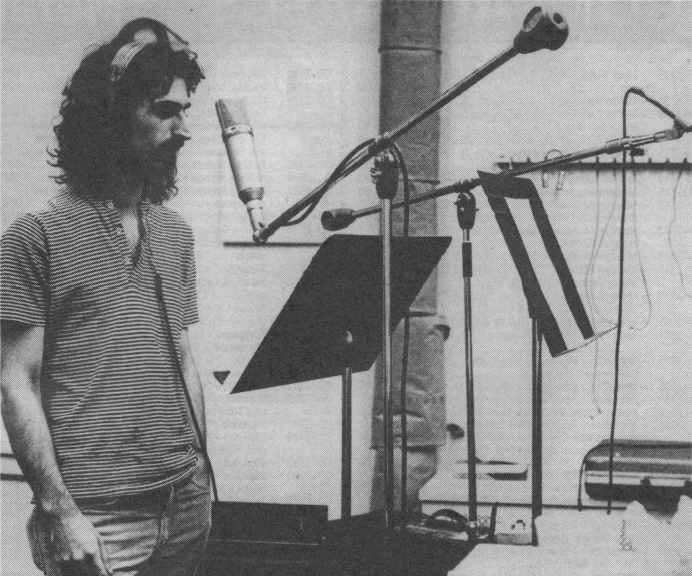 ZAPPA Well, pop music is not the end of the world. There's a whole substructure of what they call pop music which is heavy metal, in which the guitar rules. And that's never going to change. That's a style that's probably going to be with us until hell freezes over, to use a rock and roll term. But if you're talking about Whitney Houston, that other kind of pop music, they try to keep those blasphemous elements out of it. There's nothing AOR or MOR about a fuzz-tone guitar. They try to make the orchestration on those songs as neutral and comfortable as possible. And I think the listening public is, to a certain extent, deceived by what is broadcast. Because what is broadcast is not necessarily an accurate indication of what people are writing or recording. Now, what usually goes on the radio is the most banal product that every record company can manage to put together. In the United States, radio truly is a cultural embarrassment. The only creative radio you can listen to is what they call shock radio, where people are talking and making things up. There's a little spark of creativity there. But most of the music that's broadcast is harmful to your mental health.
GW Even college radio is formatted these days.
ZAPPA Well, that's because everybody wants to make The Buck. That takes us back to the career orientation we were talking about before. Everybody is looking at their watch and thinking about their pension. And they forgot how much fun it is just to get out there and play. So that's where the problem starts. If all musicians loved music so much that they'd play it no matter what happened, then all records would be terrific. Then what would go on the radio would have to be wonderful. But the radio is showing us that people don't love music all that much, but they have a tremendous idea about how their career should go. It's kinda sad, kinda boring and kinda true.
GW There was plenty of AOR and MOR pap in the Seventies as well, but a lot of it was still guitar music.
ZAPPA Yeah, but not like the guitar music of today. The Seventies stick out in my mind as the years when corporate rock was invented. And the people decided that that's the only kind of rock the human race would ever hear from then until the end of time. Except for the heavy metal bands, who were doing their vision of beauty. But then that pretty much became a formula too. Heavy metal took a real downturn when videos came in. It wasn't so much how well you could play as how tremendous you looked in front of a camera. So obviously the most important member of every heavy metal band is the hairdresser, the unsung hero of rock and roll.
GW But right from the beginning, metal quickly asserted itself as a pretty stylized genre.
ZAPPA It's been around a real long time, though. And I remember a time when people frowned on it, the early Black Sabbath and all that kind of stuff. When I say "people" I'm talking about rock writers and the kind of people that think they know. But the people who bought concert tickets, they always liked it, even though it doesn't get played on the radio. I don't think Ozzy is going to the poorhouse anytime soon.
GW What you do seems to exist in its own cubicle, apart from all of this – certainly in the conception and recording of the music. But also, now that you're marketing it on your own, it really seems to exist independently of anything else.
ZAPPA That's the only way it can exist. There is no way that what I do fits a corporate format. And unless there's a miracle of evolution that takes place at the radio broadcast level, nobody will ever hear these songs on the radio. And certainly MTV would never show a video that I would make.
GW If you had come along today as a brand-new, 20-year-old artist doing what you did when you were a brand-new, 20year-old artist...
ZAPPA I wouldn't get a contract.
Read by OCR software. If you spot errors, let me know afka (at) afka.net