Frank Zappa
The interview by John Swenson
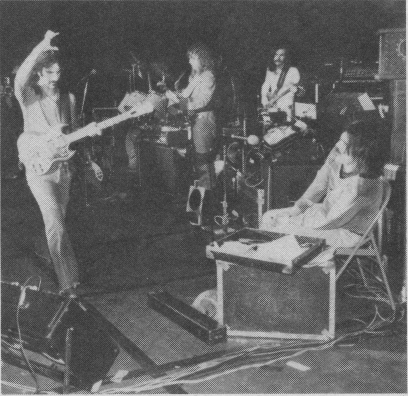
Frank Zappa was at the Palladium in New York for his perennial Pumpkin Day concert celebration with his most loyal fans. The maestro played five illuminating shows, running through a range of material which included an instrumental passage from 200 Motels, crowd pleasers like "Montana," "Cosmic Debris," "Bobby Brown," "The Illinois Enema Bandit," "I'm the Slime" and "Broken Hearts Are For Assholes," virtually everything from the recent lp's You Are What You Is and Tinseltown Rebellion, and even a variation on one of the instrumentals from the Shut Up 'N' Play Yer Guitar mail-order set.
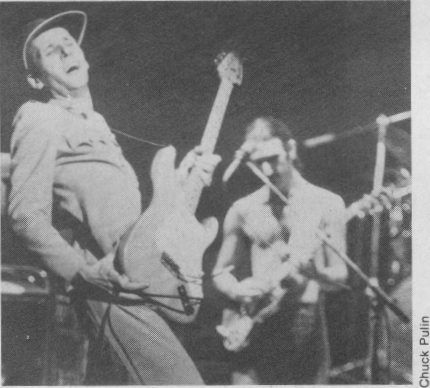
Zappa's crack eight-piece band (himself, Steve Vai and Ray White on guitars, Tommy Mars on keyboards, Bobby Martin on keyboards and horns, Ed Mann on percussion, Scott Thunes on bass and Chad Wackerman on drums) is brilliantly arranged to showcase guitar work, with White pinning down rhythms while Zappa and whiz-kid Vai play breathtaking solo after solo.
There were a few as-yet-unreleased songs thrown in for good measure, including one particularly interesting tune called "Returning Again," an ironic criticism of the wholesale regurgitation of late sixties/early seventies rock moves by current groups. The song could also be considered a Jimi Hendrix tribute (Zappa has a painting of Hendrix in his basement studio).
The ever unpredictable Zappa surprised the hall on several occasions by playing a full encore version of the most requested tune in rock concert history, "Whipping Post" (that's right, the Allman Brothers tune) in absolutely deadpan sincerity.
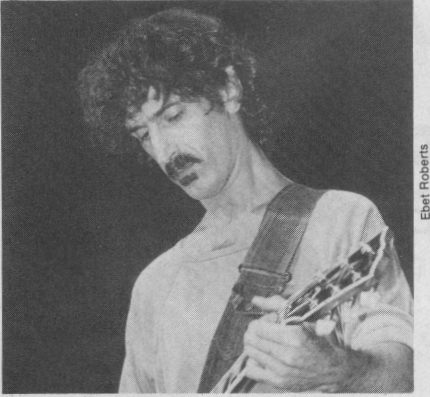
Zappa's own soloing was at an all-time peak, a fact which he later attributed to the superb accompaniment his band offered. During the Palladium stand he relied on his Les Paul almost exclusively, although he used a Stratocaster for an opening solo. Fortunately the shows were recorded and some of these solos may well turn up on forthcoming private releases like the Shut Up ... set. Zappa is such a multifaceted talent that his guitar playing is often overshadowed by his compositional ability when it's not being completely swamped in a misreading of his personality, but the fact of the matter is that he is one of the greatest guitarists we have and is sorely unappreciated as such. His guitar solo albums are only the most recent manifestation of this.
After a year-long boycott on print media interviews (he has done some television interviews during this time), Zappa agreed to talk with me following the Palladium shows. I arrived at his exclusive Upper East Side hotel just in time to see another interviewer scurry out, looking pretty goggle-eyed in a Zappa t-shirt and Smokey the Bear state trooper's hat. Turns out the guy was a state trooper with a passion for Zappa which he attributed to Frank's antidrug stance ...
FZ: By the way, I really enjoyed the review that you did of the albums in Guitar World.
GW: Oh, thanks. I really loved the records.
FZ: I am glad I did them. I mean, I have been waiting to do it for a long time. And a lot of people thought I was crazy for spending the time to do it. But, right now that group of albums is selling better than You are What You Is and Tinsel Town Rebellion. We went into a profit position after two weeks on the market.
GW: You are selling more through mail order than you are in record store distribution?
FZ: That's right.
GW: Somewhere in there is a message ...
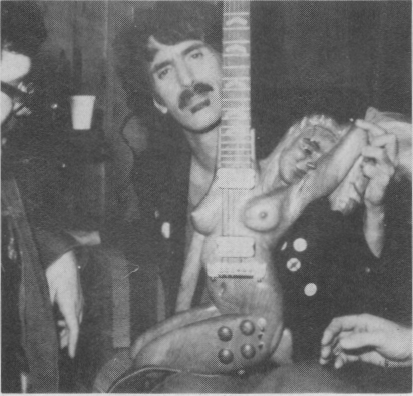 FZ: Well, I am just saying you're talking about cost of making the album, versus what it has brought in in profit after two weeks. I was in profit on the guitar albums and right now You Are What You Is is only being played on the radio in New York and Connecticut. It's not being played anyplace else and it's not selling worth a shit. And it's a great album.
And right now the guitar albums are continuing to sell.
GW: I notice that you seem to use the Les Paul almost exclusively.
FZ: Well, I had planned on using the Strat more on this tour. But, I had a bunch of modifications done to it and because I am such a nice person I don't rant and scream when work doesn't get done on my equipment. I was the last guy to have my stuff fixed up by the equipment guys prior to the start of this tour. And, as a matter of fact, they didn't send that Stratocaster out until the Las Vegas date which was two weeks into the tour. And it's not exactly right. I had some modifications done to it and it doesn't behave exactly right on the stage and so I don't really feel comfortable playing it. I was going to play more Strat on this tour. The first time I used it on the tour at all was on "Zoot Allures" last night.
GW: Do you prefer any of the guitars that you use? Is there one sound that you really feel the most comfortable with?
FZ: Well, my ideal would be a combination of a bunch of different kinds of guitars. I like the vibrato bar if it's on a Strat. But, I don't like a normal Strat neck because the curve is wrong for my hand. I like the neck that I used to have on the SG because it was a twenty-three-fret neck. And the fret spacing was more comfortable for my hand. But, I like the tone quality and sustain that I get out of the Les Paul, which is due to the bulk of the guitar. And so, if I could get all of that together in one instrument that didn't weigh a million pounds I would be a happy guy. But, as it stands now, for recording I switch around to whatever guitar makes exactly the right noise that I want and use that. And for the stage I use the Les Paul because it's the most generally suitable guitar for solo-type stuff the way I play. Although the neck isn't as fast as the SG. It really slows me down, it's more cumbersome.
GW: Are your guitars basically standard models with modifications.
FZ: Yes.
GW: They are not custom?
FZ: No. Not custom.
GW: Why don't you use custom guitars?
FZ: Well, I had one custom guitar built for me one time. And I didn't like it. And so, I'll never do it again.
GW: What kind of modifications did you build into the Les Paul?
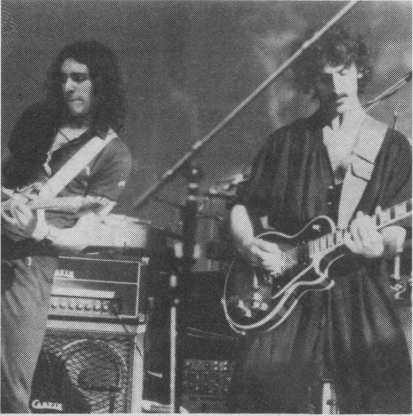 FZ: The Les Paul has a pre-amp and it has two different kinds of pick ups, and it has a Dan Armstrong pickup in the neck position and it has a carbon pickup in the bridge position. It has a Dan Armstrong gizmo called The Green Ringer built into it, which I can dial in. It also has a EQ circuit which in one position gives you about an 8db boost at 8-K and the other position gives you an 8db boost at 500 cycles, so you can either go from a bright sound to a more mid-rangey wah-wah kind of sound, all built into the guitar. And then it has a pickup selector switch that has nine positions. It changes the wiring between the pickups in a lot of different ways, so it's got a lot of tonal variation, I can make it sound just like a Telecaster if I want. Unfortunately, in that position it's not humbucking and under the lights it makes a lot of noise but in a studio it's usually okay. And then there's a little toggle switch on it that goes from series to parallel on the pickups and depending on where the pickup selector switch is set that gives you yet another whole series of variations. And so, I have eighteen times three different tone selections on that guitar.
GW: Does it maintain a unique character, though, that is strikingly different from other guitars that you use?
FZ: It's the sustain more than anything else. You get a very warm sound and it also depends on how I have my amp set. But, you can make notes ring for weeks on end on that thing. And there is no compression on it. It just sustains until you want to go home. I'm playing through three different amplifiers now. I'm using a small Acoustic studio amp, a [Carvin] and a Marshall and they are all for different EQ's, and they're miked individually. And that's blended together out in the house.
GW: I may be wrong about this but it seems in the past that the relationship of your guitar to the band was that the band would play and then you would do a solo often with accompaniment. But, this time I noticed you did a lot of work with the other guitars, while the other guitarist was playing, at the time, dual solos.
FZ: That's an illusion. There is only one point in the show where we play at the same time in linear fashion, and that's in "Stevie's Spanking," and the reason that I drop out for the first part of that is I stay out completely while he's actually playing his solo because it would distract from him. And then when he's done playing his thirty-two bars or whatever – then we play together for a little while. I tend to minimize what I'm playing so he can do all of his Stratocaster extravaganza, bend notes together and stuff like that. That's basically his song. But, the only other place where we do it in the show is in a song called "Teen Age Prostitute" where we have some triple guitar lines. And in "Your Momma" where there are some triple guitar lines. But, all of the rest of the stuff, if I am playing the solo it's with the minimum accompaniment to make it work.
GW: Yeah, that's true for the most part. But, had you always played with other guitars at the same time?
FZ: No. Not really.
GW: That is a new thing for you?
FZ: It's a fairly recent thing I've been playing with.
GW: Does that represent any ...
FZ: Major breakthrough ...
GW: Well, any working out of long-term concept?
FZ: No. I feel comfortable playing with Steve Vai, I mean, I like the way he plays. I think he's really a great guitar player. He does everything on the guitar that I don't do. He does all of the stock Stratocaster noises and he makes everything that Van Halen ever dreamed of and then some. He reads music. He plays sixteenth notes which I don't play. And he does all of this stuff that I don't do; and I think that our styles are kind of complementary.
He's a good musician and I enjoy playing with him because he's not just a Mongolian string-bender. And he's a thoroughly trained musical person. And I like working with him.
GW: Do you then change your band according to the musicians in it or do you look for the musicians to change the group?
FZ: Well, I have ideals I always shoot for but you can't always get what you want. You know, the musicians are chosen by audition. And they come in and try out against each other to see who gets the job.
GW: Yeah, but do you know what you're looking for in advance pretty much?
FZ: Sure.
GW: And then once you find ... well, take Steve for instance. Did you realize you would do those kinds of things with him?
 FZ: Oh, I think I knew that from the first time I heard his cassette. Because his cassette was intelligent and it sounded like he was a person who was interested in music rather than being just a rock and roll star. I like that.
GW: Is everything absolutely written out, or are there improvisational parts there?
FZ: Well, you can tell a guitar solo from a written part, can't you?
GW: Sure. But, ...
FZ: All of the rest of the arrangements are specified, if not on paper, then they've specified by note where I will say, "You play this at this point. And then the break goes here and this goes there." I tell them what to do. You don't just walk out on stage and let your mind run wild.
GW: Of course, but while you are in the process of developing the arrangements do you ever ... just give a sort of general instruction to the musician about what to play?
FZ: Only when it's appropriate for the texture of the song. Some things you want to have a loose kind of background. I mean, I don't hum 'em every note of a reggae background. No. They know what the style is and so they modify to suit. And I always try and design the arrangements around the assets and the liabilities of the guys who are playing. There are certain things that some people can't do. So you shouldn't ask them to do it. And there are other things that they are really good at and you are a fool if you don't get them to stick some of that into the song. So, I balance it out.
GW: What direction are you heading in right now?
FZ: Who knows?
GW: You don't have anything ...
FZ: Oh, I know what I want to do but I can only go where I can afford to go. Remember, I'm self-financed. I can tell you that I want to make a movie tomorrow or I want to go out and do something with a symphony orchestra or I want to do this or I want to do that. I have to wait and see how much money I have to invest in the next project. And that will determine what the project will be.
GW: But, given your current group ... is that pretty much what we see is what we get, or do they suggest another group of songs or ... there were some things you played that I had never heard before.
FZ: There are other things that are already recorded that you haven't heard on stage, too. Because we did a bunch of recording before we left LA.
GW: What kind of stuff can we expect? Can you describe any of it?
FZ: Well, I'll tell you what we've already recorded. A lot of stuff with [One-time Mother] Roy Estrada. A song called "Truck Driver Divorce" which will probably be the end of country and western music. It's like country music on PCP. And another song called "Willing Suspension of Disbelief" which is a science fiction extravaganza. It has everything in it about cheap monster movies that wasn't included in the song "Cheepnis." And another song called "Sex," which is a very nice song. And then there's a straight ahead mongolian sing-along song called, "No, Not Now." And there's another one called "Viva La Rosa," which is like a jazz song, bossa nova type. That features Tommy Mars on Hammond organ and recorder. And then there's all the ones that we were doing in the show that you heard that have also been recorded and haven't been released yet.
GW: What was that Jimi Hendrix song?
FZ: That's called "Returning Again."
GW: When did you write that?
FZ: Two or three years ago. It's got some good words to it.
GW: What's that line about the way they play it on the radio?
FZ: "If you listen to the radio and what they play today you can tell right away, all of those assholes really need you. Everybody come back. No one can do it like you used to. If you listen to the radio and what they play today, you can tell right away, all those assholes really need you."
GW: Is that a comment on the fact that the Doors are the second best-selling American group right now?
FZ: No, it is just a comment on the fact that as we head into the Dark Ages again you will hear only ten songs for the rest of your life. And I think a little variety never hurt.
GW: There is also ... you do really like Hendrix obviously?
FZ: Well, yeah. I think that he was really good. Steve loves Hendrix. You know, Steve, he's got tattoos on his body. He's the Stratocaster guy. And I knew Jimi. He came over to my house once. Nice guy. And it's too bad that he met such an early demise.
GW: So there is in a way a kind of tribute to him?
FZ: Of course, it's a tribute to anybody who did anything in rock and roll that set the standards for what people are doing now, and often copying in a bad way. You know, to me the original stuff ... it's just like the original rhythm and blues records. There's nothing like it. A lot of those same things are being re-recorded again and recorded cleaner and nicer and better and whatever, faster. But it's not the same. And it's really not New Wave and it's not improved anything. It's just today's freeze-dried version of the mannerisms of another form of music that already happened.
GW: There's a sense in which you play "Whipping Post" as the ultimate joke on encores, because that's the most requested encore song of all time.
FZ: Well, I'll tell you how it happened. We were playing Helsinki, Finland about six or eight years ago, and in the middle of this very quiet, nice concert hall from the back of the room a voice rings out, "Whipping Post." And I thought, if we only knew it we could blow this guy's socks off. You know, it would be great to just ... sure, fuck you, "Whipping Post" ... all right, here it is. So, when we got Bobbie Martin in the band I said, "He can sing the shit out of 'Whipping Post' and so let's go for it."
GW: What did the other members of your band think when you said ...
FZ: "God damn right, let's do it." They love it. They enjoy playing it.
GW: Did you similarly like Duane Allman?
FZ: I never listened to their music. I like "Whipping Post," though. In fact, I think they even premiered it when we were working together at this pop festival at the baseball stadium in Atlanta years and years and years ago. It was the first time I heard this song and I liked it then, thought it was really good but I am not an Allman Brothers consumer.
GW: But, as a guitarist you were obviously aware of Duane Allman.
FZ: Well, I heard him like the same way I hear other things, if it happens to be on the radio when I go someplace. I don't follow it, I don't consume it.
GW: But, you do offer a kind of homage to a famous dead guy who was a great player.
FZ: The credit is all his. It's his song. I didn't invent it. It's a great song.
GW: Yet at the same time you are making fun of Jim Morrison, right?
FZ: Well, I knew Jim Morrison too. As a matter of fact, my wife knew Jim Morrison when she was a child. They used to play together. In fact, I think she even hit him on the head with a hammer or something. And so, I know all about Jim Morrison. And, as a matter of fact, Herb Cohen tried to manage him at one time. And they were playing around LA when we first started. They were working at the Whiskey Au Go Go and all that stuff. And so I am pretty well-acquainted with the rise of Jim Morrison. And the thing that was obnoxious about Jim Morrison was when Crawdaddy decided to proclaim him the Lizard King of rock and roll and went on this bizarre rampage. And the type of merchandising that was originally associated with Doors music I thought was really distasteful and stretching the boundaries of what it actually was beyond the realm of credibility.
GW: Okay. So what you are making fun of is the deification of Jim Morrison.
FZ: No, I'm not even picking on Jim Morrison. I am talking about the machinery that takes anything and exaggerates it to the point where it's blown out of proportion and the public believes the inflated version of what the reality is. I am a realistic kind of a guy. I just try and look at things the way they are, take them for what they are, deal with them the way they are, and go on to the next case. But, Americans thrive on hype and bloated images and bloated everything, and anything that's realistic they turn away from. They want the candy gloss version of whatever it is. And Jim Morrison is only one example of that.
GW: Getting back to what you do perform, the stage act seems to be taking new directions. What gets you off as a "director?"
FZ: I enjoy doing anything that is theoretically impossible, and making it work. I mean, you saw some things on stage that were impossible and didn't even know it. If you saw what that music was that they were playing, if you saw it on paper and realized these guys were out there doing it with choreography and kind of dancing all over the stage – that was some of the hardest shit anybody in a symphony orchestra would ever be asked to play. They're dancing around and fucking doing it from memory. There's not an orchestra in the world that could have done that.
GW: It was pretty amazing.
FZ: Right. And it looks like, "Hey, we're having a good time." They fucking sweated their nuts off to learn that stuff.
GW: How long did you rehearse?
FZ: Two months. Minimum of five days a week. Sometimes six days a week. Minimum of six hours a day and sometimes ten hours a day.
GW: Does it ever happen that you put together a band and they seem like the right guys and then they just can't do it?
FZ: Sure, all the time.
GW: What do you do then?
FZ: Fire them. Get another band.
GW: But, obviously that didn't happen with these guys. The bass player was really great too.
FZ: Great. He's a great guy. His name is Scott T-h-u-n-e-s. And he's really a great guy. He's twenty-one. The drummer, Chad Wackerman is twenty-one. So is Steve Vai.
GW: You have a sort of policy of not staying with any one line-up for too long.
FZ: Well, that's not my policy. That's just the way it works out. Because a lot of times you'll hire somebody who's a great talent and he gets in there and says ... as soon as he says to himself, "I've done one tour and thousands of people have clapped for me while I was out there and it's now time for me to launch my own career." And bingo they are gone. And so you say, "Great, good bye." Have a nice career. And then we get another guy.
GW: You know, it would seem almost like ... that it's like an indulgence for you, not of yourself, to perform live with a group because it's so expensive and takes so long to work up.
FZ: Well, just so you really understand the mathematics involved, what do you think two months of rehearsal costs?
GW: Don't know.
FZ: A quarter of a million dollars. That's before I buy the airplane tickets and pay for the hotels in advance. That comes out of my pocket before I get a nickel from any ticket. That's what I have to invest to make a band sound like that. And I don't think the audience has the slightest idea what that means. I am not funded from the sky. The money that they spend on a ticket this year turns into somebody's salary next year. Or it turns into airplane tickets. It turns into new equipment. I have been telling people I don't stick this up my nose and I don't buy yachts.
GW: But, in a way it would be much cheaper for you to just record and compose and try to get your things done that way.
FZ: Yes and no. But, I mean, look – I love music. I love to play. And I enjoy going on stage and improvising a guitar solo. You know, you can't do that at home. You can sit around and noodle on your guitar but it's the instant challenge of going against the laws of physics and the laws of gravity and going on stage and playing something nobody ever heard before. And nobody would dare to play. That's what I like to do. That's ... I mean, that's sex. It's better than sex. That takes you into a realm of science. And you can't do that sitting at home and you can't do it in the recording studios. It's not the same feeling.
GW: So you don't want to take all of the money that you've made and go out and buy a farm and grow tomatoes?
FZ: No. Even though I am an Italian I do not wish to grow tomatoes.
GW: Which brings me back to that thought before ... you know, everybody is making such a big deal about ... Gee, the Rolling Stones are still actually doing this despite having more money than they know what to do with.
FZ: Than Jesus.
GW: And yet here you are making this ... I mean, actually in a sense a donation to your audience.
FZ: Hey, listen we wouldn't be here if it wasn't for the audience. I mean, I would still be off someplace scribbling stuff down that wouldn't be getting played. Unless there was somebody who wanted to hear it and paid money to hear it and bought the records, unless that exists we can't do what we do. You have to understand how the ecology of the whole thing works. It's an eco-system. A person who buys a ticket makes it possible for the event to occur next year. The person who buys the record makes the next record possible. If you like it support it. If you don't, it ain't going to be there. That's what it's all about. Because I'm not going to get a Rockefeller grant and the government's not going to send me a check. I'm just a small business operation. You know. It's up to you. You like it, help me do it. Help me pay for it.
GW: What about orchestral projects. I know we talked about this last time but do you have any?
FZ: Well, here's the orchestral policy. I have already spent as much money as I can to make them happy. I can't spend another nickel. I have already invested too much money trying to make it happen and not one note has been played. Okay? Somebody wants the orchestral. music, they pay. They pay for everything including the phone calls. I can't put any more money into it.
GW: Is there anybody interested?
 FZ: Yes. The Orchestra Nationale of Mexico City wants to do three of my ballets. That's the latest. Do you know about the orchestra in Poland? The Polish Radio Orchestra wants to give a complete concert of all of my orchestra works.
GW: All of them?
FZ: All of them.
GW: How many?
FZ: More than your mouth can hold. The Berlin Festival this August wants to do an evening of music with this orchestra in Czechoslovakia. The Buffalo Symphony wants to do a bunch of stuff in the springtime. All of these are offers that are in and nobody has signed a contract and nobody has finalized it. But that's ... every year there are offers. People call up and say, "Let's do it, let's do it, let's do it." But nobody ever signs on the line. And I'm sitting there holding the fucking bag. I still write the stuff.
GW: You are still writing?
FZ: Sure. I wrote three pieces this year. In fact, I am almost finished with a piece that I was writing for Boulez's group because he wanted me to write something for his Ensemble Intercontemporaine in Paris. But that's a small orchestra.
GW: Were you happy with the way the Varèse concerts went?
FZ: I think that most of the pieces were well played. I think that the way the concert came off was good and it should happen again.
GW: Do you mean, it ought to happen again?
FZ: It should, it ought to, yes. Because they didn't play all of his pieces. They didn't play all of the large orchestral works.
GW: It was fairly well attended. Must have done reasonably well.
FZ: It did not make a profit. It lost about six or seven thousand dollars. It costs a lot of money to hire all of those musicians, and rehearse them and rent the stuff to do it and pay off the union and all that crap.
GW: I actually thought that you were going to perform at that.
FZ: No. I am not qualified to do that. I could have conducted "Ionizations" because I did at rehearsal for awhile. But, it just wasn't ... shouldn't have been a thing for me to perform. I was there to be a host and to help draw people to the concert and I think I did my job.
GW: I was pretty impressed at how the audience, which obviously was largely made up of people that had no clue as to what that sounded like that just came because of you
 FZ: And they liked it.
GW: Right. They responded. They were delighted.
FZ: Totally quiet while the music was being played. And they liked it.
GW: That was pretty amazing actually. Because they don't get to hear that on the radio.
FZ: That's right. And they may never get to hear it again. But, they heard it that time and I think the kids who attended that concert will get their money's worth.
GW: I include myself in that. I got my money's worth, I got the ticket for free. But, not that I wouldn't have paid for it.
Who are the best guitarists who you've hired throughout the years.
FZ: Who I've hired? I'd say Steve is the best. Period.
GW: In all aspects?
FZ: Well, he doesn't play slides. Denny Walley is the only slide guy that I've had. And he was real good. But, he can't do what Steve does.
GW: You never really liked any of your guitar players that much.
FZ: Not as soloists. I mean, a lot of times a guitar player will be hired because he can sing. It's not that I'm looking to hire vast quantities of decent guitar players. I've never really picked guys as guitar player members of the group. They have always been singers.
GW: How about rhythm players?
 FZ: Well, the best rhythm player, I think, is Ray. He understands rhythm. And that's one thing that you can't find today is a good rhythm player, because guitar players don't bother to learn any chords. They don't. Everybody wants to go wee, wee, wee all the way home, whammy bar and go ape shit and play all the high screaming notes. Because nobody gets laid from being a rhythm guitar player, you know what I mean? So, nobody learns how to do that. I started off as a rhythm guitar player. I always liked strumming. I learned a bunch of chords so I had an appreciation for the people who can do that. And there is an art to it. And most people don't think in those terms anymore, everybody wants to be a lead guitar player.
GW: What about your own playing? How do you feel about that now as opposed to what you've done in the past?
FZ: I'm playing my ass off. It has definitely improved.
GW: Does it all sort of blend together or is there a level where you are jumping beyond stuff that you ever were capable of.
FZ: Well, the funny thing about the way I play is that I never practice. And everytime a tour ends and I put my guitar away I usually don't touch it until the next season's rehearsals. And every time I pick it up it's like learning to play all over again, I don't have any callouses, it hurts, I can't bend the string, you know, the guitar feels too heavy when I put it on, I feel awkward holding it. It's like somebody hands you a piece of lumber. And now you are supposed to perform again and I was off-the-road for nine months before this tour. And I didn't hardly play at all, I mean, a couple of times in the studio and that was it. I lost all of my technique, and didn't have any callouses. It was really hard to play. And so, this tour started and it was with a brand new drummer which usually takes some amount of time adjusting to. And I suddenly found that I didn't have any problem playing, I just went out there on the stage and started blasting away. I have been playing good since the beginning of the tour, and a few nights I've played things that I think are really remarkable even by my own standards, or by my own aesthetic, of what I am trying to do when I play, I think I've exceeded my goals on a couple of nights. I really do.
GW: Can you describe how that feels when you've hit that point?
FZ: Well, it's great. You just know that for that point double 00000009% that's out there in the audience that understands what's going on, that person really got the message and the rest of the people say, "Wow, he's playing loud." Whatever they think is going on. "He's going crazy." But, you know, you get to the point where you know you have just said something that nobody has ever heard before, that nobody has ever thought of before and there you did it. And on top of that, it's recorded. And you can play it for somebody later and say, "Would you believe that on such and such a night at such and such a time giving this set of circumstances under these climatic conditions this occurred? I am looking for things that are just unlikely. Rhythmic events that are unlikely. Melodic events that are unlikely. You've already heard all of the good licks that all of the good guitar players play. You've already heard every pentatonic scale there ever was. You have heard all of the chromatic scales there ever was. You've heard the Aeolian mode played with a muted palm of the hand. You have heard all of the nice bent notes. You have heard clean playing, accurate playing. You have heard it all, you know. I don't give a shit about that stuff. I want to play what's on my mind and I think I succeed when I can directly convert my compositional idea, my instant compositional idea into sound patterns right there on stage on the moment, and if the rest of the band accompanies that properly so that it obviates the musical idea, then I did it.
But, that's a lot of variables, because it means that everybody on stage has to hear each other just enough so that it works, and that everybody else's musical imagination and the support function of the rhythm section is tuned into what I'm doing. You don't have any go-for-yourselfers out there. And that's the thing that usually ruins a solo. If a drummer overplays, if the bass player overplays or the keyboard overplays ... if they don't have any sensitivity to what I'm doing or if they aren't smart enough to track the direction that I am going in it's like dragging an anchor. In fact, I'll point out the way that song, "Watermelon in Easter Hay" got it's name. It's from the statement that playing a solo with this band is like trying to grow a watermelon in Easter hay. And most of the bands that I've had it was like that. It's been just recently where I've had rhythm sections that don't get in my way and let me do what I am going to do. And also guys playing behind me who are fans of what I play. Not just fans of the group or whatever, but they really enjoy listening to what I am capable of doing given optimum circumstances and they get off on it. When you have somebody pushing you like that and working with you to help make a musical event unnatural or unknown or alien or beyond or scientific or whatever, then it's great. So I enjoy that.
GW: So that's where you do ... one of the things I wanted to know before was where you rely on the imagination of the musicians that you hire.
FZ: It's a matter of pattern recognition. The faster they can comprehend what the – do you know what a hemiola is? That's where you play a pattern across a bar or series of bars – the faster they can comprehend what my subdivision is and where I am going and what they have to do to make that thing pay off. There was a couple of things that happened I think even on the Friday night show where on one song I played this hemiola that was really complicated over seven bars. This big monstrosity thing that's ... the time is 4/4 and I am playing something really weird over seven bars and it comes out exactly on the down beat of bar number eight. And the drummer got it exactly right and I waited about twenty bars and did it again, the same type of rhythmic thing came out again. When you see that stuff on paper that's science fiction. That proves ESP. Guarantees it. There is no other way that you could do something like that, because if you took each part and wrote it out and saw what rhythm was, how else could it have happened? These people have to be reading my mind. I'm not reading theirs because I am not thinking about that, I've got something else to worry about.
GW: That's a really great description of it.
FZ: I mean, that beats the shit out of any of those blindfold card tests that they do at the famous universities. You know, you want to prove ESP, get a tape of some of those solos on the road.
GW: So that means the future Shut Up and Play Your Guitar records are going to be real monsters.
FZ: I'll tell you what. Without wishing to impinge on the sales of the present Shut Up and Play Your Guitar records, I'll guarantee you the next batch will make them sound like nothing. Because there's more interesting stuff going on right now, I mean, we're really wailing away out there. Also, I expect the sound quality will be better on the next albums too because of my own equipment rather than relying on record equipment.
GW: Do you have particular favorites now that you've got some distance from those three records?
FZ: I like "Stucco Homes" and "While You Were Out." I've always kind of liked those ones. And I like ... I think it's the first Shut Up and Play Your Guitar record. I like "Heavy Duty Judy," I like "Soup and Old Clothes." Those are my favorites.
GW: Why did you include those voice segues?
FZ: Because I tried the album ... I edited it together with no vocal texture in it and I thought it was flat. I think it needed just a vocal distraction to set you up for the next thing, because one solo after another after another with no interruption is – to me it wasn't dynamic enough.
GW: Was that why you had those conversations and weird sounds on "Lumpy Gravy."
FZ: No. That was the composition on "Lumpy Gravy." In this case, it just served as punctuation, just to give your ears a chance to stop hearing a fuzz tone for a minute and hear another texture and then it set you up for the next thing. It just – it's structural.
GW: Does it bother you that you are not revered as a great guitarist?
FZ: But, I am revered as a great guitarist by at least four or five people. And that's better than none.
GW: What I meant to say is that, you know, where somebody like Eddie Van Halen can become a big star ...
FZ: Eddie Van Halen is a good guitar player, you know, he's entitled to all of the adulation that he can acquire. That's great. So, what I am supposed to say? There's a lot of good guitar players out there. I'll guarantee you that I am the only person doing what I am doing, though. Because I don't approach it as a guitar star. I go out there to play compositions. I want to do compositions instantly on the guitar. I want to take chord change or a harmonic climate and I want to build a composition on the spur of the moment that makes sense, that takes some chances, that goes someplace where nobody else wanted to go, that says things that nobody else wanted to say, that represents my musical personality, that has some emotional content that speaks to the people who want to hear that kind of stuff. And for the ones that don't like guitar stuff at all they can forget it, it will be over in a minute and it will be back to another part of the song. That's what it's all about. A lot of people can't stand to hear me play the guitar because it's not regular rhythm. You know, everybody wants to tap their foot, when I go crazy, they lose continuity, they can't count it, they can't think it, they can't feel it, so they just totally reject it. They want that nice, safe, straight up and down stuff, and there is tons of it to go around but, just don't come to me for it because I am not the guy to play it for you. I can't play it. I don't know how to play it. I couldn't play straight up and down. It's unnatural to me. I don't even enjoy listening to it. It's not my world. It's like wearing a coat and a tie.
GW: A lot of people have caught up to the sophistication of your musical concept who were completely mystified by it when you first started.
FZ: There are some people that have caught up to it to the point where they can tell that it's music. Where they don't reject it anymore. But whether they have caught up to it to the point where they can comprehend it is a matter for further discussion because I don't think they understand it, I don't think they know why it's done, I don't think they know why it works or how it works. I don't think they want it to work, because if they understood what was really going on, then they would have to reject everything else because I think that what I am doing is the best solution to the musical problems that are set up at the time. I am going for optimum solutions to musical problems. And I think I am doing it the right way.
I am providing good solutions to the empty canvas problem. Okay, I think other people are providing really boring solutions to the empty canvas problem. Really safe, really boring, but entirely competent solutions to the problem. To me, a lot of other people sound like clowns on velvet. You know what I mean? If you have a piece of black velvet and wanted to solve that problem you'd paint a nice clown on there. You know? Or you do one of those Keane paintings with the children with the large eyes. You know, somebody likes that stuff. And there it is for them. That is not my solution to the empty canvas problem. I am going for something else.
GW: That wasn't always ... there was more experimentation going on eleven years ago because it hadn't all been run through, there were still things that you could do that hadn't been done before.
FZ: The problem has been all along, unless you are a soloist by yourself on the stage with nobody else around, improvisation is a communal effort and requires the assistance of somebody doing the background part and somebody doing the foreground part.
Prior to today I have not had an ensemble that was capable of that type of aesthetic realization. The early Mothers weren't that musically skilled. I mean they had their qualities but to be able to support me in doing the kind of thing I'm doing now, they couldn't do it. And my technique has improved, and my equipment has improved, so now aside from playing the notes that I want to play it's easier for me to make the sounds that I want to make whereas in years past I didn't have a sound that I enjoyed coming out of my guitar cause I didn't have the right stuff to do it with. I'm more satisfied with my timbre. If you don't like the way your instrument sounds there's certain things you just can't play on it and there's certain things that just won't come out. Especially on an electric guitar, which is determined by acoustic situations, otherwise the feedback won't be at the right frequency, and all that kind of stuff, if you have the machinery to allow you to tailor that tone to each room then you can really go, and now I think I have that. So I look forward to every gig because I know I'm going to be able to play at least eight solos during each show. I can get eight chances to decorate a piece of time canvas and I crave it, I really crave it.
To me, if every one of those things was written down as I played it I would be just as happy to sign my name to it as a musical composition that I would sit down and write on a table, cause that's what I'm doing, I'm a composer, it's just that instead of a pencil I'm using a guitar.
GW: That's definitely the impression I've had, that you're reaching for spontaneous composition, that virtually every time you record something you could put it out as a record so that your whole body of work is valuable instead of the pop concept of instant disposability.
FZ: But then on the other hand if what I'm doing does stay around for a long time, then perhaps it's not really that valuable because the value is determined by how many people want to consume it, and the audience for what I do is unfortunately small because not that many people have been told that it's cool to like this. As long as you are told over and over again that the apex of perfection is REO Speedwagon and Pat Benatar, then as long as you believe that that's what's cool, then that's all you will ever buy and that's all you will ever listen to and all you will ever admire. But if somebody comes along and says "Hey, wait a minute, you know this over here is really good," then maybe some other people will listen to it, but nobody ever says that about our stuff because they're still all tied up with questions like "Well, is he a genius or isn't he?" "Well, did he shit on the stage and eat it or didn't he?" All dumb stuff like that from sixteen years ago and it doesn't even relate to the present day. You can't beat it. I'm not gonna spend my life going around trying to correct everybody's statistical inaccuracies because I've got other things to do. But by the same token this stuff is hanging over my career like a cloud.
GW: It's amazing. The other night I took my thirteen-year-old sister to the show to my mother's great dismay.
FZ: I'm sure.
GW: On the way over to the show I saw a friend who doesn't go to many concerts any more and I told him "I'm going to see Frank Zappa." So he said "Oh yeah, is he gonna shit on stage?" Then my sister sat through the show and I asked her what she thought of it and she said "That wasn't so crazy," I hadn't told her it was gonna be weird. So there you get the two extremes.
FZ: Right. Well, people want me to shit on stage, they should go and hire somebody that looks like me and pay him to eat doo doo. I don't shit on stage, I don't eat doo doo, I don't step on baby chickens, I don't do any of that stuff. I'm a real good guitar player. I sing some funny songs sometimes. I'm not that crazy. I even had my kids ask me "Did you ever shit on the stage before?" I mean they hear it in their fuckin' school.
GW: Well, I know you want to get something to eat so I'll end it there.
FZ: Did you get enough?
 |
 |
"Guitar magazines always want to know what size strings I use. You wanna know what strings I use? OK, on the Les Paul, the top E string is 8, the B string is 10, the G string is 13, the D string is 24, the A string is 32 and the E string is 46. And they're Maximus."
Read by OCR software. If you spot errors, let me know afka (at) afka.net