Rolling Stone
 USA
USASee also Scrapbook --> Rolling Stone ads
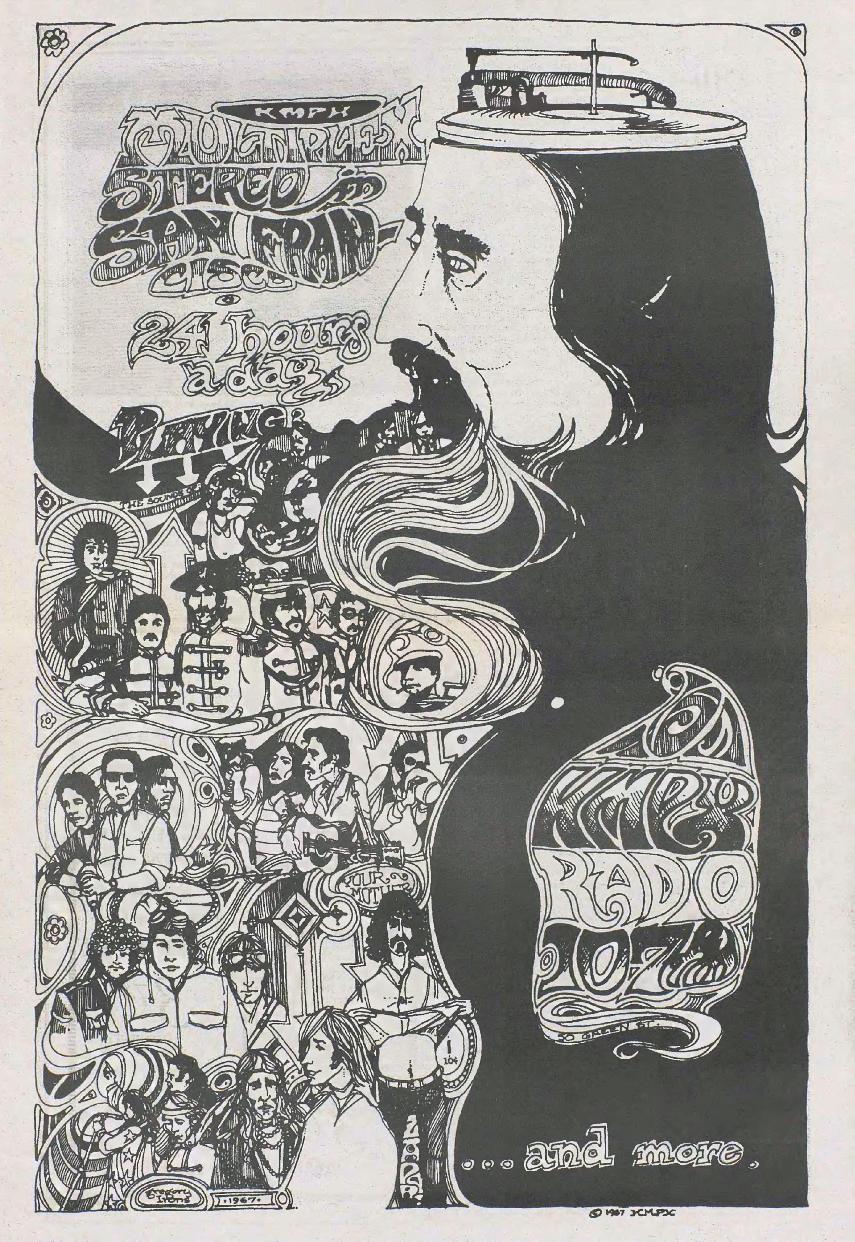
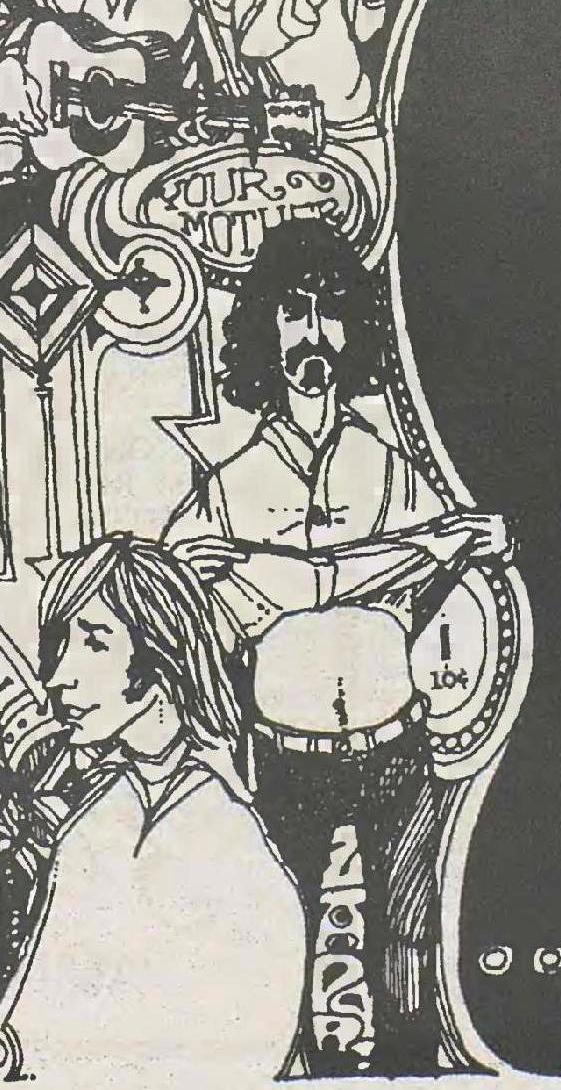
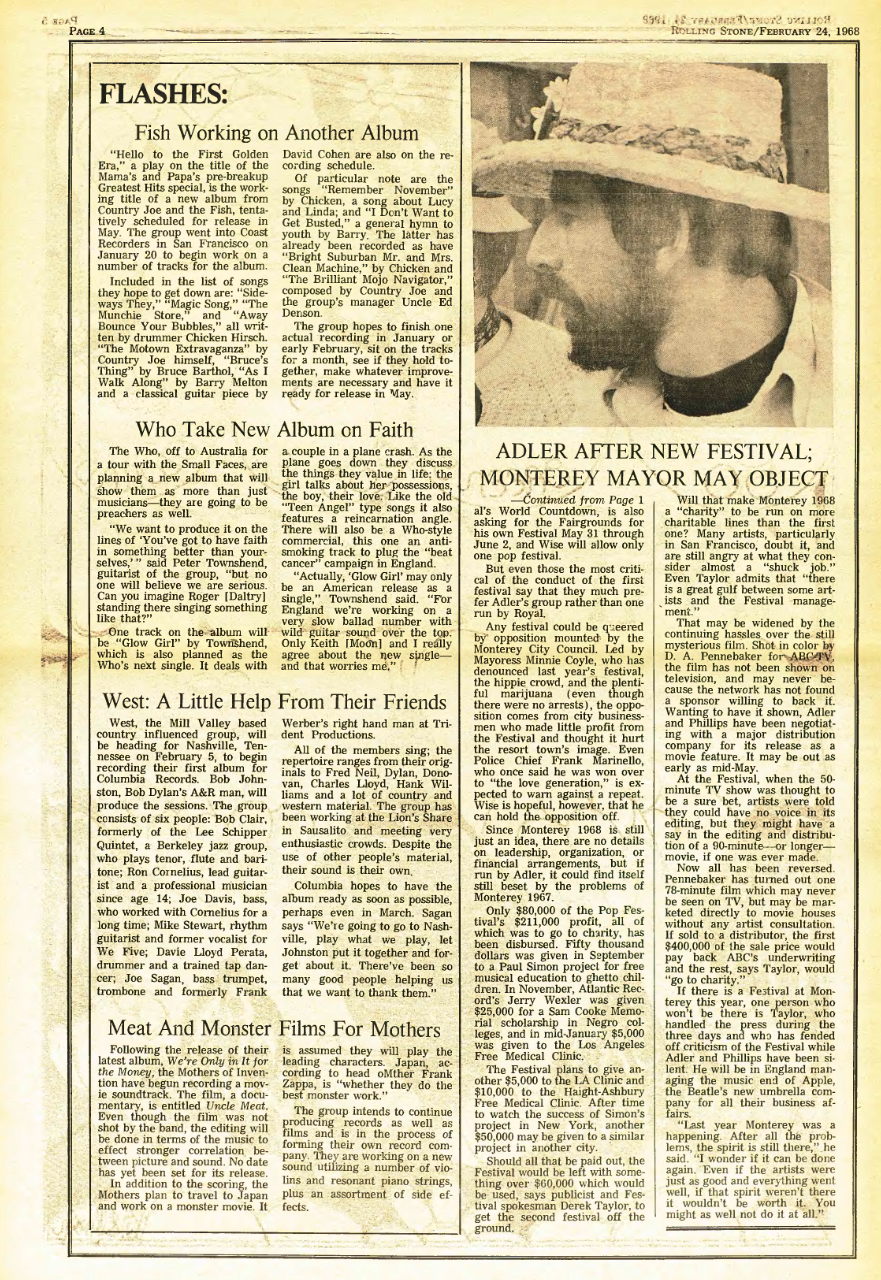
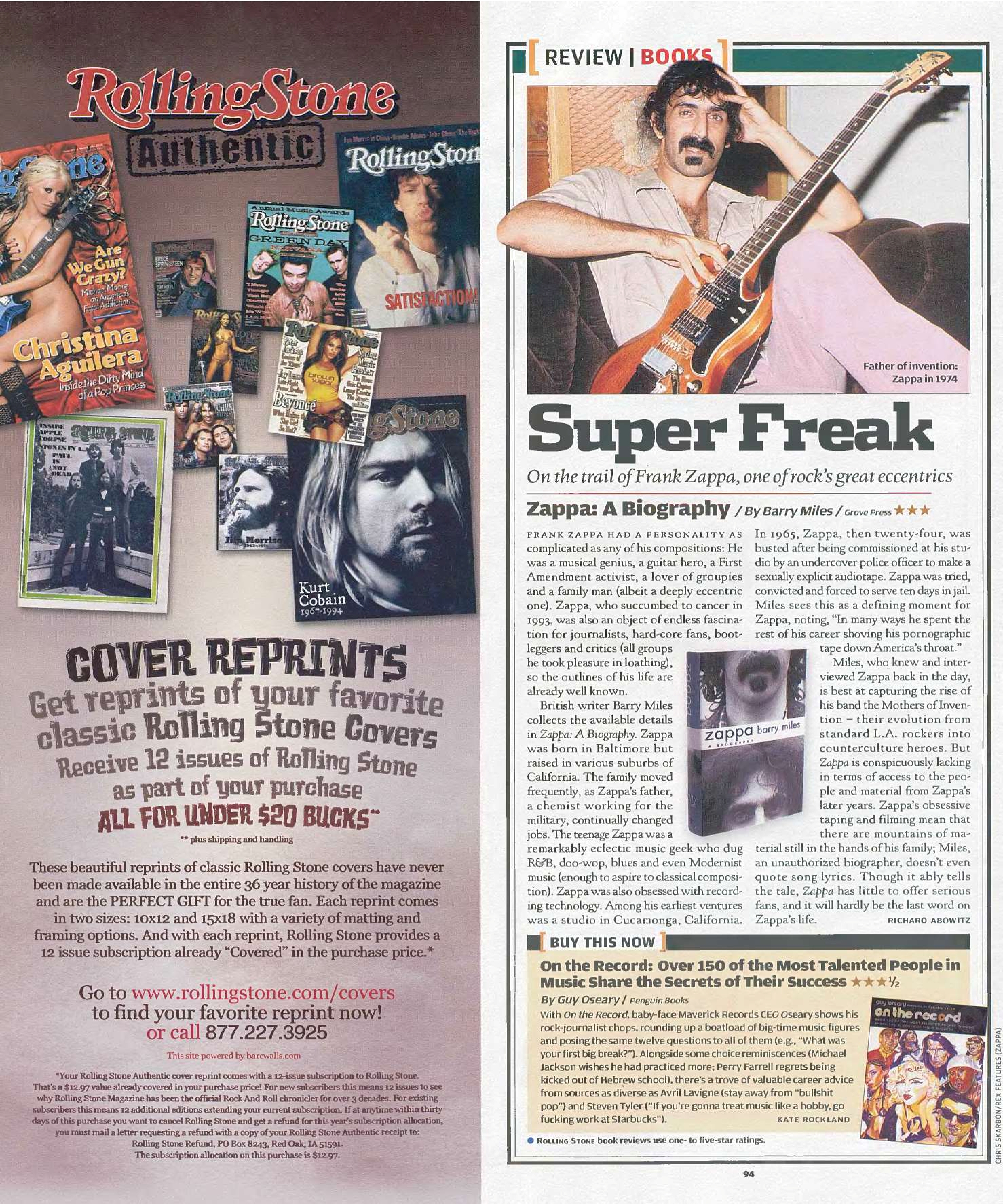
In the very first issue of Rolling Stone Frank Zappa is presented on page 5, which includes a full-page KMPX ad. This ad was repeated in some other early issues of Rolling Stone. KMPX was a San Francisco FM radio station known as the birthplace of underground radio (wikipedia).
This ad is by Gregory Irons. "Gregory Irons was an infamous psychedelic poster designer of the 60's, who after the hippie hangover of the early 70's became a gothic underground comic book artist. In the late 70's to the early 80's he became a controversial tattoo specialist and established himself as one of the greatest unrenowed artists to come out of America." (nudemagazine.co.uk)
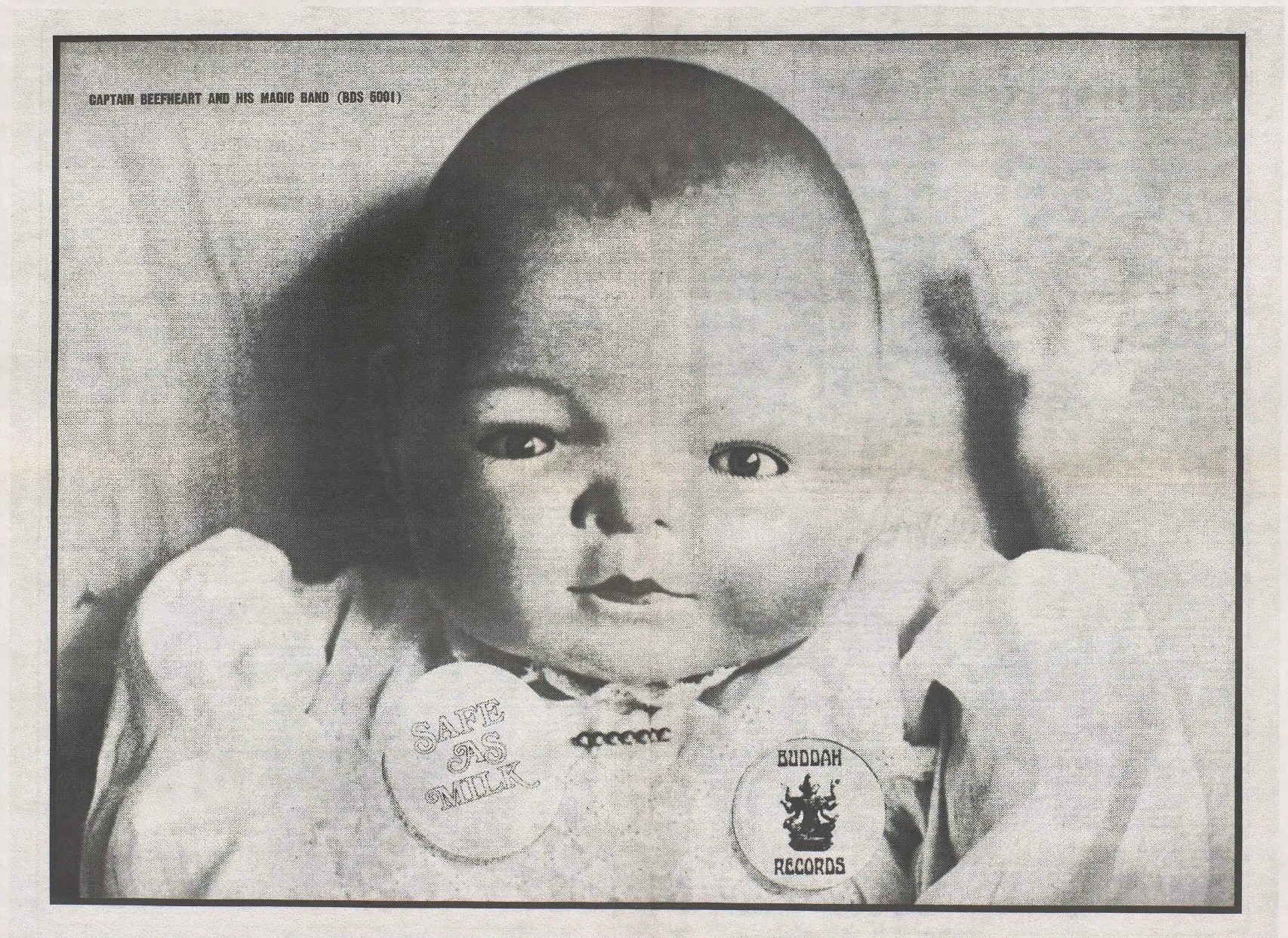
Another super ad is on pages 13-14 – Safe As Milk by Captain Beefheart.
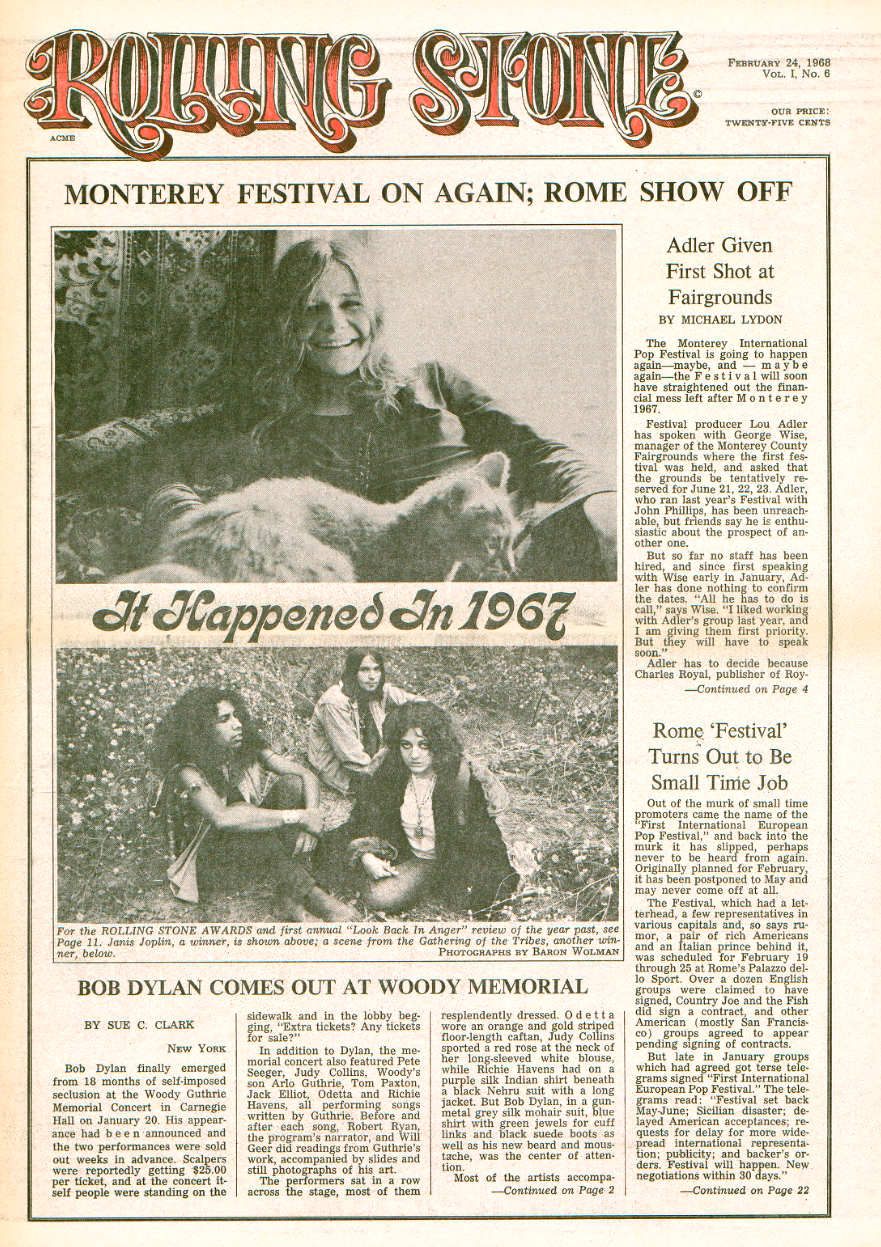
Following the release of their latest album,
We're Only in It for the Money, the Mothers of Invention have
begun recording a movie soundtrack. The film, a documentary,
is entitled Uncle Meat. Even though the film was not shot by
the band, the editing will be done in terms of the music to
effect stronger correlation between picture and sound. No date
has yet been set for its release.
In addition to the scoring, the Mothers plan to travel to Japan
and work on a monster movie. It is assumed they will play the
leading characters. Japan, according to head Mother Frank Zappa,
is "whether they do the best monster work."
The group intends to continue producing records as well as films
and is in the process of forming their own record company. They
are workmg on a new sound utilizing a number of violins and
resonant piano strings, plus an assortment of side effects.
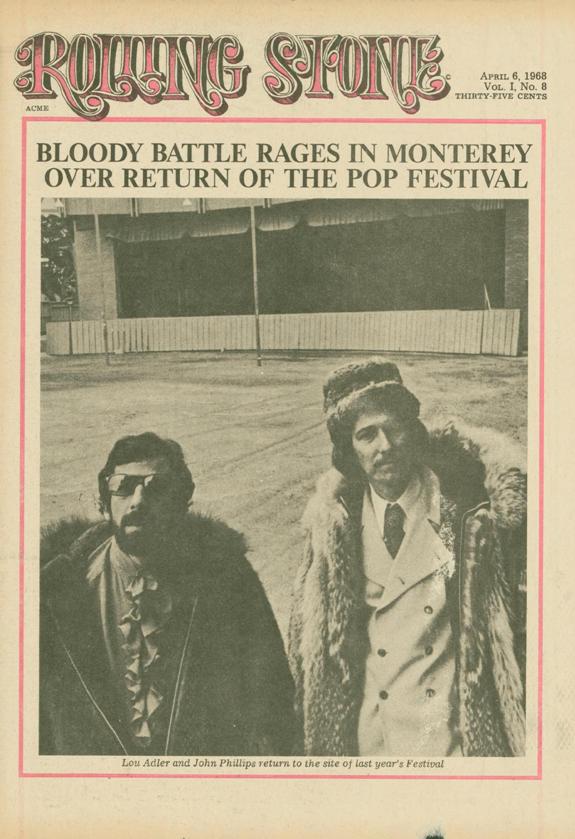
Frank Zappa is a supreme genius of American music today. A direct function of this fact, perhaps, is the incredible obstacle course that each of his albums has had to follow between recording and release. One, Lumpy Gravy, hasn't made it at all. And it has been a good four months since this album was first advertised in the press. (read more)
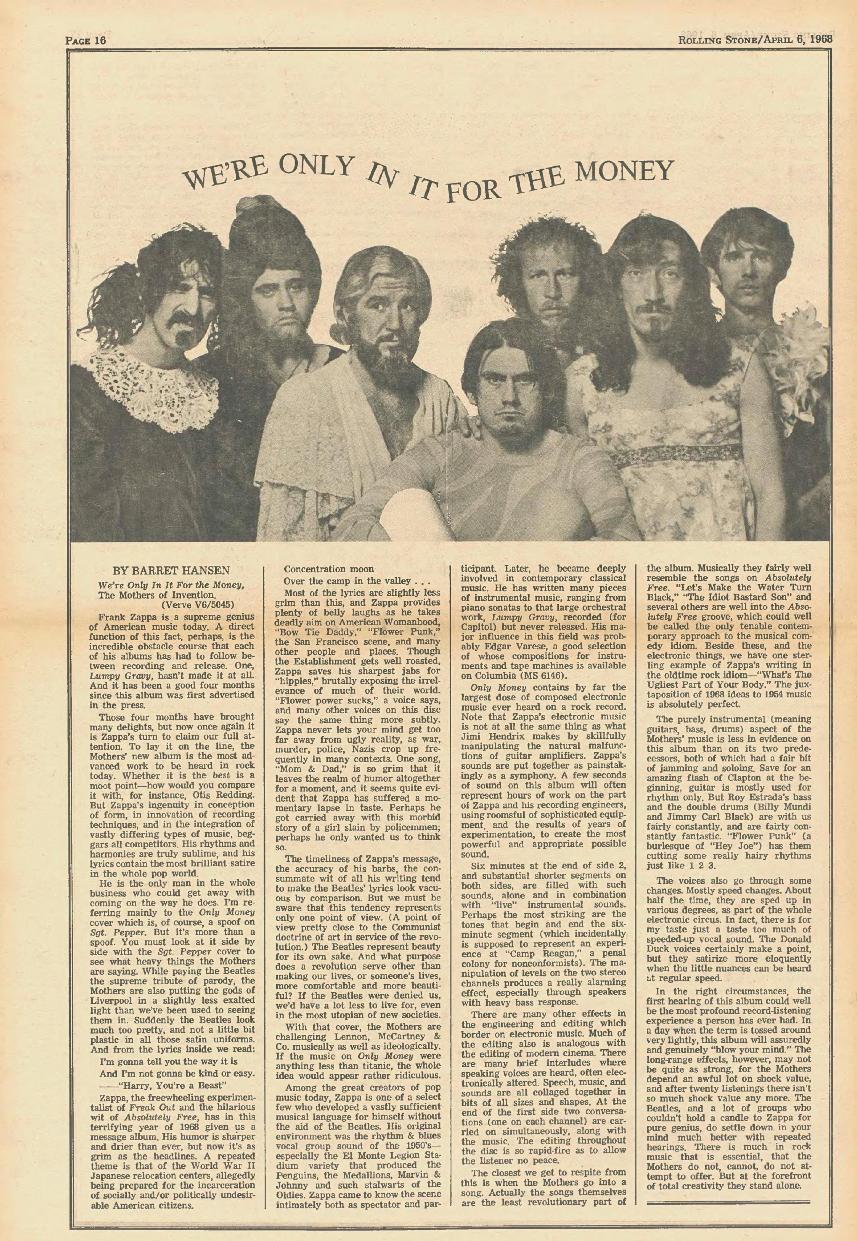
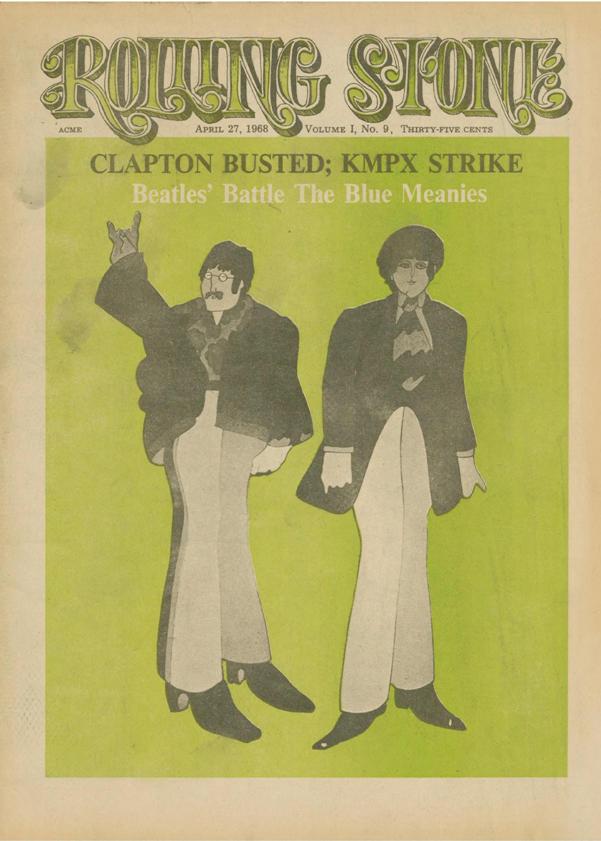
1968 April 27
No. 9
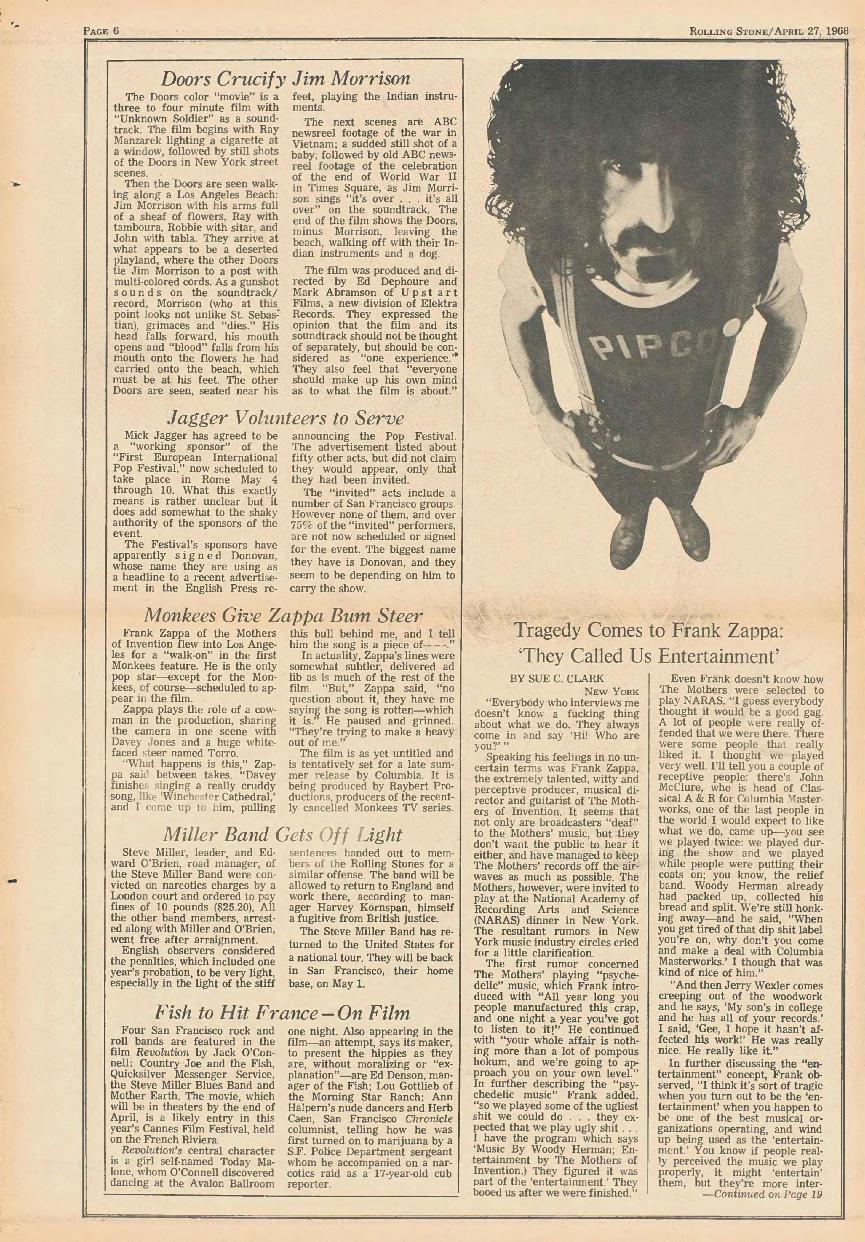
Monkees Give Zappa Bum Steer
By ?, p 6
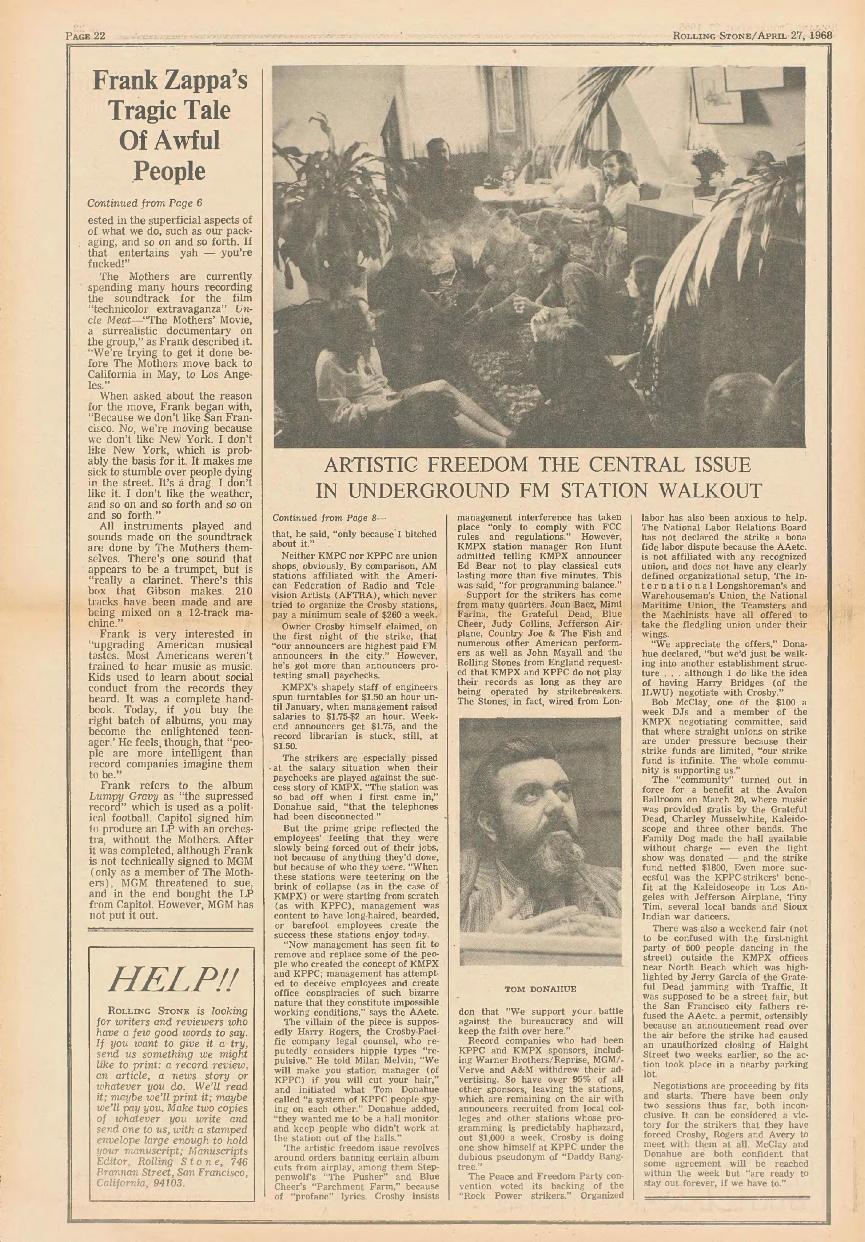
Tragedy Comes
To Frank Zappa: 'They Called Us Entertainment'
By Sue C. Clark, pp 6, 22
Monkees Give Zappa Bum Steer:
Frank Zappa of the Mothers of Invention flew into Los Angeles
for a "walk-on" in the first Monkees feature. He is
the only pop star – except for the Monkees, of course –
scheduled to appear in the film.
Zappa plays the role of a cowman in the production, sharing
the camera in one scene with Davey Jones and a huge white faced
steer named Torro.
"What happens is this," Zappa said between takes. "Davey finishes
singing a really cruddy song, like 'Winchester Cathedral'
and I come up to him, pulling this bull behind me, and I tell
him the song is a piece of – – – – ."
In actuality, Zappa's lines were somewhat subtler, delivered
ad lib as is much of the rest of the film. "But,"
Zappa said, "no question about it, they have me saying
the song is rotten – which it is." He paused and
grinned. "They're trying to make a heavy out of me."
The film is as yet untitled and is tentatively set for a late
summer release by Columbia. It is being produced by Raybert
Productions, producers of the recently cancelled Monkees TV
series.
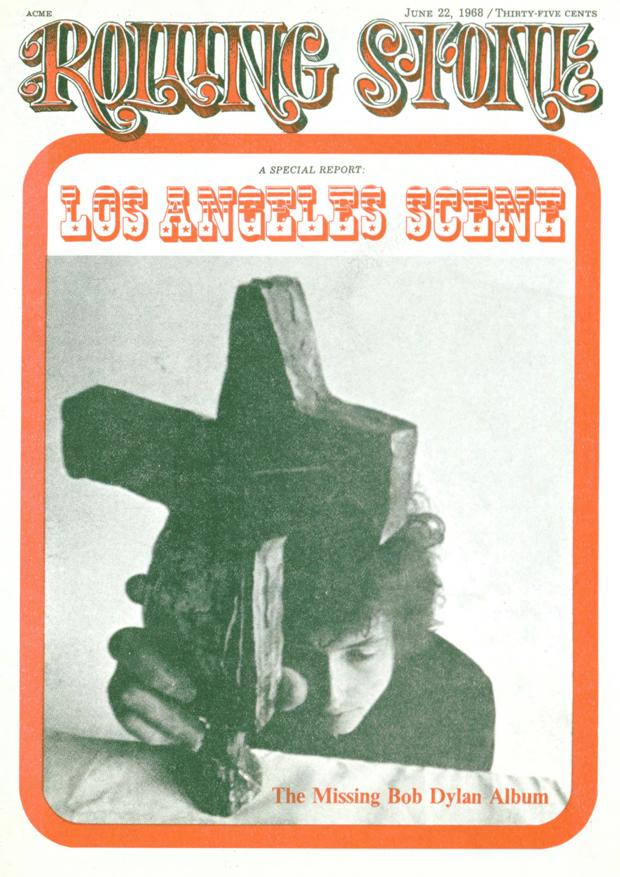
1968 June 22
No. 12
Los Angeles Scene
By Jerry Hopkins, pp 11-15
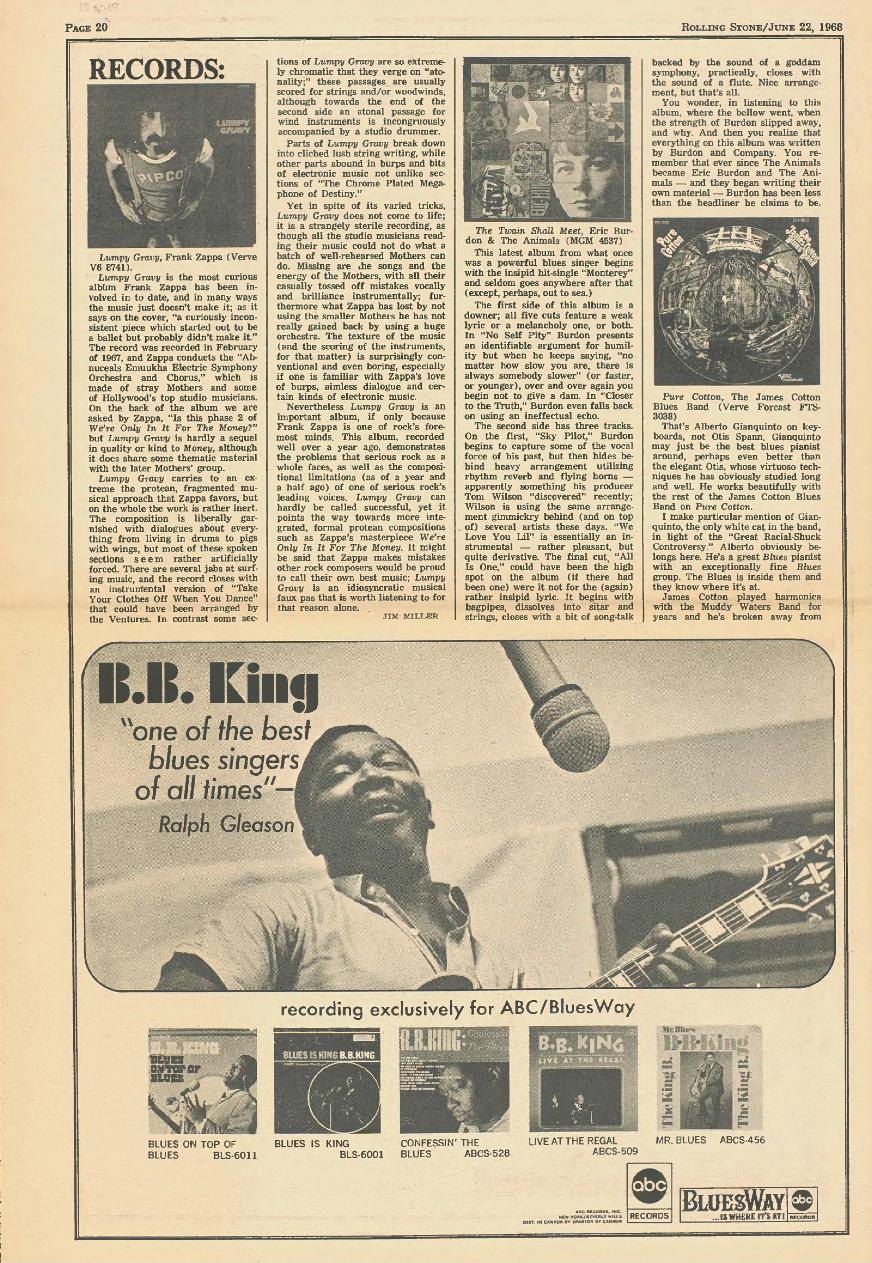
Lumpy Gravy (review)
By Jim Miller, p 20
Long and interesting special report "Los Angeles Scene" contains several mentions of Frank Zappa.
Lumpy Gravy review:
Nevertheless Lumpy Gravy is an important album,
if only because Frank Zappa is one of rock's foremost minds.
This album, recorded well over a year ago, demonstrates the
problems that serious rock as a whole faces, as well as the
compositional limitations (as of a year and a half ago) of one
of serious rock's leading voices. Lumpy Gravy can
hardly be called successful, yet it points the way towards more
integrated, formal protean compositions such as Zappa's
masterpiece We're Only In It For The Money. It
might be said that Zappa makes mistakes other rock composers
would be proud to call their own best music; Lumpy Gravy
is an idiosyncratic musical faux pas that is worth listening
to for that reason alone. (read
more)
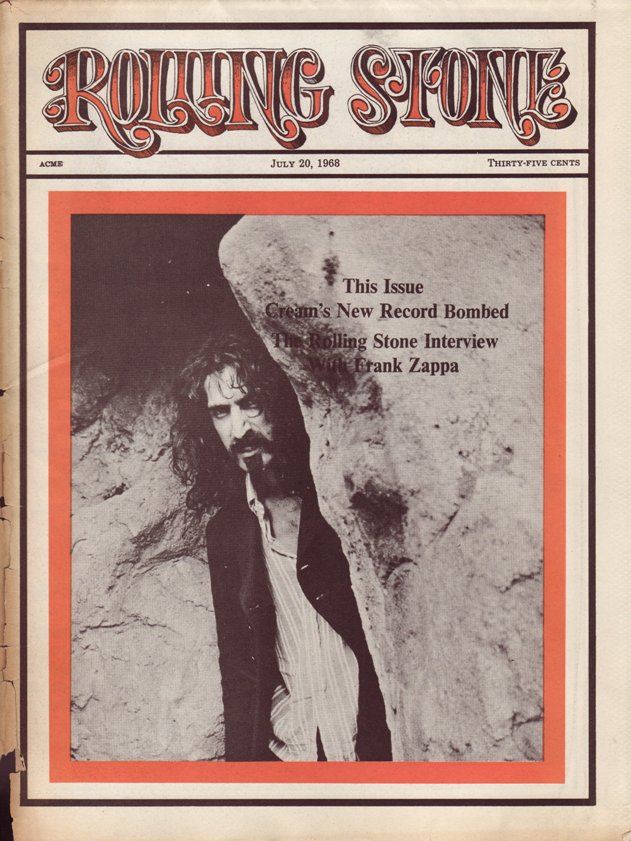
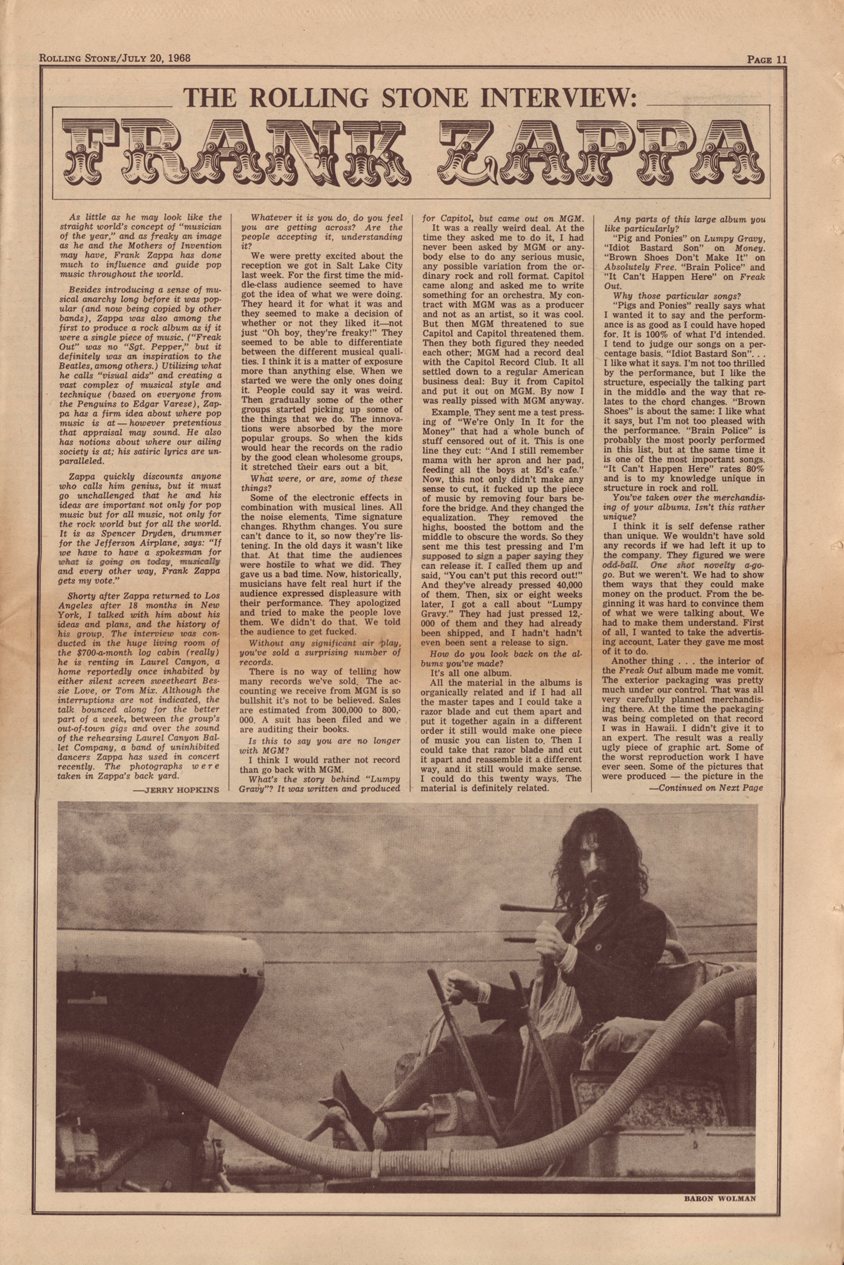
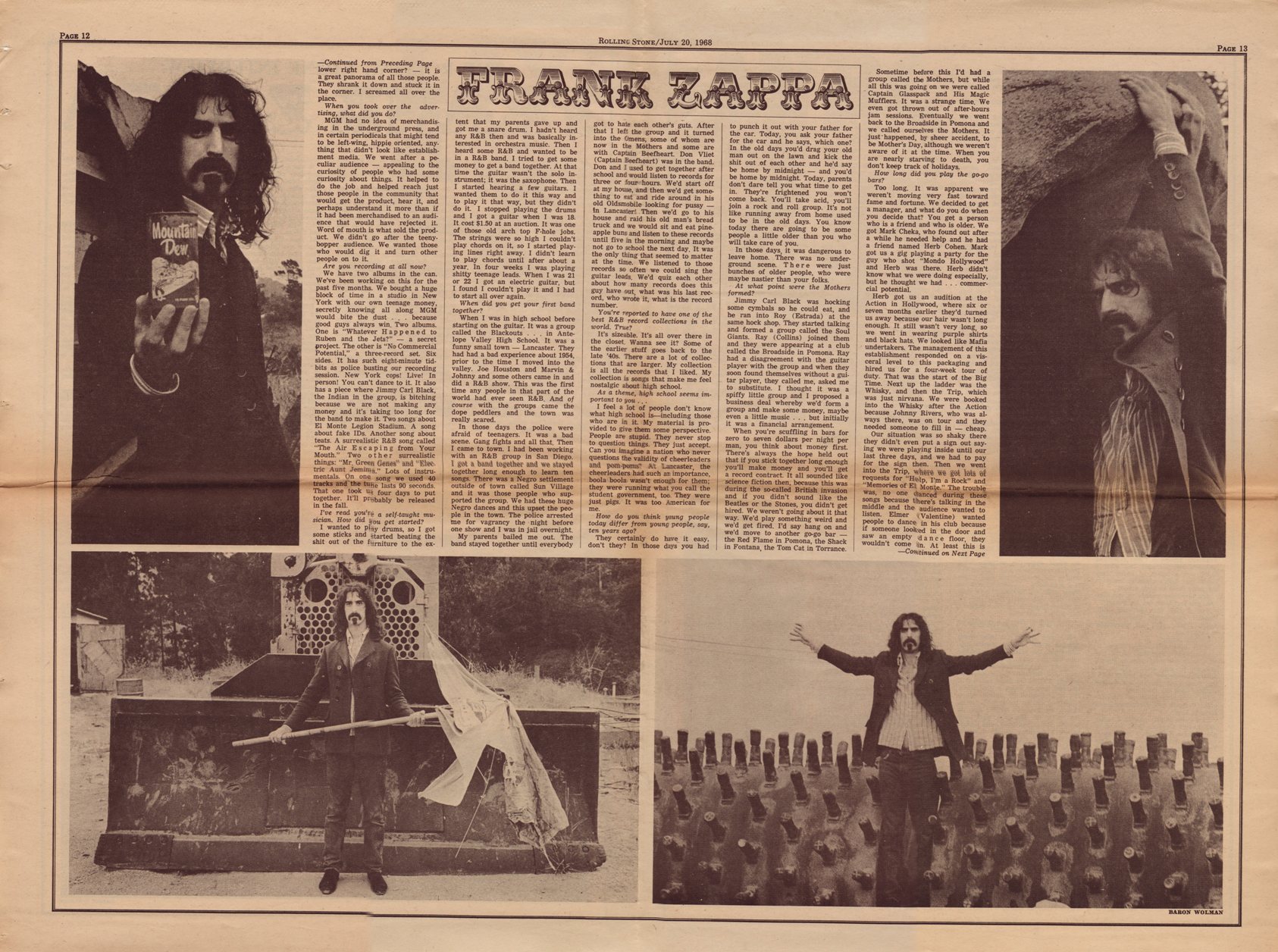
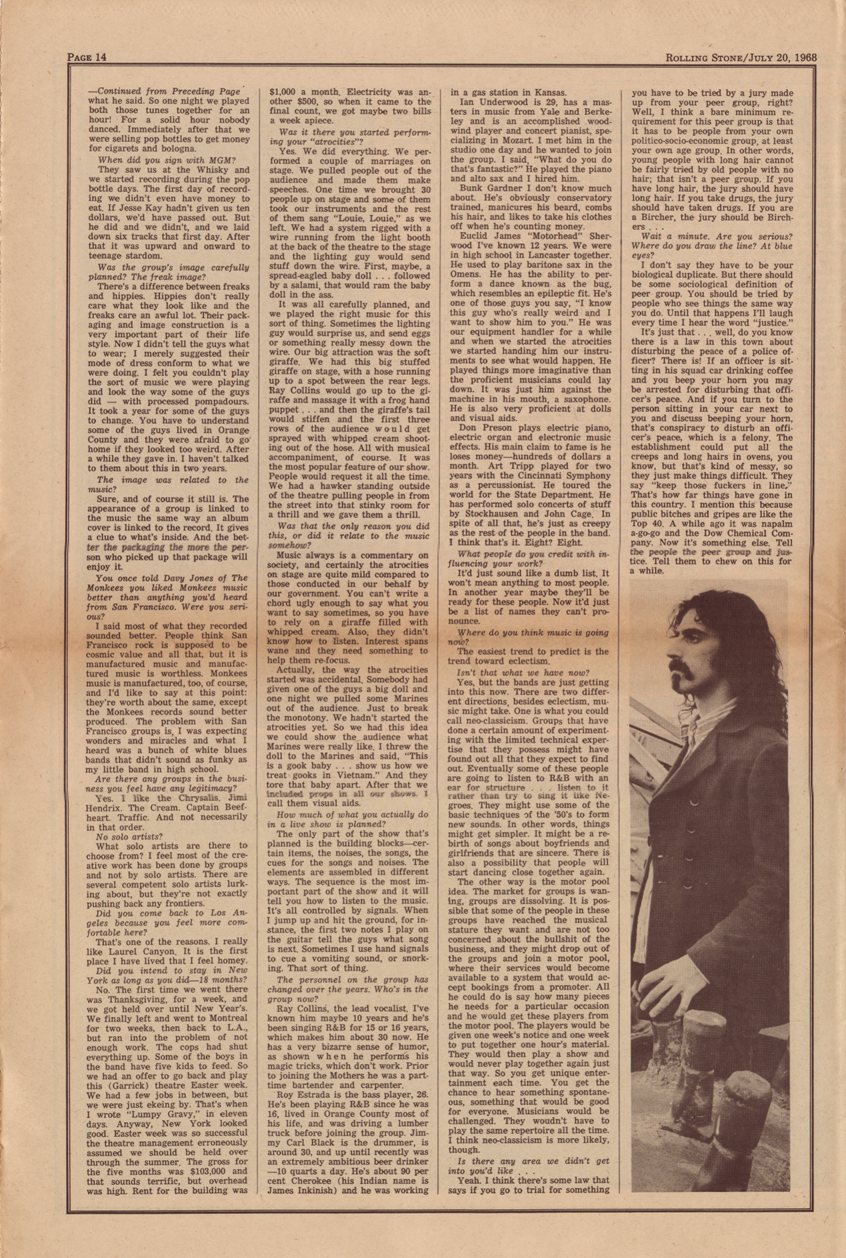
Whatever it is you do, do you feel you are getting across? Are the people accepting it, understanding it?
We were pretty excited about the reception we got in Salt Lake City last week. For the first time the middle-class audience seemed to have got the idea of what we were doing. They heard it for what it was and they seemed to make a decision of whether or not they liked it – not just "Oh boy, they're freaky!" They seemed to be able to differentiate between the different musical qualities. I think it is a matter of exposure more than anything else. When we started we were the only ones doing it. People could say it was weird. Then gradually some of the other groups started picking up some of the things that we do. The innovations were absorbed by the more popular groups. So when the kids would hear the records on the radio by the good clean wholesome groups, it stretched their cars out a bit. (read more)
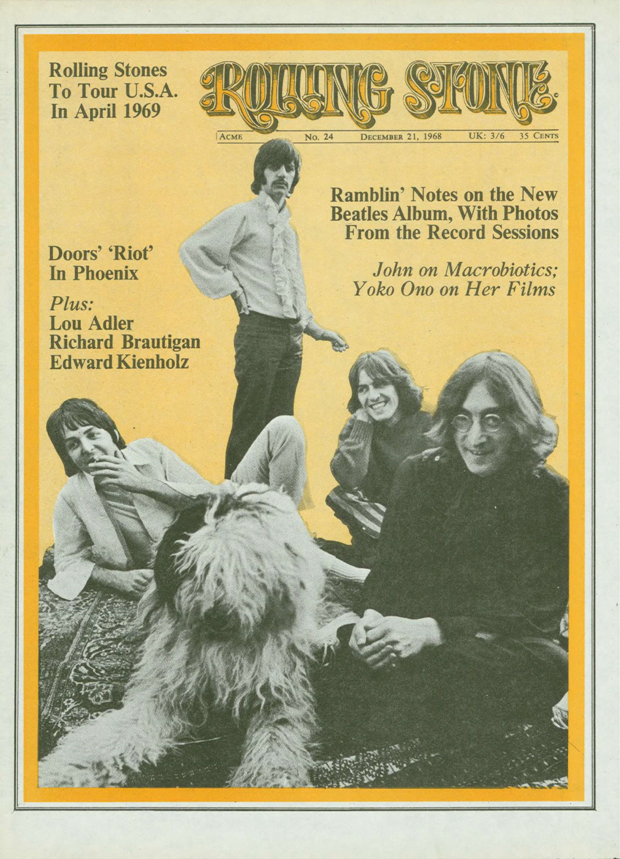
1968 December 21
No. 24
Cruising With Ruben & The Jets (review)
By Greil Marcus & Jeff Rappaport, p 28
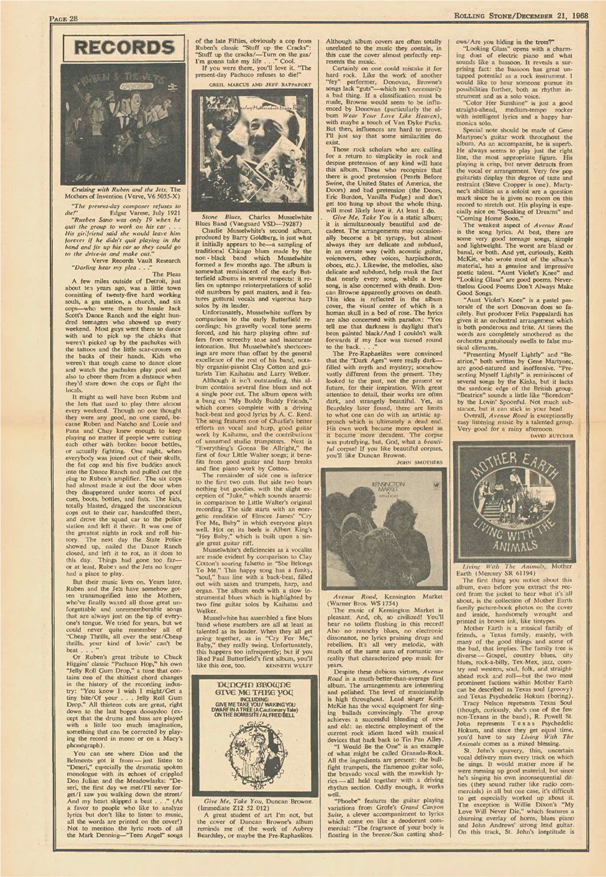
A few miles outside of Detroit, just about ten years ago, was a little town consisting of twenty-five hard working souls, a gas station, a church, and six cops—who were there to hassle Jack Scott’s Dance Ranch and the eight hundred teenagers who showed up every weekend. Most guys went there to dance with and to pick up the chicks that weren’t picked up by the pachukes with the tattoos and the little scar-crosses on the backs of their hands. Kids who weren’t that tough came to dance close and watch the pachukes play pool and also to cheer them from a distance when they’d stare down the cops or fight the locals. (read more)
1969 February 15
No. 27
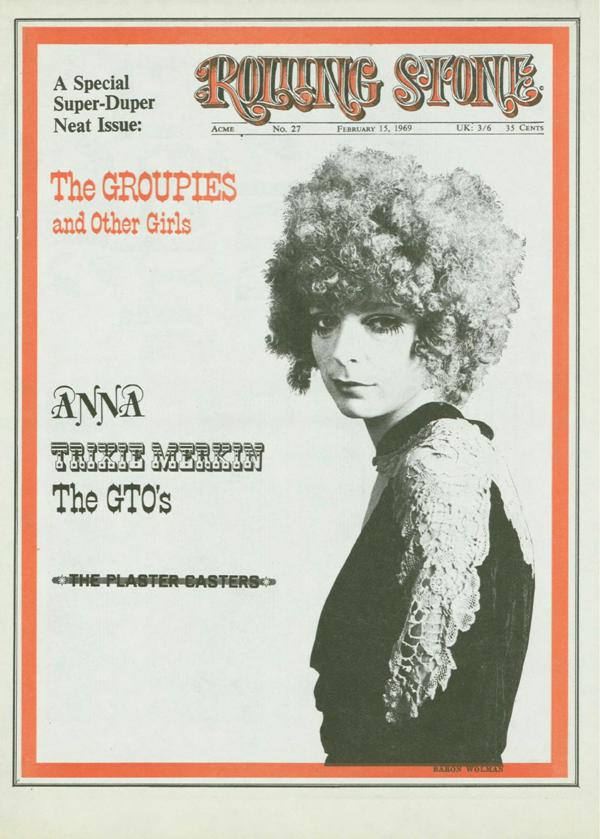
The
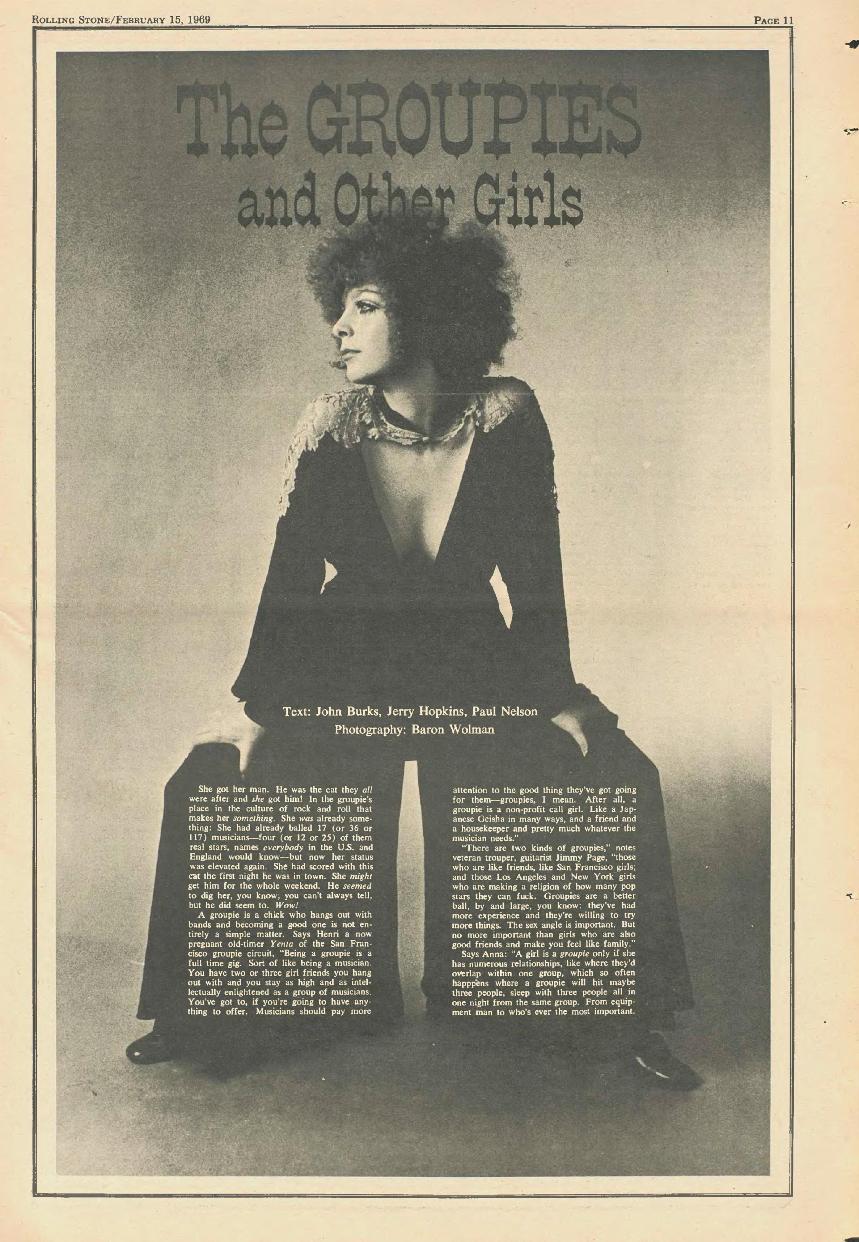
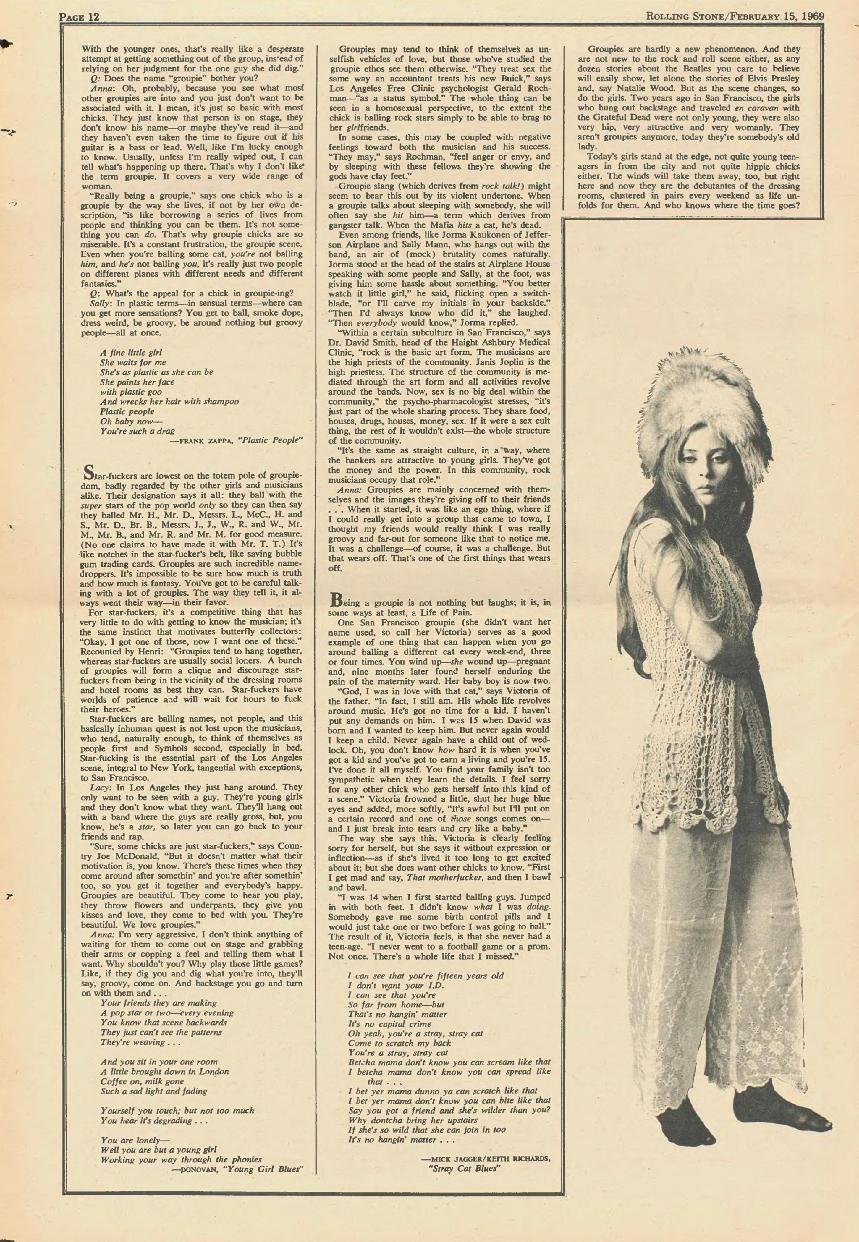
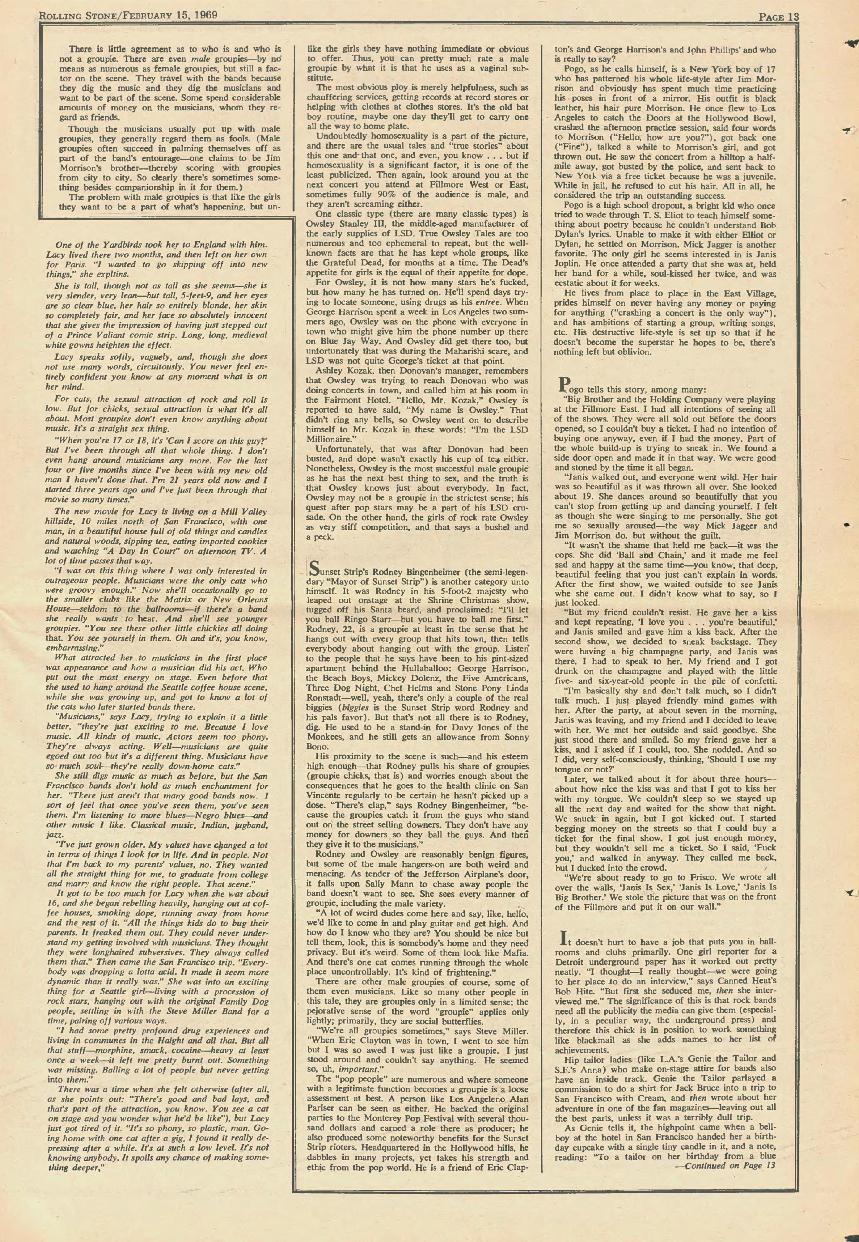
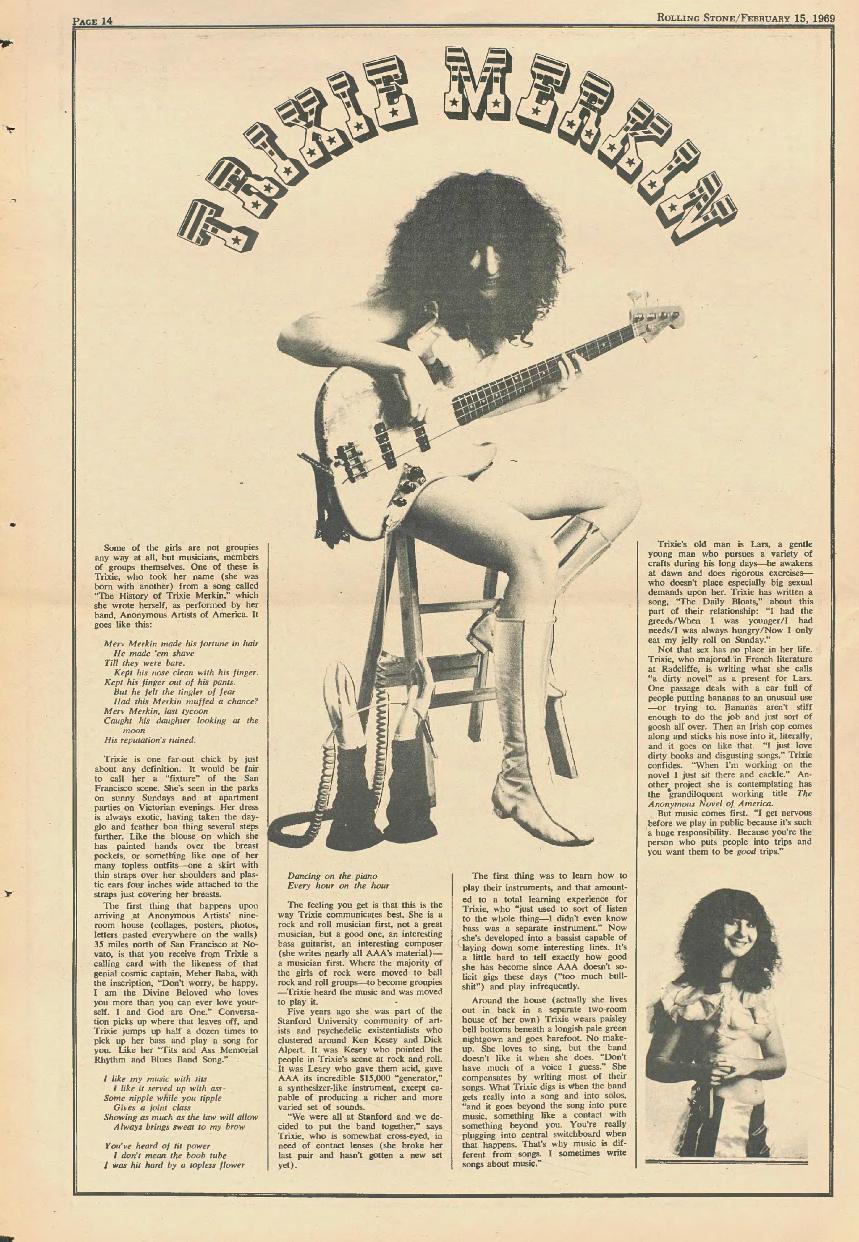
Groupies and Other Girls
Text by John Burks, Jerry Hopkins, Paul Nelson
Photography: Baron Wolman, pp 11-24, 26
including stories of
Trixie Merkin
The GTO's
The Plaster Casters
Anna
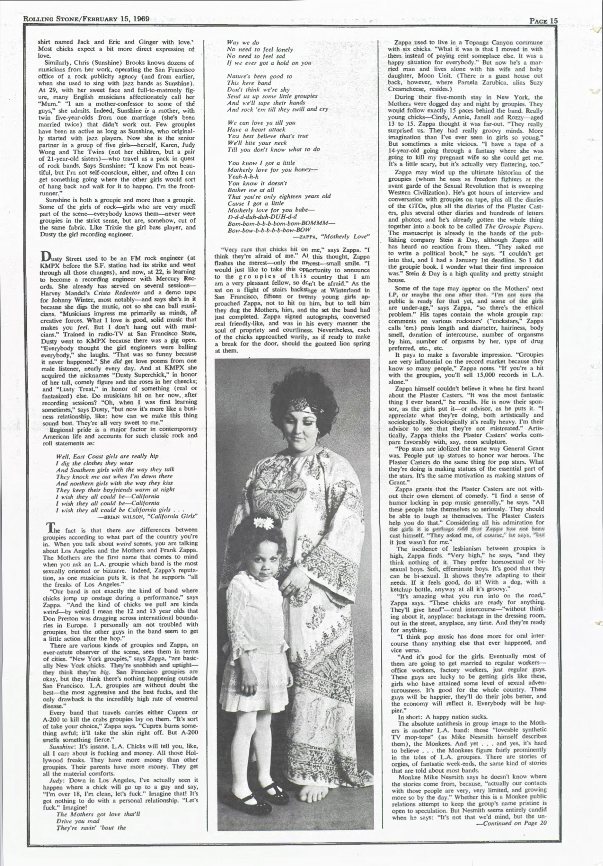
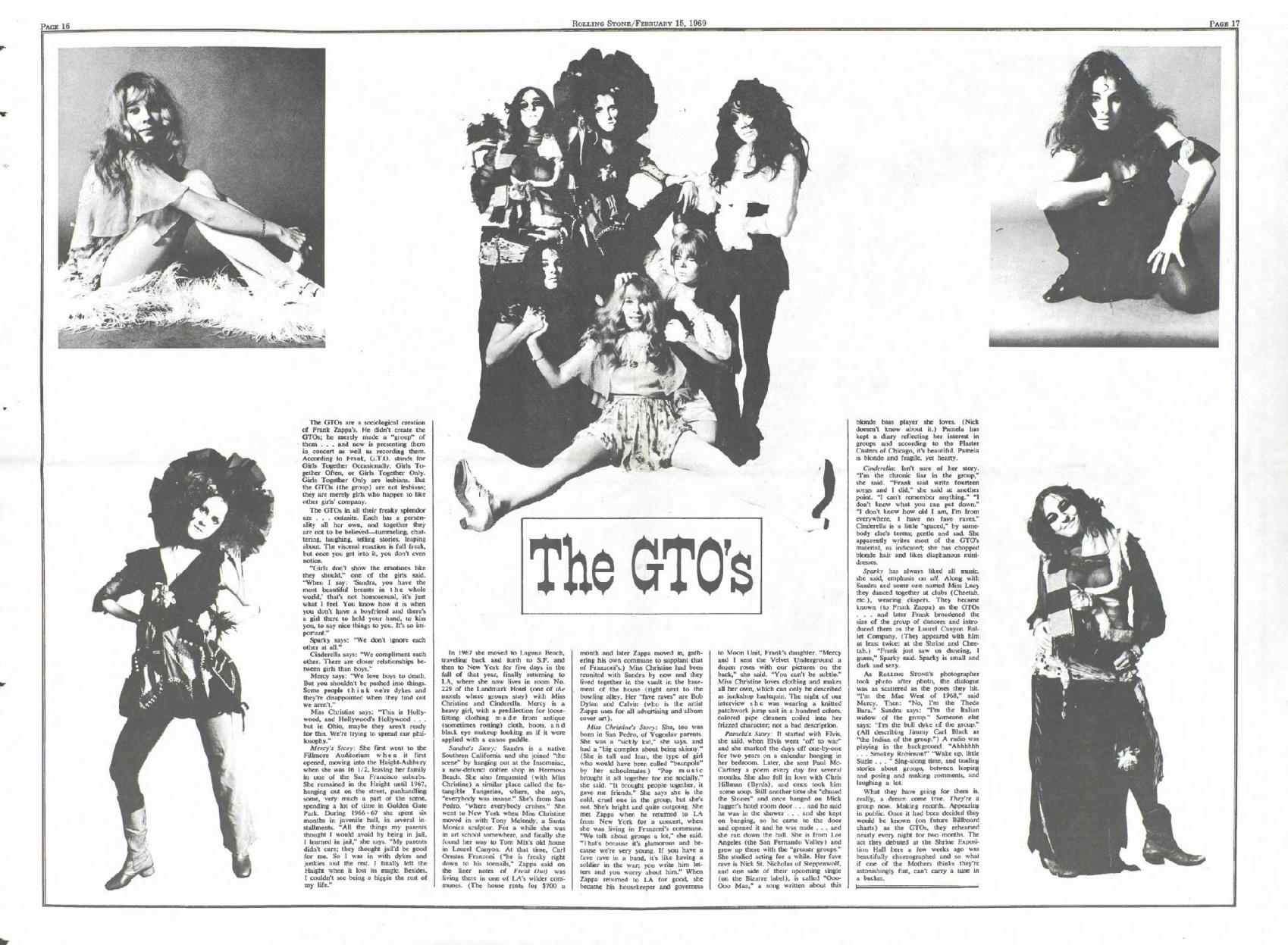
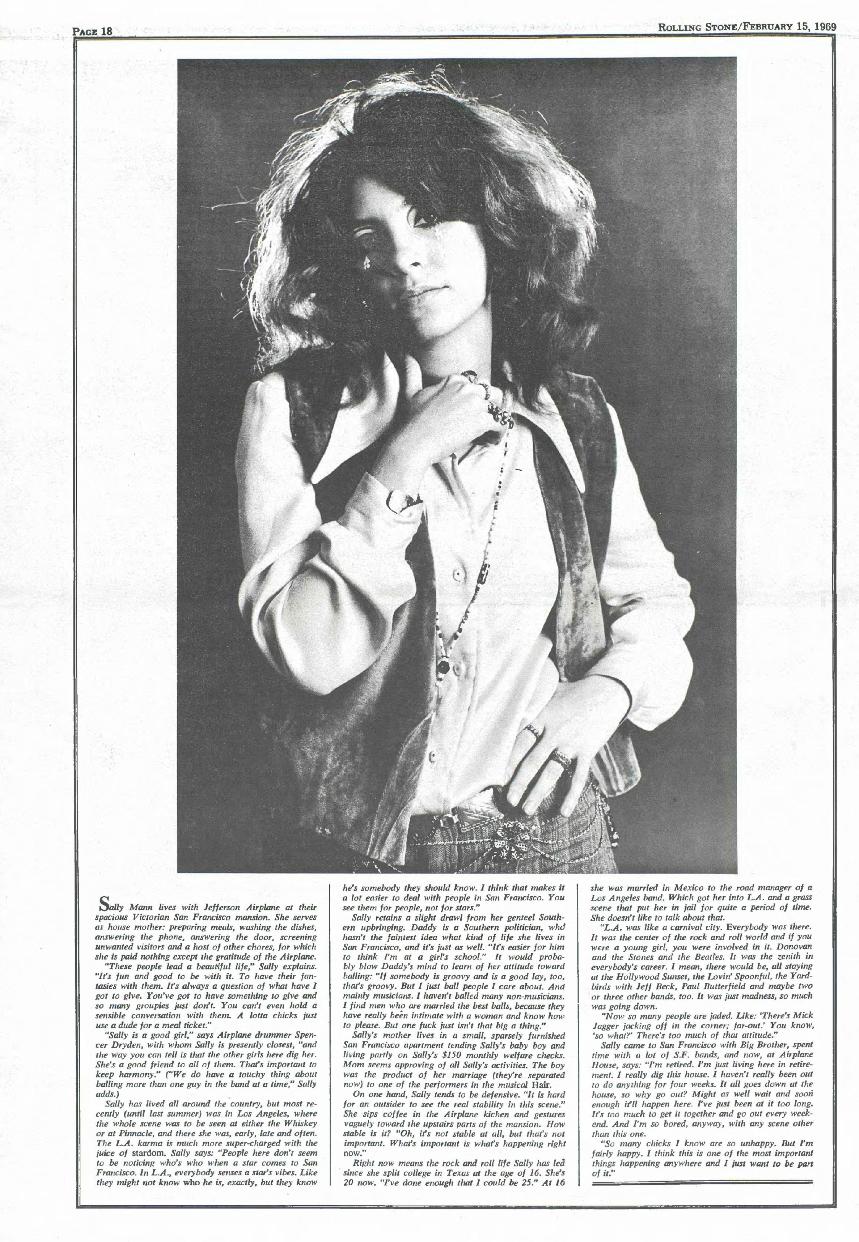
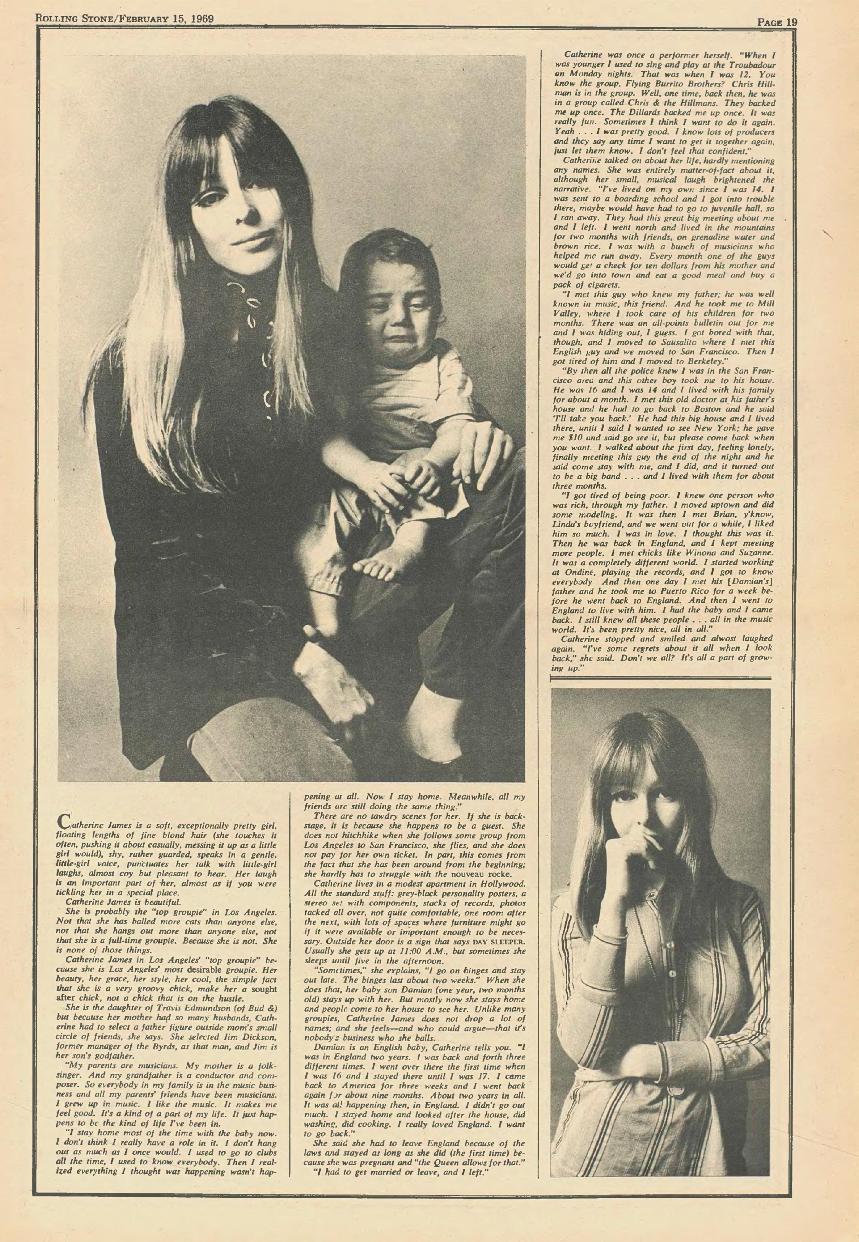
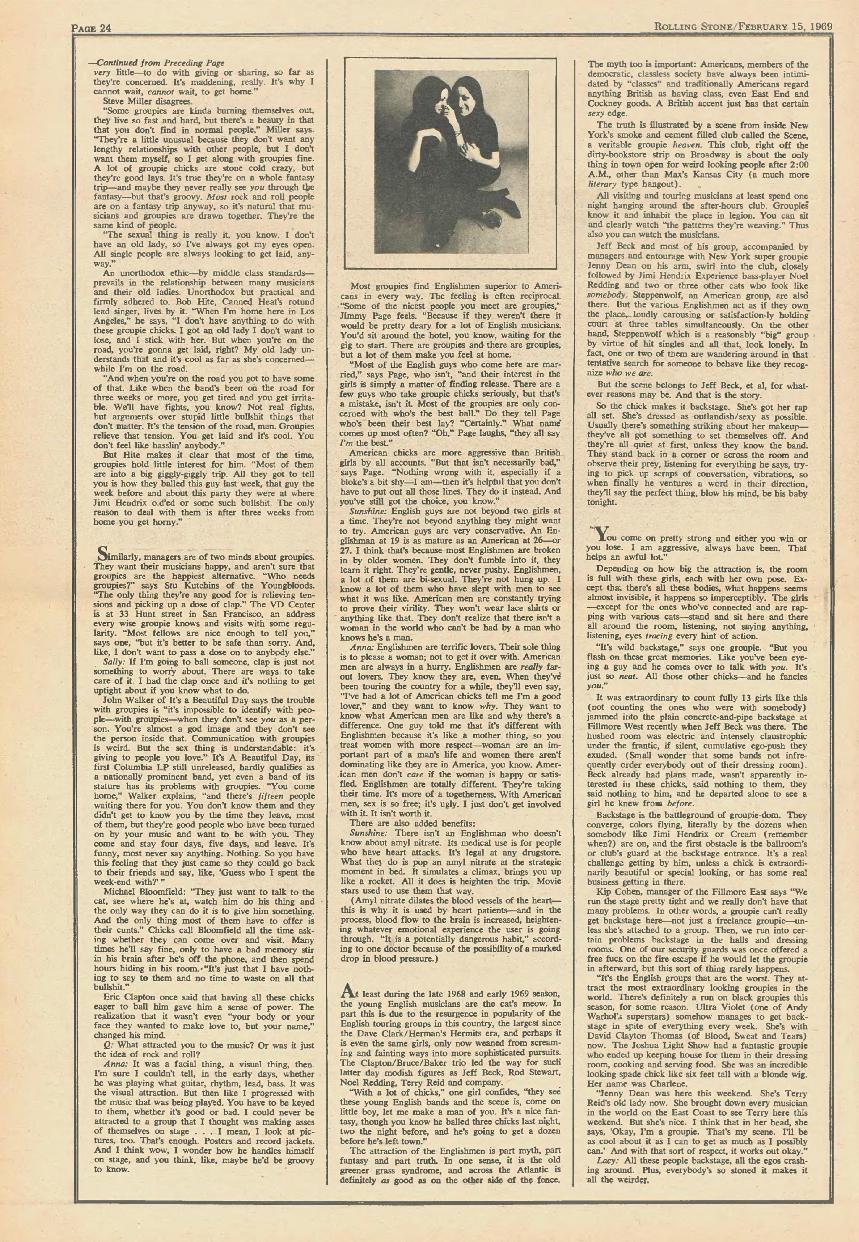
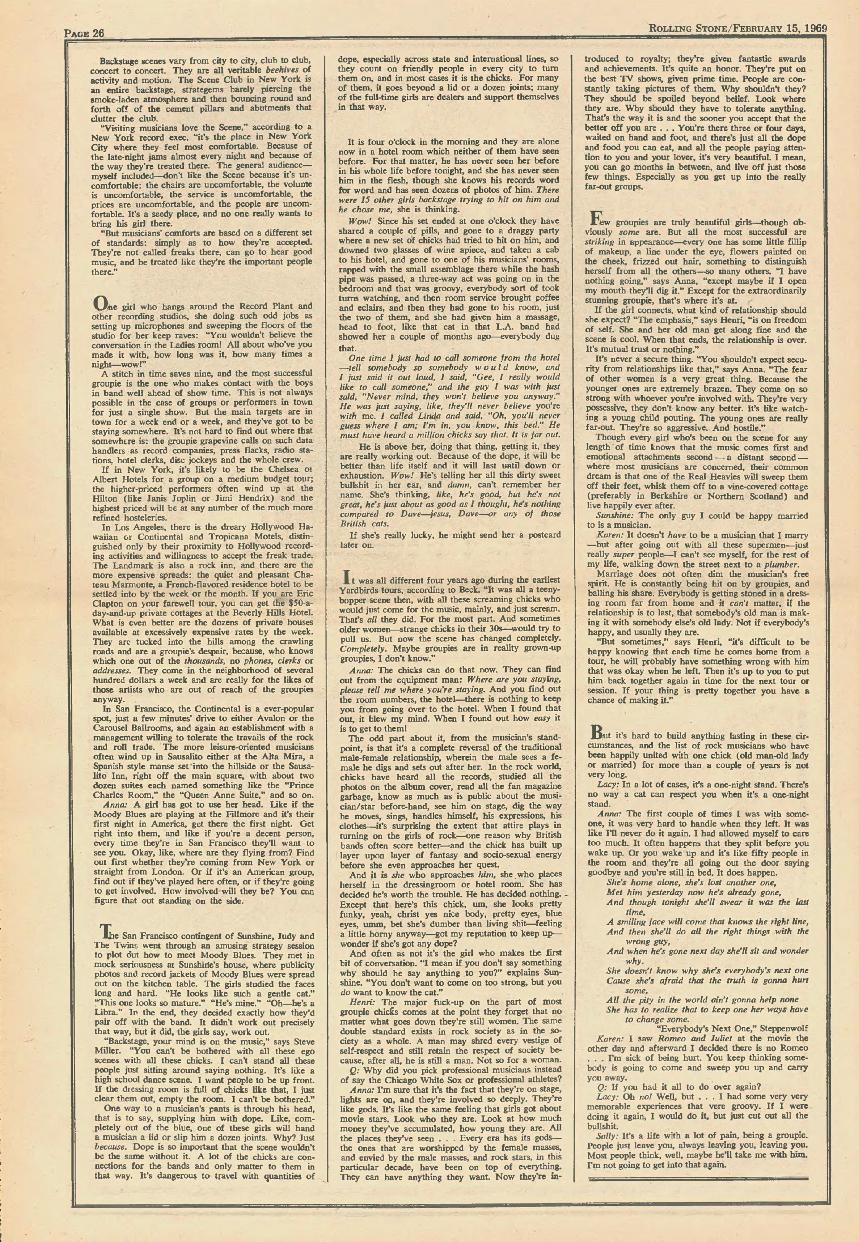
The fact is that there are differences between groupies according to what part of the country you're in. When you talk about weird scenes, you are talking about Los Angeles and the Mothers and Frank Zappa. The Mothers are the first name that comes to mind when you ask an LA. groupie which band is the most sexually oriented or bizarre. Indeed, Zappa`s reputation, as one musician puts it, is that he supports "all the freaks of Los Angeles."(read more)
Expanded and revised version of this issue was published in 1970 as a separate book Groupies And Other Girls.
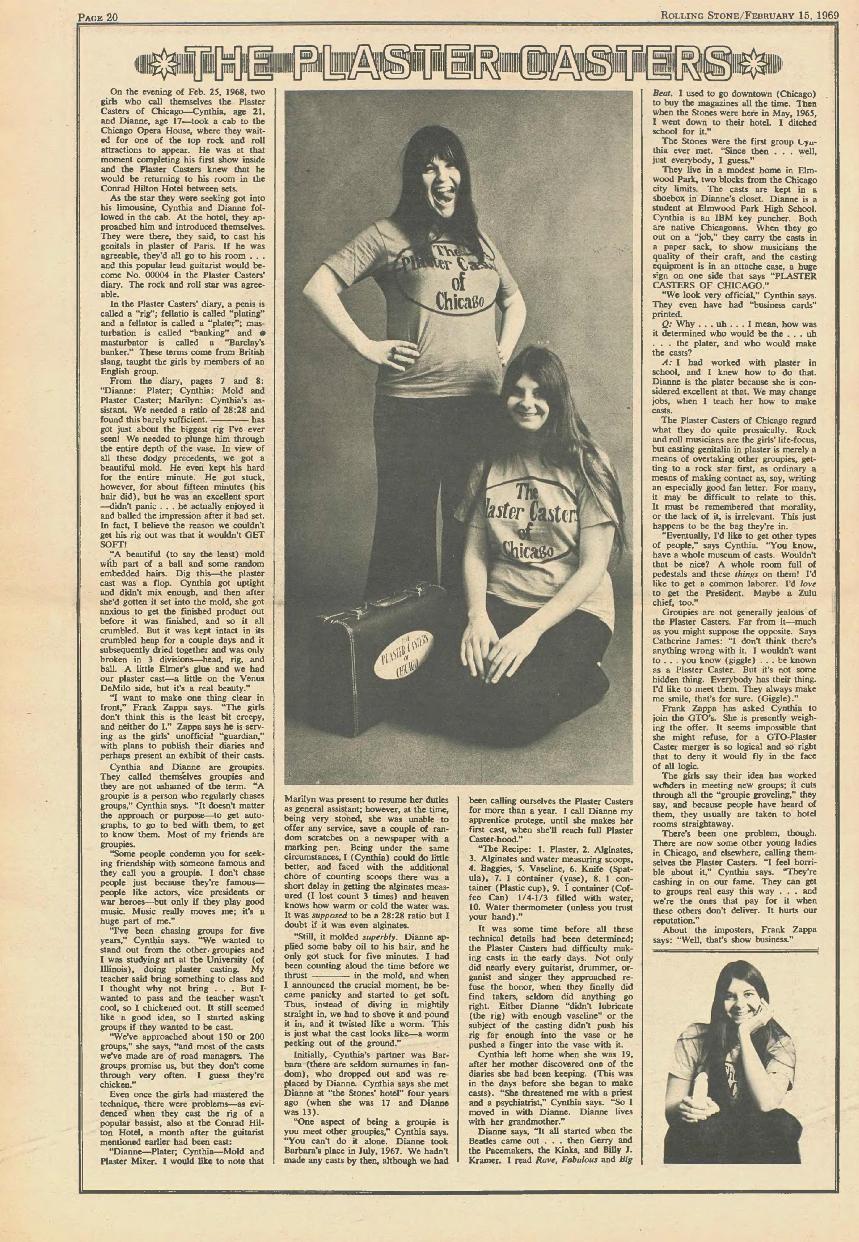
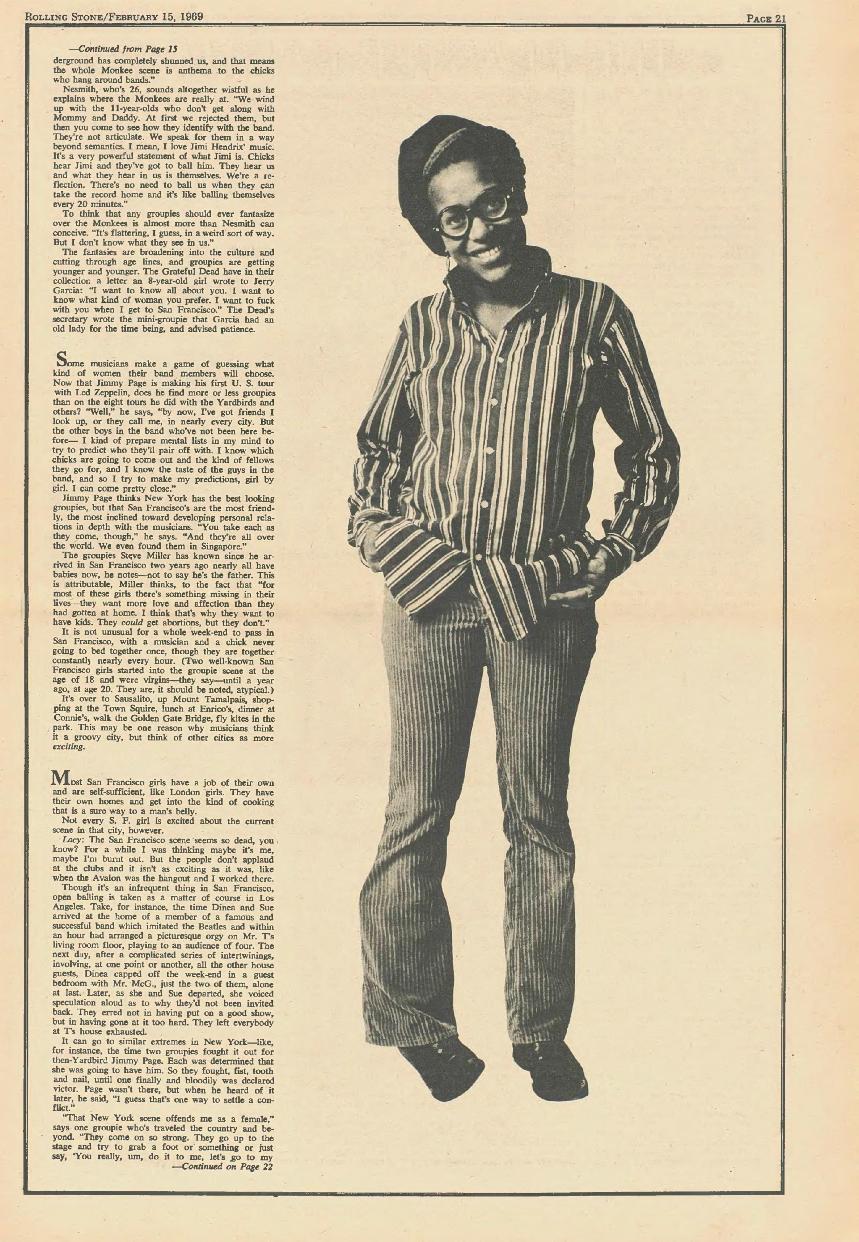
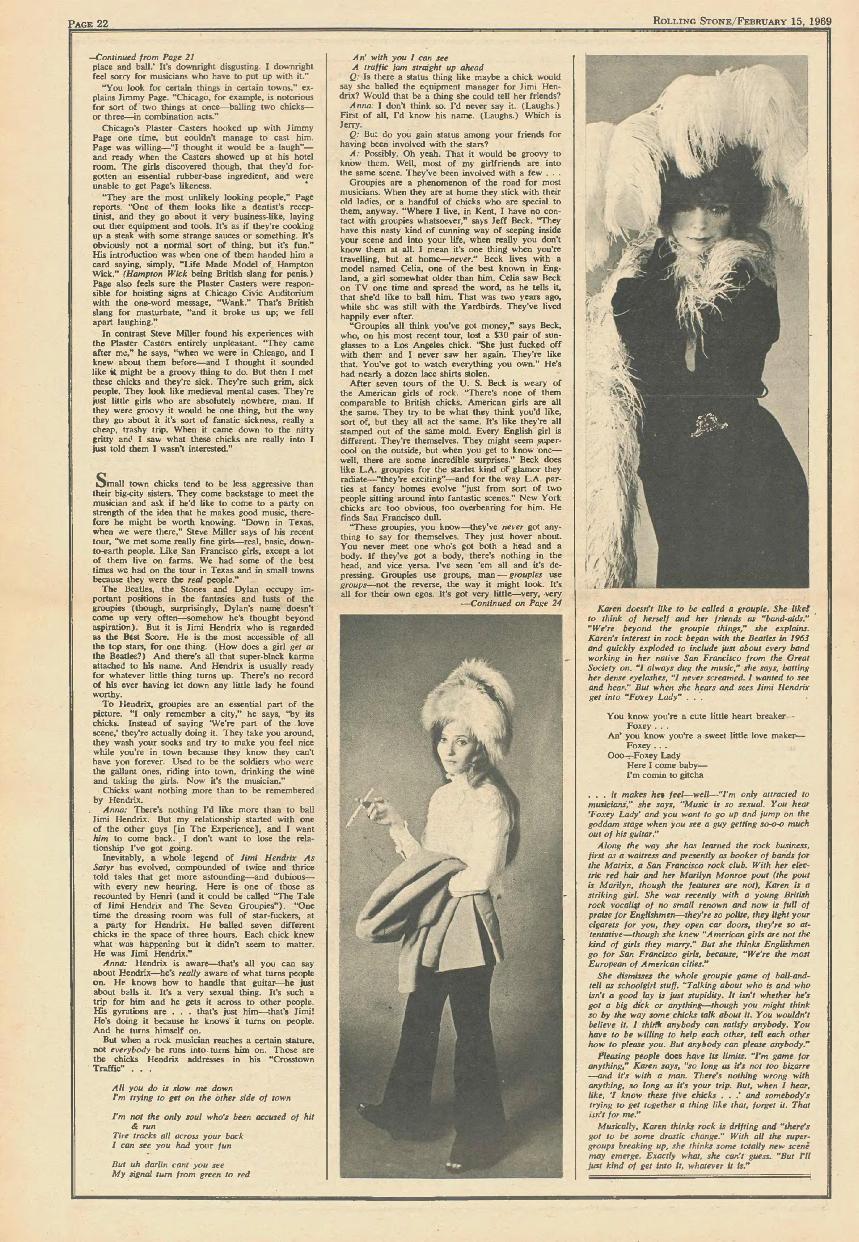
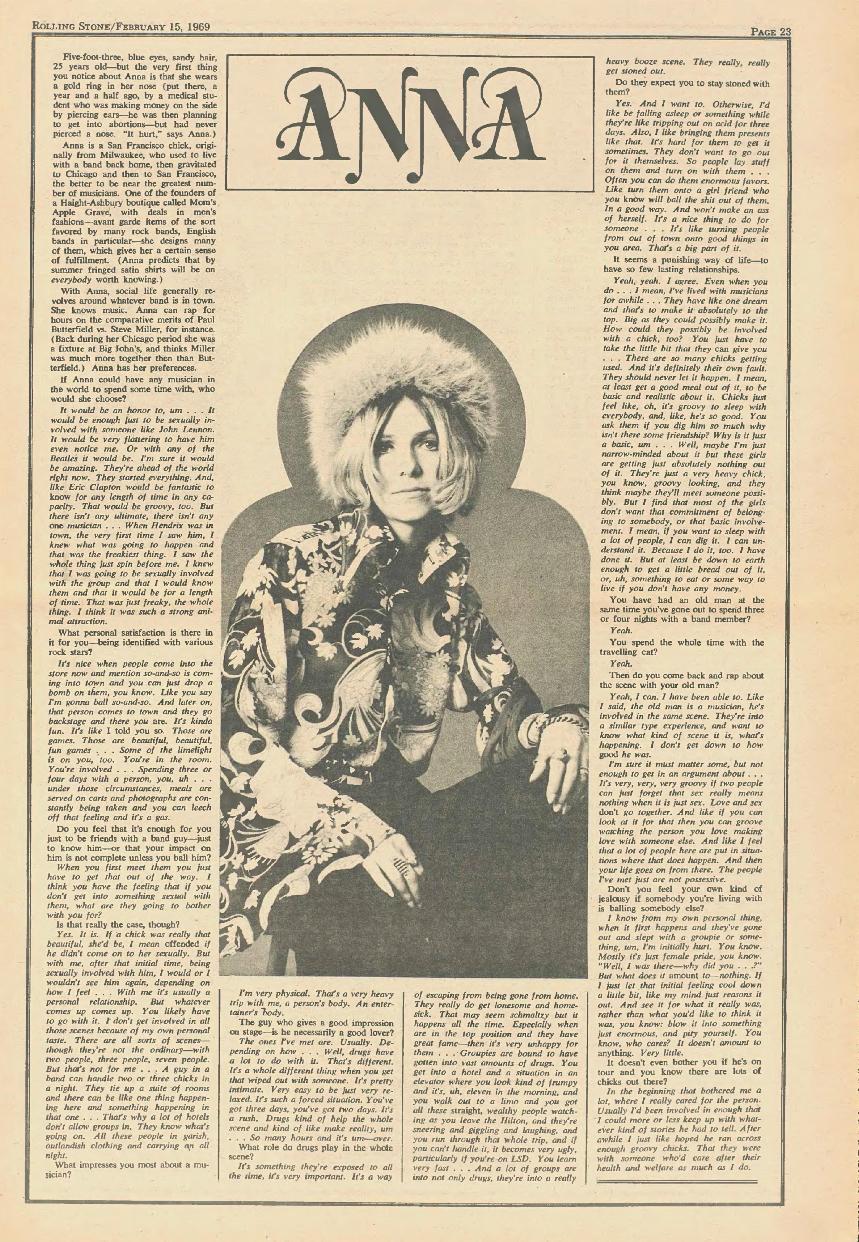
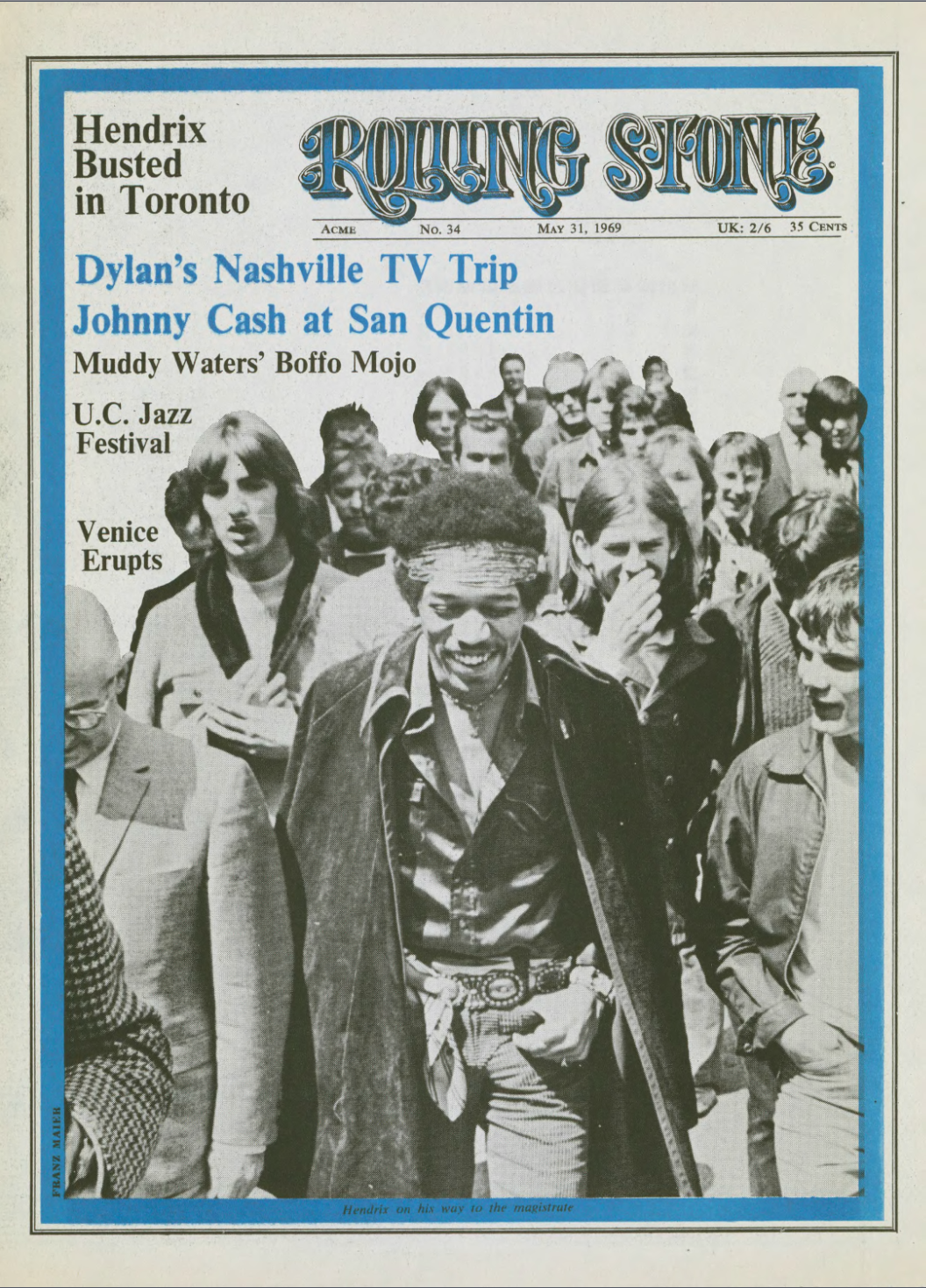
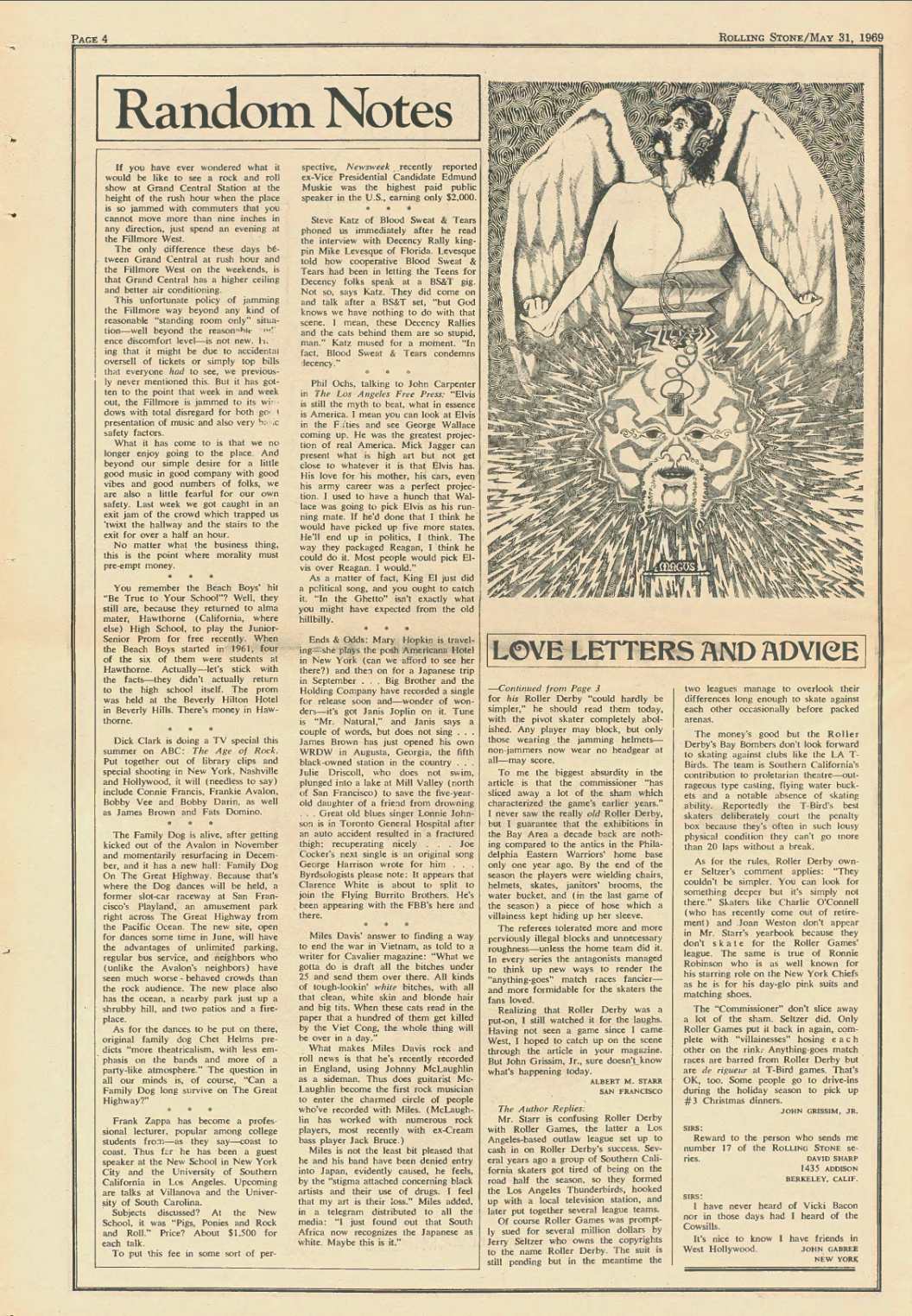
Random notes. page 4: Frank
Zappa has become a professional lecturer, popular among college
students from – as they say – coast to coast. Thus far he has
been a guest speaker at the New School in New York City and
the University of Southern Califomia in Los Angeles. Upcoming
are talks at Villanova and the University of South Carolina.
Subjects discussed? At the New School it was "Pigs, Ponies and
Rock and Roll." Price? About $1,500 for each talk. To put this
fee in some sort of perspective, Newsweek recently
reported ex-Vice Presidential Candidate Edmund Muskie was the
highest paid public speaker in the U.S.. earning only $2,000.
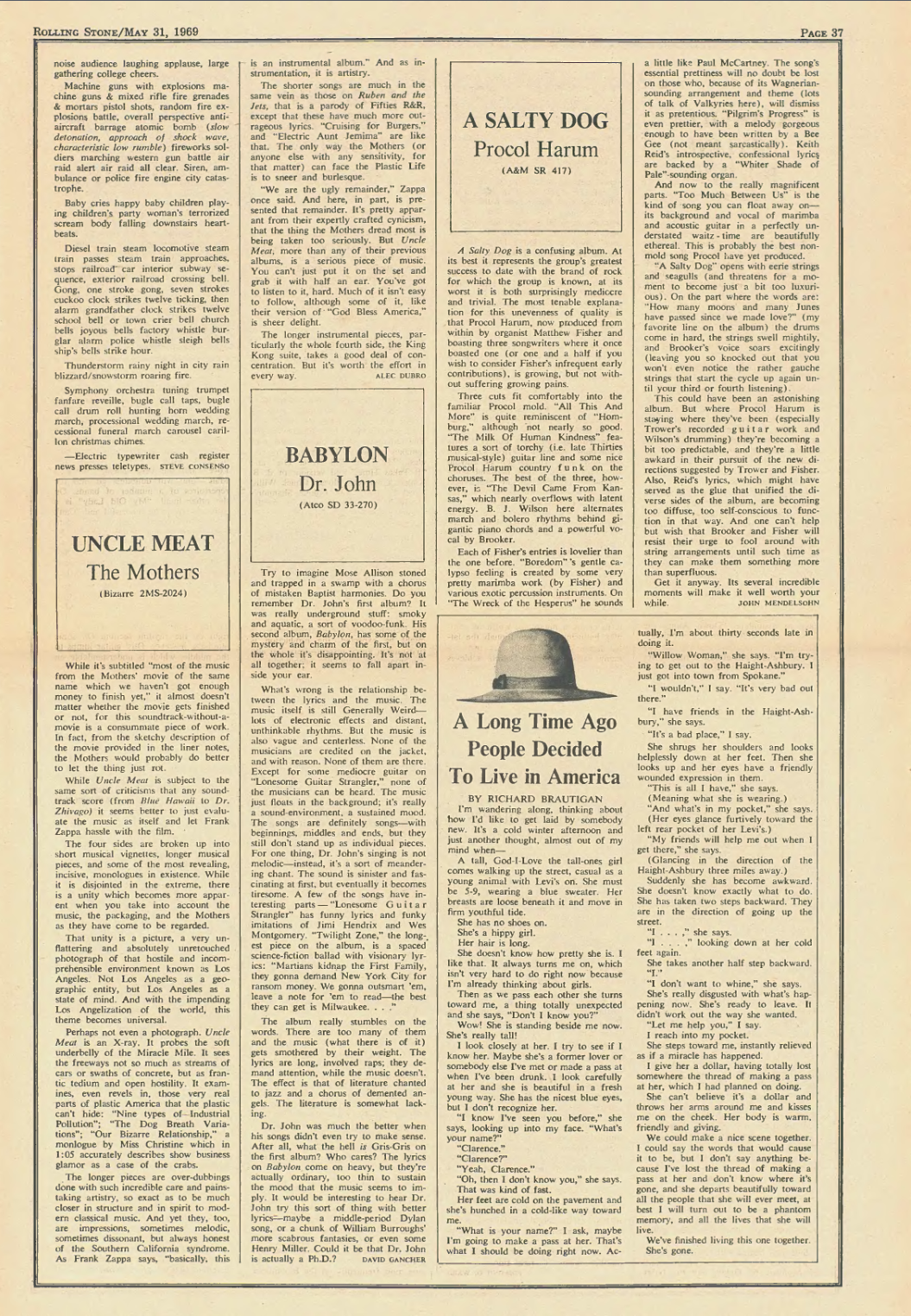
Uncle Meat. page 37. While it’s subtitled “most of
the music from the Mothers’ movie of the same name which we
haven’t got enough money to finish yet,” it almost doesn’t matter
whether the movie gets finished or not, for this soundtrack-without-a-movie
is a consummate piece of work. In fact, from the sketchy description
of the movie provided in the liner notes, the Mothers would
probably do better to let the thing just rot. (read
more)
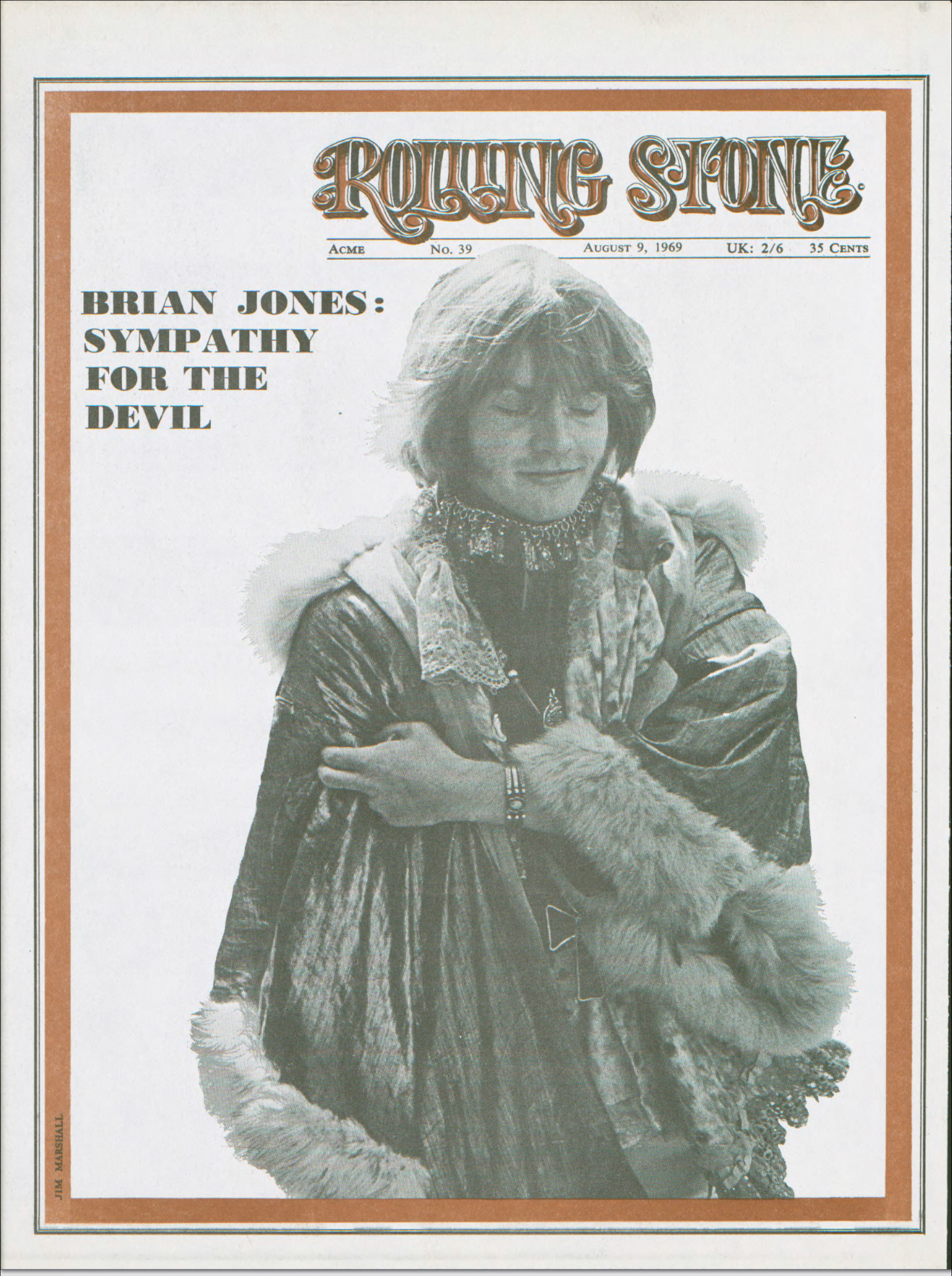
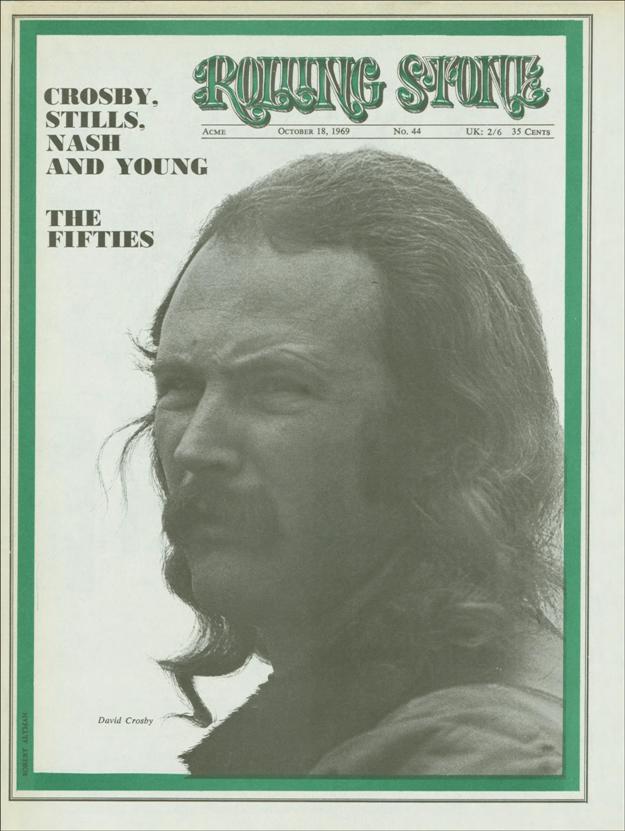
The first indication that the revolutionary nine-member band was aproaching the end of its musical career came with an announcement that the Mothers had cancelled all bookings from now until the end of the year so Zappa could concentrate on other projects long in progress. A talk with Zappa revealed the break was more complete than that. (read more)
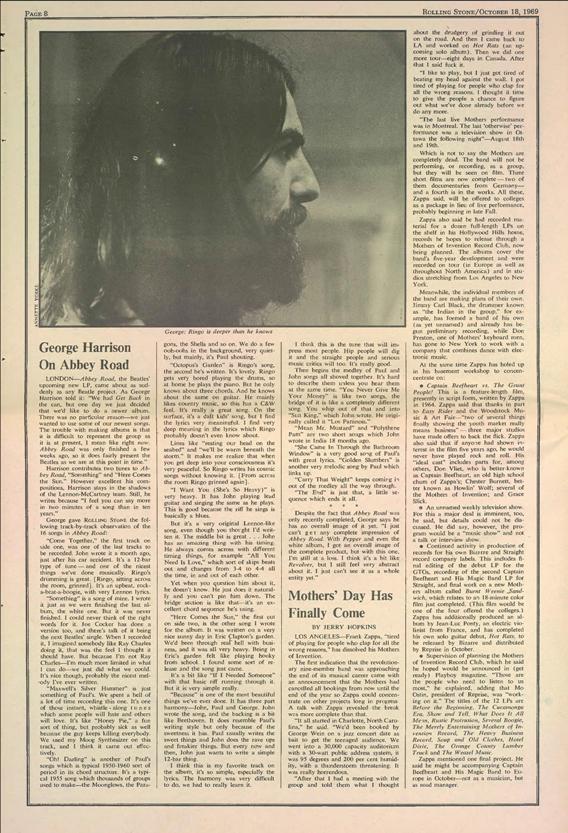
Source: home.online.no/~corneliu
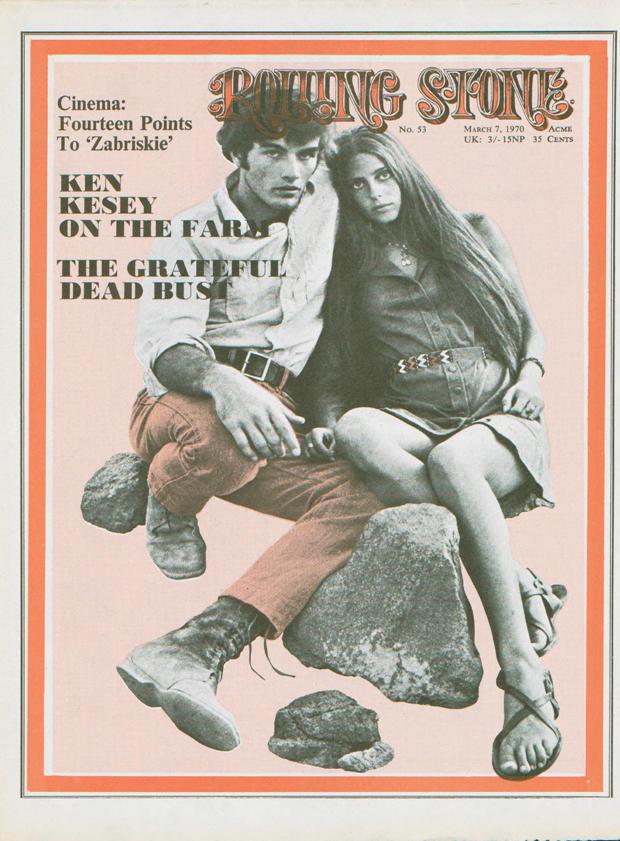
This recording brings together a set of mostly little-known talents that whale the tar out of every other informal "jam" album released in rock and roll for the past two years. If Hot Rats is any indication of where Zappa is headed on his own, we are in for some fiendish rides indeed. (read more)
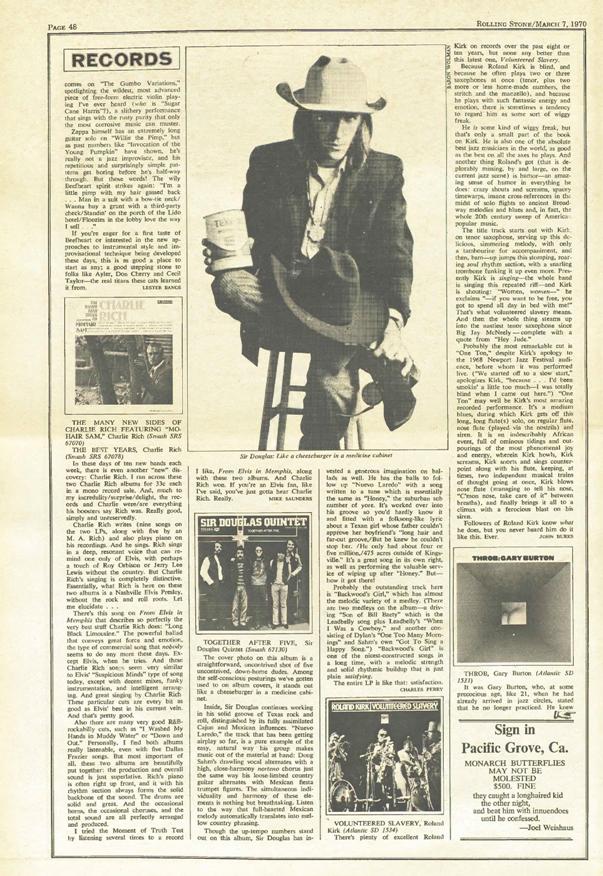
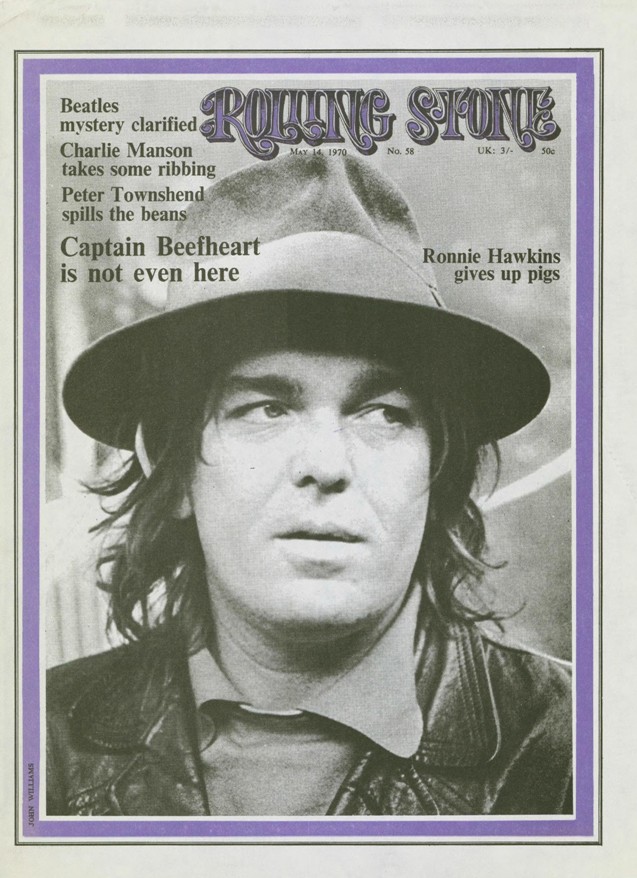
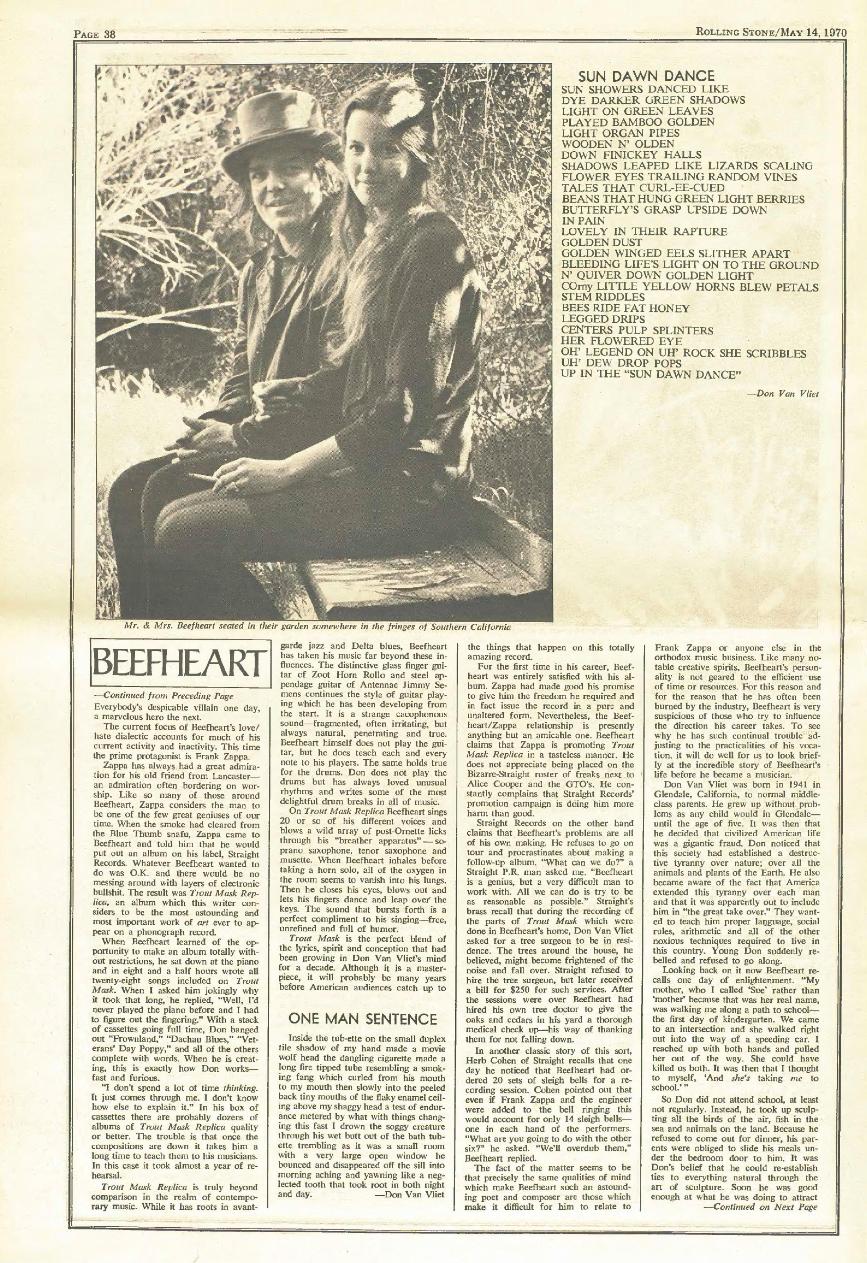
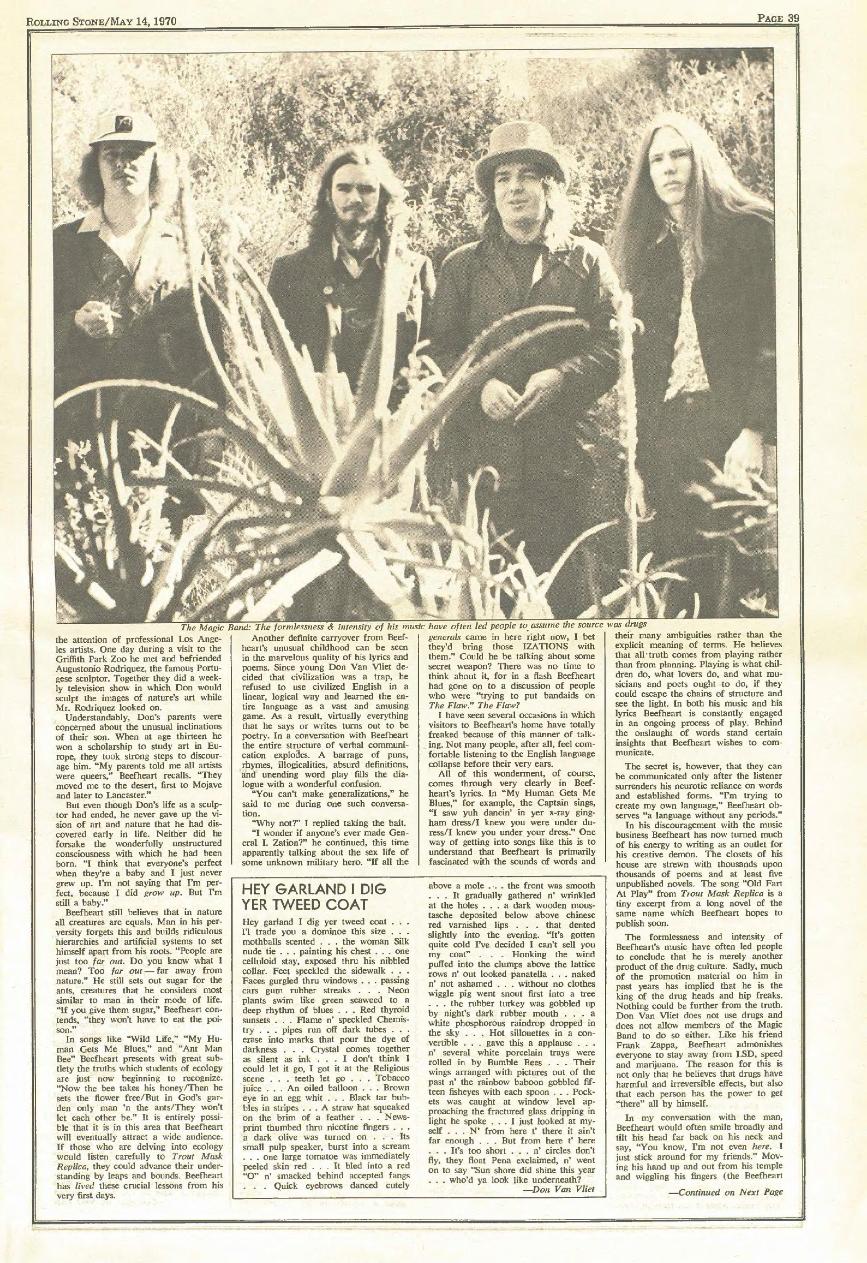
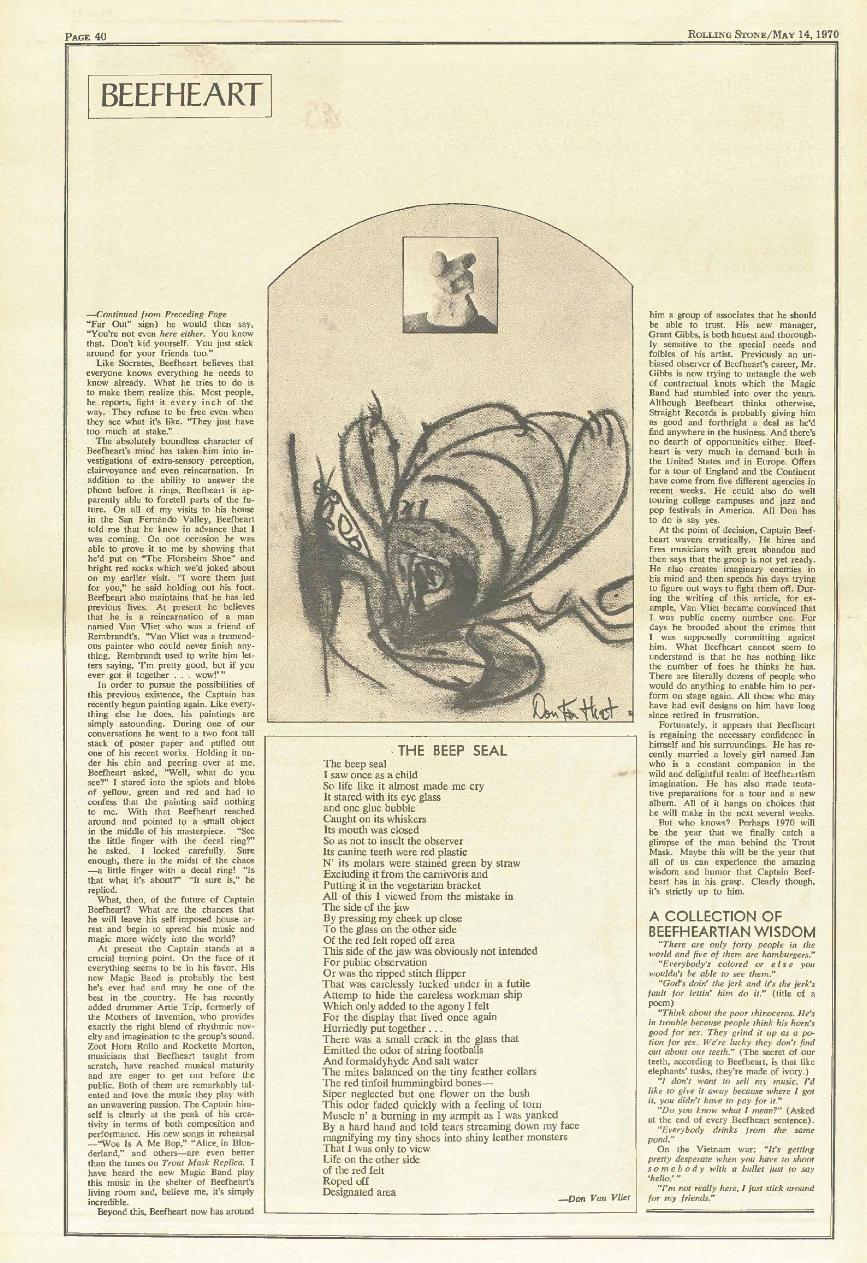
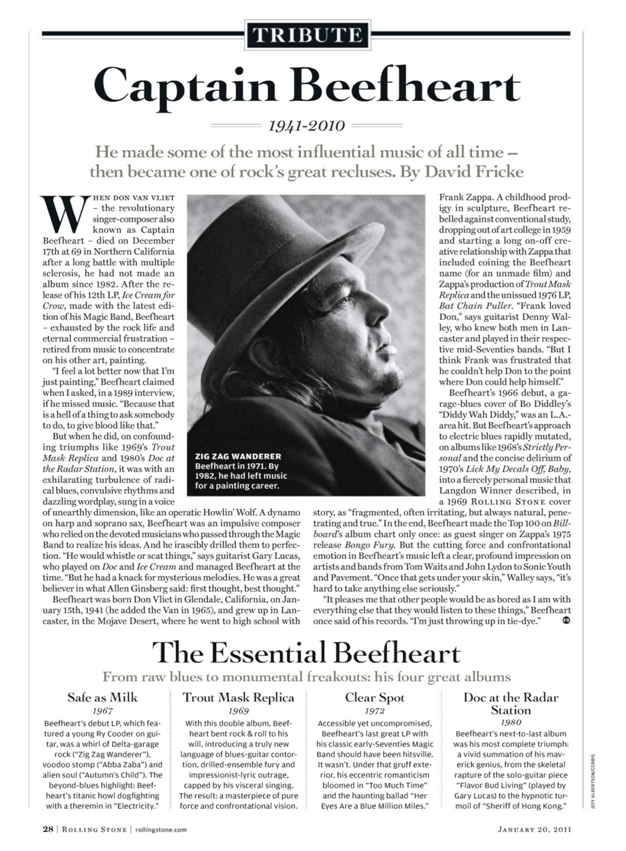
"Uh oh, the phone," Captain Beefheart mumbled as he placed his tarnished soprano saxophone in its case. "I have to answer the telephone." It was a very peculiar thing to say. The phone had not rung.
Beefheart walked quickly from his place by the upright piano across the dimly lit living room to the cushion where the telephone lay. He waited. After ten seconds of stony silence it finally rang. None of the half dozen or so persons in the room seemed at all astounded by what had just happened. In the world of Captain Beefheart, the extraordinary is the rule. (read more)
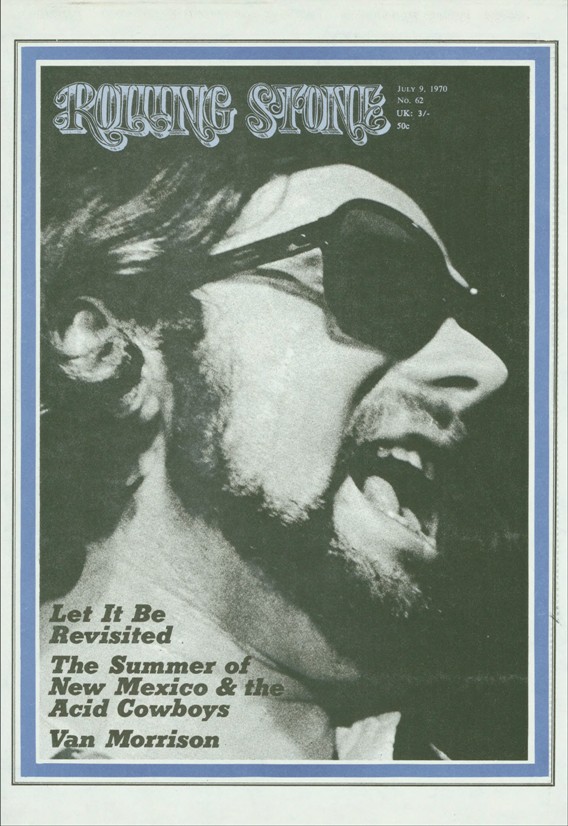
While the musical wedding of Frank Zappa and Zubin Mehta and their respective backup men at Pauley Pavilion was not a complete success, it did prove once and for all why other recent couplings of rock and symphonic elements have been such wretched failures. (read more)
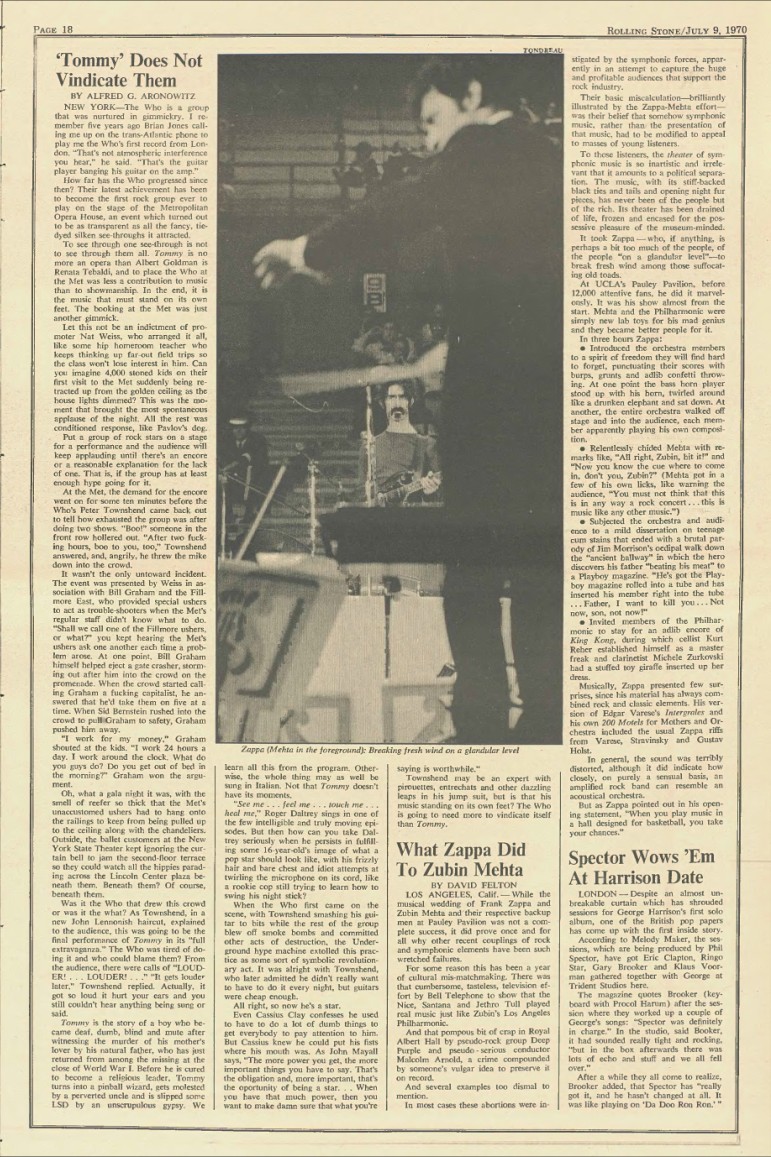
Source: home.online.no/~corneliu
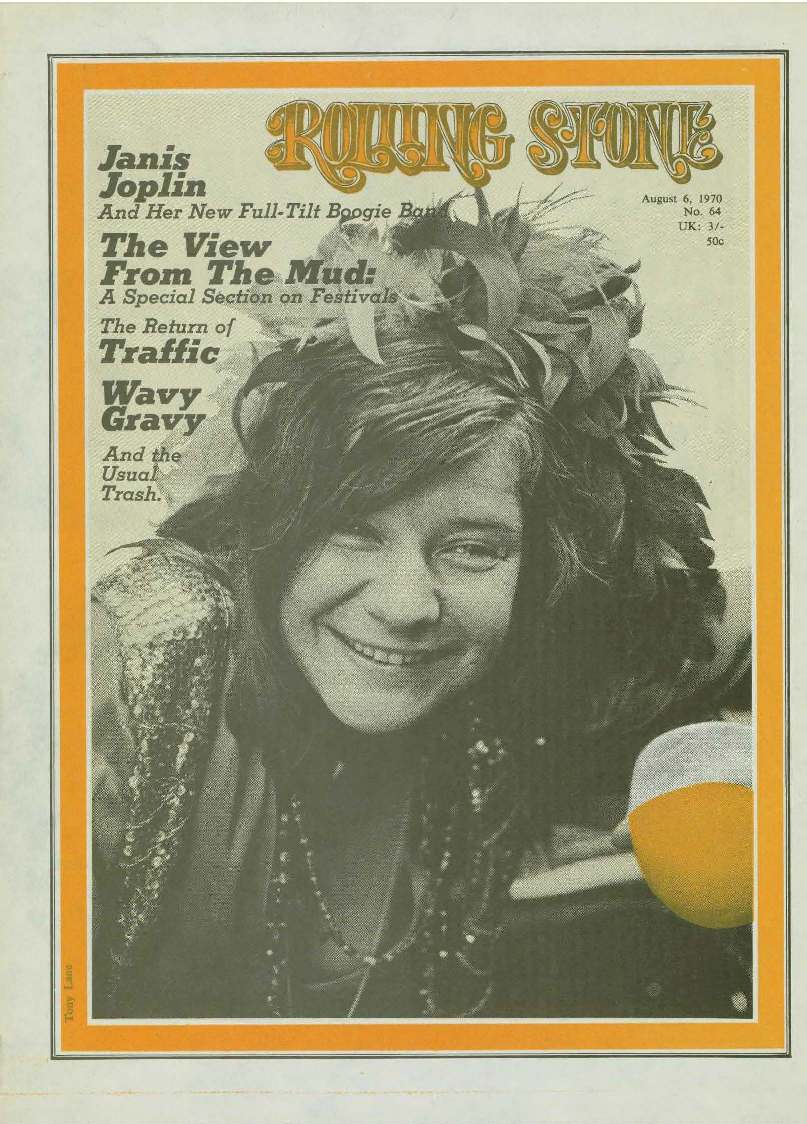
Here we have the fruits of one of the most rewarding and boundary-obliterating collaborations in a coon's age. Jean-Luc Ponty is a French gypsy jazz violinist (if categories mean anything anymore) with an unusually fluid style that is full of wide leaps, unorthodox bowing techniques, and big surprises, and he has met his match in the resourceful Frank Zappa, whose efforts here should establish him as a major musical mastermind. (read more)
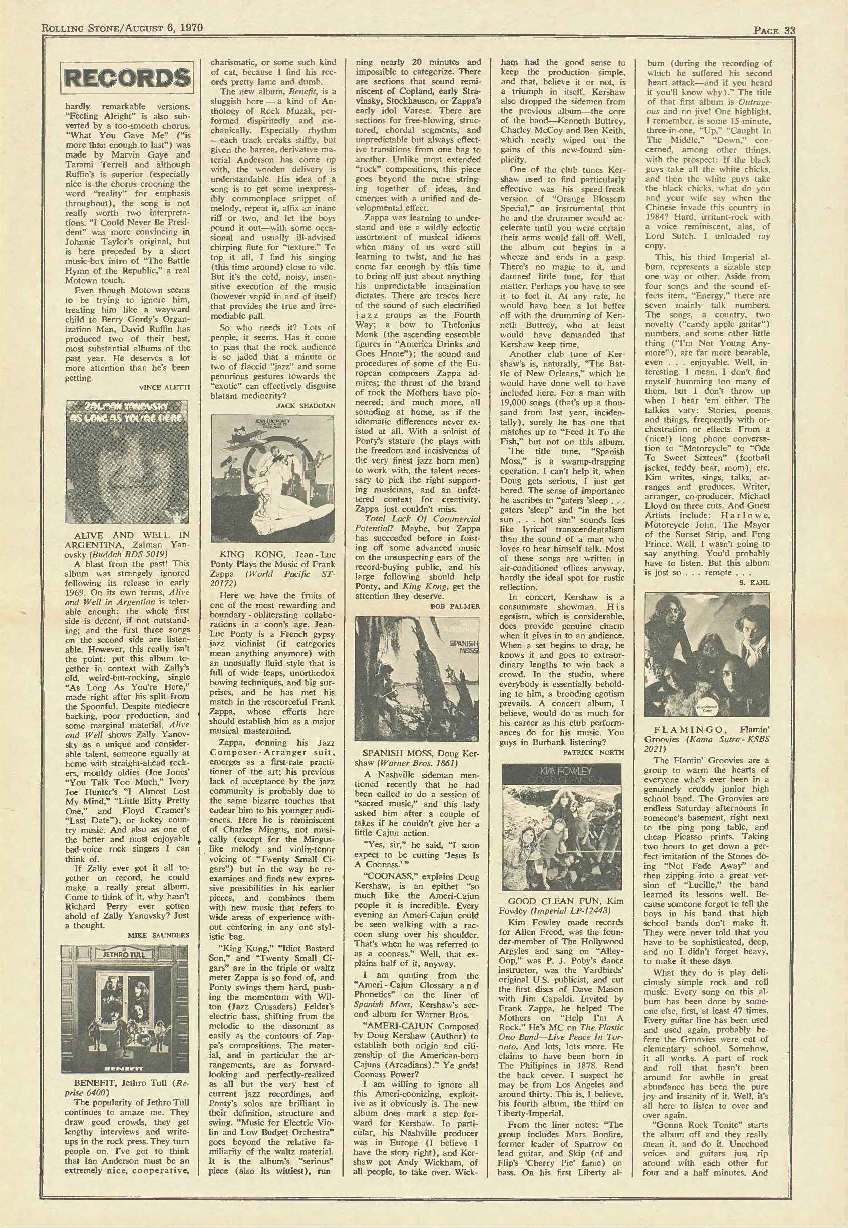
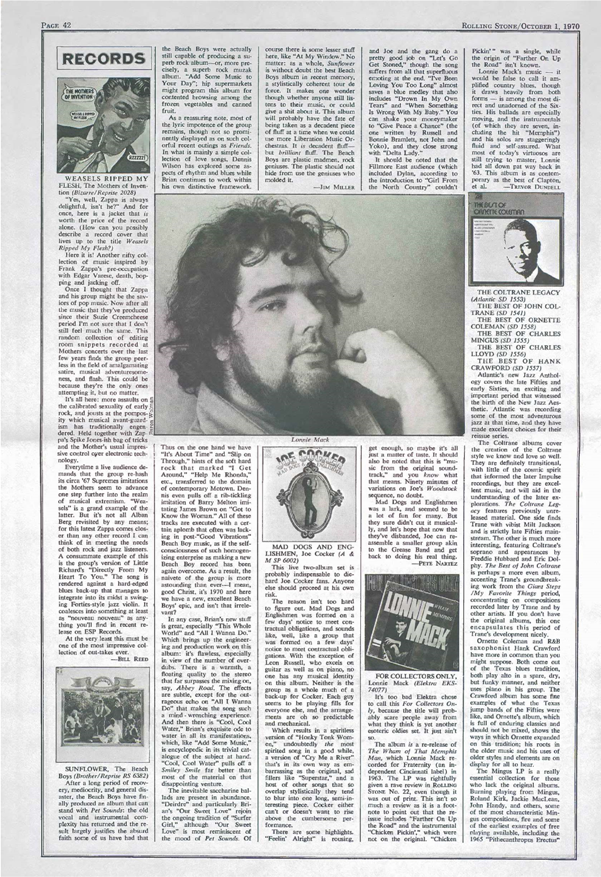
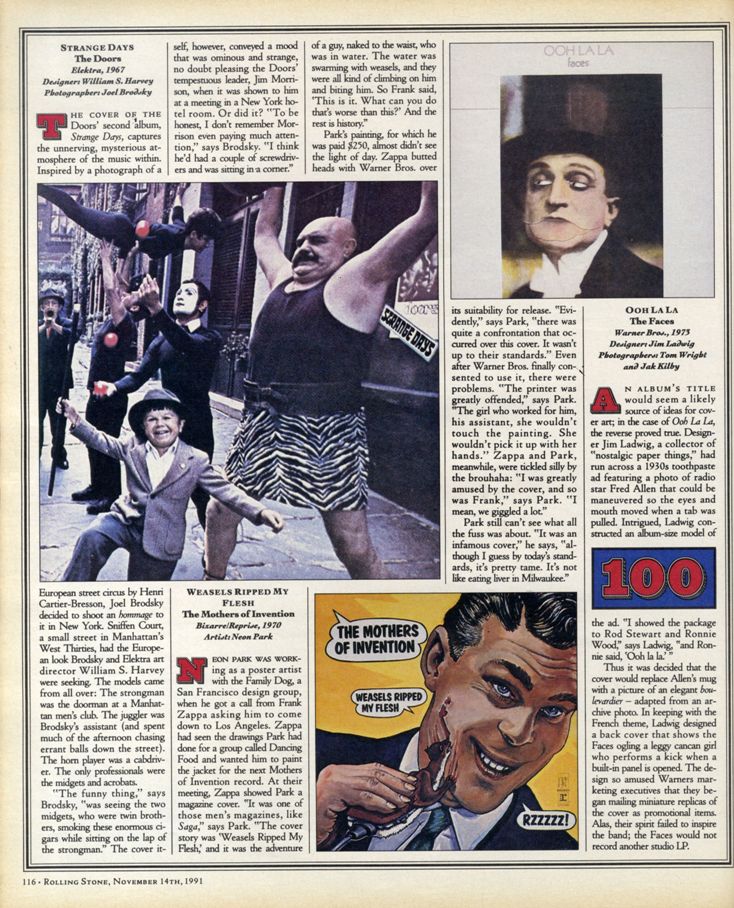
"Yes, well, Zappa is always delightful, isn't he?" And for once, here is a jacket that is worth the price of the record alone. (How can you possibly describe a record cover that lives up to the title Weasels Ripped My Flesh?) (read more)
Source: superseventies.com
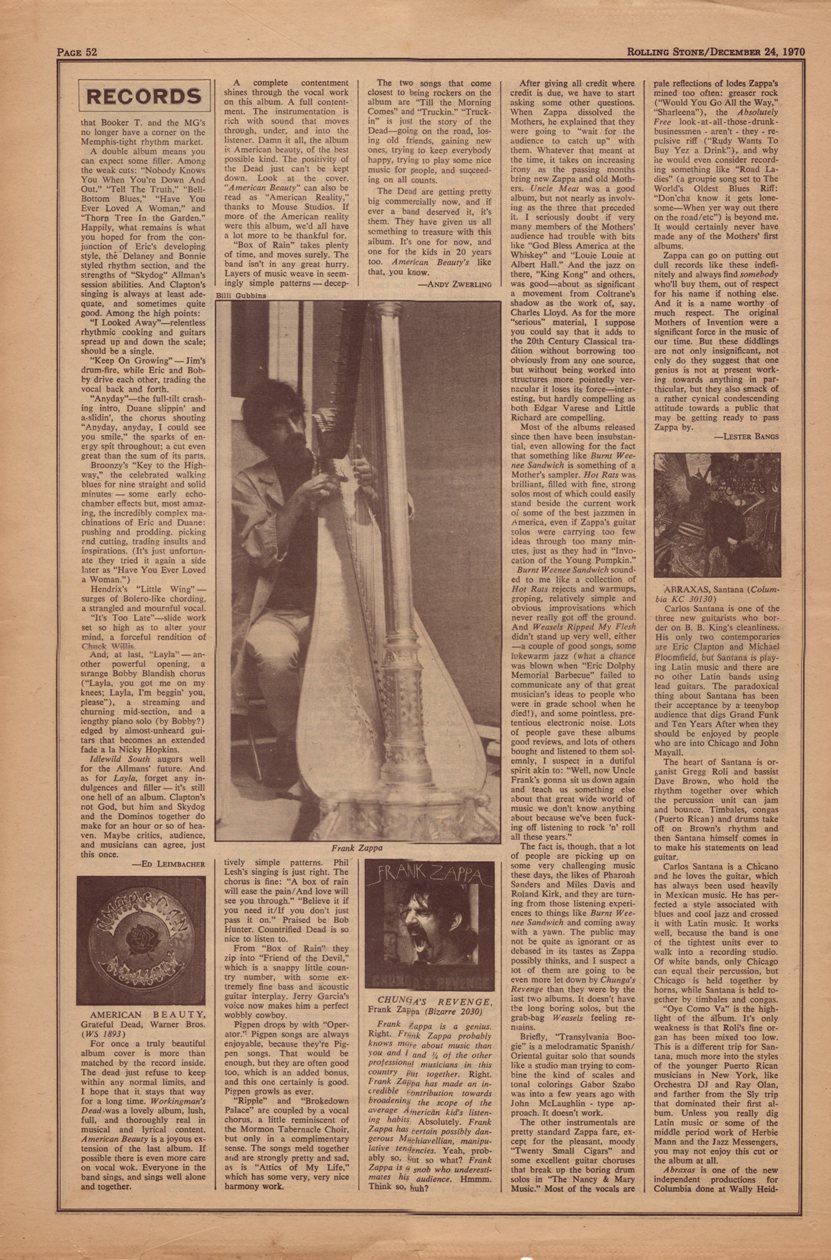
Frank Zappa is a genius. Right. Frank Zappa probably knows more about music than you and I and 3/4 of the other professional musicians in this country put together. Right. Frank Zappa has made an incredible contribution towards broadening the scope of the average American kid's listening habits. Absolutely. Frank Zappa has certain possibly dangerous Machiavellian, manipulative tendencies. Yeah, probably so, but so what? Frank Zappa is a snob who underestimates his audience. Hmmm. Think so, huh? (read more)
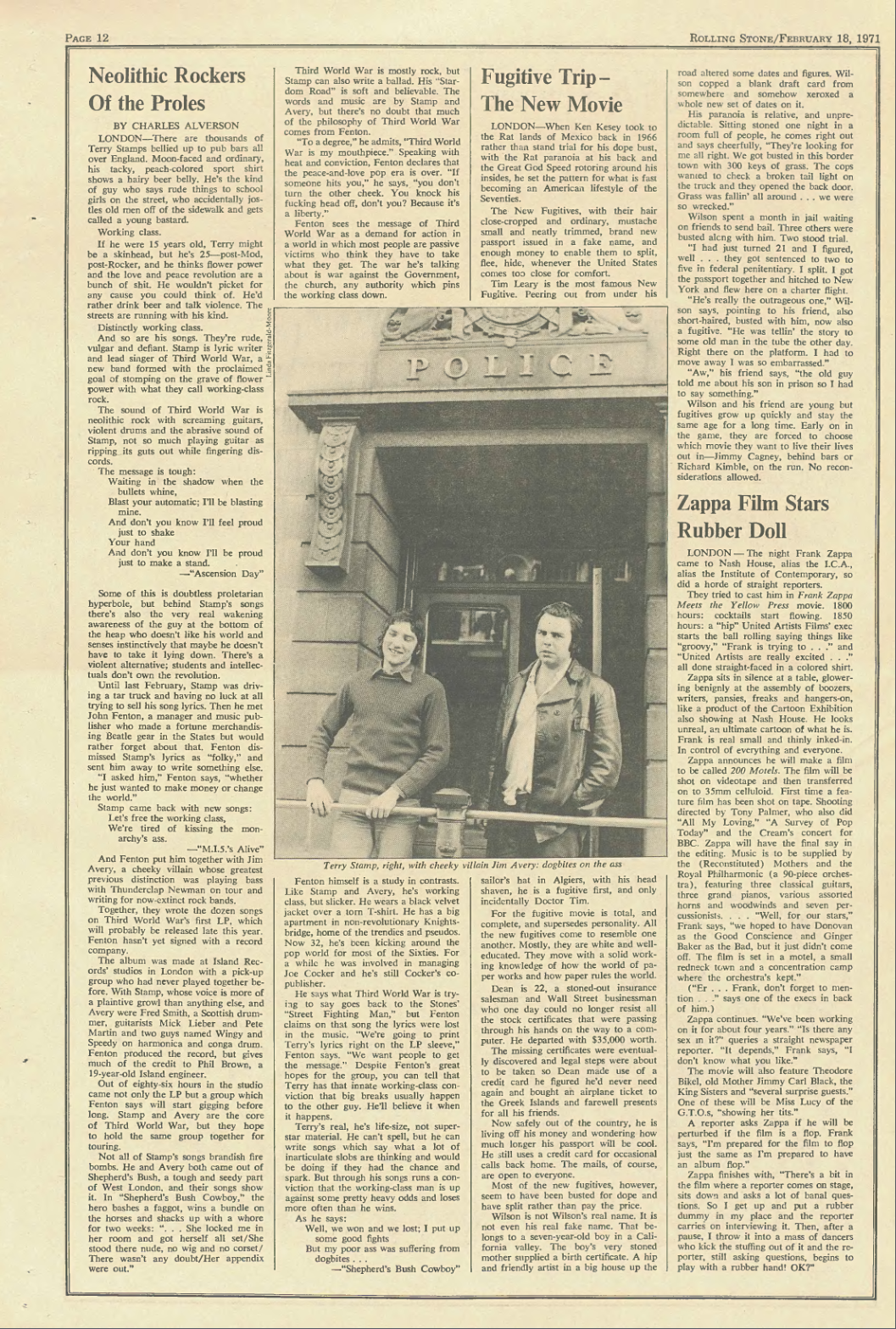
The night Frank Zappa came to Nash House, alias the I.C.A., alias the Institute of Contemporary, so did a horde of straight reporters. They tried to cast him in Frank Zappa Meets the Yellow Press movie. 1800 hours: cocktails start flowing. 1850 hours: a “hip” United Artists Films’ exec starts the ball rolling saying things like “groovy,” “Frank is trying to . . .” and “United Artists are really excited . . .” all done straight-faced in a colored shirt. (read more)
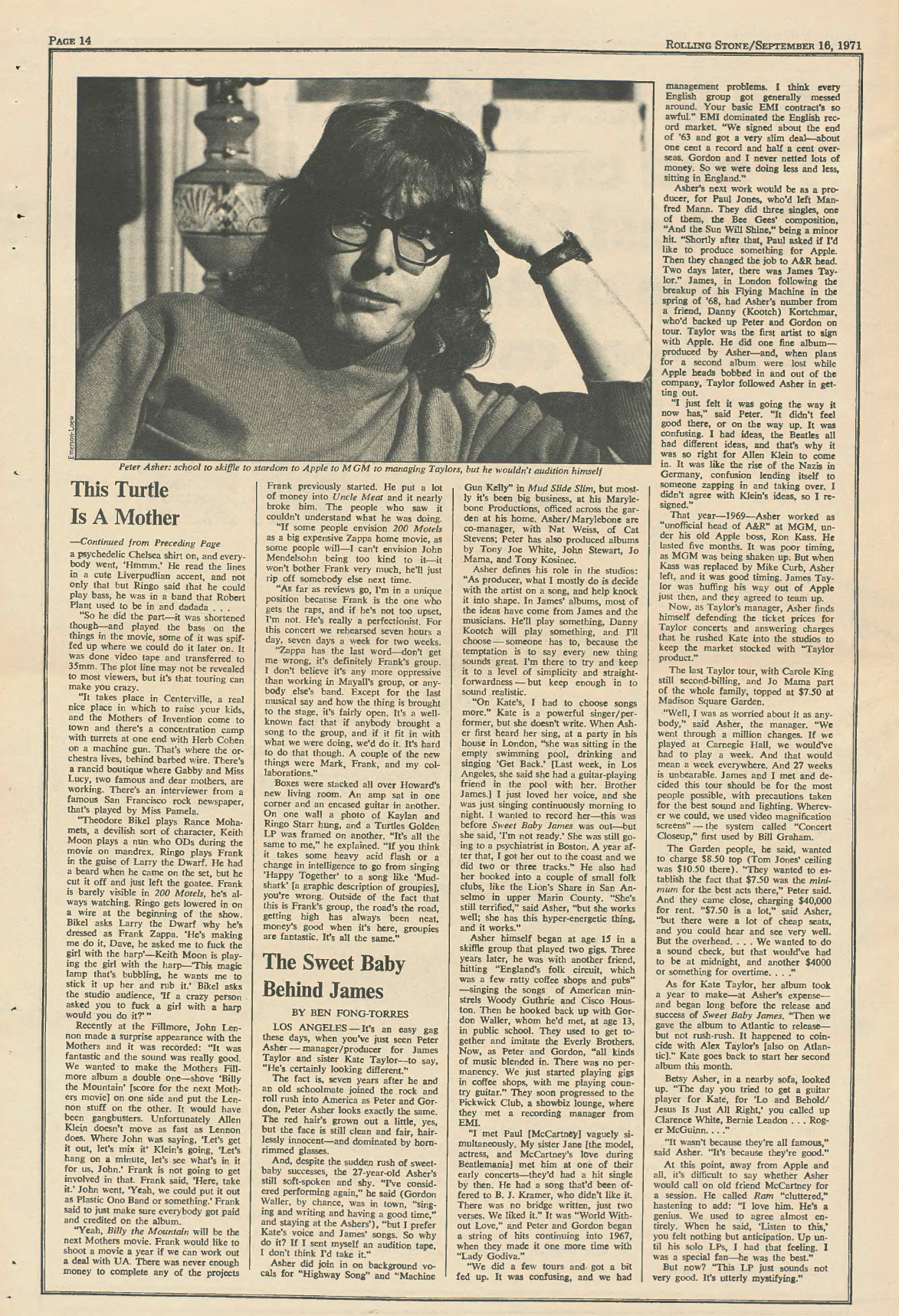
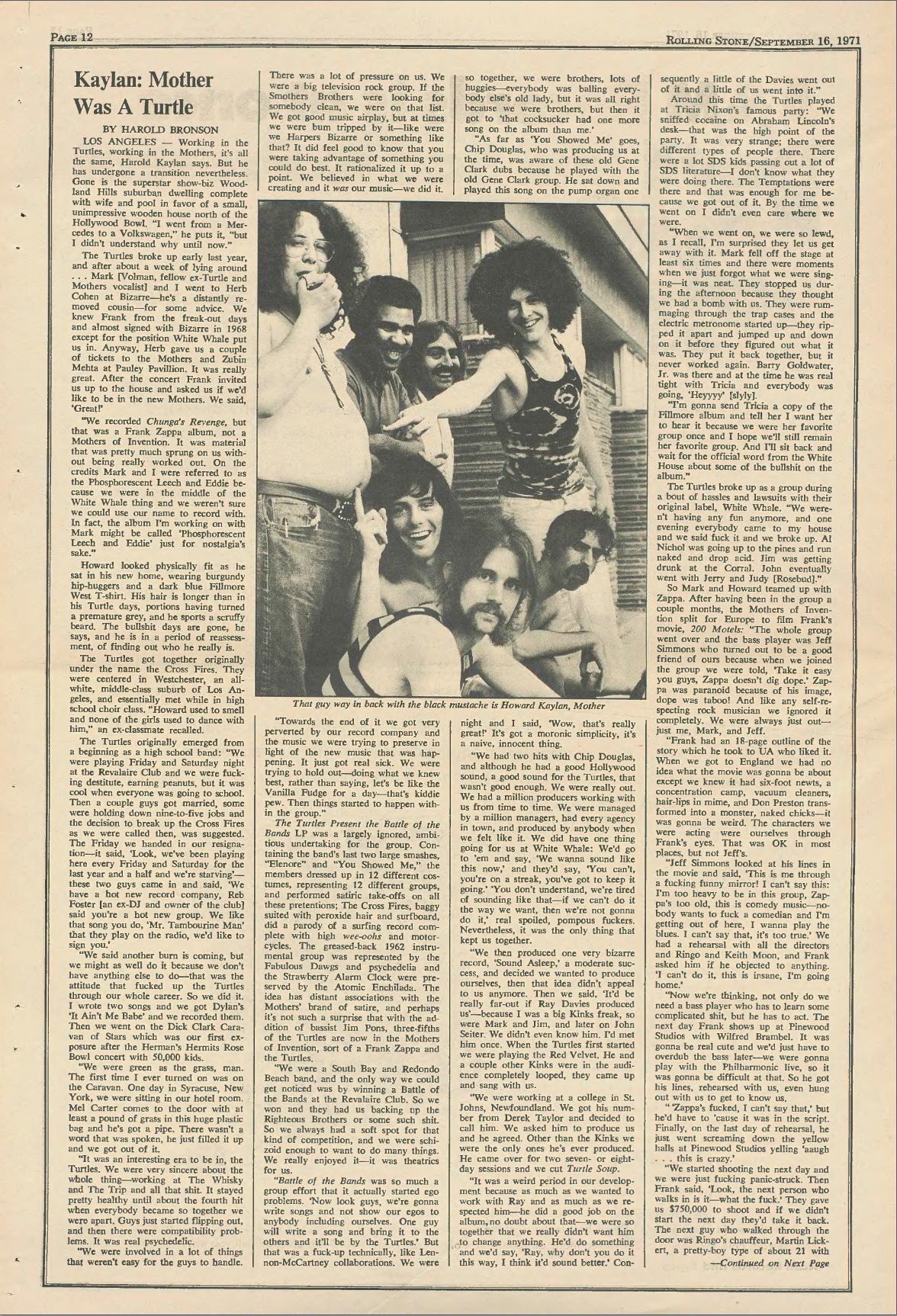
The Turtles broke up early last year, and after about a week of lying around . . . Mark [Volman, fellow ex-Turtle and Mothers vocalist] and I went to Herb Cohen at Bizarre – he’s a distantly removed cousin – for some advice. We knew Frank from the freak-out days and almost signed with Bizarre in 1968 except for the position White Whale put us in. Anyway. Herb gave as a couple of tickets to the Mothers and Zubin Mehta at Pauley Pavillion. It was really great. After the concert Frank invited us up to the house and asked us if we’d like to be in the new Mothers. We said, ‘Great!’ (read more)
It may seem a quaint notion now, but there actually was a time when Frank Zappa was considered one of the prime geniuses of rock. Somehow it just didn’t seem to matter all that much that those of his compositions which bore any relationship to rock ‘n‘ roll form at all were either sarcastic exercises in calculated banality or self-indulgent parodies of Fifties group harmonies, and at the time we were still largely convinced that this perennial air of snot-mustached condescension was good for us: Uncle Frank as all-purpose conscience pointing out our lameness and simultaneously educating us to that great wide world of music out there beyond our punky ignorance, his pointer guiding us from track to track: “See, this is jazz, and now for a taste of Stravinsky, and notice how we‘ve interwoven it all with a few Motown arrangements and fuzztones that all you stupid little ‘Louie Louie‘ brained bastards can understand . . .” (read more)
Maybe Frank Zappa and Dennis Hopper should get it on together and make a film. That way, we wouldn’t be subjected to the pretentious crap that they put out on two separate occasions, but could sit through one dreadful, boring, execrable flick and be done with it all. (read more)
Maybe you like Frank Zappa’s vocally-oriented new Mothers. Maybe you thought all those instrumentals in 7/4 time with sneezing saxophones and slinky wah-wah guitar solos were too far out, or dull, or something. Maybe you liked the mock-oratorio style of 200 Motels and Live at the Fillmore. If that’s the case, you might as well stop reading this and go out and buy Just Another Band From L.A. because it’s just another Frank Zappa album with plenty more of the same. (read more)
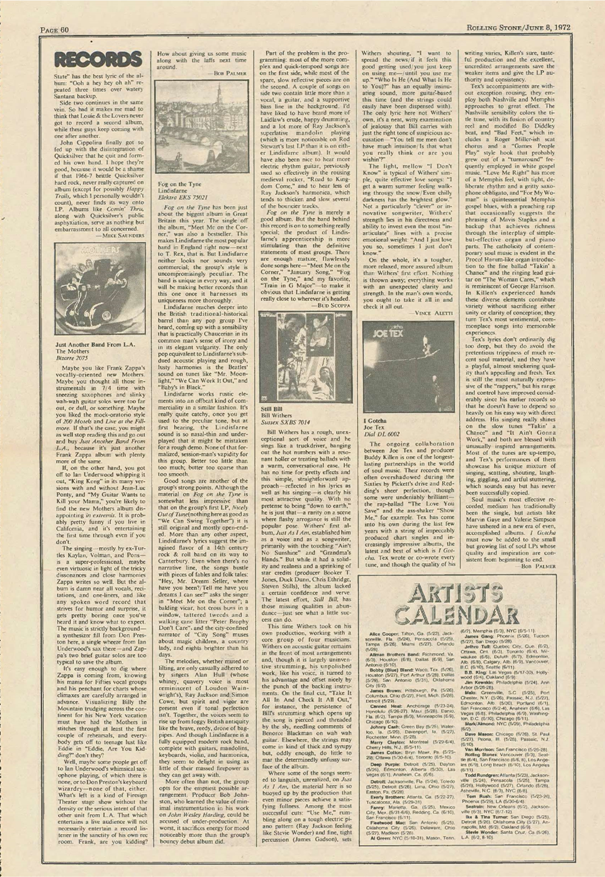
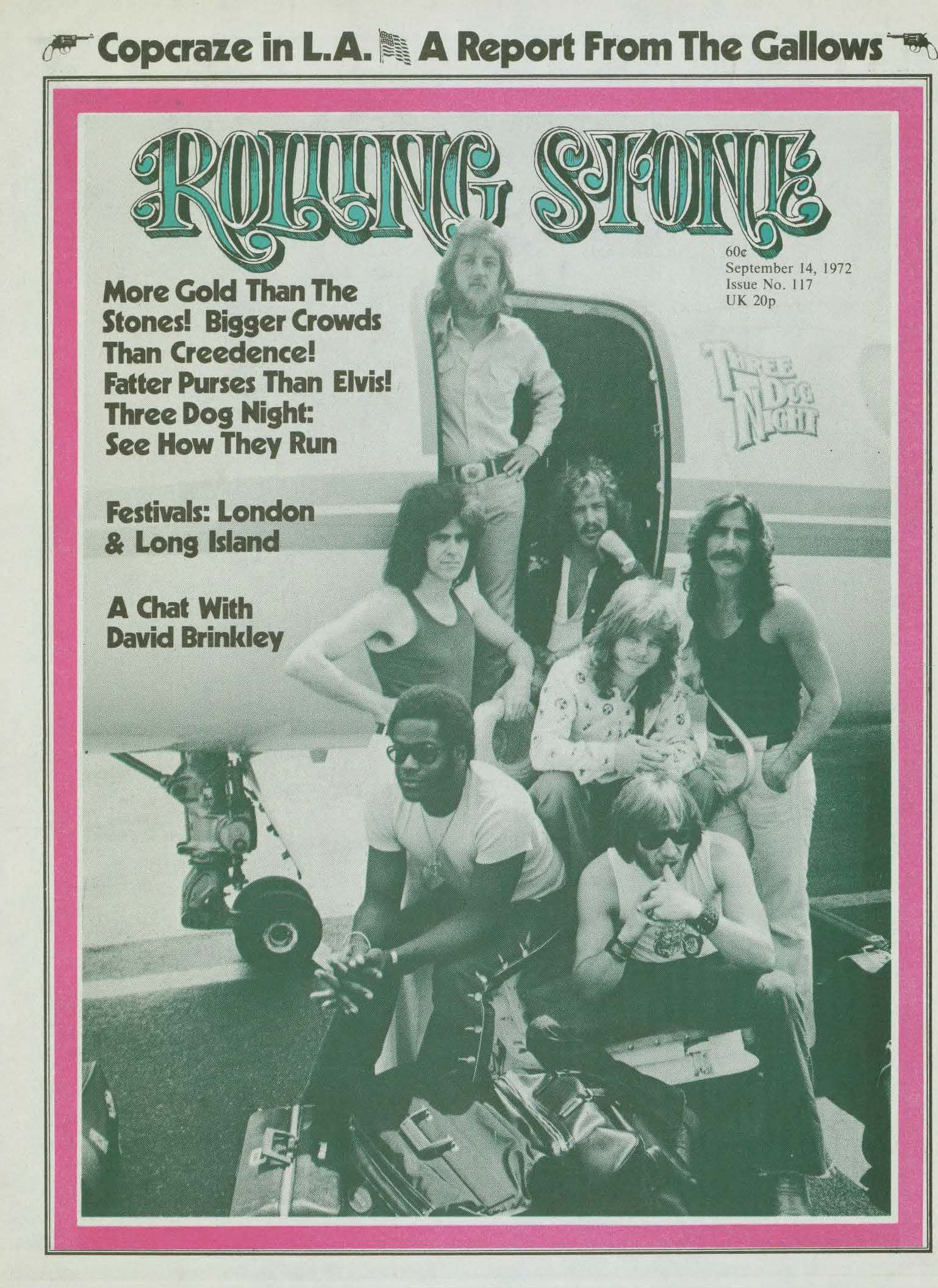
1972 September 14
No. 117
No Commercial
Potential: The Saga of Frank Zappa and the Mothers of Invention
By Andrew Gordon, p 60
People are scared of Frank Zappa. John Lennon was so 1972 awed during his first audience with the Head Mother he was afraid Zappa would snap off his head like a fox gobbling up a chicken. Critics are scared of Frank Zappa, and this has been an obstacle to understanding him as a figure. For years, Zappa has floated coolly above the scene, a hip puppet-master, untouchable and beyond criticism because everyone knew he was a fucking genius. The Mother Superior. (read more)
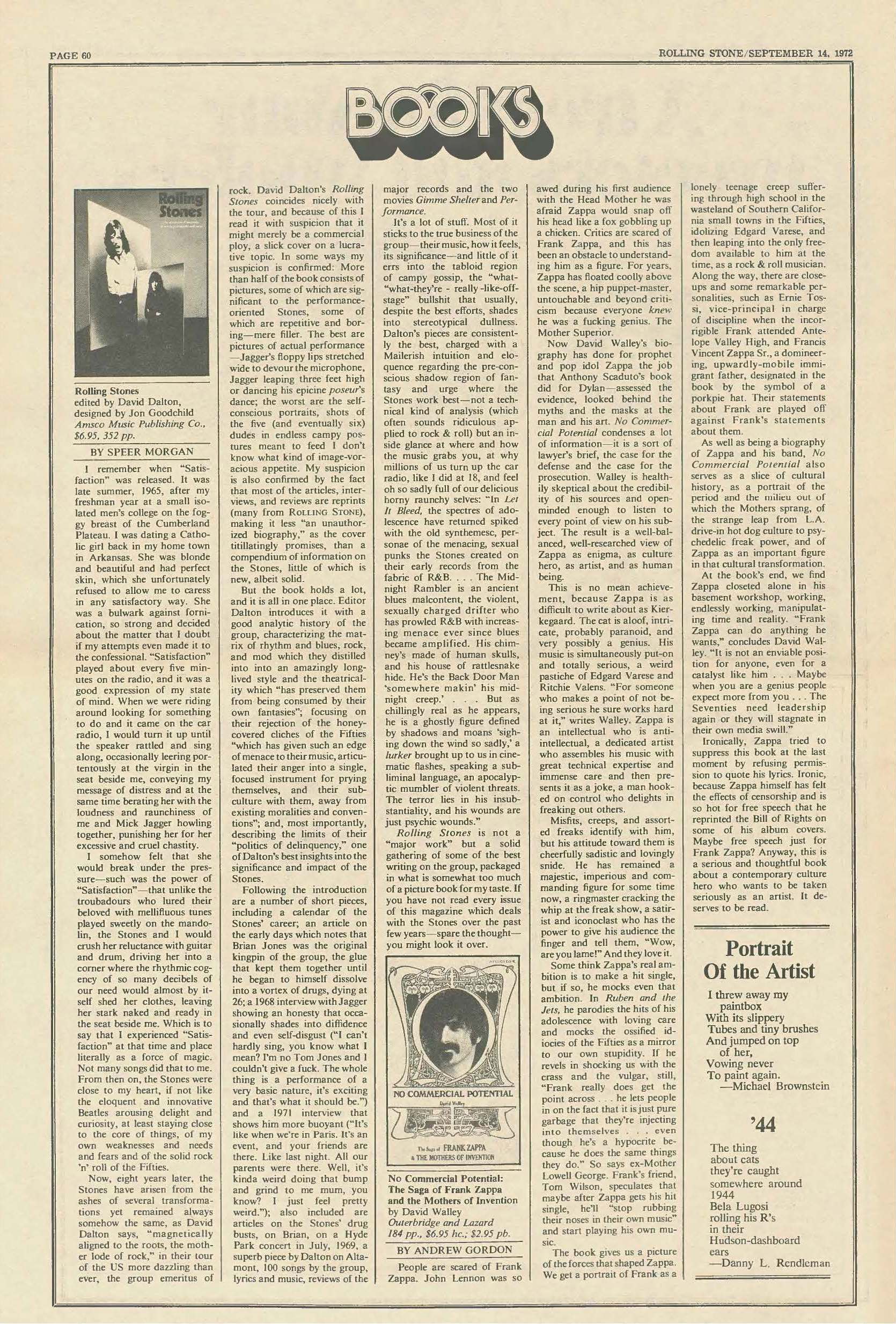
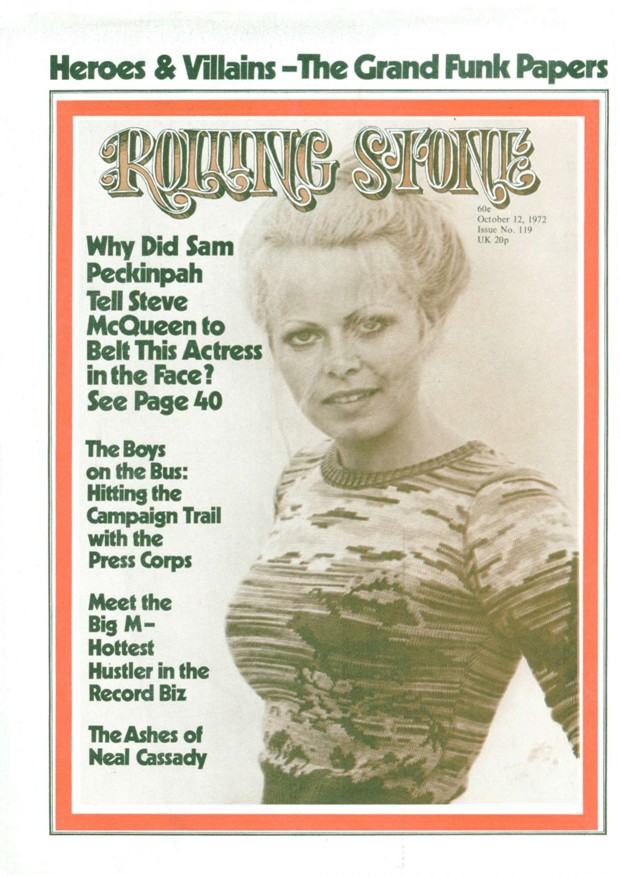
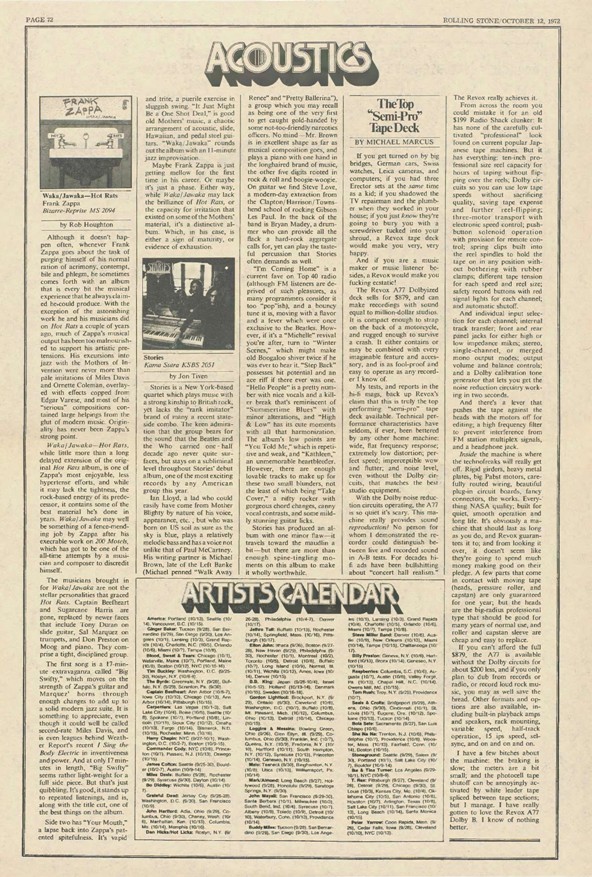
Although it doesn’t happen often, whenever Frank Zappa goes about the task of purging himself of his normal ration of acrimony, contempt, bile and phlegm, he sometimes comes forth with an album that is every bit the musical experience that he always claimed he could produce. With the exception of the astonishing work he and his musicians did on Hot Rats a couple of years ago, much of Zappa’s musical output has been too malnourished to support his artistic pretensions. His excursions into jazz with the Mothers of Invention were never more than pale imitations of Miles Davis and Ornette Coleman, overlayed with effects copped from Edgar Varése, and most of his “serious” compositions contained large helpings from the glut of modern music. Originality has never been Zappa’s strong point. (read more)
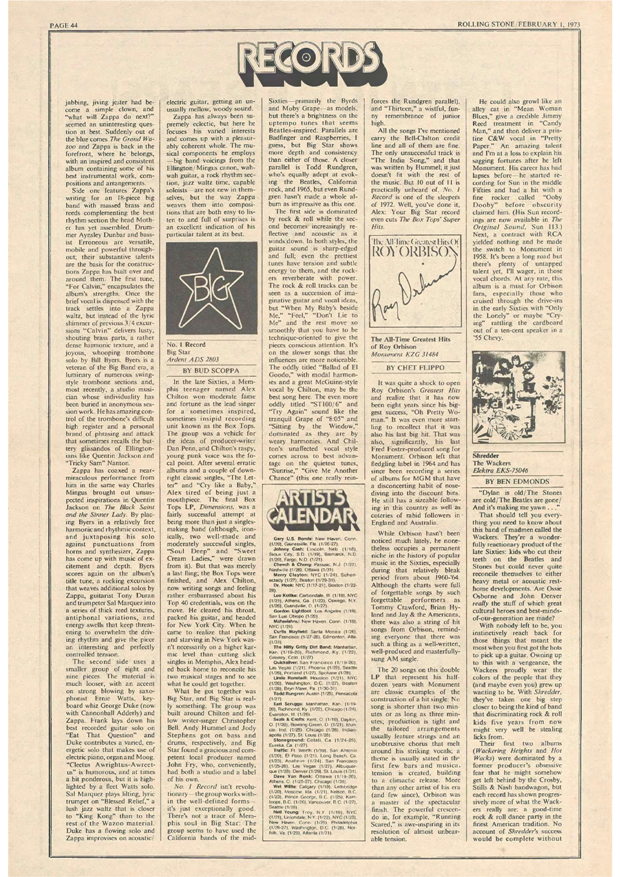
Zappa's recent tangents have met with mixed response. The presence of the Phlorescent Leech and Eddie on several albums of vocal hi-jinks and the empty ponderousness of 200 Motels were even less satisfying than the undirected energies of the second Hot Rats album. It seemed that Zappa had lost the coherent outrageousness that made albums like Uncle Meat and Ruben and the Jets such special landmarks in the rock avant-garde of the Sixties; the jabbing, jiving jester had become a simple clown, and “what will Zappa do next?” seemed an uninteresting question at best. Suddenly out of the blue comes The Grand Wazoo and Zappa is back in the forefront, where he belongs, with an inspired and consistent album containing some of his best instrumental work, compositions and arrangements. (read more)
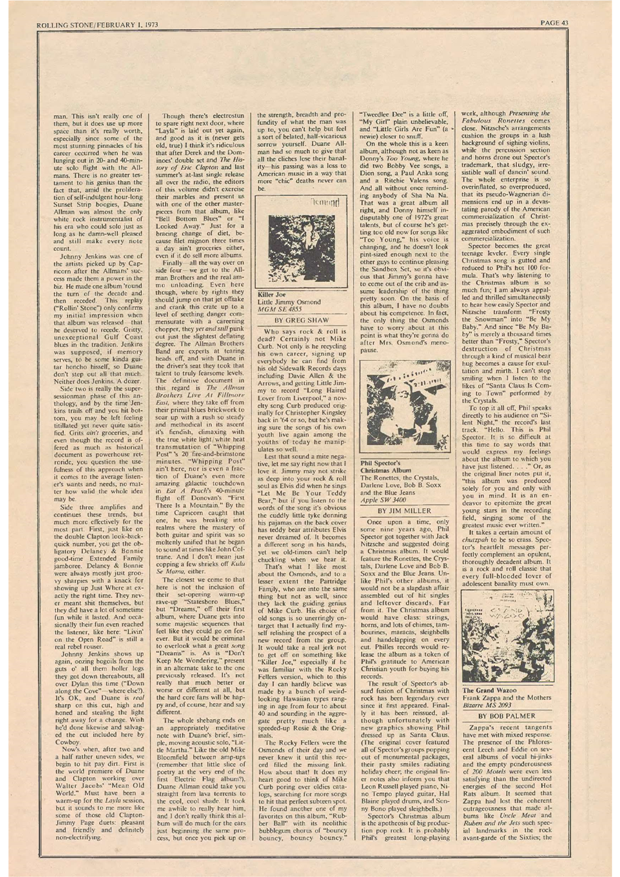
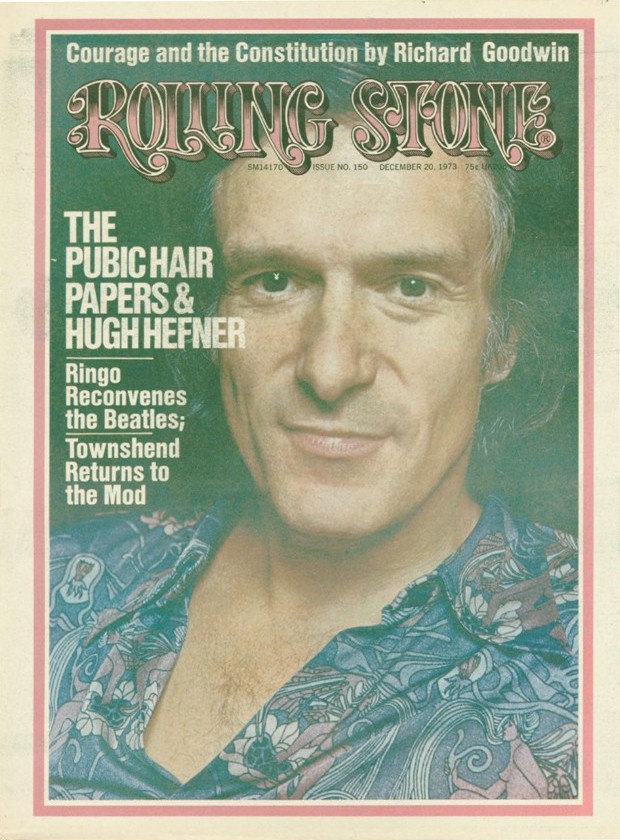
A year has passed since Just Another Band From L.A., and I awaited this one under the impression that Zappa's output, though becoming predictable, was being perfected. But this LP is shorn of those references which would have made Band incomprehensible to those not having logged time in the city of L.A. Also missing (and missed) are former Turtles Kaylan and Volman, whose Flo and Eddie albums in turn need Zappa. (read more)
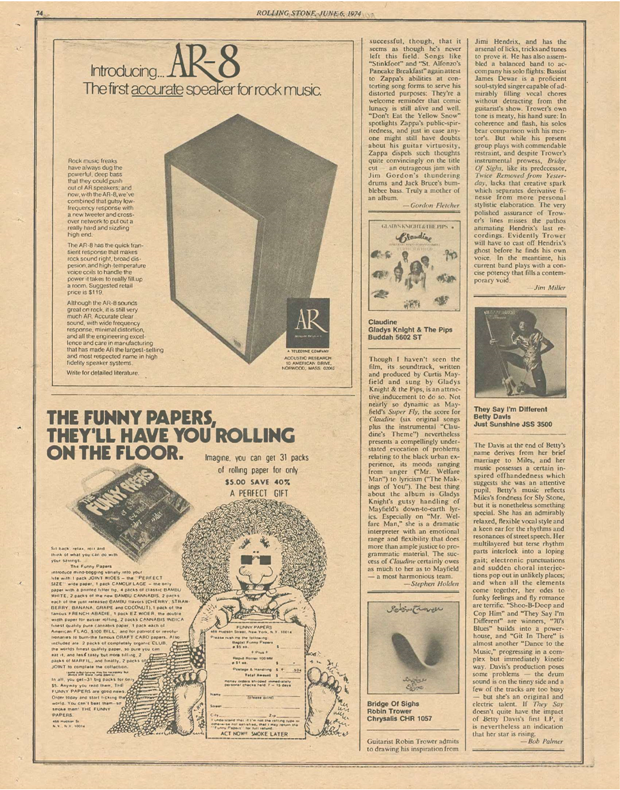
Having proven his stellar musicianship on a series of instrumental-based solo albums, Frank Zappa is now returning to the musical satire on which his formidable reputation was built. Apostrophe turns out to be so brilliantly successful, though, that it seems as though he's never left this field. (read more)
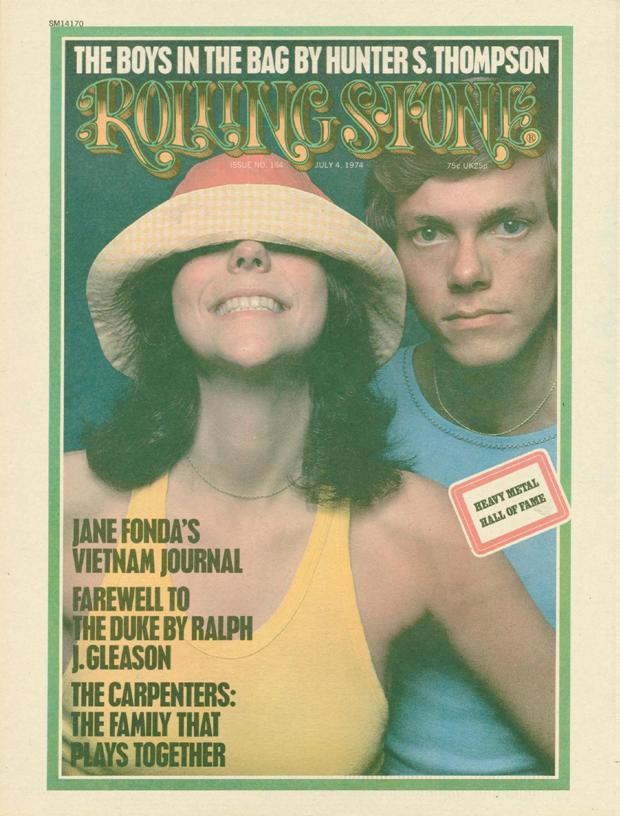
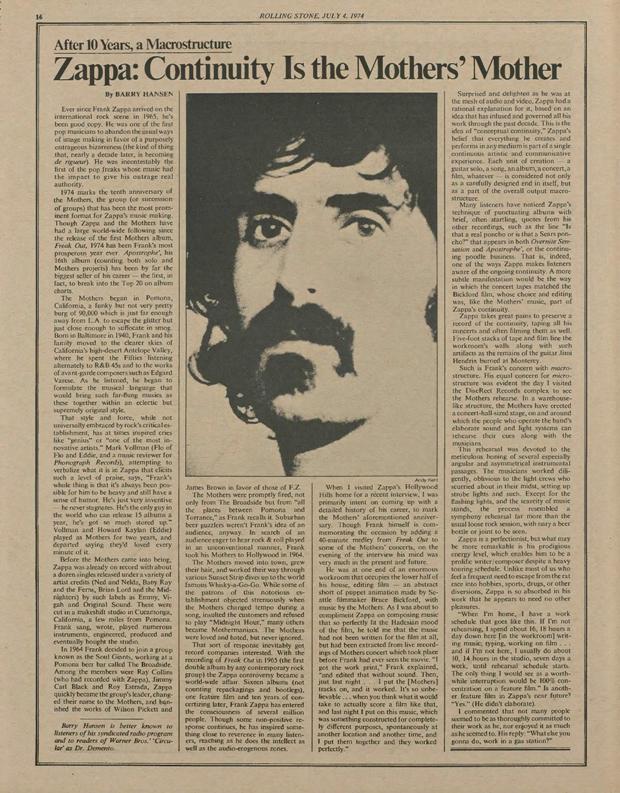
Ever since Frank Zappa arrived on the international rock scene in l965, he's been good copy. He was one of the first pop musicians to abandon the usual ways of image making in favor of a purposely outrageous bizarreness (the kind of thing that, nearly a decade later, is becoming de rigueur). He was incontestably the first of the pop freaks whose music had the impact to give his outrage real authority. (read more)
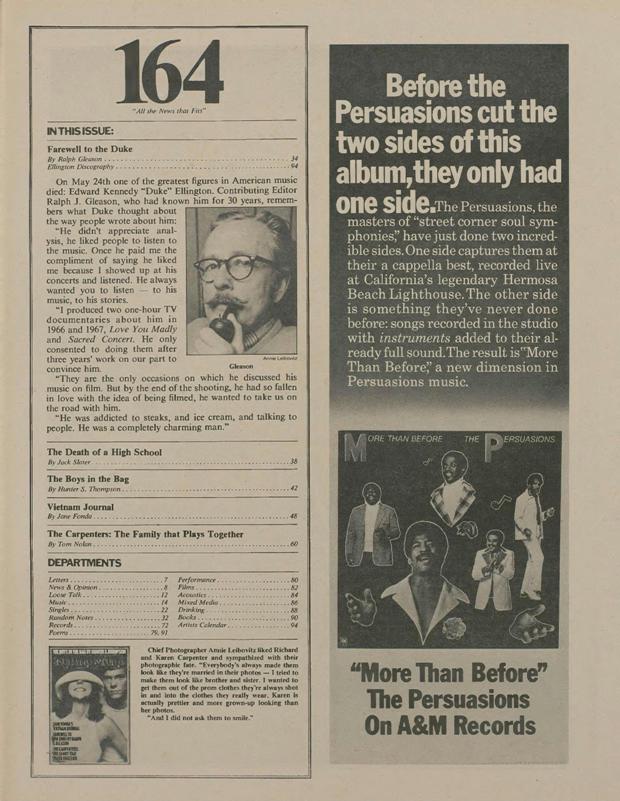
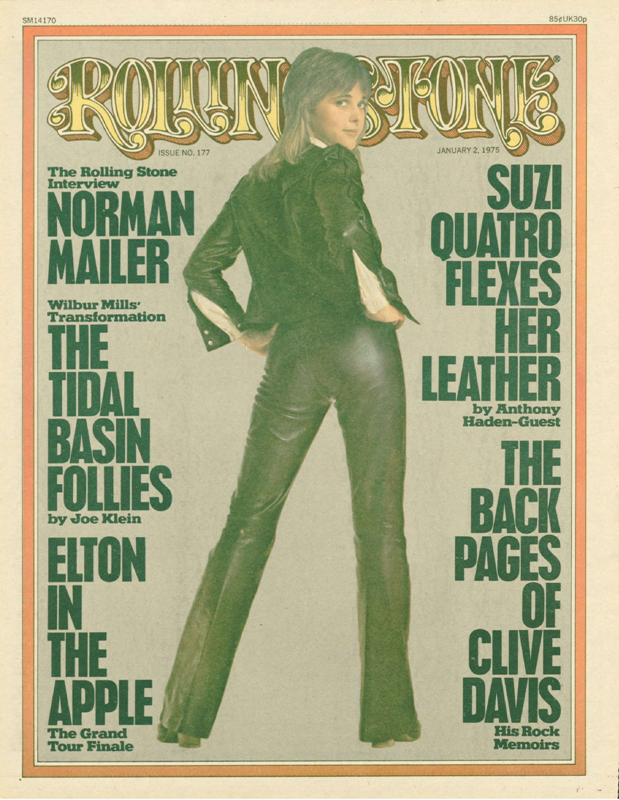
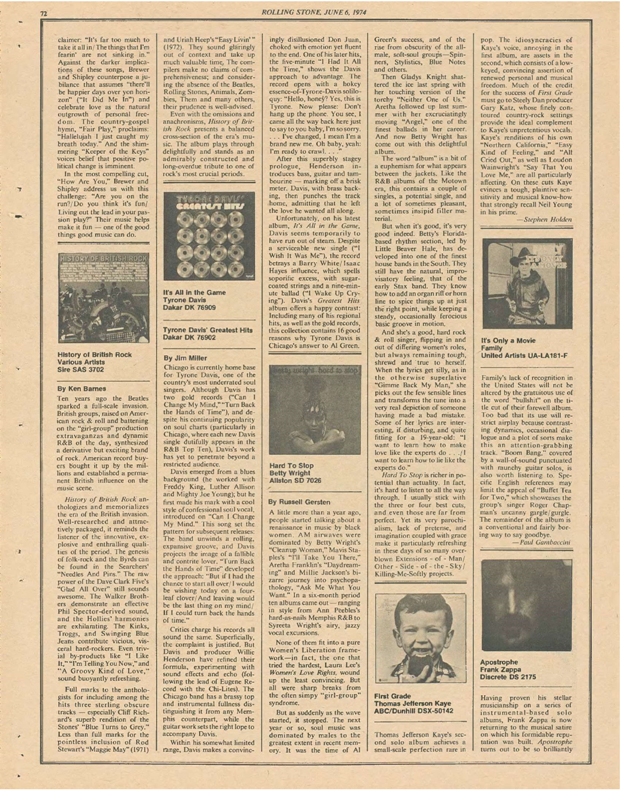
This is sort of like jazz in its own peculiar way, Zappa says during a rap in "Be-Bop Tango," and he's right, because Roxy & Elsewhere is about as close to a traditional musical form as the Mothers are ever likely to come. (read more)
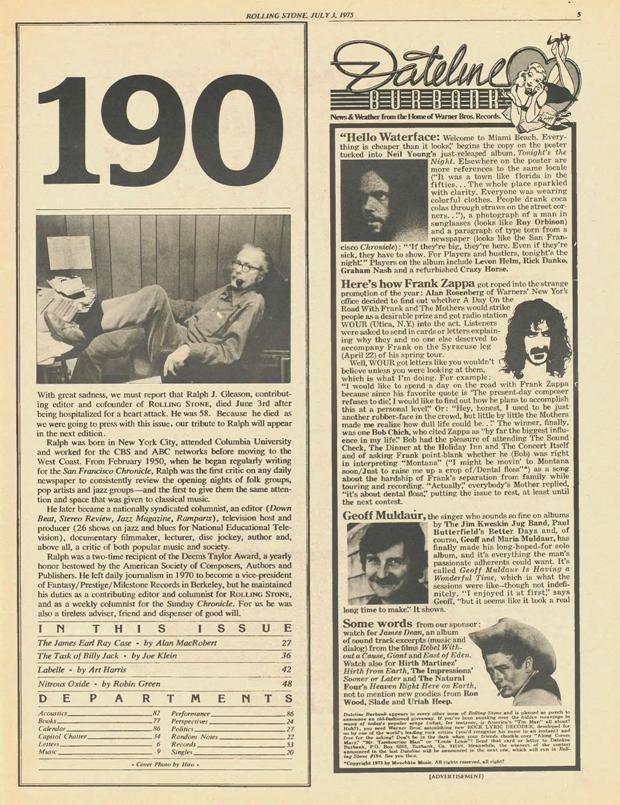
Page 5:
Here’s how Frank Zappa get roped into the strange promotion of the year: Alan Rosenberg of Warners' New York office decided to find out whether A Day On the Road With Frank and The Mothers would strike people as a desirable prize and got radio station WOUR (Utica, N.Y.) into the act. Listeners were asked to send in cards or letters explaining why they and no one else deserved to accompany Frank on the Syracuse leg (April 22) of his spring tour.
Well, WOUR got letters like you wouldn't believe unless you were looking at them, which is what I'm doing. For example: "I would like to spend a day on the road with Frank Zappa because since his favorite quote is 'The present-day composer refuses to die,' I would like to find out how he plans to accomplish this at a personal level." Or: "Hey, honest I used to be just another rubber-face in the crowd, but little by little the Mothers made me realize how dull life could be ..." The winner, finally, was one Bob Chich, who cited Zappa as "by far the biggest influence in my life." Bob had the pleasure of attending The Sound Check, The Dinner at the Holiday Inn and The Concert Itself and of asking Frank point-blank whether he (Bob) was right in interpreting "Montana" ("I might be movin' to Montana soon/Just to raise me up a crop of/Dental floss") as a song about the hardship of Frank’s separation from family while touring and recording. "Actually," everybody's Mother replied, "it's about dental floss," putting the issue to rest, at least until the next contest.
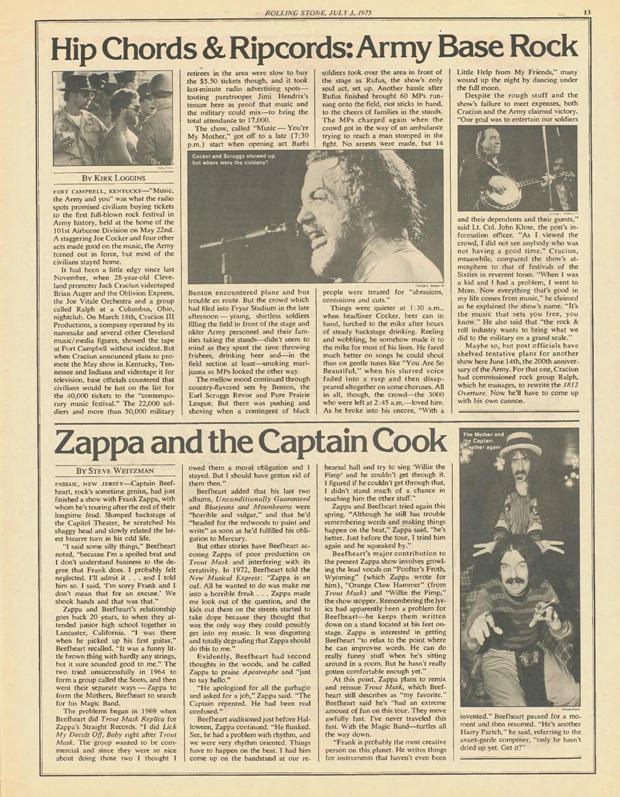
Zappa and the Captain Cook:
PASSAIC, NEW JERSEY – Captain Beefheart, rock's sometime genius, had just finished a show with Frank Zappa, with whom he's touring after the end of their longtime feud. Slumped backstage at the Capitol Theatre, he scratched his shaggy head and slowly related the latest bizarre turn in his odd life. (read more)
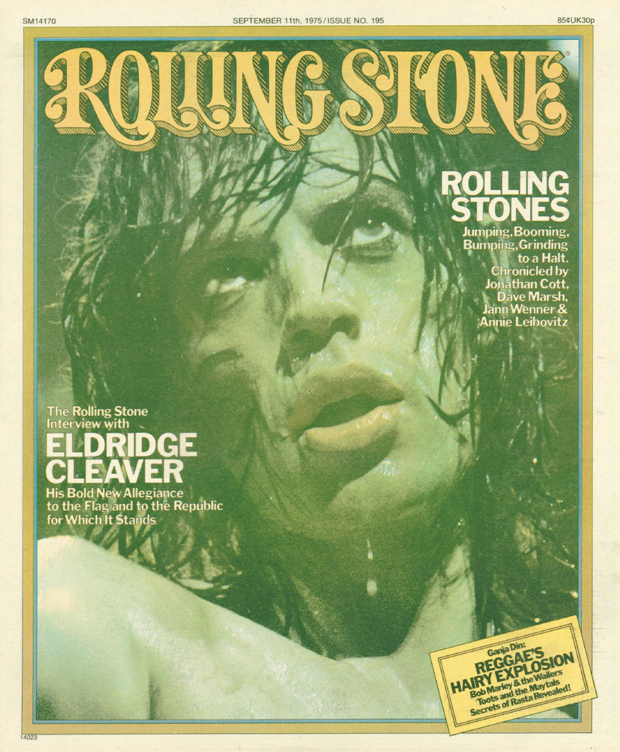
One Size Fits All
Frank Zappa and the Mothers of Invention
Discreet DS 2216
Zappa’s latest aggregation of musicians is equipped to follow its leader into whatever musical terrain he wishes to explore. Unfortunately he seems to be resting comfortably now in the middle of the road. With a hit under his belt, he seems content simply to shuttle the deck a few times and deal out the same hand. One Size Fits All is music that is proficient with rarely a trace of inspiration (a few brief keyboard flourishes by George Duke) and lyrics that are not only vague but generally mindless. I doubt whether anyone outside the group has any idea what these songs are supposed to be about.
The only song that’s even mildly noteworthy is "Sofa No. 2," if only because Zappa sings in German (the English translation appears on the cover). It you wish to learn how to say "I am the author of all tucks and damask piping" in a foreign language, here’s your chance.
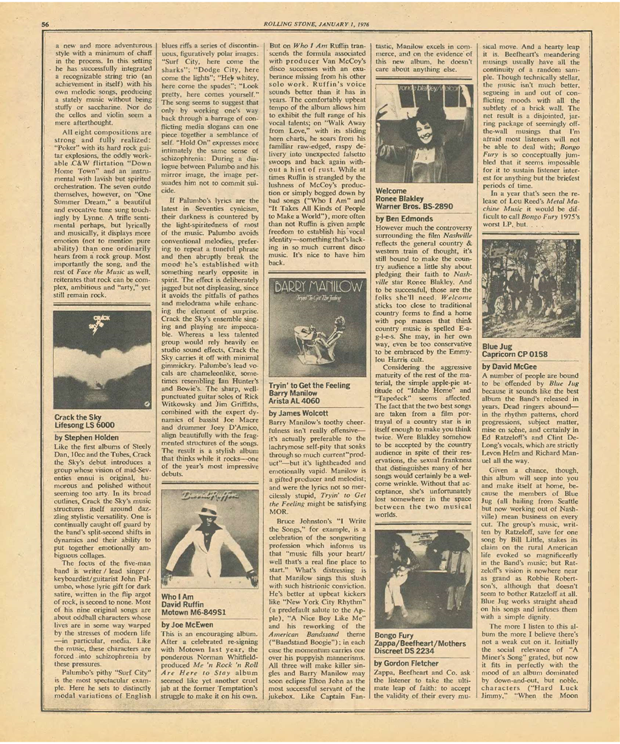
Zappa, Beefheart and Co. ask the listener to take the ultimate leap of faith: to accept the validity of their every musical move. And a hearty leap it is. Beefheart's meandering musings usually have all the continuity of a random sample. Though technically stellar, the music isn't much better, segueing in and out of conflicting moods with all the subtlety of a brick wall. The net result is a disjointed, jarring package of seemingly off-the-wall musings that I'm afraid most listeners will not be able to deal with; Bongo Fury is so conceptually jumbled that it seems impossible for it to sustain listener interest for anything but the briefest periods of time.
In a year that's seen the release of Lou Reed's Metal Machine Music it would be difficult to call Bongo Fury 1975's worst LP, but….
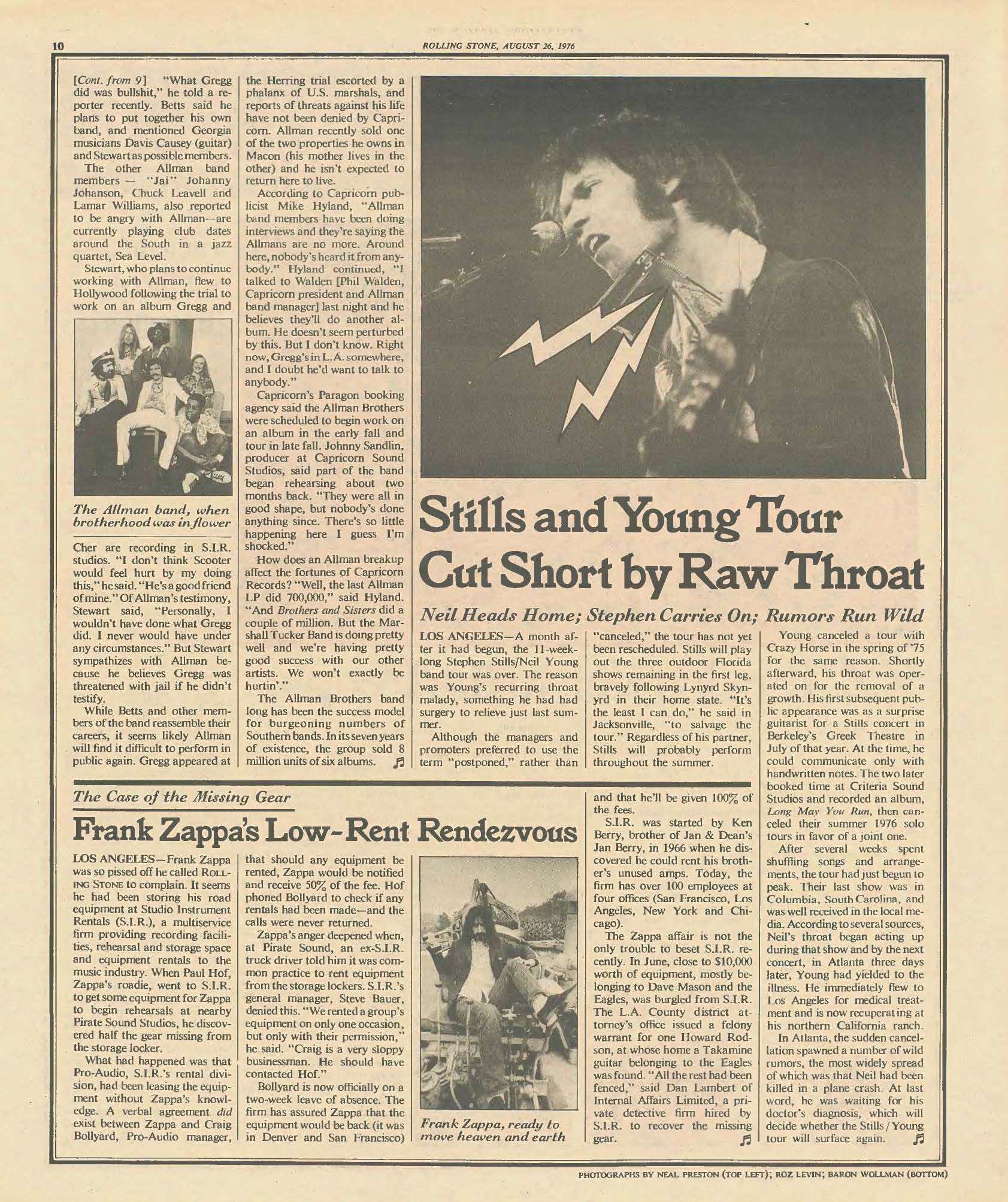
Zappa complains about the company that stores his tour equipment.
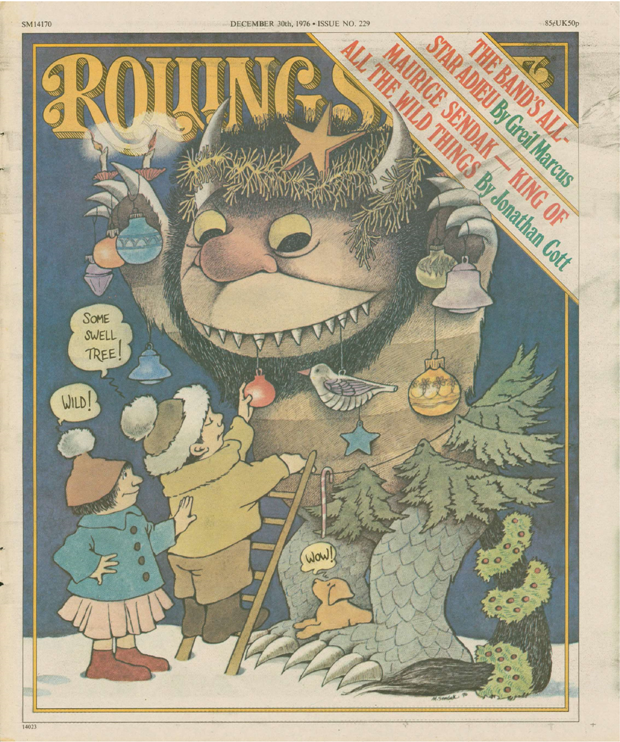
With regard to poo-poo, snot, vomit, depersonalized sex, booze, zoot suits and the banality of mainstream rock, Frank Zappa, one of rock’s original angry young men, remains vehement. And Zoot Allures is his latest blow against the Empire. You do remember the Empire? (read more)
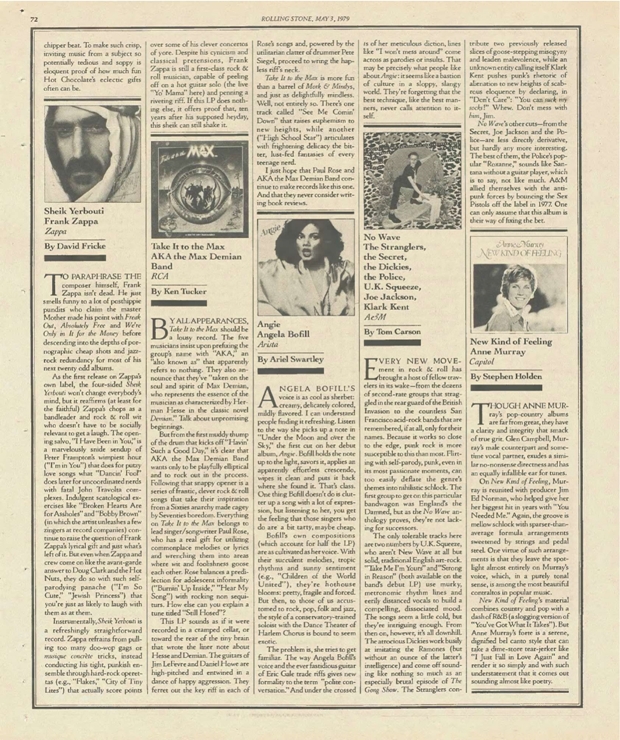
To paraphrase the composer himself, Frank Zappa isn’t dead. He just smells funny to a lot of posthippie pundits who claim the master Mother made his point with Freak Out, Absolutely Free and We’re Only in It for the Money before descending into the depths of pornographic cheap shots and jazz-rock redundancy for most of his next twenty odd albums. (read more)
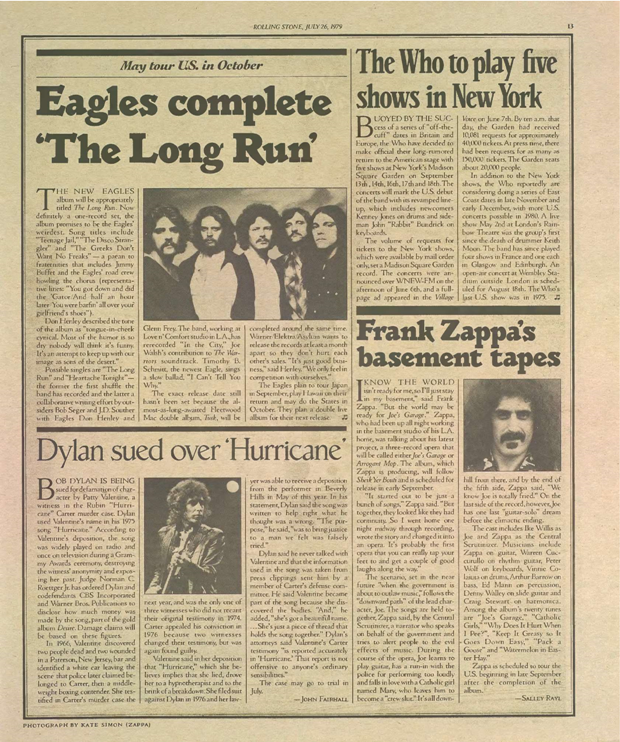
“I know the world isn't ready for me, so I'll just stay in my basement,” said Frank Zappa. “But the world may be ready for Joe’s Garage.” Zappa, who had been up all night working in the basement studio of his L.A. home, was talking about his latest project, a three-record opera that will be called either Joe’s Garage or Arrogant Mop. The album, which Zappa is producing, will follow Sheik Yerbouti and is scheduled for release in early September. (read more)
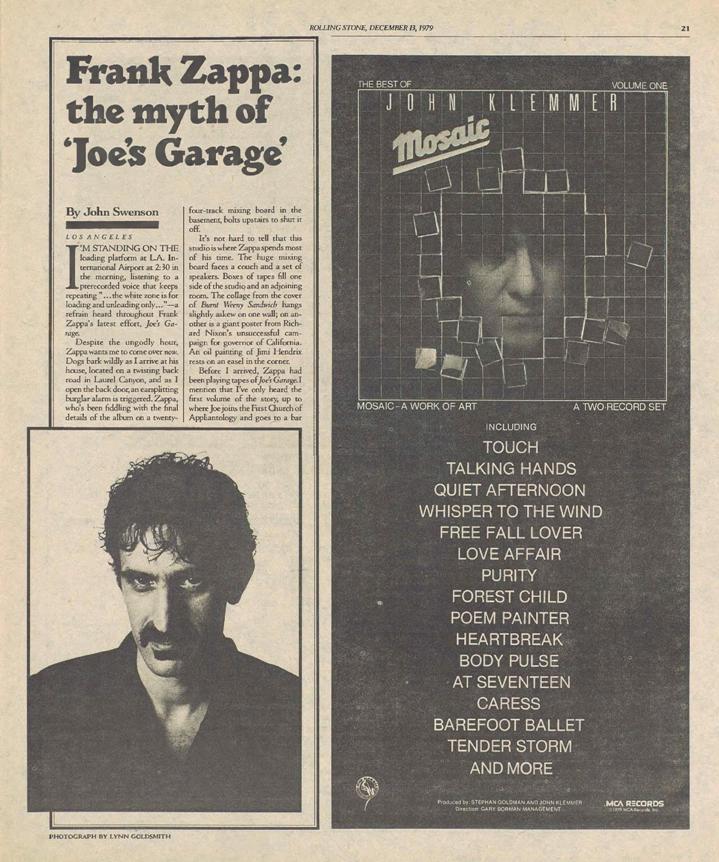
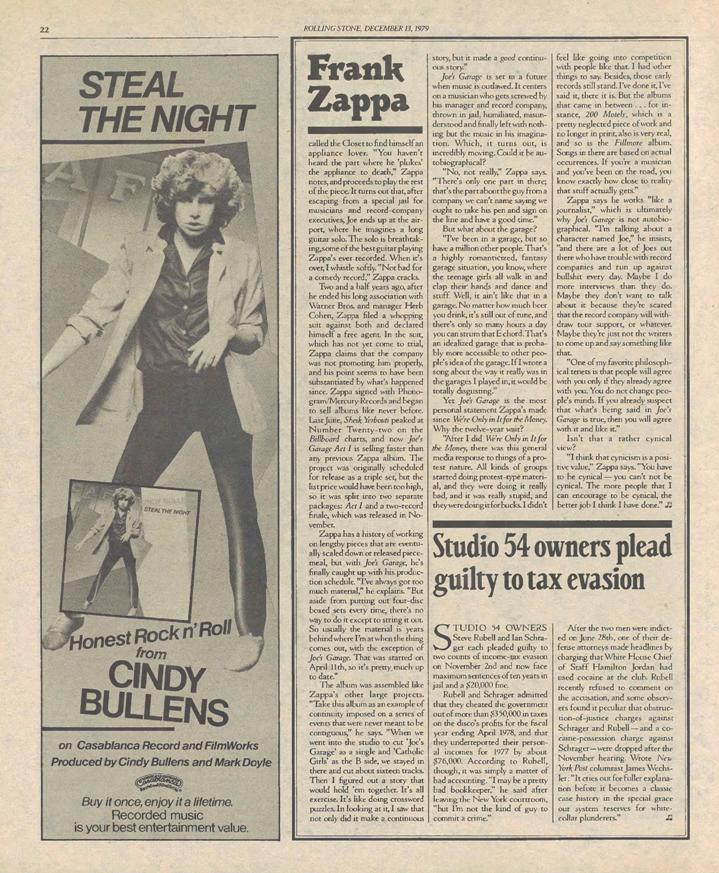
I'm standing on the loading platform at L.A. International Airport at 2:30 in the morning, listening to a prerecorded voice that keeps repeating "...the white zone is for loading and unloading only..." – a refrain heard throughout Frank Zappa's latest effort, Joe's Garage. (read more)
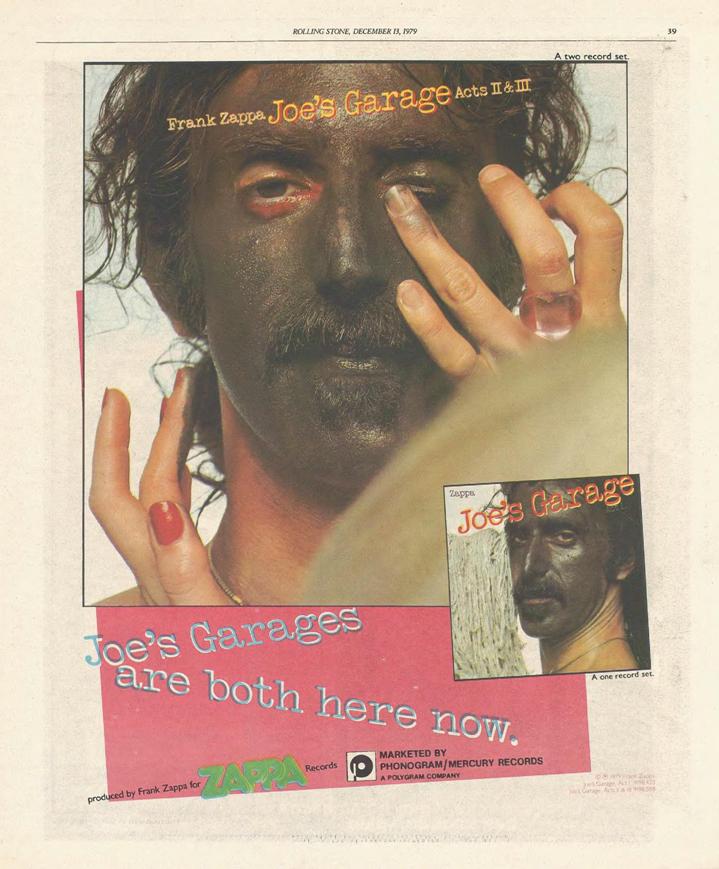
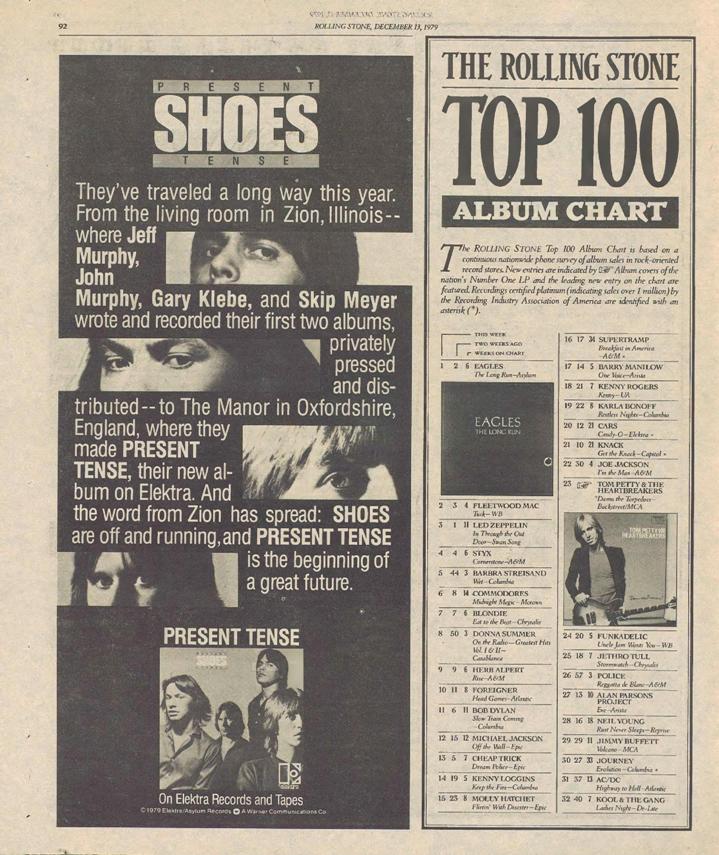
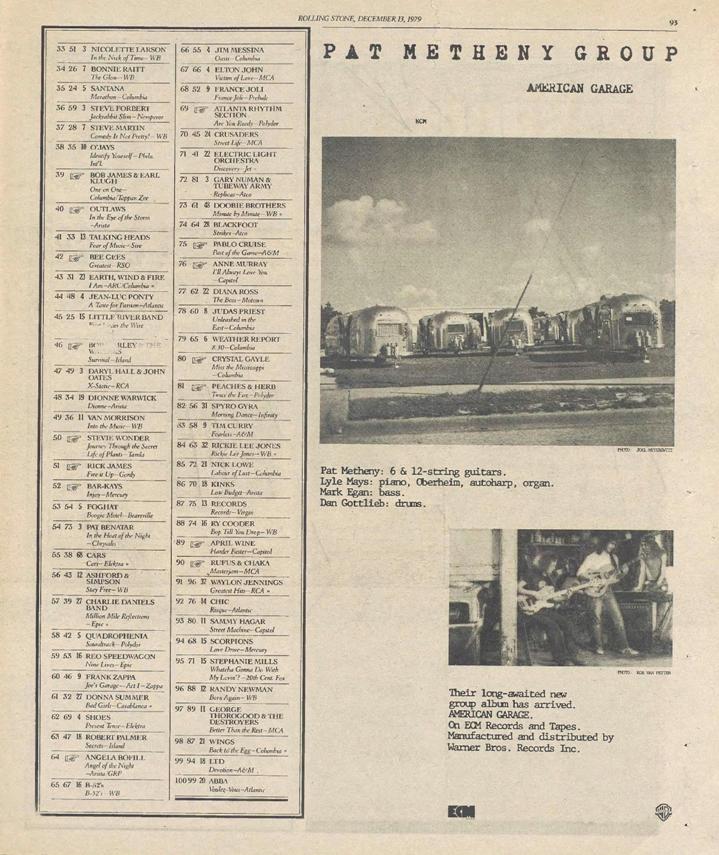
Beside the interview issue contains Joe's Garage ad on page 39. In albums chart Joe's Garage Act I was on place 60 this week, 46 last week.
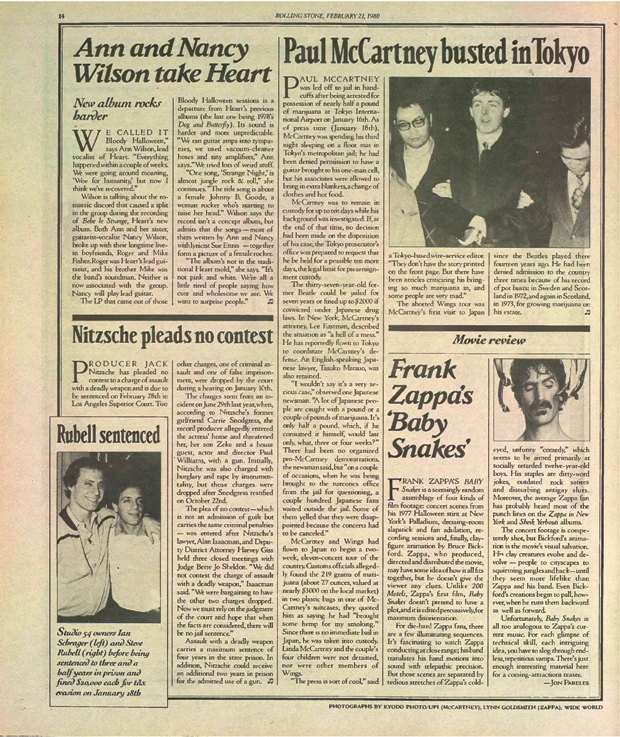
FRANK ZAPPA’S Baby Snakes is a seemingly random assemblage of four kinds of film footage: concert scenes from his 1977 Halloween stint at New York’s Palladium, dressing-room slapstick and fan adulation, recording sessions and, finally, clay-figure animation by Bruce Bickford. Zappa, who produced, directed and distributed the movie, may have some idea of how it all fits together, but he doesn’t give the viewer any clues. Unlike 200 Motels, Zappa's first film, Baby Snakes doesn’t pretend to have a plot, and it is edited percussively, for maximum disorientation.
For die-hard Zappa fans, there are a few illuminating sequences. It’s fascinating to watch Zappa conducting at close range; his band translates his hand motions into sound with telepathic precision. But those scenes are separated by tedious stretches of Zappa’s cold-eyed, unfunny “comedy,” which seems to be aimed primarily at socially retarded twelve-year-old boys. His staples are dirty-word jokes, outdated rock satires and disturbing antigay slurs. Moreover, the average Zappa fan has probably heard most of the punch lines on the Zappa in New York and Sheik Yerbouti albums.
The concert footage is competently shot, but Bickford’s animation is the movie’s visual salvation. His clay creatures evolve and devolve – people to cityscapes to squirming junglesancl back – until they seem more lifelike than Zappa and his band. Even Bickford’s creations begin to pall, however, when he runs them backward as well as forward.
Unfortunately, Baby Snakes is all too analogous to Zappa’s current music. For each glimpse of technical skill, each intriguing idea, you have to slog through endless, repetitious vamps. There’s just enough interesting material here for a coming-attractions teaser.
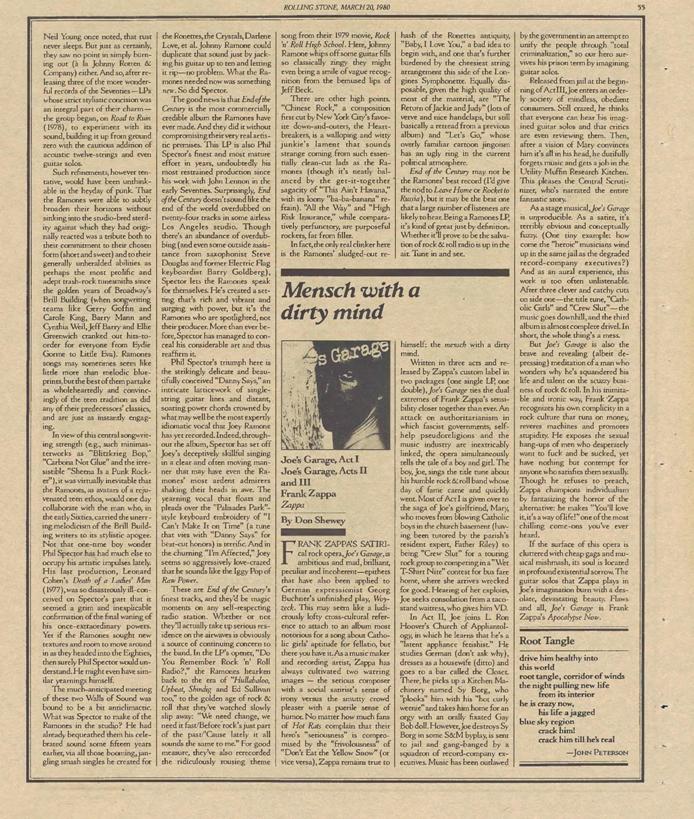
Frank Zappa’s satirical rock opera, Joe’s Garage, is ambitious and mad, brilliant, peculiar and incoherent – epithets that have also been applied to German expressionist Georg Buchner’s unfinished play, Woyzeck. This may seem like a ludicrously lofty cross-cultural reference to attach to an album most notorious for a song about Catholic girls’ aptitude for fellatio, but there you have it. As a music maker and recording artist, Zappa has always cultivated two warring images – the serious composer with a social satirist’s sense of irony versus the smutty crowd pleaser with a puerile sense of humor. No matter how much fans of Hot Rats complain that their hero’s “seriousness” is compromised by the “frivolousness” of “Don’t Eat the Yellow Snow” (or vice versa), Zappa remains true to himself: the mensch with a dirty mind. (read more)
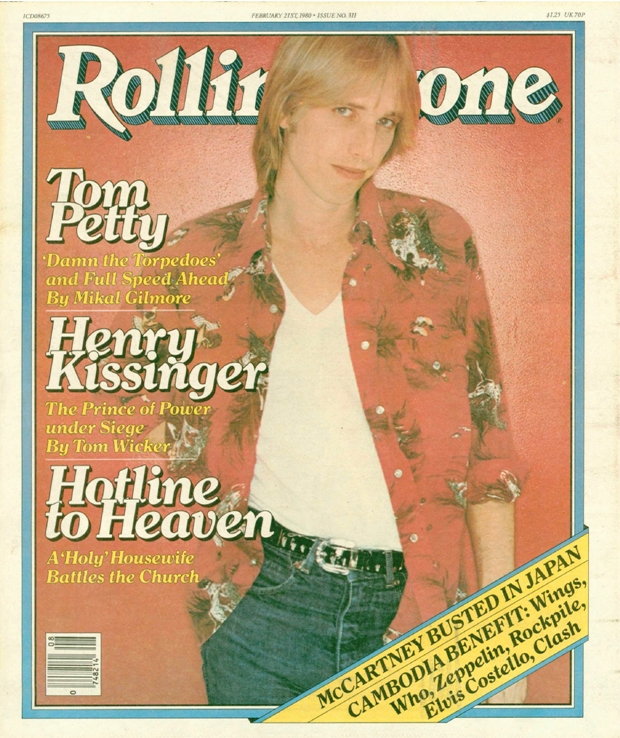
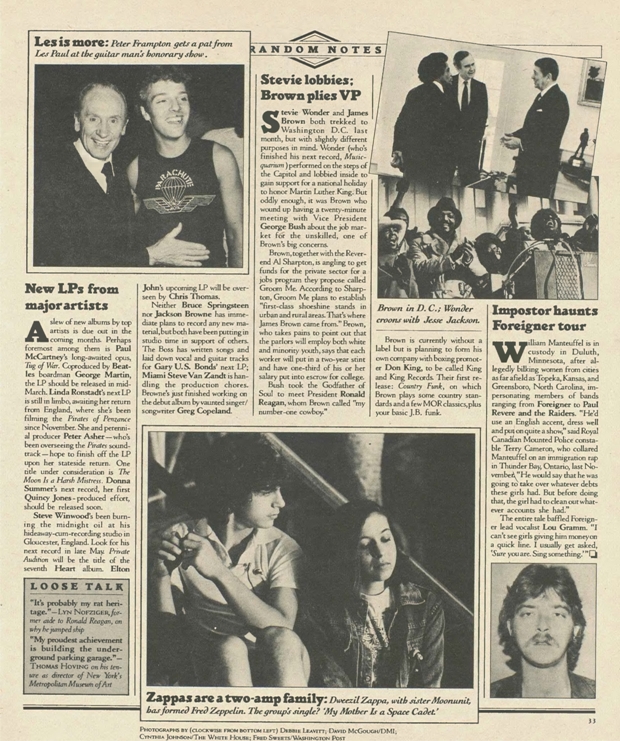
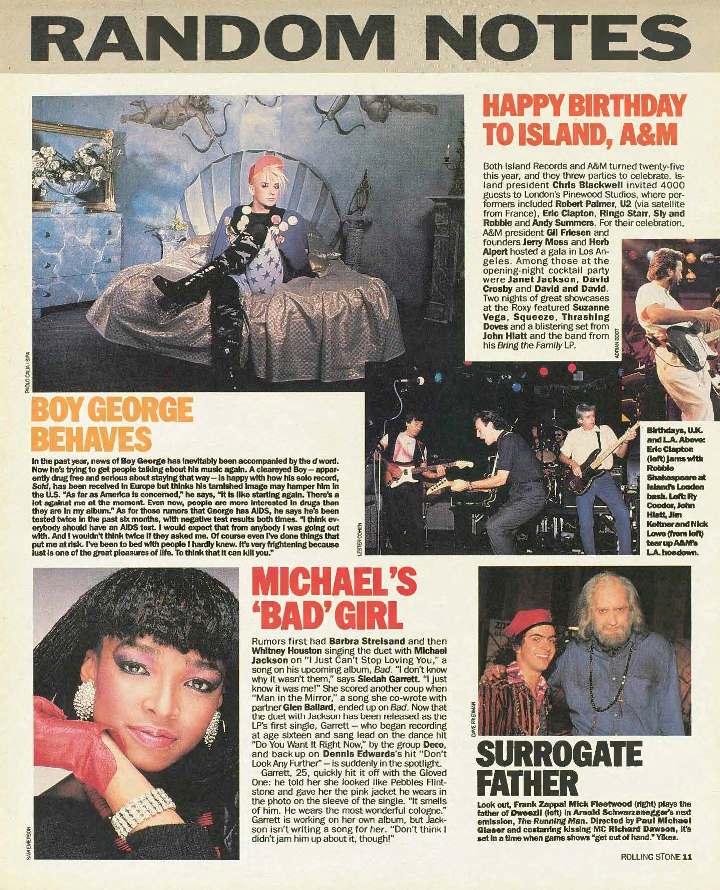
Zappas are a two-amp family: Dweezil Zappa, with sister Moon Unit, has formed Fred Zeppelin. The group's single? 'My Mother Is a Space Cadet' (page 33).
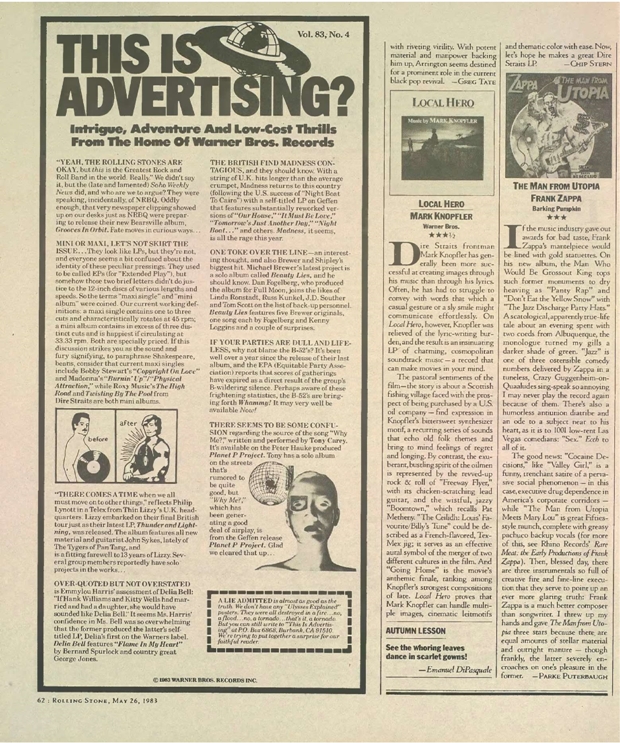
If the music industry gave out awards for bad taste, Frank Zappa’s mantelpiece would be lined with gold statuettes. On his new album, the Man Who Would Be Grossout King taps such former monuments to dry heaving as “Panty Rap” and “Don’t Eat the Yellow Snow” with “The Jazz Discharge Party Hats.” A scatological, apparently true-life tale about an evening spent with two coeds from Albuquerque, the monologue turned my gills a darker shade of green. “Jazz” is one of three ostensible comedy numbers delivered by Zappa in a tuneless, Crazy Guggenheim-on-Quaaludes sing-speak so annoying I may never play the record again because of them. There’s also a humorless antiunion diatribe and an ode to a subject near to his heart, as it is to 1001 low-rent Las Vegas comedians: “Sex.” Ecch to all of it.
The good news: “Cocaine Decisions,” like “Valley Girl,” is a funny, trenchant satire of a pervasive social phenomenon – in this case, executive drug dependence in America’s corporate corridors – while “The Man from Utopia Meets Mary Lou” is great Fifties- style raunch, complete with greasy pachuco backup vocals (for more of this, see Rhino Records’ Rare Meat: the Early Productions of Frank Zappa). Then, blessed day, there are three insrrumentals so full of creative fire and fine-line execution that they serve to point up an ever more glaring truth: Frank Zappa is a much better composer than songwriter. I threw up my hands and gave The Man from Utopia three stars because there are equal amounts of stellar material and outright manure – though frankly, the latter severely encroaches on one’s pleasure in the former.
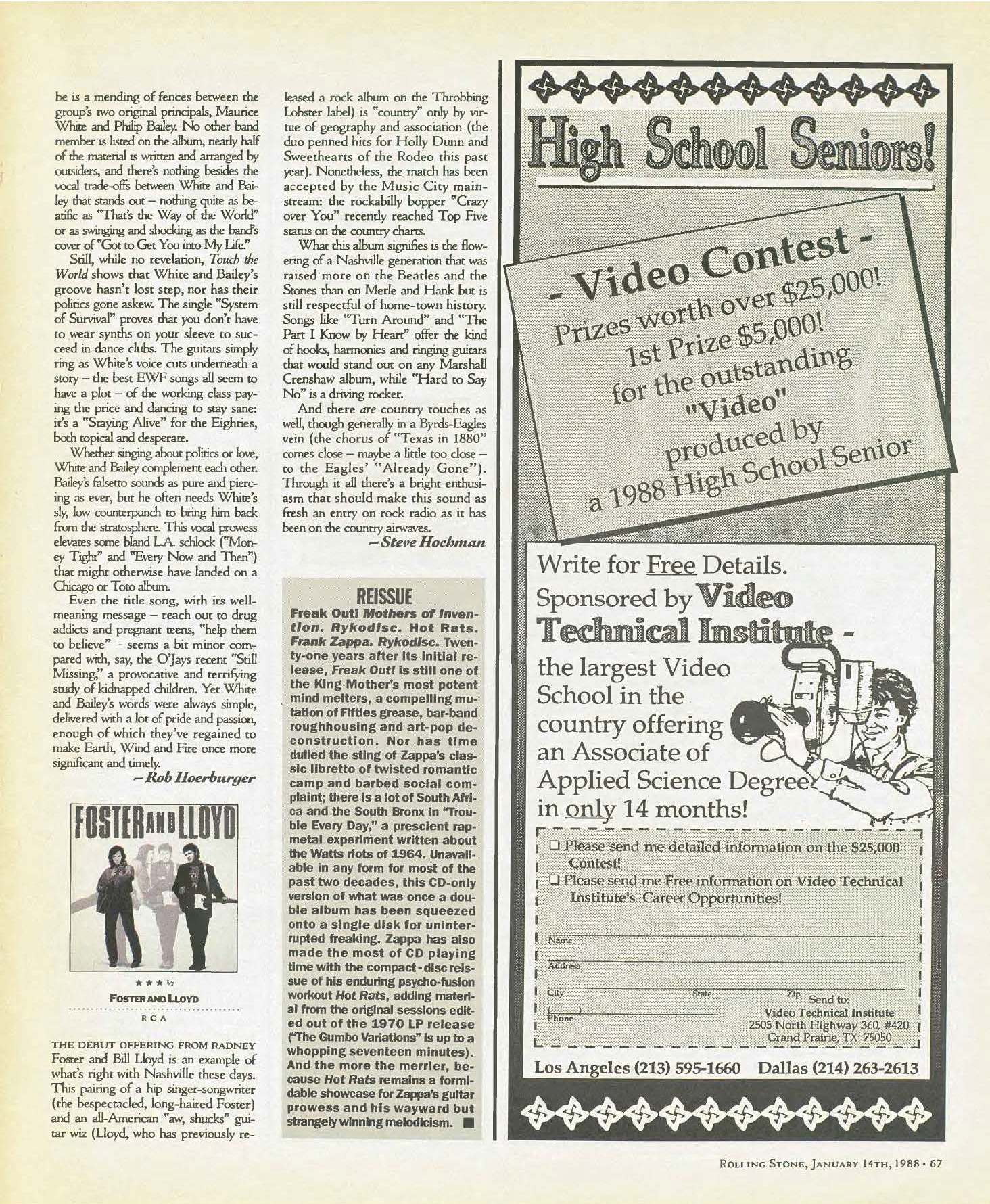
For many Zappa fans, however, the big news is the recent release of ten titles from the Zappa catalog, including vintage Mothers of Invention albums, on eight compact discs. The albums range from the 1967 classics We're Only In It For The Money and Lumpy Gravy to such recordings as the 1972 big-band record The Grand Wazoo, Zappa's 1984 Off-Off-Off-Broadway-style opera, Thing-Fish, and the 1986 Frank Zappa Meets The Mothers Of Prevention. The CDs were issued by Rykodisc, a Massachusetts-based firm whose agreement with Zappa calls for the release on CD of two dozen Zappa albums over the next three years. (read more)
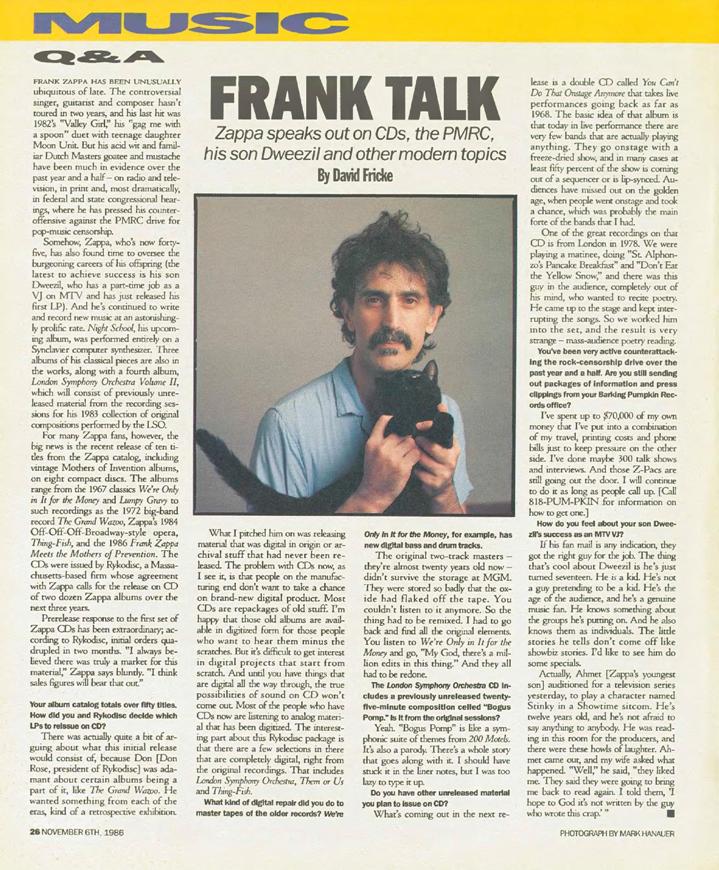
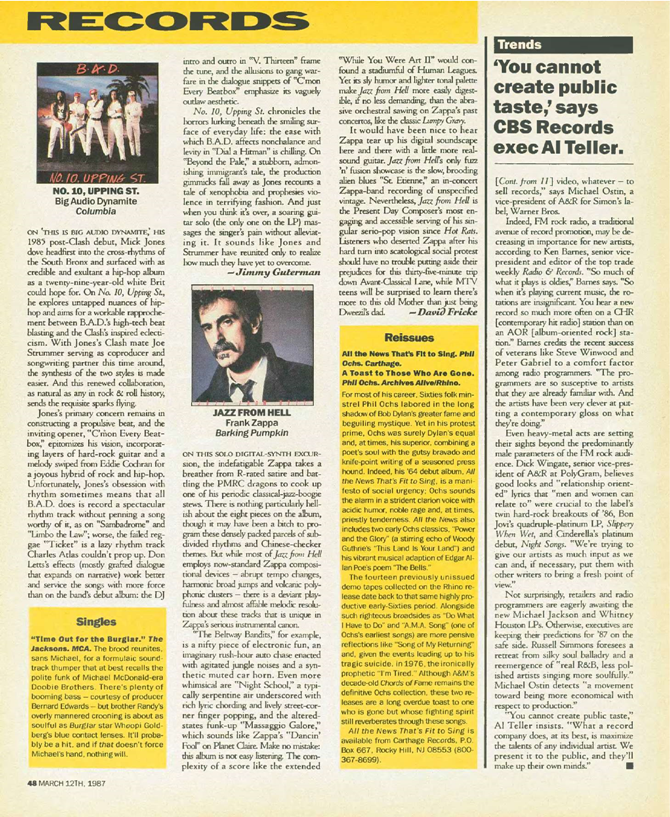
On this solo digital-synth excursion, the indefatigable Zappa takes a breather from R-rated satire and battling the PMRC dragons to cook up one of his periodic classical-jazz-boogie stews. There is nothing particularly hellish about the eight pieces on the album, though it may have been a bitch to program these densely packed parcels of subdivided rhythms and Chinese-checker themes. But while most of Jazz from Hell employs now-standard Zappa compositional devices — abrupt tempo changes, harmonic broad jumps and volcanic polyphonic clusters — there is a deviant playfulness and almost affable melodic resolution about these tracks that is unique in Zappa’s serious instrumental canon. (read more)
1987 August 27
No. 507
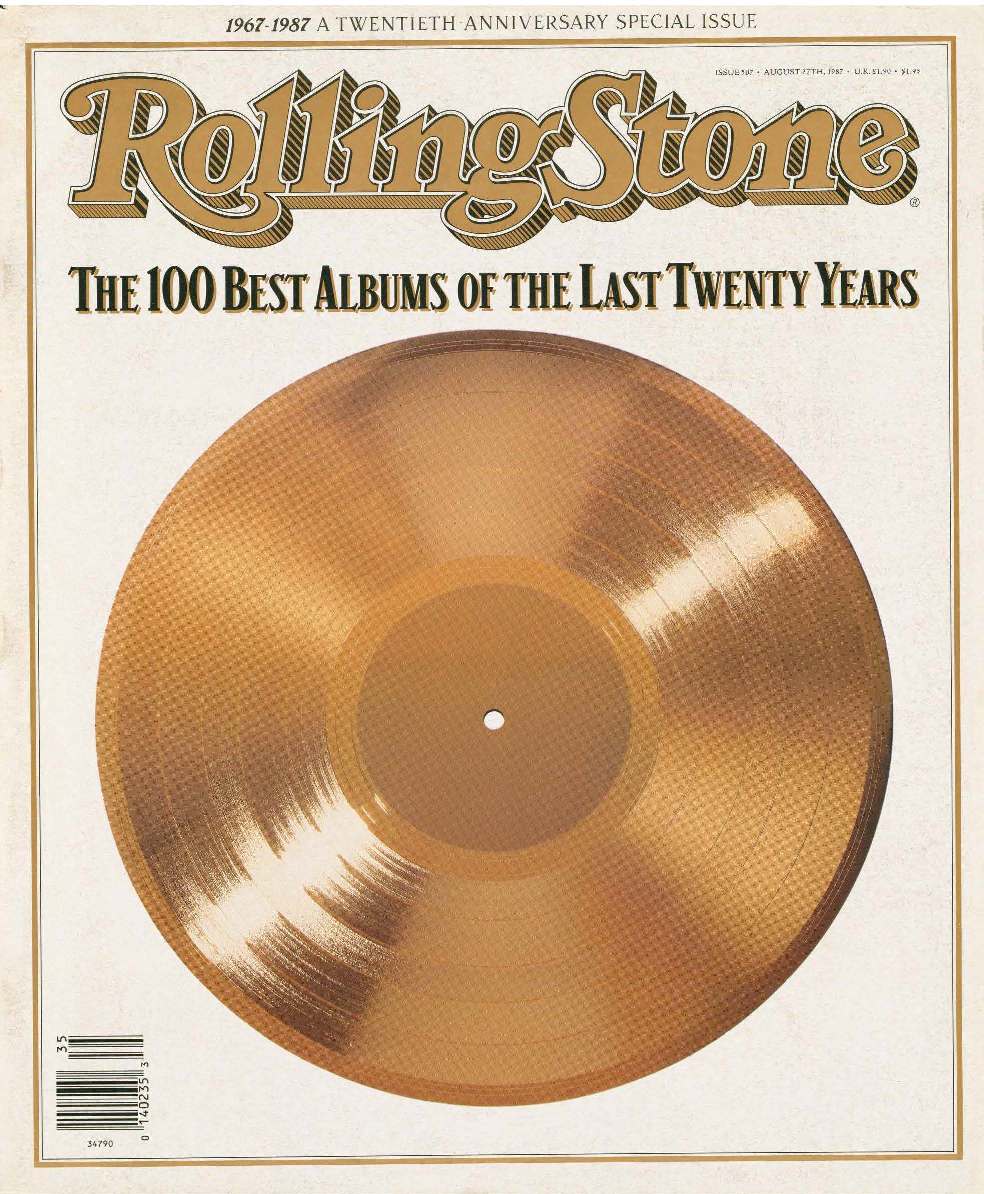
The 100 Best Albums of the Last
Twenty Years #77
We're
Only In It For The Money
By ?, pp 144-146
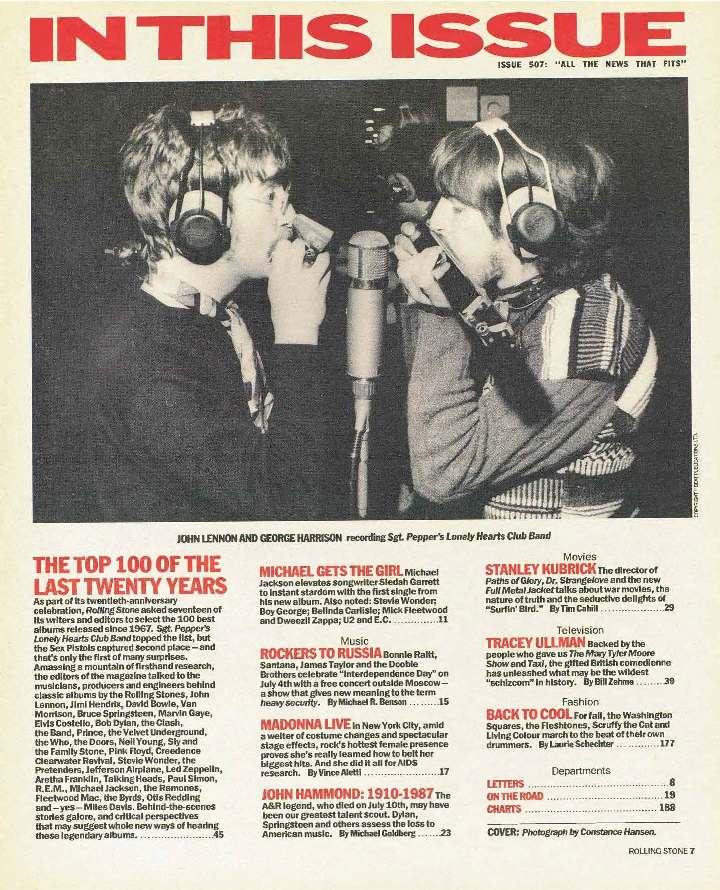
NINETEEN SIXTY-SEVEN'S SUMMER OF LOVE WAS kicked off with the June 2nd release of Sgt. Pepper's Lonely Hearts Club Band. In San Francisco hippies hailed the dawn of a new pop-based youth culture. But down in Los Angeles, Frank Zappa had his doubts. (read more)
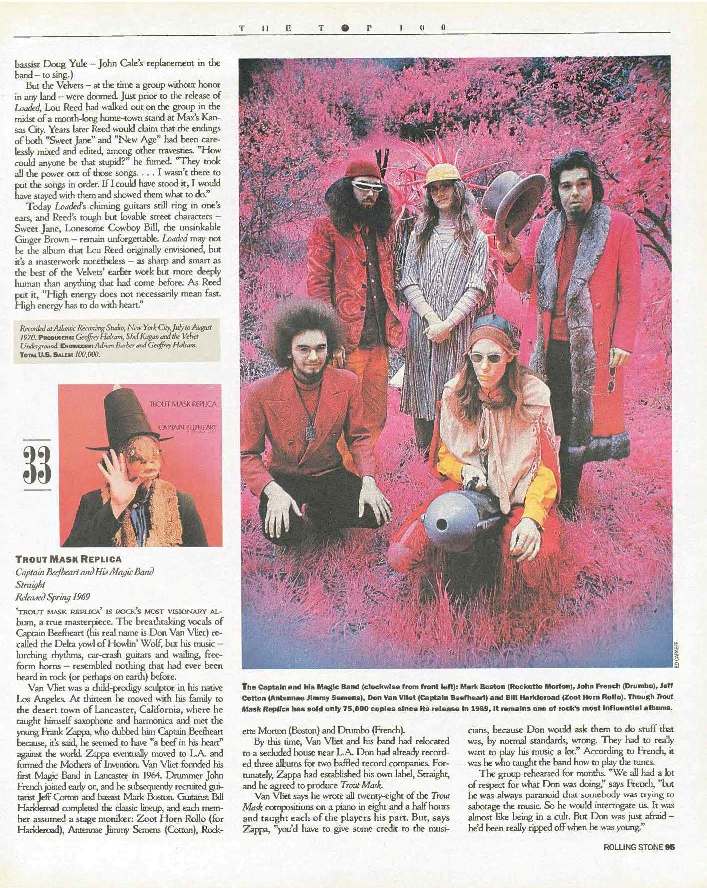
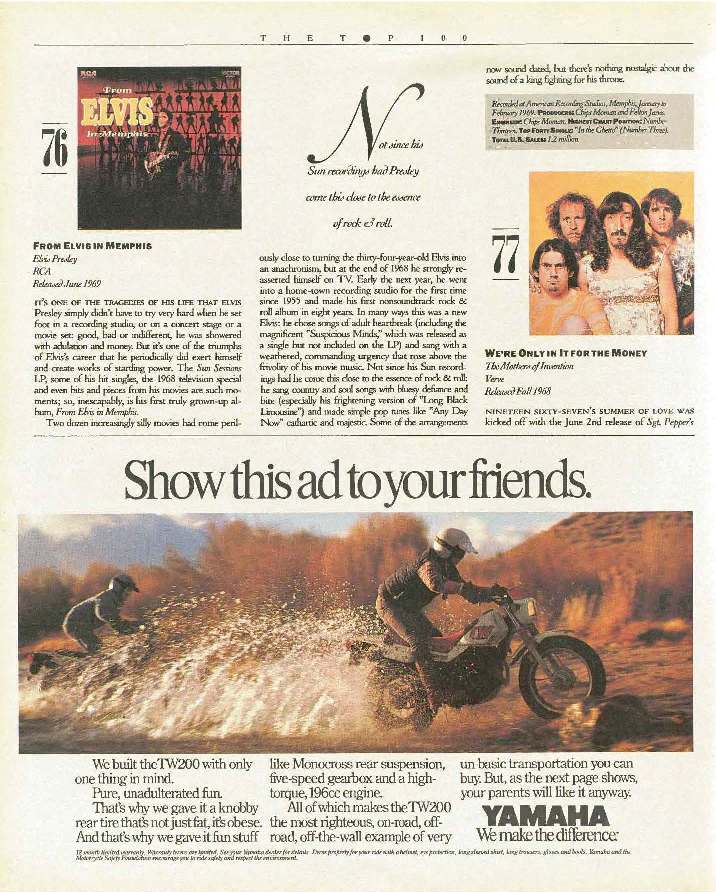
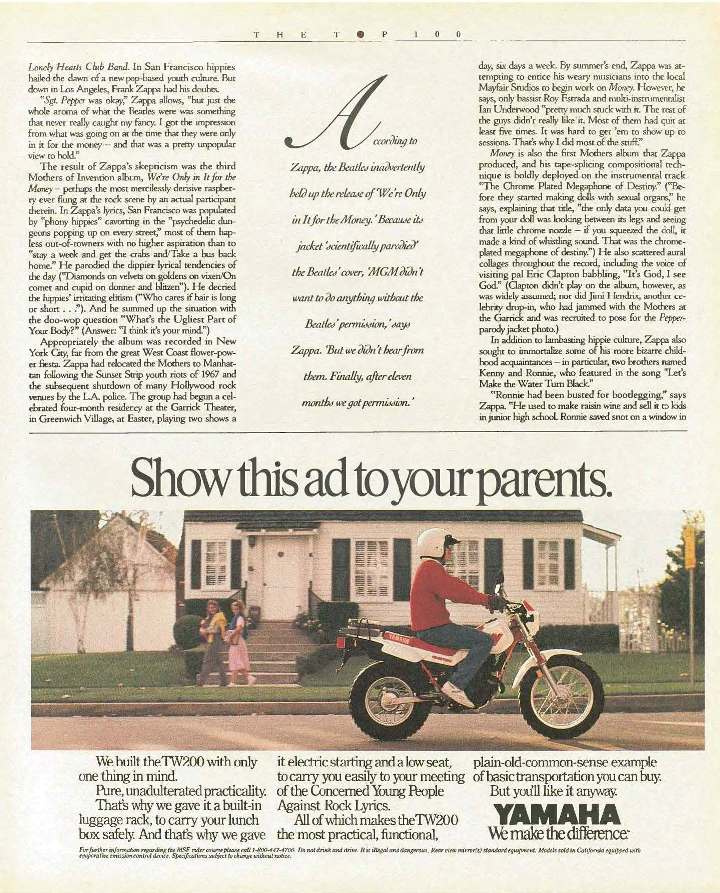
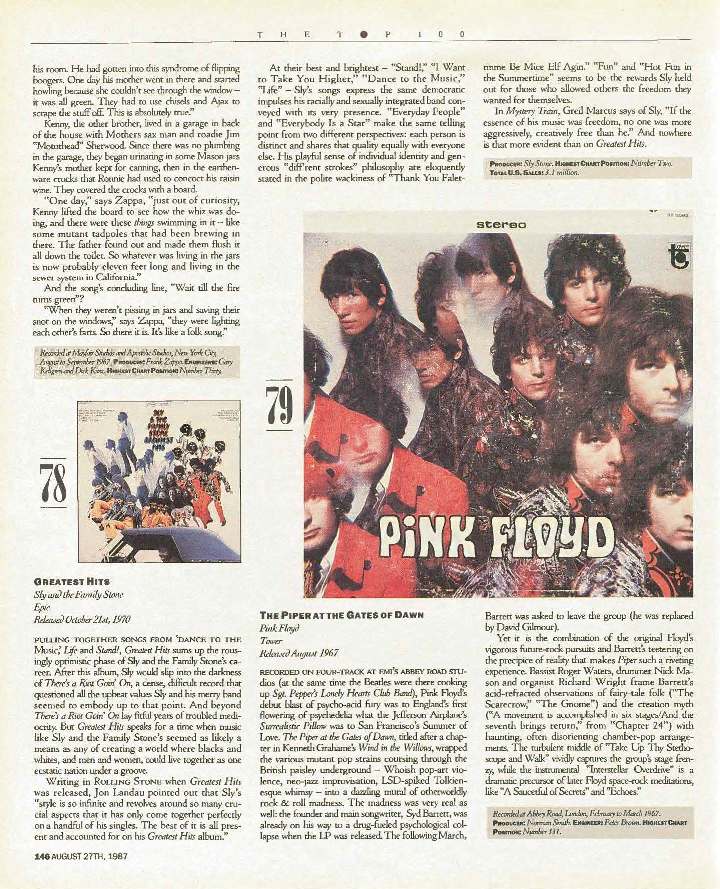
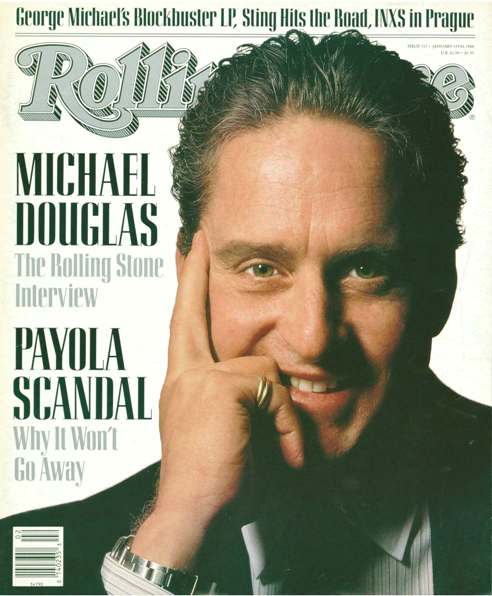
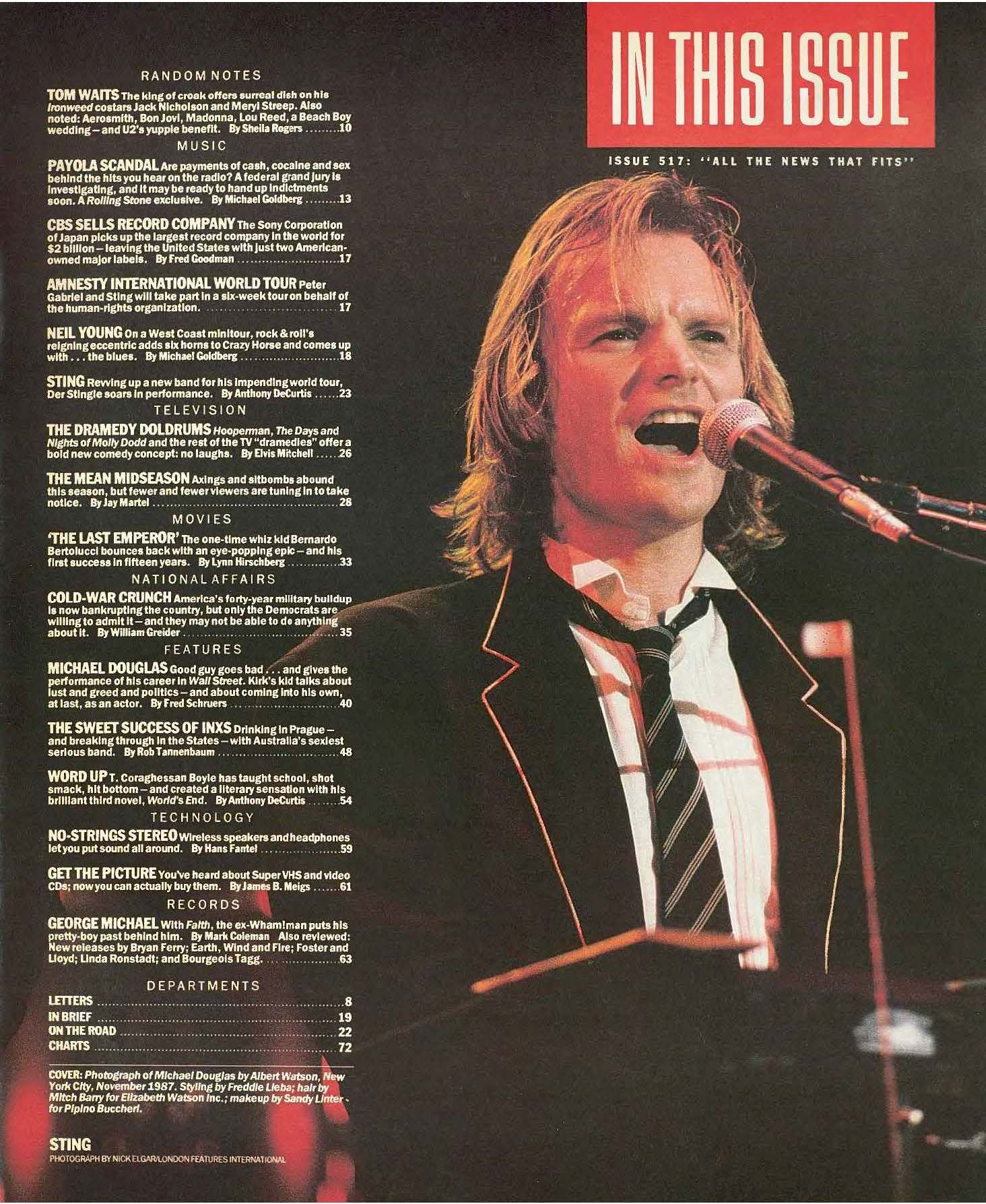
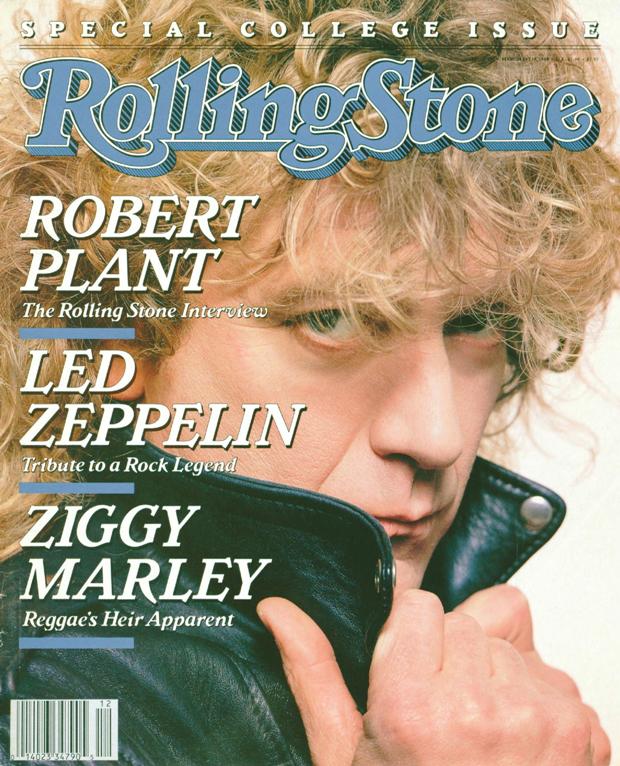
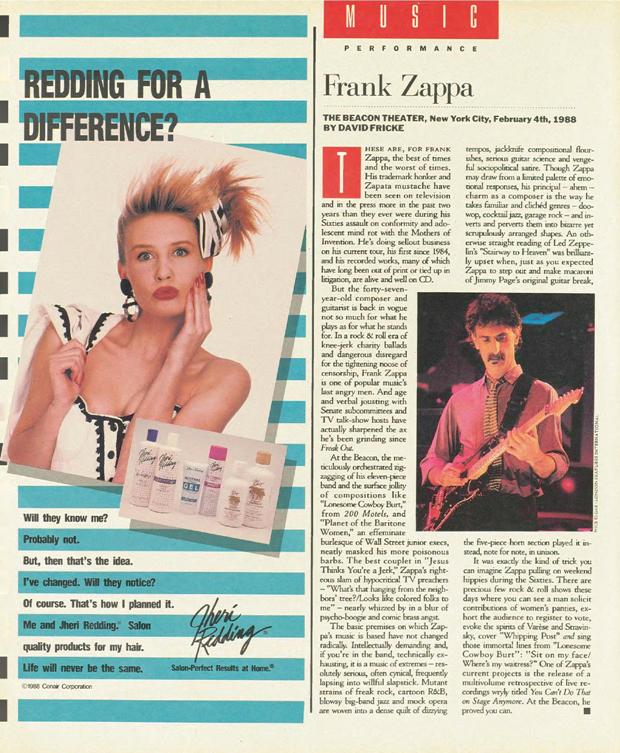
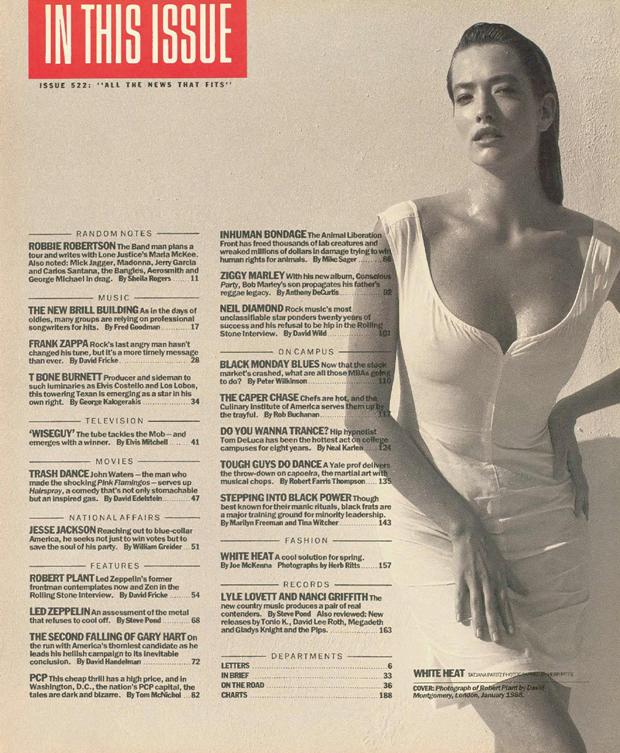
Rock's last angry man hasn't changed his tune, but it's a more timely message than ever.
Review on February 4h, 1988 concert in the Beacon Theatre, NYC.
1991 November 14
No. 617
100 Classic Album Covers
Weasels Ripped My Flesh - The Mothers Of Invention
By ?, p 116
Neon Park was working as a poster artist with the Family
Dog, a San Francisco design group, when he got a call from Frank
Zappa asking him to come down to Los Angeles. Zappa had seen
the drawings Park had done for a group called Dancing Food and
wanted him to paint the jacket for the next Mothers of Invention
record. At their meeting, Zappa showed Park a magazine cover.
“It was one of those men’s magazines, like Saga,” says
Park. "The cover story was ‘Weasels Ripped My Flesh,’ and it
was the adventure its suitability for release. “Evidently,”
says Park, “there was quite a confrontation that occurred over
this cover. It wasn’t up to their standards.” Even after Warner
Bros. finally consented to use it, there were problems. “The
printer was greatly offended,” says Park. “The girl who worked
for him, his assistant, she wouldn’t touch the painting. She
wouldn’t pick it up with her hands.” Zappa and Park, meanwhile,
were tickled silly by the brouhaha: “I was greatly amused by
the cover, and so was Frank,” says Park. “I mean, we giggled
a lot.”
Park still can’t see what all the fuss was about. “It was an
infamous cover,” he says, “although I guess by today’s standards,
it’s pretty tame. It’s not like eating liver in Milwaukee.”
Source: Fulvio Fiore
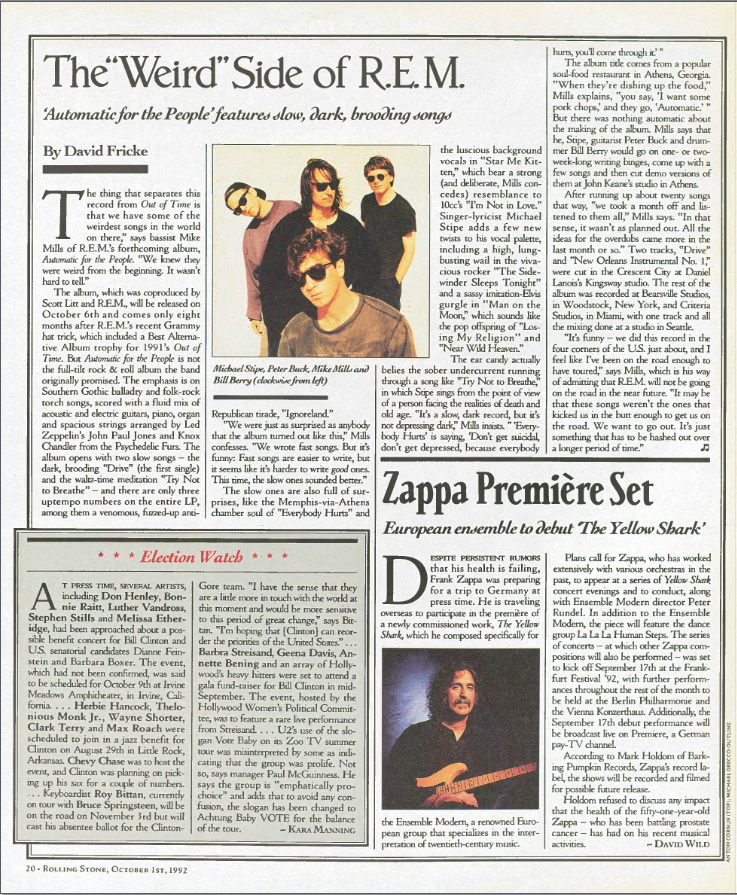
European ensemble to debut 'The Yellow Shark'.
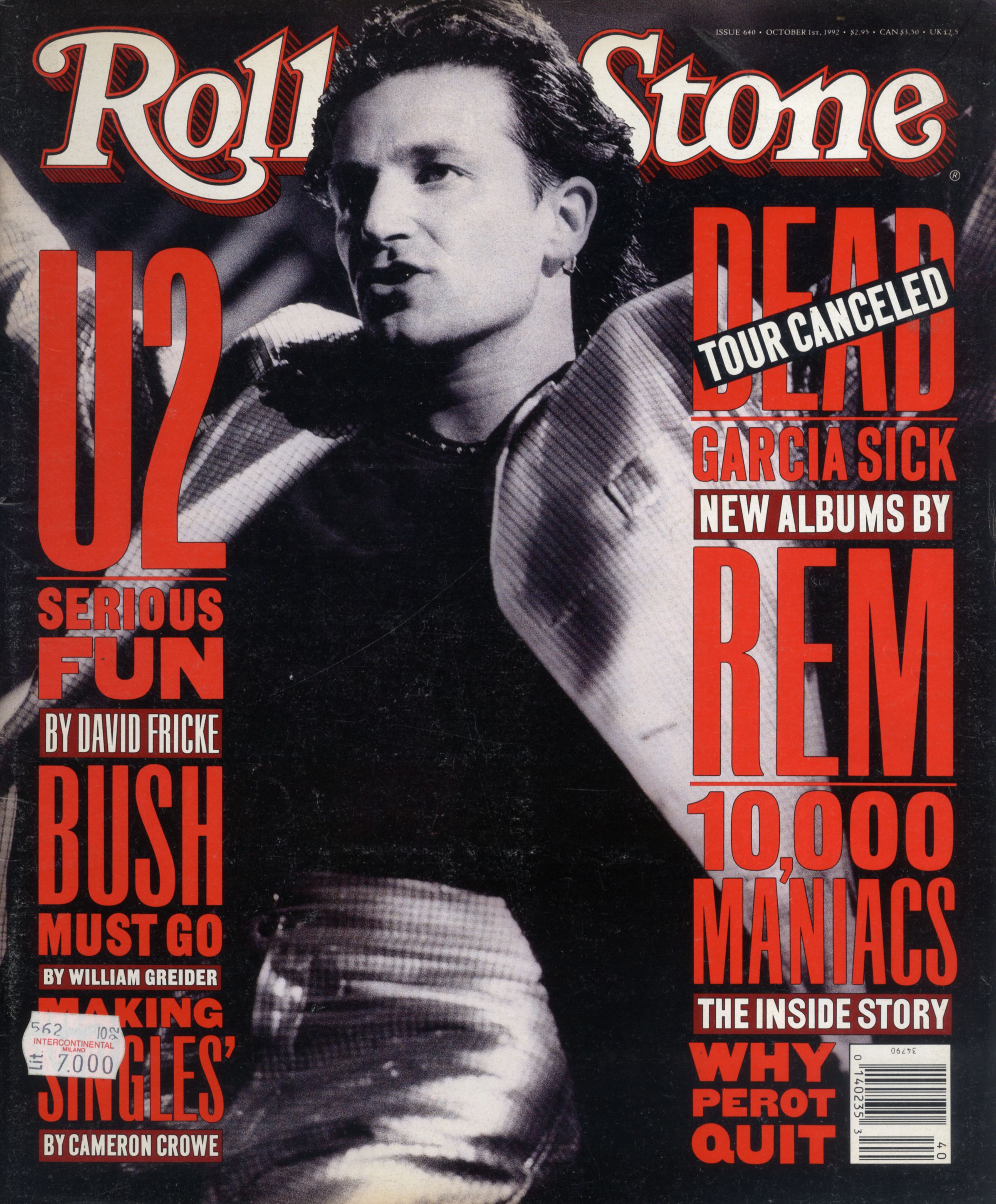
Despise persistent rumors that his health is failing, Frank Zappa was preparing for a trip to Germany at press time. He is traveling overseas to participate in the première of a newly commissioned work, The Yellow Shark, which he composed specifically for the Ensemble Modern, a renowned European group that specializes in the interpretation of twentieth-century music.
Plans call for Zappa, who has worked extensively with various orchestras in the past, to appear at a series of Yellow Shark concert evenings and to conduct, along with Ensemble Modern director Peter Rundel. In addition to the Ensemble Modern, the piece will feature the dance group La La La Human Steps. The series of concerts – at which other Zappa compositions will also be performed – was set to kick off September 17th at the Frankfurt Festival '92, with further performances throughout the rest of the month to be held at the Berlin Philharmonic and the Vienna Konzerthaus. Additionally, the September 17th debut performance will be broadcast live on Premiere, a German pay-TV channel.
According to Mark Holdom of Barking Pumpkin Records, Zappa's record label, the shows will be recorded and filmed for possible future release.
Holdom refused to discuss any impact that the health of the fifty-one-year-old Zappa – who has been battling prostate cancer – has had on his recent musical activities.
Source: Fulvio Fiore
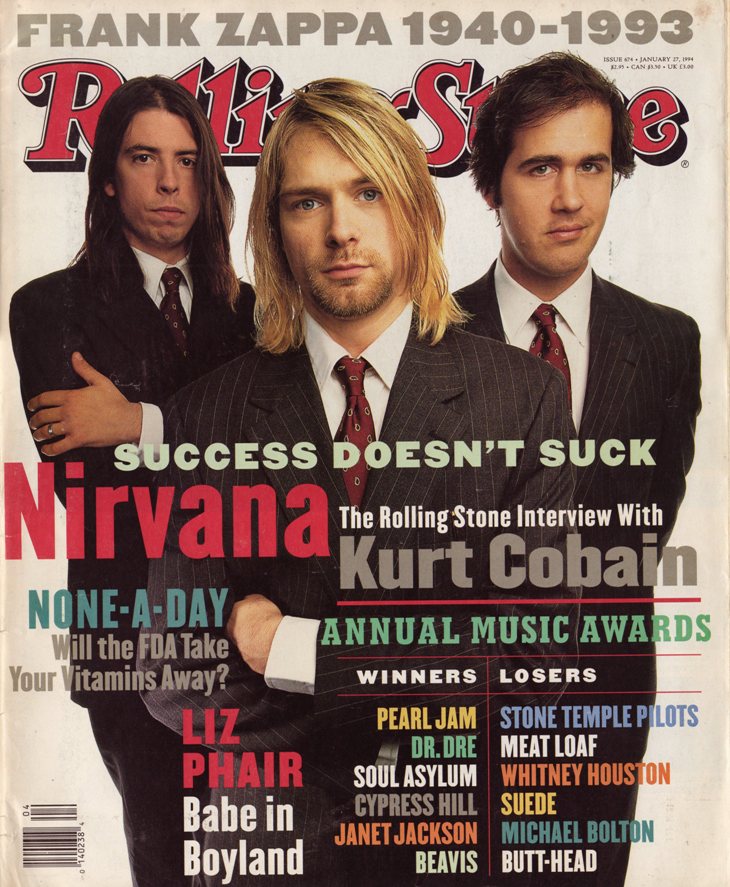
1994 January 27
No. 674
Frank Zappa 1940-1993
By David Fricke, pp 11-13, 15-16
The Essential Zappa
Discography by John Swenson, p 15
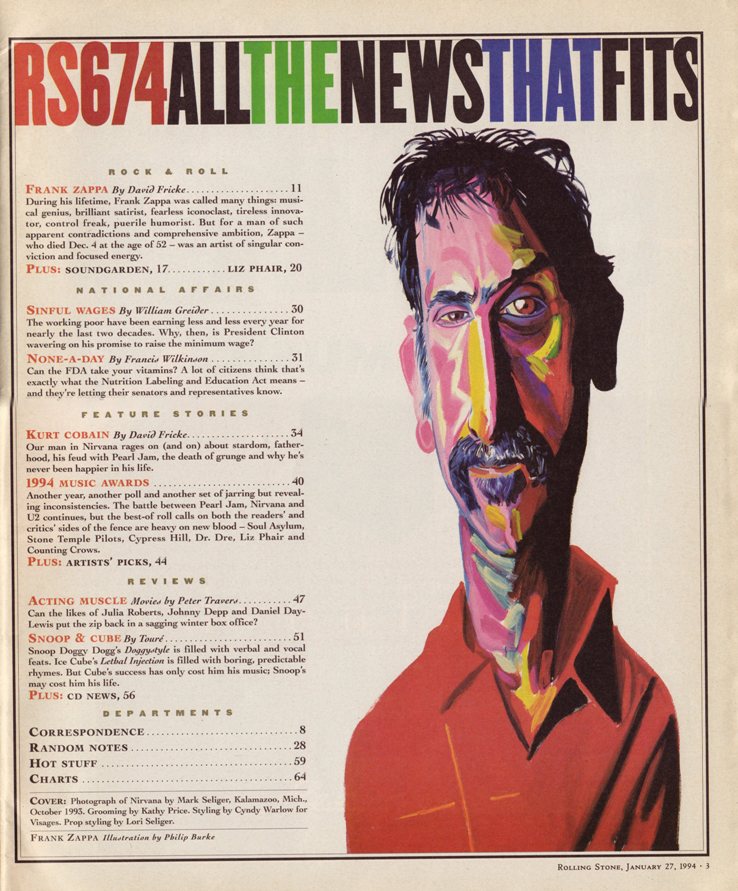
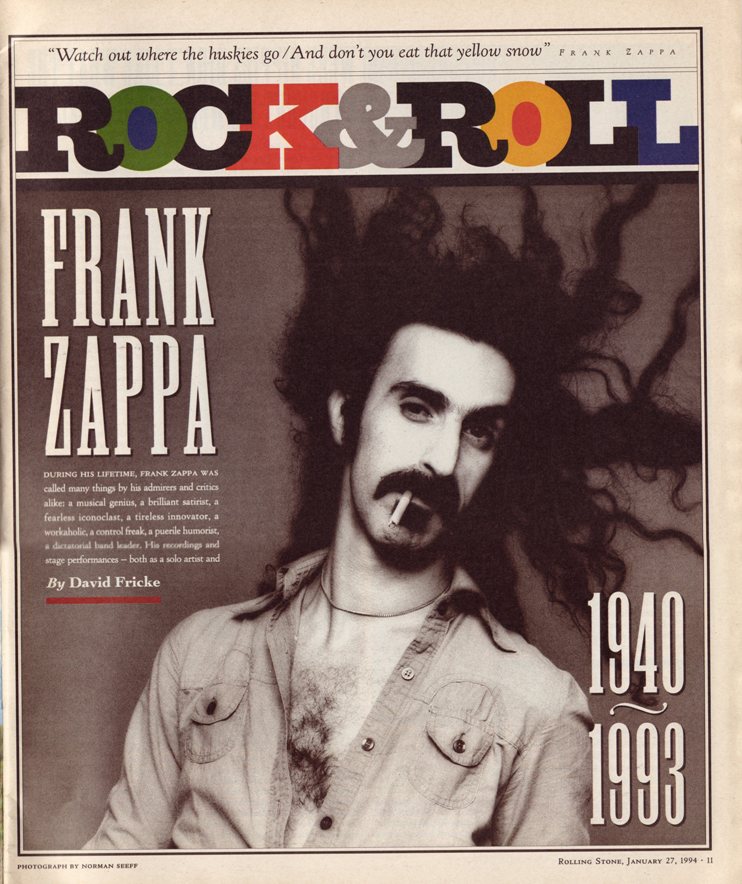
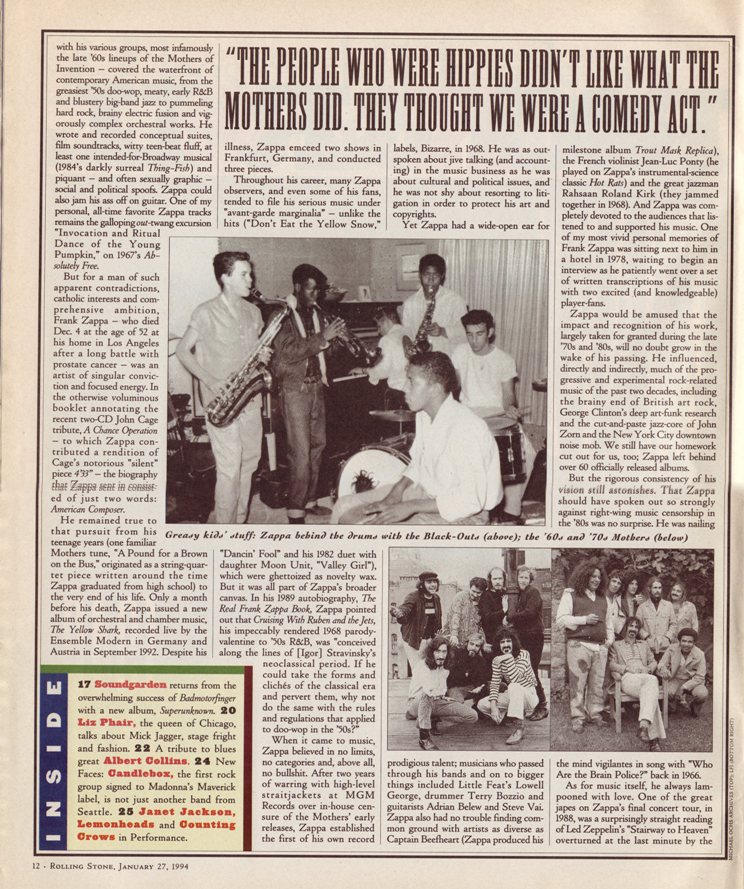
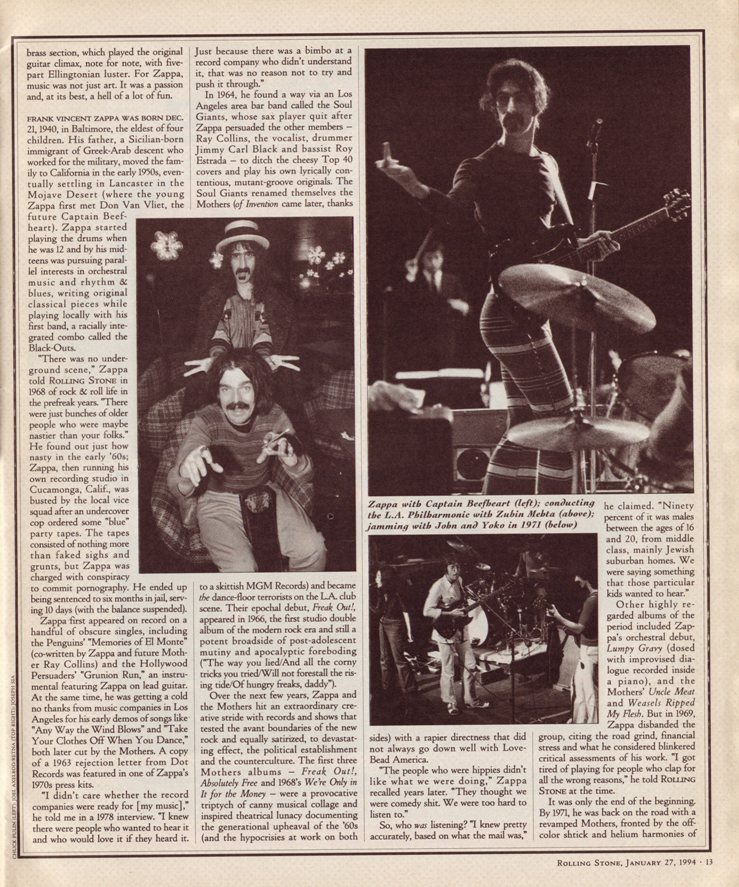
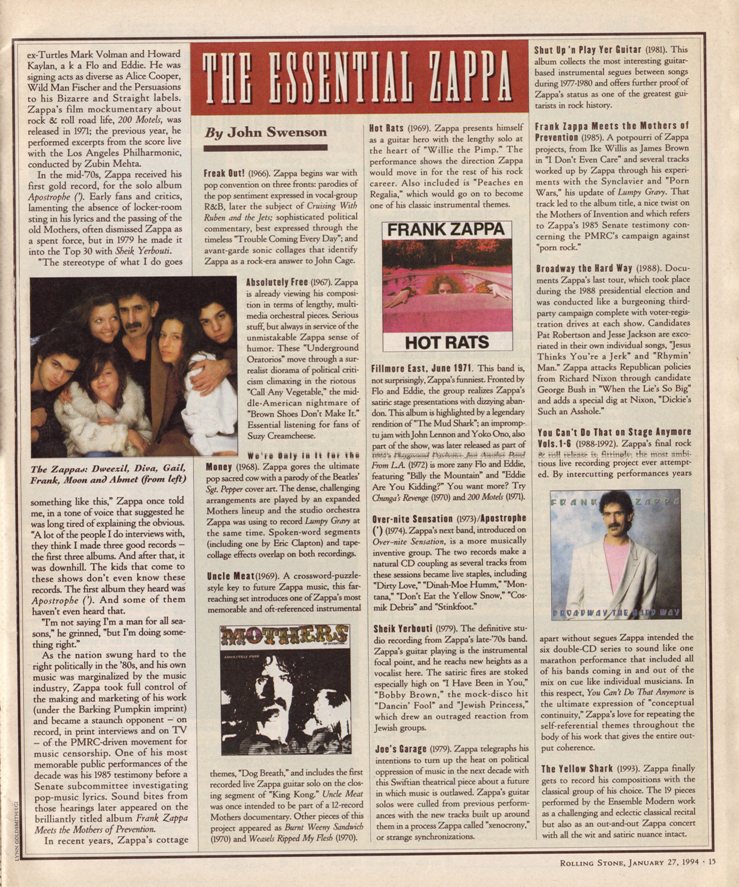
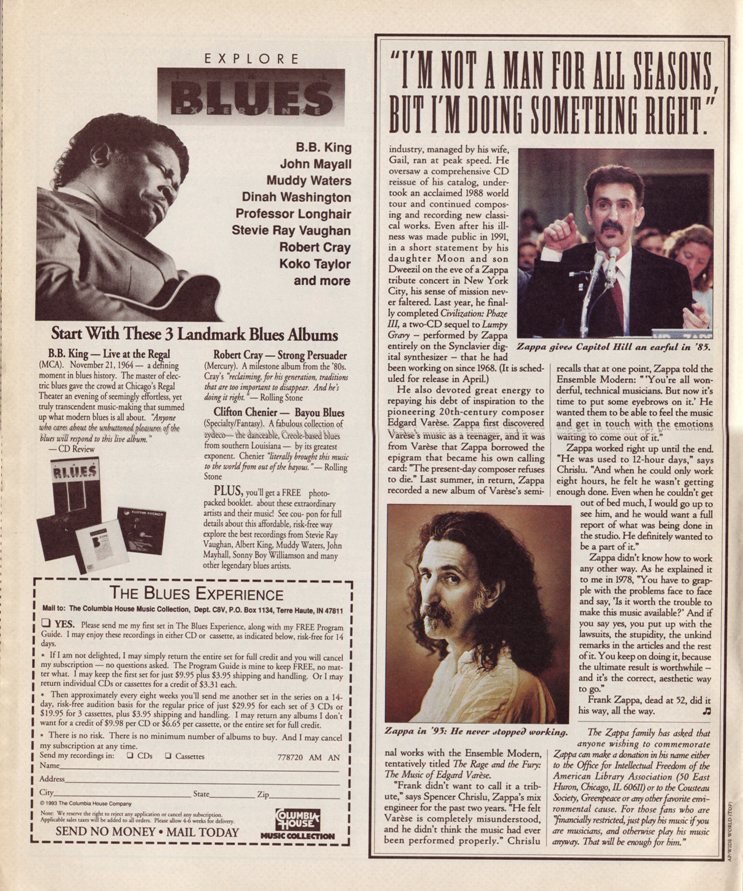
I first heard this dense and deliciously twisted album in 1993 in the room where much of it was created: Frank Zappa's recording studio at his home, in Los Angeles. I felt privileged and a little sad; Zappa was upstairs, too ill to receive visitors. Two months later I was writing his obituary. (read more)
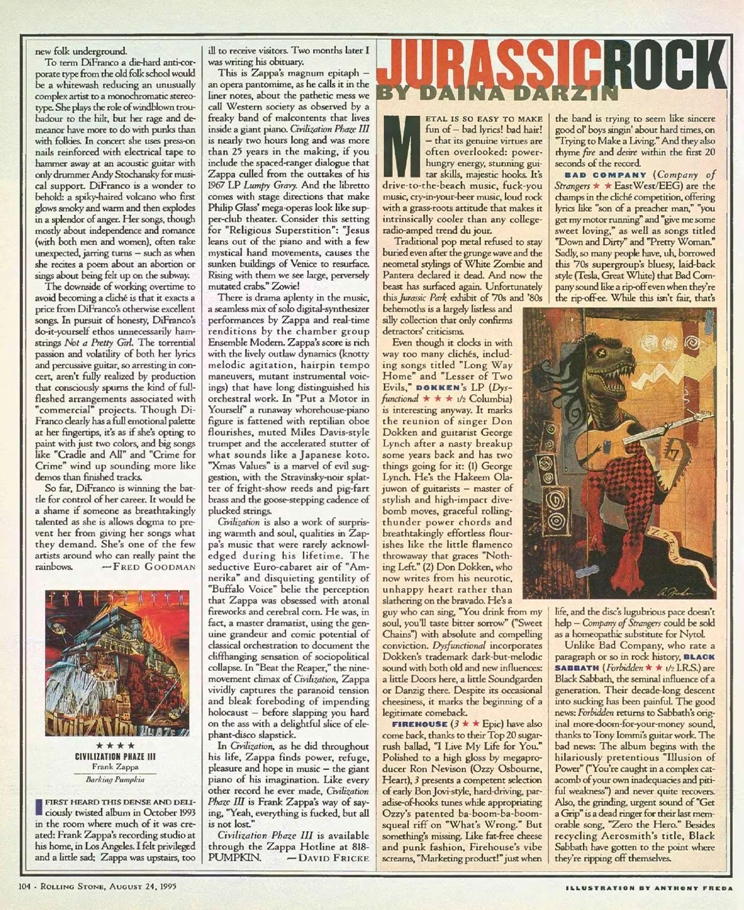
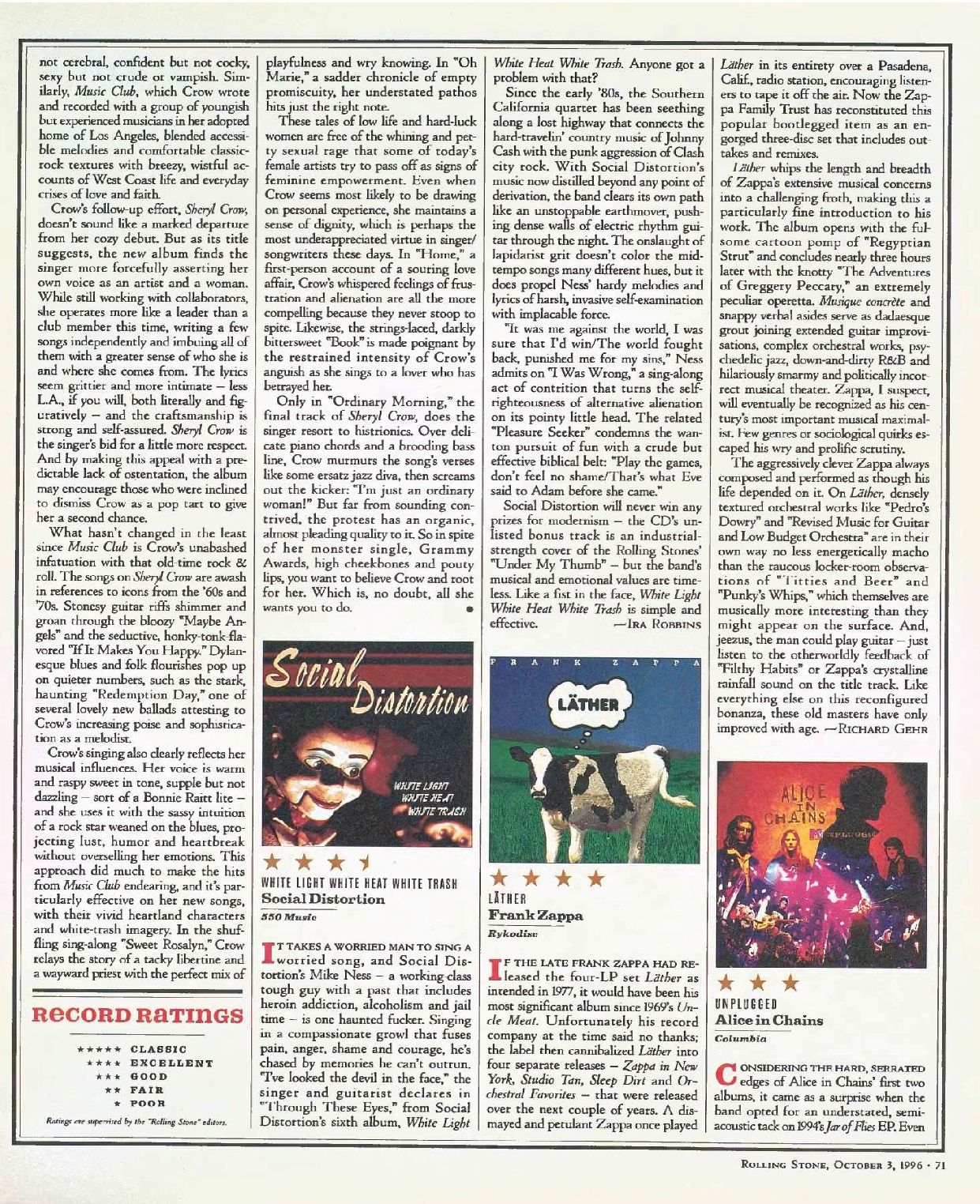
IF THE LATE FRANK ZAPPA HAD released the four-LP set Läther as intended in 1977, it would have been his most significant album since 1969's Uncle Meat. (read more)
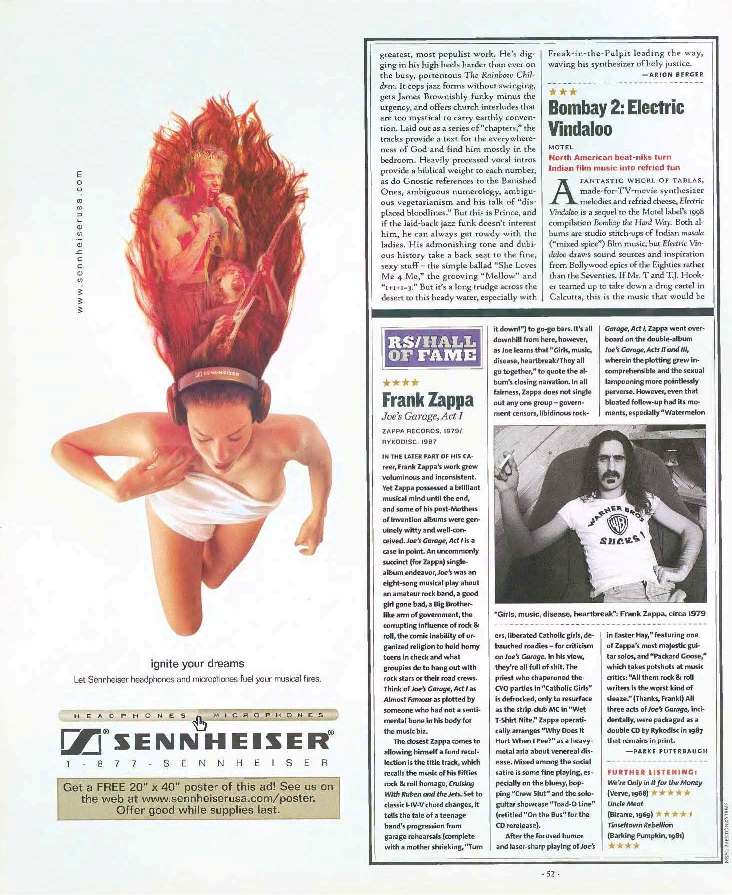
IN THE LATER PART OF HIS career, Frank Zappa's work grew voluminous and inconsistent. Yet Zappa possessed a brilliant musical mind until the end, and some of his post-Mothers of Invention albums were genuinely witty and well-conceived. Joe's Garage, Act I is a case in point. (read more)
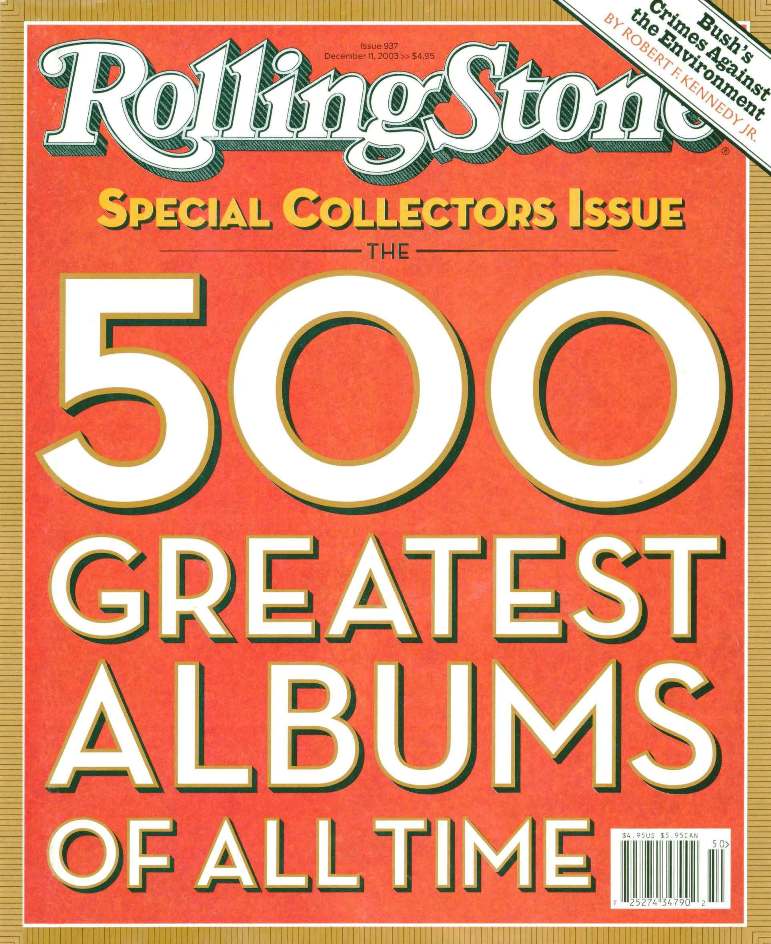
2003 December 11
No. 937
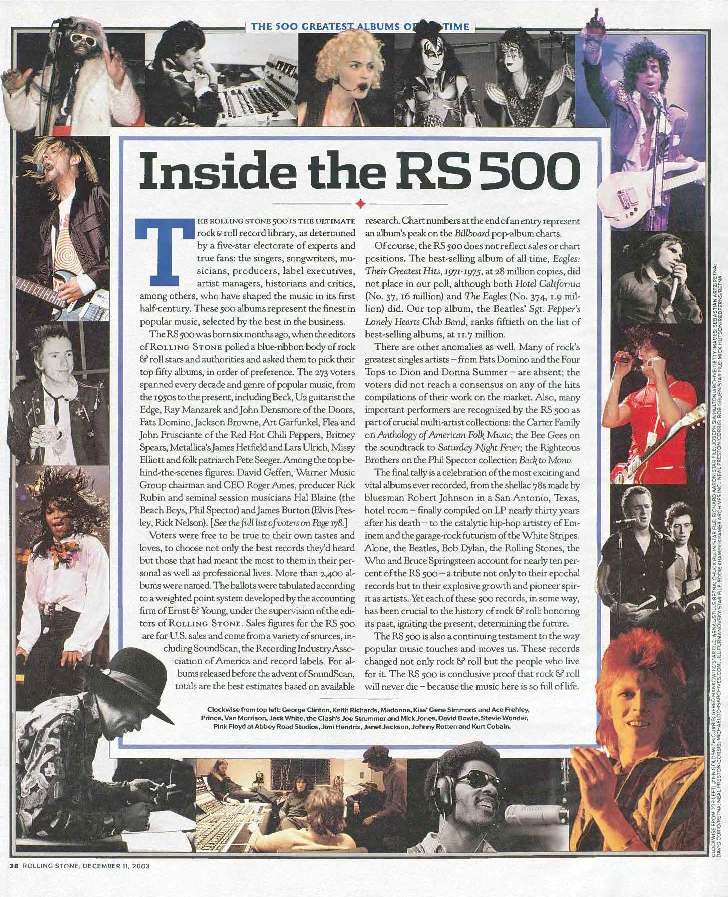
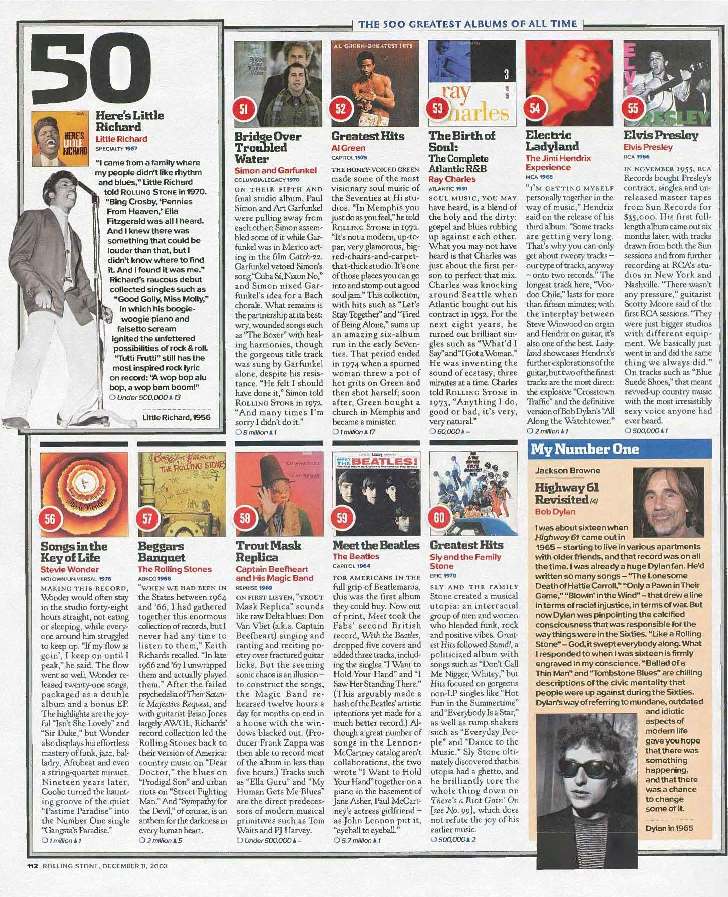
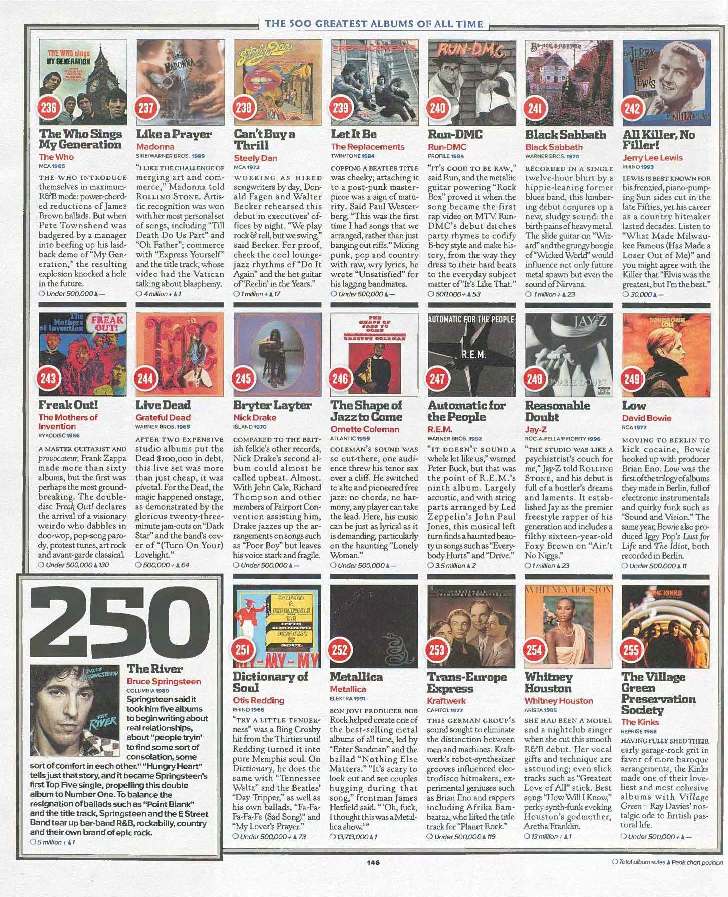
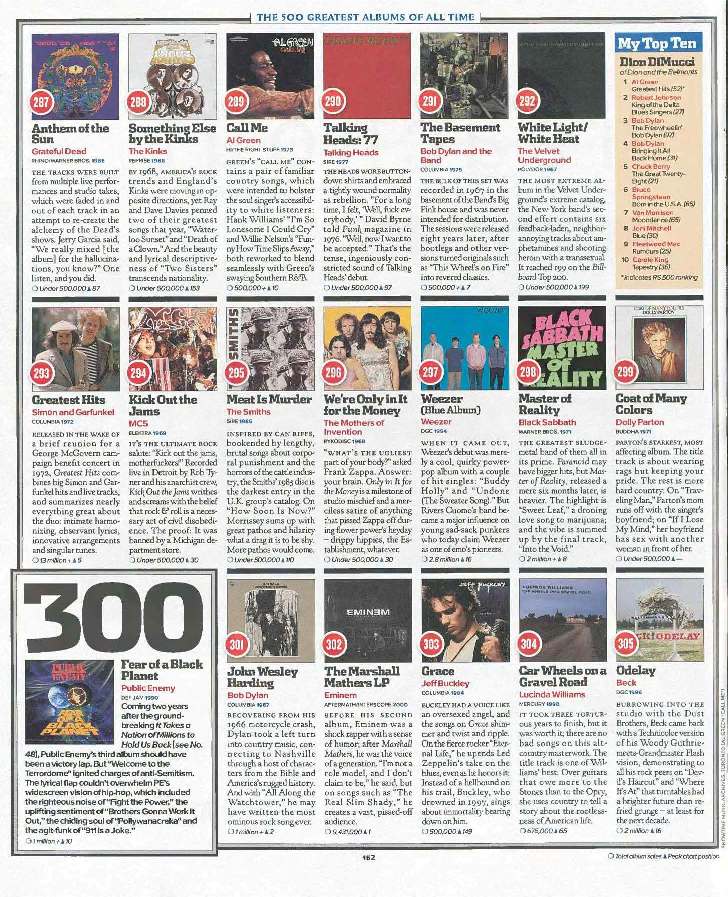
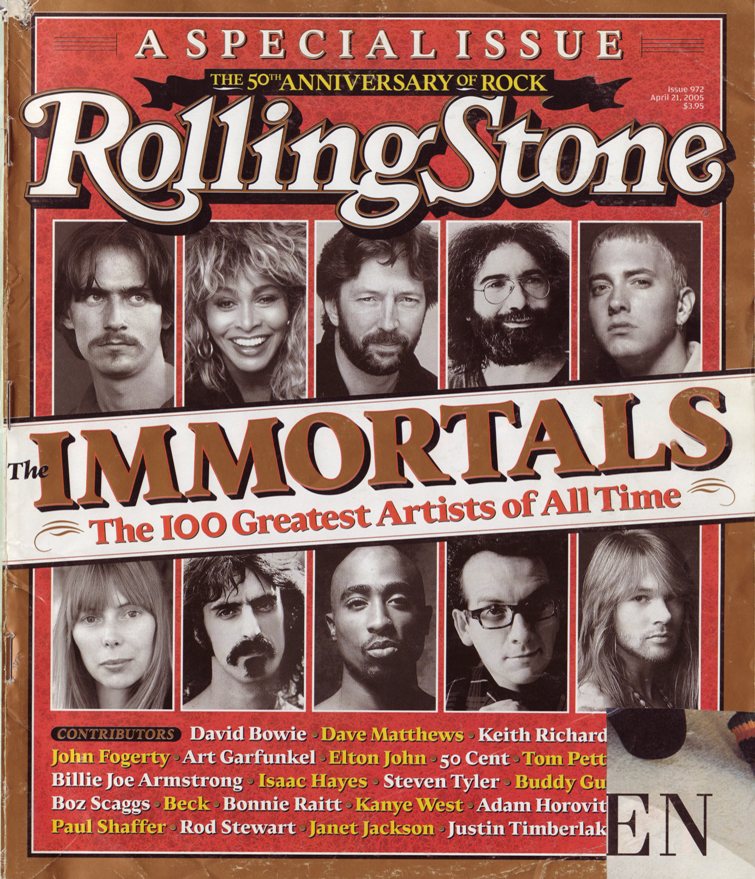
The 500 Greatest Albums Of All Time
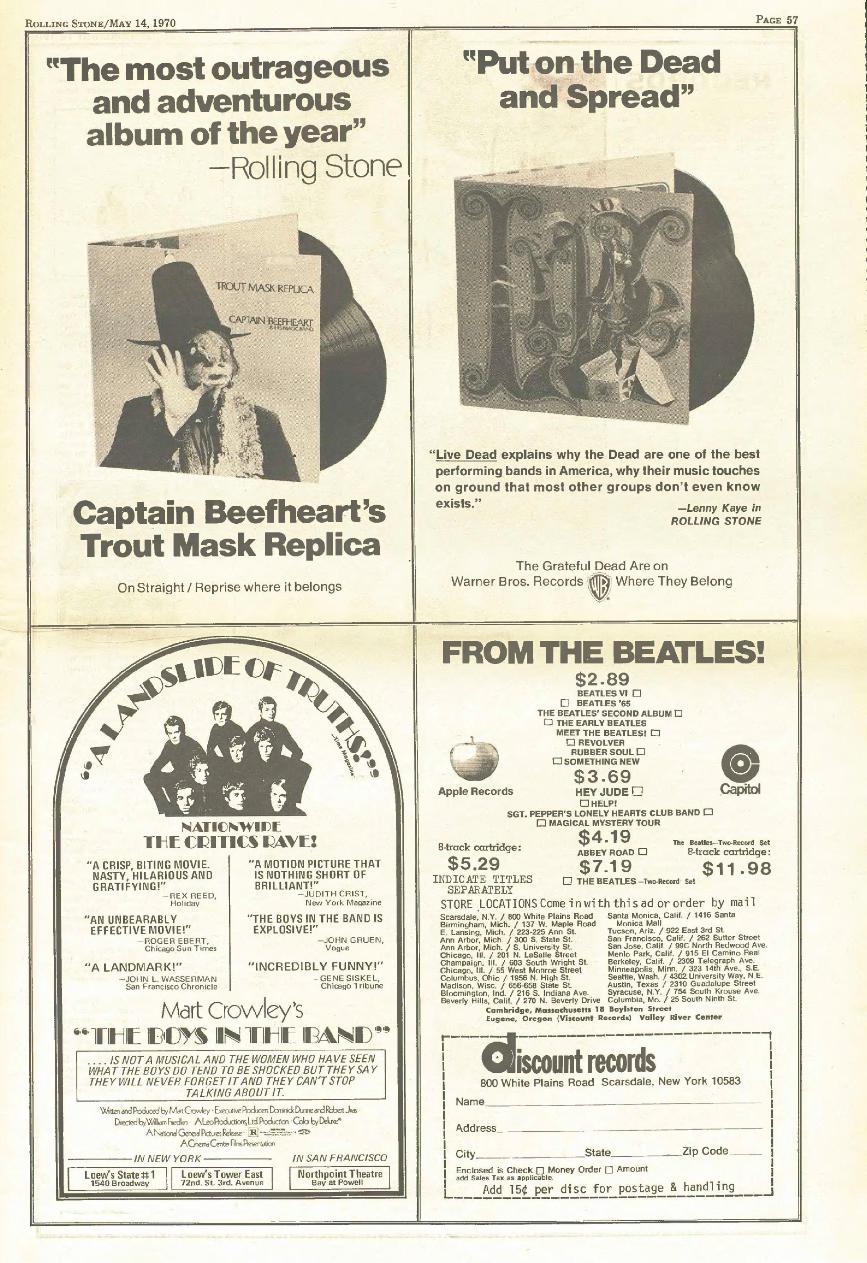
#58 Trout Mask Replica
#243 Freak Out!
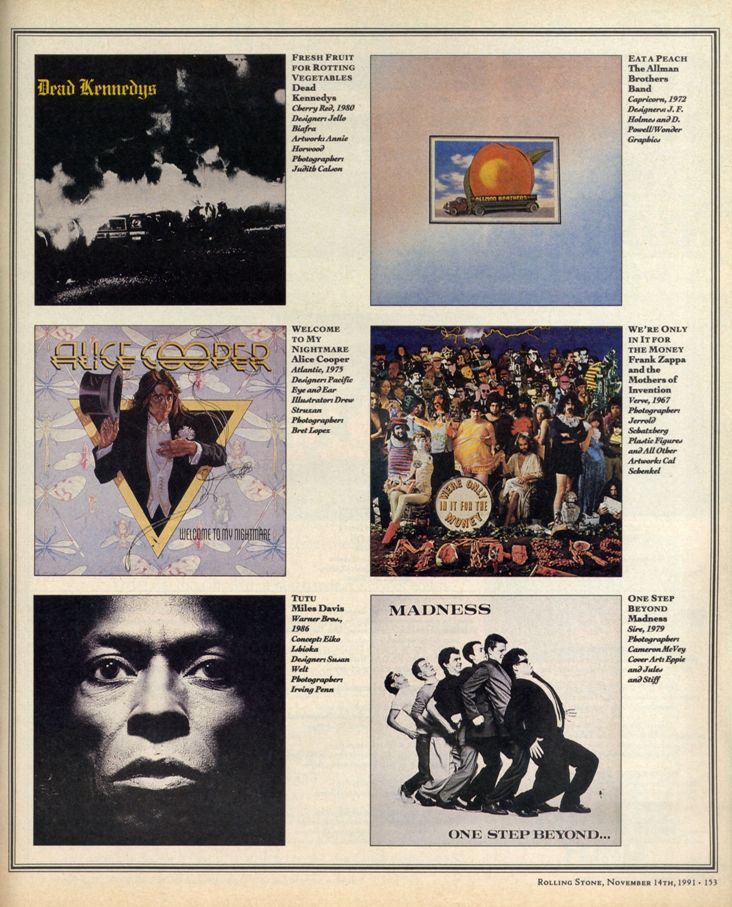
#296 We're Only In It For The Money
By Rolling Stone, pp 83-179
This list was slightly updated in 2012 and more thoroughly in 2020, with all three albums excluded from the list.
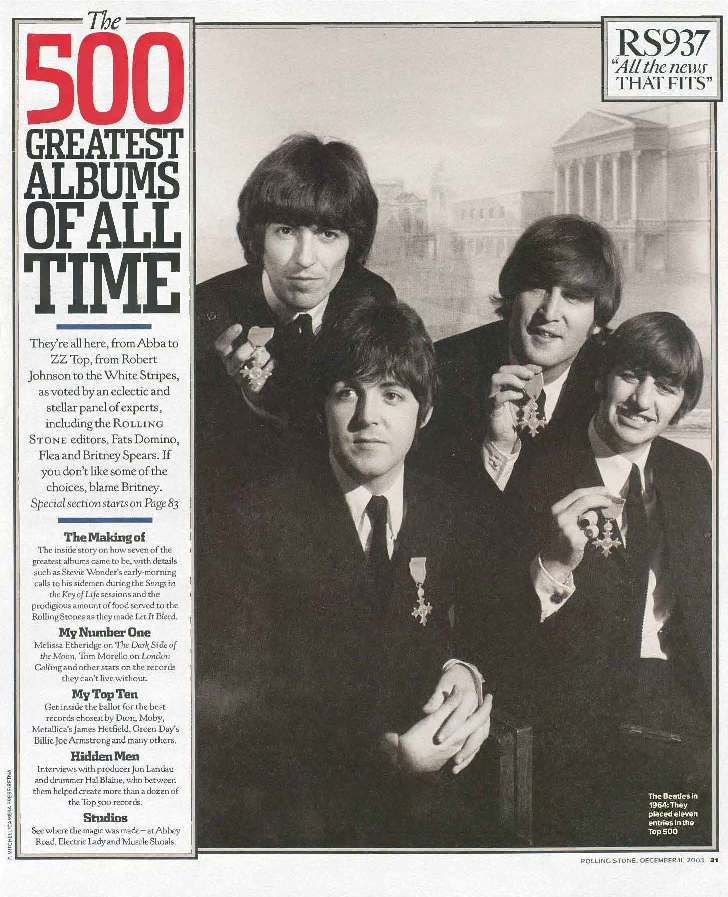
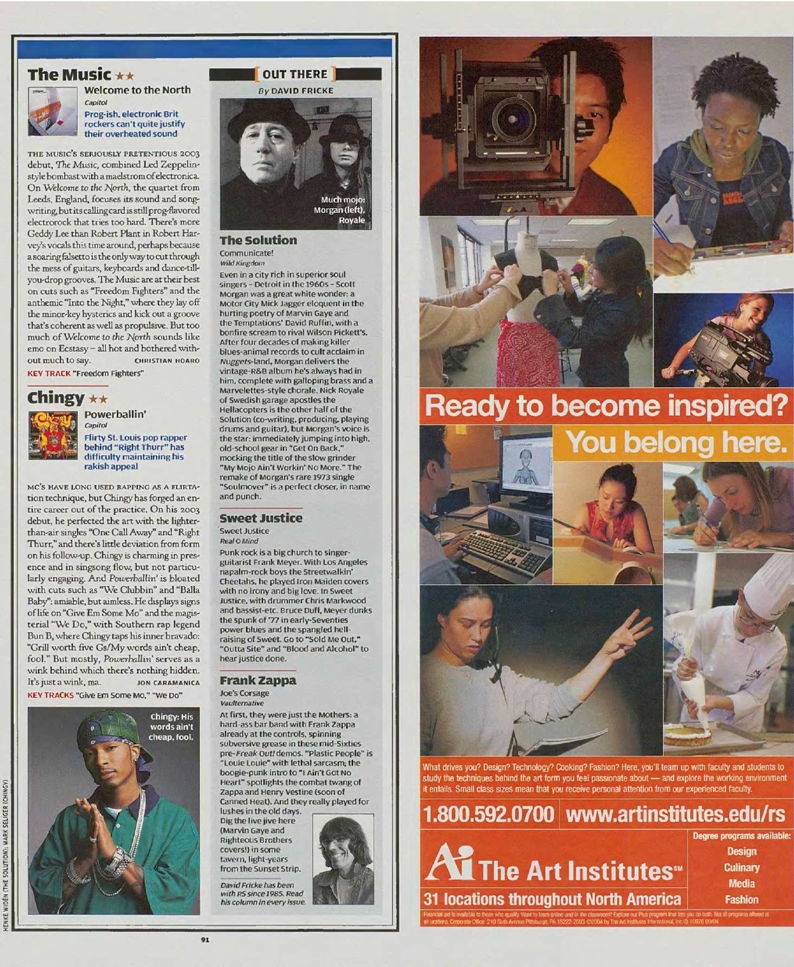
At first, they were just the Mothers: a hard-ass bar band with Frank Zappa already at the controls, spinning subversive grease in these mid-Sixties pre-Freak Out! demos. "Plastic People" is "Louie Louie" with lethal sarcasm; the boogie-punk intro to "I Ain't Got No Heart" spotlights the combat twang of Zappa and Henry Vestine (soon of Canned Heat). And they really played for lushes in the old days. Dig the live jive here (Marvin Gaye and Righteous Brothers covers!) in some tavern, light-tears from the Sunset Strip.
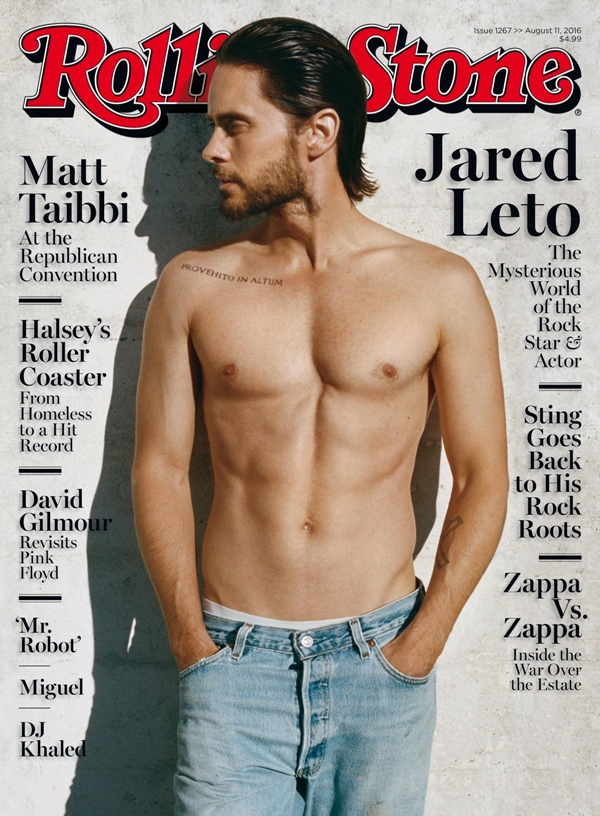
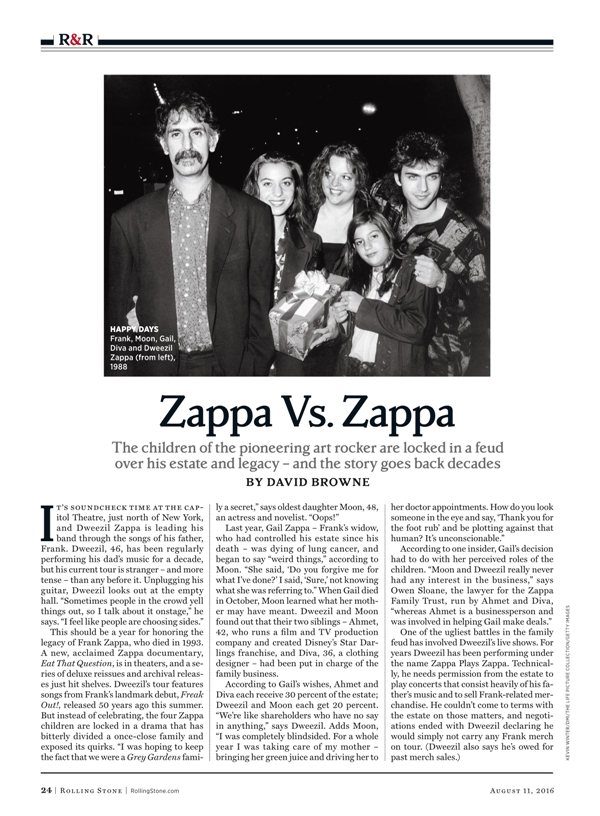
The children of the pioneering art rocker are locked in a feud over his estate and legacy – and the story goes back decades.