They're Doing the Interview of the Century – Part 1
By Den Simms, Eric Buxton, Rob Samler
Society Pages (US), #1, April 1990
"THEY'RE DOING THE INTERVIEW OF THE CENTURY"
A four and a half hour chit-chat with Professor Zappa, Part 1
On the evening of December 22,1989, the three Society Pages executives conducted an interview with Frank Zappa in the comfortable basement listening room of his home in the hills of Los Angeles. We could gush on forever about how gracious and hospitable Frank was, and he was generous enough to give us six hours out of his schedule. Although we all know Frank to be a regular, nice guy, our expectations were greatly exceeded. He even served us Christmas cookies and refreshing beverages.
The entire Zappa family was home prepping for the oncoming Christmas holiday & hanging out and preparing edibles. The kitchen is obviously the nucleus of the Zappa family.
We would like to express special thanks to publicist Jim Nagle for arranging and scheduling this interview. We would also like to express infinite graditude to Frank for his time, his words, his groovy vibes, etc., etc., etc.....
The following is part 1 of our interview. In the spirit of accuracy in journalism, we have endeavored to present this interview in word for word form, with only an occasional microscopic modification needed for translation into print.
Participants include: Den Simms (DS); Eric Buxton (EB); Rob Samler (RS); Jim Nagle (JN); and of course, Frank Zappa (FZ).
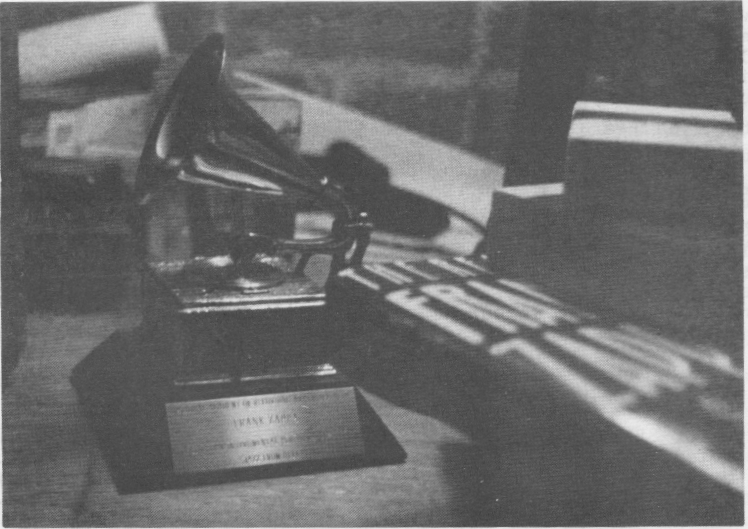
FZ's Grammy for "Jazz from Hell"
Photo by Rob Samler
INTERVIEW WITH FRANK ZAPPA
December 22, 1989
FZ: Hello?! Hello?! Hello?!! Hello!?
DS: Here we go. Alright. [To Rob & Eric] So what was the thing that you had said about "Manny The Camper" on the way here?
FZ: He wants to buy some white. Manny the camper wants to buy some white. Ya wait long enough, all the songs come true. [1]
EB: Who was the original Manny the camper? I know he wanted white gas, but who was he?
FZ: Just anybody named Manny who had an RV, y'know.
EB: And here he is.
FZ: Yeah. I'm sure he has an RV too. It's probably bullet-proof. One more thing is maybe he'll return to Managua. You could go unnoticed in such a place. (laughter)
EB: Him and Imelda and Leona (unintelligible).
DS: It's always sort of traditional for somebody who's interviewing you to ask about your kids names, but since we've got that story down pretty much, y'know, we have Moon versus Motorhead; we have Dweezil – Gail's toe; we have Ahmet as Ahmet Ertegun and Rodan the Japanese monster, right?
FZ: And Emuukha.
DS: And Emuukha. How does that fit in? I know of the Emuukha Abnuceals Orchestra? What do those words mean?
FZ: I made 'em up.
DS: Just made up words?
FZ: Where do you think words come from? Somebody's gotta make 'em up, y'know. They're only made out of letters.
DS: Alright. And Diva has a middle name, right?
FZ: Well – no, she doesn't, but she's been thinking about adding one. She flips back and forth on this. She actually has two middle names. Sometimes she, when she writes a note to us and signs it formally, it says: "Diva Thin-Muffin Pigeen". Now, she made those up. I have no responsibility for that. She happened to think that those were good names, and I would not be too surprised if she names at least one of her children "Pigeen", because she thinks that's a nice name.
DS: My own area of particular interest, something I've been concentrating on, certainly since that tour, is what you guys did in 1988, so perhaps I could start with some stuff that pertains to that. Can you talk about how you utilized the synclavier on that tour, and, we heard about something you were perhaps puttin' together called "Goin' To Hell".... ?
FZ: "Goin' To Hell" was a sequence that has all these different ways to say "You're goin' to hell", many different ways to say the word "Jee-zus", and then it has all these ugly burping, growling, devil worship kind of demon noises in the background, and some low grunting instrumental sounds. I put this sequence together, and.... what we'd do with the synclavier on that tour is each night there would be a sequence, like a complete composition, loaded it into the synclavier, and during the improvised part of the show, I could turn that sequence on. The synclavier would play a collection of sounds and then the band would play along with it. On some nights we used "You're Goin' To Hell"; on some nights we used some stuff with the congress voices; some nights other things.
DS: There was one particular sound I can remember too, which kinda got me off, it sounded like a combination of you, I believe, from the Mothers Of Prevention album, saying the word "bondage", combined with a burp.
FZ: Oh yeah. That was not me. That's my nephew, Jade, and Jade, he has the ability to burp very loud and very long, and he can also burp words. So, when he was here visiting in '87, we had a sampling session with Jade. In fact, he got paid the same as any other musician that comes in here to do samples. I stood him in front of a microphone, and let him do an assortment of burps, and then gave him a list of words and phrases to burp, and some of those were put into the synclavier and that's what ya heard.
DS: What did he use to induce the burps with? Somethin' like Pepsi, or, uh....
FZ: Well, he could do it just by gulping air.
DS: No kidding?
FZ: Yeah.
DS: That's peculiar. Can you talk about how the synclavier was MIDIed to some of the other instruments on stage? I guess Ed's silicone mallets, and some of the keyboards?
FZ: Yeah. 'Bout the middle of the tour we hooked up some wires so that I could throw a switch on the stage and any one of three different musicians on stage could trigger the synclavier with their instrumental set-up, so that Ed could trigger the samples on the synclavier by playing the silicone mallets, and if I flip the switch another way, Bobby Martin could trigger it from his MIDI keyboard, or Chad could trigger it from his octopads.
DS: I assume there was probably also some things that you had beforehand manufactured with the synclavier that they were able to do, such as Ed's little guitar riff that he would do....
FZ: No that's actually his sample. That was in his little sampler. Just a loop of one guitar strum. I don't even own that sample.
DS: Most of the samples Ed was working with, were those his or some of his and some of yours... ?
FZ: Most of the sounds you heard from Ed were either his samples or synthesizer sounds that were triggered by the silicone mallets.
DS: I see. Havin' the silicone mallets really kind of opened things up for him, didn't it?
FZ: Yeah.
DS: I guess not only just in terms of the array of sounds that he can use, but also in not having to carry around tubular bells, and all that kind of stuff.
FZ: Yeah. Also the fact that the sound goes through a wire to the mixing console and I don't have to worry about mixing things.
DS: And the problems associated with that. Uh...I've got so many questions here, I definitely can't go through all these, so I'm gonna try to weed through some of these. Um ...OK, uh....
EB: What color is your aura? [2]
All: (much laughter)
DS: It seems to me that Scott's role on that last tour was... well, he was more out towards the front of the stage, and had a wireless, and he was one of. the more ... um, I don't know, I can't think of another word other than "entertaining". He was running around the stage more, and....
FZ: But he did that in '84 also. I mean, if you look at the videos of Does Humor Belong In Music, he was somewhat frolicsome in that band.
DS: I suppose I had that impression because I only got to see the last two shows in '84, and got to see a bunch of 'em in '88.
FZ: Um hmm. Yeah, but he's always been one of the showmanship people in the band, and in fact, one of his legendary performances in '81 was Salt Lake City, where, we used to do Envelopes, and for the first thirty-two bars, there was no bass. So rather than just stand still on stage while Tommy played his part, Scott would invent little things to do, that were not bass parts. In Salt Lake City he decided that he was gonna take this aluminum canister that he had mayonnaise in it for the sandwiches backstage, and he brought it out with him onto the stage, and in the space of thirty-two bars, took his shirt off, took this little rubber spatula thing, coated his entire chest and arms with mayonnaise, in this elaborate ceremony, and then strapped his bass back on and came in on the beat when if was time to play, which seemed a very... kind of off the wall thing to do.
DS: Another thing I really like about Scott, is I like his solo that he does in "Nigger Bizniz", which to me, sort of ... um, I've known Scott for quite awhile; I knew Scott before he got involved with your band, and ... uh ... the way that he solos in that song reminds one of the way that Scott is, which is somewhat comical and, uh ... definitely aspects of being a buffoon.
FZ: Well see, he's more than comical. He's a fabulous guy. I felt really upset that the other people in the band chose to hate him, and chose to hate the way he played, thereby bringing about the demise of the band. That's ... really unfortunate.
DS: What did they have against the way that he played, which to my ears, sounds fantastic?
FZ: Well, me too. That's why I hired him. You know what? The real answer to that .... I'll tell you this way. I just finished doing a documentary for German television. They shot there for two days and at the end of the second day, Scott and Mike Keneally came over, while we were videotaping upstairs, and I told the interviewer, "Why don't you ask these guys what happened to that 1988 band?" And so, for the first time, I actually heard it, in their words, what went on. So, I got a nice piece of video tape of Scott and Keneally answering all those questions in detail.
DS: At the time that that happened, your fans were really confused and really wanted to know what was happening, and there wasn't alot of information that was forthcoming about that. I wound up talking with Mike about it. Just in meeting Mike on tour, and finding out that his background was a little bit different than most people you get in your band, in that he was a real ardent fan of your music, y'know, the walking dictionary of your songs, and all that, was a little different than most of the other people that...
FZ: No, actually there have been two other walking dictionaries .... Arthur Barrow was a walking dictionary, and to a degree, so was Ike, but Keneally is a unique individual, because not only is he a walking dictionary, I've never seen anybody able to memorize anything as fast as Keneally. He's absolutely a sponge for memorizing musical passages. Y'know, if you ... well, Colaiuta could memorize fast, but only for the drums, but Keneally memorizes the entire chunk, the melody, the chords, the rhythm, he gets a picture of it and he can replicate it, y'know, like Boom! Right after he's heard it.
DS: Putting that in the context of playing your music and in your bands, that's a real high compliment.
FZ: Yeah.
DS: He's also a really good guy. In meeting him and just talking with him, I got the feeling that if I was ever gonna get a straight story on that from somebody who was involved and might have their opinion swayed by their own personal experiences on it, if somebody could give me a straight story, it seemed like he might be somebody who could.
FZ: Yeah. He's a real straight guy.
DS: And he basically, in his opinion, he told me that he thought that Scott had got a raw deal. I could have asked Scott, but Scott is Scott. He's somewhat personally involved there.
FZ: Yeah, and he did get a raw deal. But you know who really got a raw deal
was the fans, because they could still be listening to that band right now. What happened was that it seemed like out of a twelve piece band, there were three guys that thought Scott was OK. Me, Keneally and Scott. And there may have been others who thought he was OK, but they bowed to pressure from a few guys who just hated his guts. It was like a herd instinct, y'know, and they all just decided, "Well, we'll just say this guy is, uh, an asshole, and we'll try and get him out of the band." What is this, like garage band mentality?
DS: There were things that happened that you, on stage, termed, at one point, as you called them – playground psychotics. [3]
FZ: That's a phrase coined by Jeff Simmons, and that's all it is, playground psychoticism.
DS: Yeah. Well, that was too bad.
EB: I like your Christmas tree.
FZ: Well, there's a better one upstairs. I mean, this one is dyin' a horrible death here in the corner, but you gotta understand, although we have every intention of putting ornaments on the little tree they get for me in the basement, nobody ever gets around to it, and I never have time to decorate it. So this may be ....
EB: Would you like me to string the lights while we're here?
FZ: Go ahead! It may be the only way that I get some fuckin' stuff on my tree. (laughter)
EB: It's nice, but it's like, leaning over and...
FZ: Well it's ... dejected, and it's dry. And the reason it's dry is see that pan at the bottom? They hammer this nail through the tree to stick it in that pan. They made a hole in the pan, so it won't hold water! (laughter) This is California engineering, guys!
DS: Another example of a flake.
FZ: That's right! So you can imagine somebody out there going "Geraldo! Hammer that spike through that pan into the....!" (laughter)
DS: (laughs) I have a list of people I've wanted to ask you about, just to get a reaction from you, as far as those people, and Geraldo was one of 'em. [4]
FZ: There it is – "Geraldo. Fix the pan on the bottom of the tree".
DS: Compared to what you did in 1988, in past tours, certainly through the eighties, you seem to be a little more restrained in terms of audience participation, and just, the aspect of having the audience be directly involved with the music, but in 1988, you seemed to get right back into doing quite a lot of that.
FZ: Well, audience participation depends on two things, well, more than two. First of all, it depends on the audience. You got the wrong kind of audience, you'll never get 'em to participate. The next important thing is where you're performing. If you are in a theater, it's a little bit easier to do it if there's a stage apron out in front where you can accommodate people, because if you're just playing on one of those kind of built-up stages, like you do in a coliseum or something like that, there's not enough dancing area, or if people come up there, they're gonna trip over the wires on the stage, and you'll be out of business.
DS: Well, more than audience participation, per se, I guess maybe I could say too that there seemed to be more of a willingness for chances to be taken, for just real wacko things to occur spontaneously. Maybe I can compare this to '84. My own impression of '84 was that certainly, in comparison to '88, it seemed more rote. Things seemed more ... kinda the same series of songs that would be done, more or less, pretty much the same way, with less of that tendency for all of a sudden things to just take off; for the secret word to be used, with as much gusto as it was used in '88. The secret word in '88 was brought to a new level of absurdity.
FZ: A fine art. Yeah. Well, you gotta understand that you put a band together and before they can do the secret word, they gotta be so assured that they know the material, that they can get back to safe ground if the secret word doesn't work, (laughter) or y'know. The secret word, it takes a lot of practice to be able to get a whole band to think in that mode, because if you rehearse a song, and you're performing it during the concert, you're relying on what you learned during the rehearsal, in order to do a good job and get everything in order. But say you're playing along, and suddenly somebody in the band starts saying, or doing something which is not part of what you learned. That can really fuck you up if you don't know what to do in that instance. Also, you gotta know that on stage, sometimes it's difficult to hear what the other guys are saying. So the secret word stuff is risky business.
DS: Well, I think takin' chances, in the long run, in the overview, I think pays off. Again, personal perspective.
FZ: Well, I like doing it, but the bands don't always like doing it, because nobody wants to go on stage, and in the middle of their splendid, blue solo spotlight wind up fucking up. (laughter) It could mean the difference between a blow job and black mark on your report card. (laughter) You just don't wanna fuck up out there.
DS: How do they react when a mistake happens on stage, and you integrate that, y'know, sort of teasing them about that in the show?
FZ: Well, some people get upset about it and other people just take it as, like business as usual. I mean, there's certain mistakes that keep getting made over and over and over again, and when they get made so many times, I have to ask myself, "Am I gonna flip out here? Or am I going to make a joke out of it?" Usually I'll make a joke out of it. I think that it's better than ripping my hair out, saying, "No, No, No!!! Don't you guys know what you're doing?" Because, I don't believe that they make the mistake to make me feel bad, or to cheat the audience out of the good performance, but people make mistakes, so what do ya do with it? Use it as material. Bobby Martin has a habit of forgetting the words to certain songs, rather consistently.
DS: He has to stay after school afterwards.
FZ: Well ... the....
DS: I remember you saying that, I believe in Hartford or somewhere. [5] I think later on, you made a mistake, and somebody in the audience passed you a note that said something like, "Are you gonna have to stay after school after this one", [6] or something like that happened, didn't it?
FZ: Oh, I make mistakes up there all the time, but uh, I can do it. I wrote it so I can fuck it up. (laughter) I'll give myself that license. But I don't go out there with the intention of making any mistakes, and I don't think the other guys do either.
EB: With you, it's experimentation.
FZ: (laughs) No, with me it's just the same as the other guys, 'cause I forget, y'know.
DS: Here's something that I was just talkin' with Jim [Nagle, FZ's publicist] about a little while ago. You mentioned that you didn't think it was gonna be possible to tour again unless somebody was able to underwrite the tour, somethin' like Pepsi, or some other...
FZ: No. No, I'm not thinkin' of Pepsi, that's for sure.
DS: Right. Or just some other company that could give you sponsorship. D'you think there's anybody around that has economic weight to be able to underwrite a rock and roll tour that doesn't have to worry about their corporate image and stuff, to be able to take on somebody that's "controversial"?
FZ: Not a company, but there's a country.
DS: A-hah. Do tell.
FZ: Well, I was negotiating with these people in Spain, because, y'know, they have the World's Fair there in 1992, they got the Olympics, and they have the 500th anniversary of Christopher Columbus. That all happens in '92, and there have been ongoing negotiations for over a year with the Worlds Fair and the Christopher Columbus organization about either putting together a "World Orchestra" that would tour, or financing some sort of a tour of a rock band, and I'll hear more about that after the first of the year. But there's no way that I'd agree to do it unless one hundred percent of all the expenses are picked up, and I am guaranteed that at the end of the thing, I walk away with a profit, because in '88, everybody else got paid, and they all got paid a lot of money, and I lost a lot of money, and I'm not going to repeat that experience again.
DS: Do you think that if that tour had been able to maintain and continue, if the band hadn't broken up, and you...
FZ: I'd be talkin' to you in a dressing room right now.
DS: I thought that if you had been playing through the summer across the United States, some of those summer kind of, oh what do they call 'em ... pavilion type venues...
FZ: Yeah. Shed dates.
DS: ... that hold larger larger audiences and such, d'you think that that might have helped to balance the books?
FZ: No question, because we had a whole summer's worth of job offers, like fifty thousand dollars a night offers that we could have played, but ya can't play those offers if there's no band. And you can't play those offers if you have to finish your European tour, and go back into rehearsal and replace anybody in the band, because it takes months to train people to do that.
DS: Right. You spend several months in rehearsal before you go out, right?
FZ: Four months for that tour. And so, to train people to do it, they're not training for free. You have to pay them a salary, y'know. So, I looked at the numbers. You take the deficit from the four months of the tour, you add to it the further deficit of going into more rehearsals, the fact that the rehearsals would take up the whole summer, and you would miss all the high-paying dates, and then you would have to go back on the road in September or October, and there was just no way to do it.
DS: Go back on the road when it starts gettin' cold again, and start havin' to play inside....
FZ: Yeah. And also having to play inside in places, well, the trick about playing in the winter months is, in the East coast, especially, you are competing with the hockey teams, and the basketball teams, and they have the indoor venues booked, and you have to route your tour around their occupancy of those buildings. So, every time you have to take a divergence in your tour routing that takes you out of the nice straight line, economical jumps from one city to another, every time you have to go (FZ illustrates with hand
gestures) VOOP! like that in order to play a date someplace else, your costs go way up, because you're runnin' the trucks, and, y'know...
DS: It don't come cheap.
FZ: It's a mess.
DS: OK. Here's something in a completely different direction. Quite often your music contains quotes from [Giuseppe] Verdi's "Aida", [Richard] Wagner's "Lohengrin", and [Georges] Bizet's "Carmen". Are you an opera buff?
FZ: No.
DS: What about those pieces of music appeals to you? You've been playing around with them for years.
FZ: They're all good tunes.
DS: Yeah. Particularly the "Lohengrin". You've kinda had a fancy for that for pretty much throughout your career, haven't you?
FZ: Yeah. Y'know, I never heard "Lohengrin" until Hi-Fi was invented. Long time ago, before Hi-Fi, I didn't know that there was such a thing called "Lohengrin", and I found out about it because, one day I went to this record store, and they gave away this forty-five RPM demonstration disc of what Hi-Fi sounds like, and that was the thing that was on there. Like, the first Hi-Fi I ever heard was this performance of "Lohengrin", by [Arturo] Toscanini.
DS: And it appealed to ya.
FZ: Yeah. Nothin' else on there did, but.... (laughter)
EB: (unintelligible) with that Varèse record when you first saw it, right? (unintelligible) they used it to demonstrate the Hi-Fis, and they never sold one?
FZ: Yeah. But they weren't giving that away. I mean, this was like a special promo disc that RCA had made.
DS: Let me ask you somethin' else, kind of in the same vein. You obviously have quoted many times too, and you have a penchant for it, the opening notes to [Igor Stravinsky's] "The Rite Of Spring". Now, I've heard that when an orchestra plays "The Rite Of Spring", that there's this aspect of tension that settles over the orchestra, because, what is it, a bassoon that plays that note, and it's hard for him to get a good straight attack on that opening note, and everybody wonders whether he's gonna blow it or not.
FZ: Well, I don't know whether it's correct to say the note is not on the horn, but if it is on the horn, it is one of the most difficult notes to get out of the horn.
DS: Right. Is your fancy for that just because you like the line, or does it have something to do with that particular aspect of it?
FZ: No, it's... I like the line. I think it's a genius line.
DS: Yeah, it is.
FZ: And so is all the stuff that comes after it, which is, that's (laughs) a little hard to quote all that. (laughter)
DS: In 1988, you guys played "America The Beautiful", and I noticed that there was a short lyric change, which was "The only place to be" instead of "God shed his grace on thee". What was the reason for that?
FZ: I'm not sure God did shed his grace on this country. (laughter)
DS: What led up to you playing the Untouchables Theme? How did that come about?
FZ: I think that's a great piece of music. That's a genius TV theme, and I've always liked it. One day, we were in Chicago at a sound check, and I said, "We should play The Untouchables". But nobody could remember exactly how it went. So Laurel Fishman went to a television station, and got a cassette, this TV station was running The Untouchables there, and talked somebody at the station into making a little audio cassette of the theme. We brought it back to the sound check. We listened to the cassette through the speakers that played into the room. The horn players went over and stood next to the speakers and they listened... (to Eric) Were you there at that soundcheck?
EB: Yeah, I was there.
FZ: Alright! And they listened carefully and each guy picked out his own part out of this thing, and they sketched out their parts, and that's how we learned The Untouchables.
DS: That's great! Those are the kind of things about Frank Zappa's bands that I really like. Those abilities to do stuff, to pluck stuff out of somewhere and to do that. You know, that whole Daniel Schorr medley thing, [7] that whole... y'know, I was there for the rehearsal, and I watched how that rehearsal came together, and for me, personally, watching that rehearsal was one of the best musical experiences I've ever had. Seeing how the whole thing comes together.
FZ: It's fun to do. That proves it's fun to do music, if guys just think about music when they're in the band. But the minute they start thinkin' about stuff that is not music, I mean, maybe even in Chicago these guys are sayin' to themselves, "What the fuck do we have to do this for? Do we have to go over and stand in front of this speaker and figure out what the third sax part harmony is to The Untouchables? Jeezus Christ! I'm a jazz musician! (laughter) Should I really be doing this?" Y'know, but the net result for the audience, I think they get off on it, and so there's a time to decide, "OK. You're a jazz musician, but you're here to entertain people too."
DS: You got a job to do.
FZ: Yeah.
DS: I didn't get a chance to see the Jimmy Swaggart / Beatles medley. I did get to hear parts of it, and to hear the thing, to know what it's about. But I didn't get to see it personally. Never having seen it, I have to let my imagination tell me what's happening onstage when it's happening. In "Louisiana Hooker With Herpes", when you guys sing that refrain, and then the word "Oww!" comes after that, I always had this picture of somebody with herpes putting their hand to their lip and going, "Oww!" Did you guys do that, or was that just in my mind?
FZ: No, I grabbed my balls for that one. (laughter) Well, we got plenty of audience sing along on that one.
DS: Yeah. It was a good idea. Are we gonna get to hear that on a recording? What's the status on that?
FZ: I would love to be able to release it, but see, I don't have the right to release it without permission from the publisher, and after that... Michael Jackson owns the publishing, so after my song about him, I'm not too convinced that I would...
DS: Well, he seemed to have a pretty good humor about, certainly about the parody that Weird Al [Yankovic] has been doing of his music. Needless to say, it wasn't quite as biting of a commentary as you gave it, but...
FZ: It's not the same. (laughter)
DS: So it's all up to Michael and the people on his end, who control those kinds of decisions?
FZ: Yeah. Sure, I, mean, I've already edited together one version of it that I could play for ya. It does exist, and it's been mixed, but I don't have the right to release it.
DS: Yeah. Has there been any indication whether ... I assume that you've contacted them and asked them if you could do it.
FZ: Actually we haven't contacted them directly. Gail was the person who handles all that stuff. We have spoken to a few lawyers about it just to find out whether or not I had the right to release it, and just pay them the royalties on it without getting permission, and they said no, that you have to get permission to do it.
DS: Well, I can assure you that your fans really wanna hear that one really bad.
FZ: Well, they really need to hear it. It's a good one.
DS: That's one that seven-eighths of the country, who didn't get to hear the tour, heard about that.
FZ: That would sum it up pretty good.
DS: Yeah, I think so.
FZ: That shoulda been a rock video in release at the time (laughter) that, uh...
DS: You had mentioned too, that you might release [Maurice Ravel's] Bolero as a single, I suppose only in Europe, because of some copyright regulations here in the U.S.
FZ: Yeah, the only place in the world where the copyright has expired, and it's public domain in England. And so, if it's released and manufactured in England, then it could be done, and I've got an assembled mix of it. Sounds great. Maybe next year.
DS: That was a wonderful arrangement. I really liked the little, oh, what was it, "My Sharona", inside there.
FZ: See, you haven't even heard the way it was finally y'know, by the end of the European part of the tour, they really had it down, and they were playing it well. They weren't playing it that well in the U.S. cause we just started doing it within the last ten days of the U.S. tour, so it was still kind of a fresh arrangement. We played it all over Europe, and it was a major hit in the show.
DS: The shows I saw were in the beginning of the tour, so a lot of these things that came later in the tour, the only ways I've been able to hear a lot of this stuff is through the kind of cheezy little cassettes that people make in their seats in the audience, and there was really a lot of good stuff that ... y'know, we wanna hear that stuff on an album some day.
FZ: Don't worry, you'll get it. I'm hoping to have that out next year. There's a lot of stuff that comes out next year, 'cause it's the twenty-fifth anniversary, and one goal is to have the entire catalog available on CD.
DS: Boy, that's a task, huh?
FZ: Well, there's, umm ... what, about a dozen titles that have yet to be released. Ryko's gonna release eight of 'em, no, it's actually more than a dozen, and the rest will either come out through Ryko or another new contract, or they'll be coming out on Barking Pumpkin through Capitol.
DS: Has the work, in terms of remixing, and all that stuff, has that work been completed yet?
FZ: The only thing that is not done is putting together Live In New York, because that's been remixed and extra material has been added into it, and I'm about two-thirds of the way through assembling those new mixes for that al
bum.
DS: Here's something related to that. I believe that you mentioned recently that you were planning on releasing those three "ugly albums" that Warner Brothers put out, putting them out the way that they put 'em out, with the same covers....
FZ: With their covers, yeah.
DS: Right. As opposed to reverting back to your original intentions of putting out Läther as the four record set. Why did you choose to do that?
FZ: Because boxes are difficult to purchase, because they cost more, and stores are reluctant to, first of all, stores are reluctant to stock anything that I do, but they're even more reluctant to stock a box.
DS: Actually, Ryko has been doing real well with keeping your stuff on the shelf. I can tell you as a longtime consumer of your music, that from the point that Ryko got involved with you, what they do is in marked contrast with what I had seen previous to that.
FZ: Yeah. Well, sometimes they do and sometimes they don't. There's still strong resistance in chain stores, and there's even stronger resistance as far as the video stuff goes. I think we have to thank our Christian brethren for that.
DS: Yeah, perhaps. You think so? You think there's something conspiratorial happening?
FZ: Well, I'll guarantee you that in the case of one major national chain store, the guy who runs the thing, he's a born-again Christian, and refuses to stock anything that I do. So maybe that's just his little...
EB: Who is it?
FZ: Oh ... I can't remember, but....
JN: Blockbuster?
FZ: Yeah, uh, it's either Blockbuster or, um...
JN: I know the guy who runs that is a born-again too.
FZ: Yeah. This is Wahl Lee, the guy who runs MPI, told me that he's had trouble with two, maybe three of these national chains that just won't put the stuff in the store.
DS: Well we would like to know what store is treating you that way so we can ... act accordingly.
FZ: Well, actually, the guy to talk to about stores that won't stock my stuff is Trooper Ash, Chuck Ash, because he's gone to stores in Pennsylvania that just refuse to carry it. Did you meet Chuck? He was there in Washington D.C. He was a Pennsylvania State Trooper that did the interview with me... [8]
DS: I saw you talking with him. I was aware of him being there, yeah. But I haven't met him personally.
FZ: So we'll give you his phone number. I mean, aside from being a State Trooper, he's also a fan, and...
EB: That's a great interview.
FZ: Yeah, a really good interview.
DS: You did an interview with him back in '81 or something...
FZ: I've done two tapes with him that have been used in the Pennsylvania school systems.
DS: Yeah, I remember from that earlier interview that he, uh, ... I found it kind of curious because he is a Pennsylvania State Trooper, I kinda thought, "Is this gonna lead into questions about drugs?" And I know what your views on drugs are....
FZ: That's what it was, exactly. About drugs.
DS: That's kinda what I assumed it would be used for, part of a ... somethin' for the kids.
FZ: Well, they had a big disclaimer on it that these were Frank Zappa's views and not (laughter) the views of the Pennsylvania State Police. (laughs) But, speaking of my views on drugs, y'know, certainly there are some people who agree with the way I think, and in some surprising....
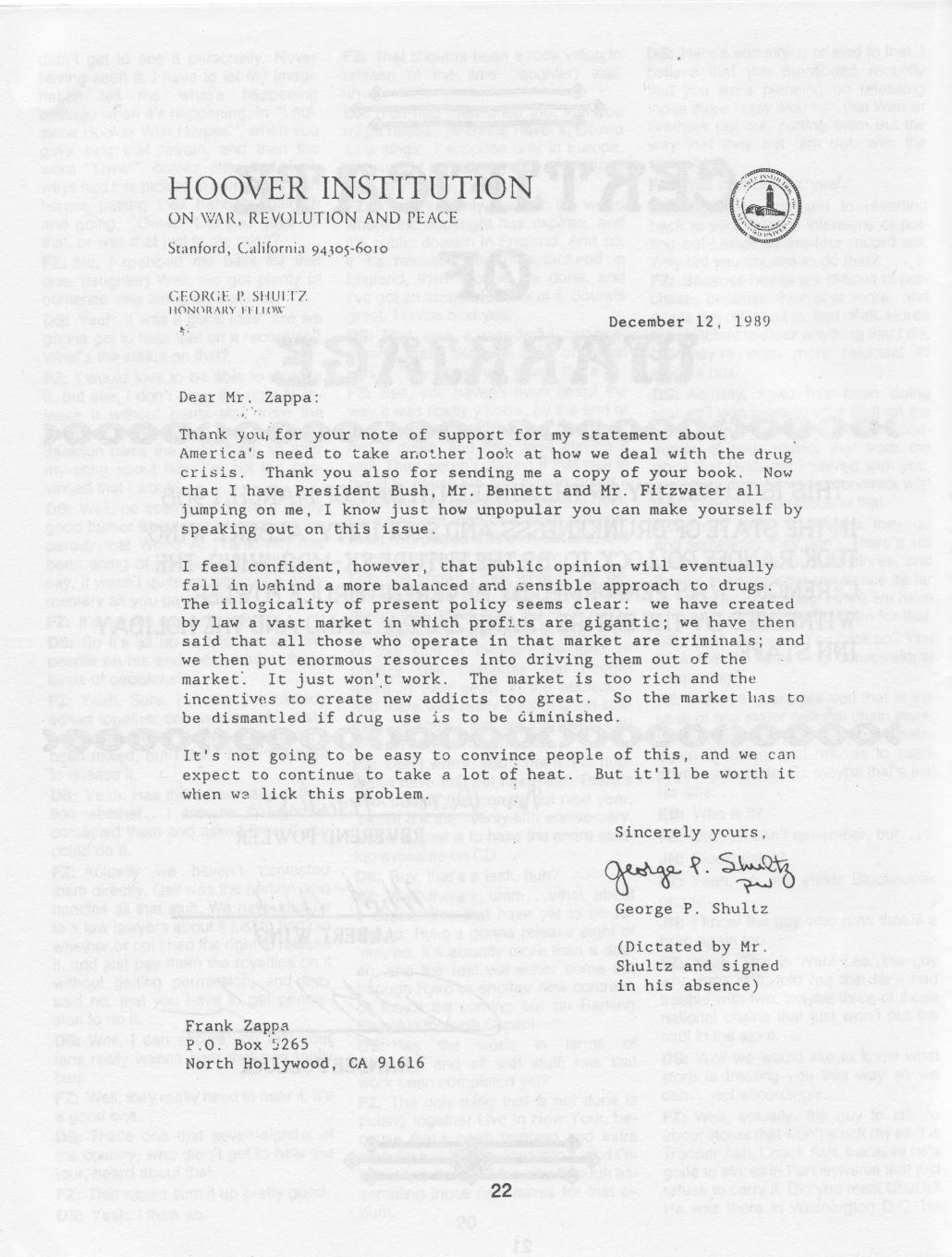
DS: As of late, George Shultz.
FZ: I was gonna say, I got a letter from him in the other room.
DS: No kidding!?
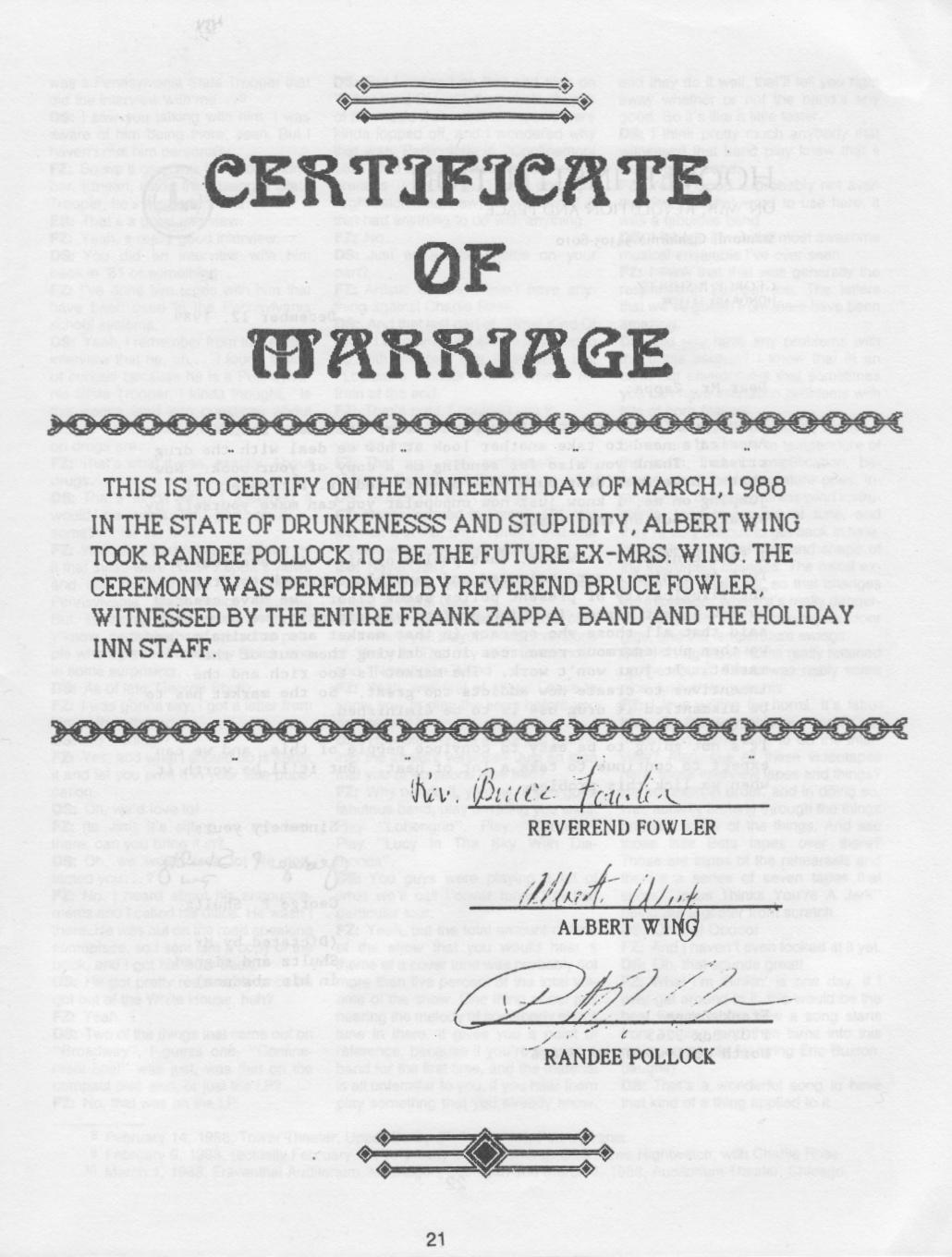
FZ: Yes, and what I should do is Xerox it and let you print it in your little publication.
DS: Oh, we'd love to!
FZ: (to Jim) It's sitting on my desk there, can you bring it in?
DS: Oh, we would love to! He contacted you ... ?
FZ: No. I heard about his announcements and I called his office. He wasn't there. He was out on the road speaking someplace, so I sent him a copy of the book, and I got his letter back.
DS: He got pretty reasonable once he got out of the White House, huh?
FZ: Yeah.
DS: Two of the things that came out on "Broadway", I guess one, "Confinement Loaf" was just, was that on the compact disc also, or just the LP?
FZ: No, that was on the LP.
DS: But I noticed on that and also on "What Kind Of Girl", that whole chunks of the music that came at the end were kinda lopped off, and I wondered why that was. Particularly in "Confinement Loaf" that second verse had some references to Charlie Rose and the Nightwatch interview, [9] I wondered if that had anything to do with anything.
FZ: No.
DS: Just an artistic choice on your part?
FZ: Artistic choice. I don't have anything against Charlie Rose.
DS: And that last part of "What Kind Of Girl". I wondered if that had anything to do with the fact that there was that "Louisiana Hooker With Herpes" refrain at the end.
FZ: That's right. I couldn't use it.
DS: That was also a wonderful thing you did there.
FZ: That was only performed ... uh, twice, in Detroit and Chicago.
DS: Muskegon and Chicago. [10]
FZ: It was learned in Detroit, OK. We learned it at the, um ... what's that little theater where we were working at...
EB: Royal Oak?
FZ: Yeah. We learned it at a soundcheck at Royal Oak.
DS: Leading up to that, you did a concert where you played straight versions of "Lucy In The Sky With Diamonds" and "Norwegian Wood".
FZ: Yeah, well first of all, you have to know how to play the song before you can pervert it.
DS: How did it come about just getting into the straight versions? Just an idea that you or someone else had?
FZ: Why not do it, y'know. If you got a fabulous band, play anything you want. Play "Lohengrin". Play "Carmen". Play "Lucy In The Sky With Diamonds".
DS: You guys were playing a lot of what we'll call "cover tunes" in that particular tour.
FZ: Yeah, but the total amount of time of the show that you would hear a theme of a cover tune was probably not more than five percent of the total volume of the show. One thing about just hearing the melody of somebody else's tune in there, it gives you a point of reference, because if you're hearing a band for the first time, and the material is all unfamiliar to you, if you hear them play something that you already know, and they do it well, that'll tell you right away whether or not the band's any good. So it's like a little tester.
DS: I think pretty much anybody that witnessed that band play knew that it was a good band.
FZ: Yeah. Good is probably not even the best (laughs) word to use here. It was a fabulous band.
DS: I though it was the most awesome musical ensemble I've ever seen.
FZ: I think that that was generally the response in Europe, too. The letters that we've gotten from there have been amazing.
DS: Did you have any problems with the brass section? I know that in an electrical environment that sometimes you can have intonation problems with lots of horn players.
FZ: The intonation problems, believe it or not, are due more to temperature of the room, than to amplification, because when the temperature goes, instruments, brass and brass wind instruments, tend to go out of tune, and they're very difficult to get back in tune, because the actual size and shape of the instrument changes. The metal expands and contracts, so that changes the intonation. Where it's really dangerous is when you're playing outdoor gigs, and the temperature swings.
DS: Having those horns really fattened up the sound. There was really some nice, lush arrangements.
FZ: I love writing for horns. It's fabulous. By the way, this guy form Germany who came here to do the interview? Also, see all these videotapes here, these interview tapes and things? He put them in order, and in doing so, was actually looking through the things and lost a few of the things. And see those little Beta tapes over there? Those are tapes of the rehearsals and there's a series of seven tapes that show "Jesus Thinks You're A Jerk" being put together from scratch.
DS: Ooooo! Ooooo!
FZ: And I haven't even looked at it yet.
DS: Oh, that sounds great!
FZ: What I'm thinkin' is one day, if I ever get around to it, this would be the best way to show how a song starts from nothing, and then turns into this major spectacle featuring Eric Buxton. (laughs)
DS: That's a wonderful song to have that kind of a thing applied to it.
FZ: But it would take a lot of editing, because, like, seven Beta tapes is seven hours, No! It's more. I think Beta's are two hours, so maybe fourteen hours of rehearsal that has to be squeezed down so that you could see each little section being developed.
DS: Oh, that sounds great. There's a particular moment of that song that really gets me off a lot, and that is that metamorphosis of, I think it's somethin' like "Battle Hymn Of The Republic" mixed with...
FZ: "Dixie".
DS: With "Dixie", and "Old Rugged Cross", and how that changes into "Louie, Louie". (FZ laughs) That was really a sweet idea. Speaking of "Louie, Louie", that seems like sort of a joke for you, and I'll just make the guess that that's because in your early days you were in bands where lots of people seriously said, "play 'Louie, Louie'".
FZ: Well, I was also in bands when "Louie, Louie", before The Kingsmen made it into the joke that everybody recognizes now. "Louie, Louie" used to be a really cool tune, the Richard Berry version of it. It had, y'know, a nice arrangement to it, and a whole different feel to it. It wasn't until The Kingsmen version that it became the, y'know, the Animal House joke that it is right now.
EB: What happened to all of that stuff that you played for us last time that was gonna be on Stage, Volume Three? (laughter)
FZ: Well, it's gonna be on either Four or it's gonna be on Five. Four is finished. It's sitting in there. I don't throw anything away, you know that.
DS: In "Jesus Thinks You're A Jerk", and in a lot of other tunes, I guess in "Rhymin' Man" and in many other songs that you've written, there's snatches of other little music, something that strikes me as a real Charles Ives kind of thing to do, your tendency to take little musical quotes from places and work them into the arrangement, and usually I'm pretty good at identifying what those are. But in 1988, there was a couple that stumped me where I couldn't come up with a title of what they are. So maybe you can help me on these.
FZ: OK, great. Alright.
DS: In "Jesus", there's a little melody that one would associate with, in a cartoon or something, with seein' someone ride a horse. [11]
FZ: That's called the "Light Cavalry Overture" by Franz von Suppé.
DS: OK. In "Cruising For Burgers", there's the little Hawaiian melody, which you did in a, not with the kind of a rhythm that one would normally think of it being... [12]
FZ: It's called the ''Hawaiian War Chant", and I don't know who wrote that.
DS: And how 'bout that chromatic sounding circus melody which you used...
FZ: (FZ hums the melody). [13]
DS: Exactly.
FZ: I don't know what that's called, but it's like...
DS: The famous...
FZ: Yeah, that's The Circus Lick.
DS: Exactly, but you don't know the name of it? 'Cause it's gotta have a title. It came from somewhere.
FZ: I'm sure it does, but I don't know what it is.
DS: That again, that's an aspect of your music, something that you've been doing all through your career that really gets me off a lot. I like...
FZ: Well, they're like visual aids, you know. If you think of music as somethin' to watch with your ears, then those are like visual aids. You tell a story and then you show 'em a picture and then the point gets across faster. But go through "Rhymin' Man". Did you catch all the licks in "Rhymin' Man"?
DS: Most of them, although you did an interview with somebody. . .which one of those interviews was it, Dallas or, Chattanooga, where the guy was able to catch one... [14]
RS: "Hallelujah, I'm A Bum".
DS: "Hallelujah, I'm A Bum". That one had slipped by me, so I was really glad that he got that one.
FZ: Did you get "Mississippi Mud"?
DS: No.
FZ: You didn't get that?
DS: No.
FZ: 'Dipped his hands in the doctors blood and rubbed it on his shirt like playin' with mud" (FZ hums melody which follows those lyrics) (laughs)
"It's a treat to beat your feet in the Mississippi Mud". (laughter)
DS: Oh, that's great! The more I learn about your music, the impression that I get more than any other one is the more that I know, the more I get the feeling of how much stuff there is in there that's sailing right past.
FZ: It's whizzin' right by you.
DS: Yeah, and I pride myself with being pretty good at pluckin' a lot of that stuff out of there.
FZ: The problem is, that, y'know, because I'm so old, I've heard more music, and more kinds of music than the average listener today. I lived through a whole musical area that most of the fans that listen to it now, they never heard those songs, so, y'know, things that would seem automatic to me, as a visual aid, so to speak, you'll never know. I mean, you've probably never even heard "Mississippi Mud" or...
DS: I don't know if I ever have. It's certainly nothin' I'm familiar with.
FZ: Well, one day, in an old movie, you'll hear that song, and you'll go, "Uh-oh! It's Rhymin' Man". (laughs)
DS: I'll tell ya how one of these came about for me recently, and that was I was watching a Woody Allen movie on TV, [15] and in the soundtrack of that was a jazz standard which I heard and thought to myself, "That, that's part of 'Punky's Whips"'. And I went, "What is this? What is this?" And I thought, "Well, I'll wait until the end of the movie, the credits will whiz by, and I'll be able to pluck it out." Credits whiz by and there's all these thousands of songs on it. Well, OK maybe I'll see a tape of the movie on a VCR one day, I'll be able to stop it and see what the song was.
FZ: So you wanna know what the song was?
DS: I found out what it was about a week later when I saw an American Express commercial on TV. They had somebody singing "Isn't It Romantic?"
FZ: Yeah!
DS: I went, pulled out the fake book and there it is, y'know. (FZ laughs) That's the kind of stuff that I'm convinced that your music will eternally challenge me with those kinds of things, and always keep me interested.
FZ: Well, y'know, there's a limited number of those things in there, I mean, it's like, everything I write isn't riddled with that, but certain types of songs, especially ones with vocals, when you need to put in a little musical joke, that's the resource that you draw on.
DS: Yeah, well that's an aspect of your music that I really enjoy. You did a new instrumental in Europe, [16] which we don't really have a defined title on yet, which maybe was called "The Dessicated Number", or "The Dessicated Texture", or something like that.
FZ: Yeah, it's called "Dessicated", or "Berlin", 'cause it was written in Berlin.
DS: How do you feel about the way that that turned out? Were you satisfied with any of those performances and such, or...
FZ: Well, it was never done perfectly, but there is a version that has been edited together that I could play for you that's pretty good. It was only played three or four times.
DS: And I understand that at the same time, Mike tells me that you were writing some other little pieces that you were, I suppose you were composing these while you were traveling?
FZ: Yeah.
DS: And he tells me that you composed several other little things that happened, um ... in a package with all these.
FZ: Yeah, there were chord things for the horns. I would write the composition, copy out the parts in the afternoon, and then go to the soundcheck, give 'em the parts, and say, "OK. During, say, 'King Kong' or, uh, one of those songs..."
DS: Right. "Pound For A Brown" or something like that.
FZ: Yeah. Something like that. "Y'know, when I give you the cue just start playing this". And that's how they were used.
DS: These songs like "Pound For A Brown" or "King Kong" or "Dessicated Number", the ones that had the extended "outside" part that comes in the middle of the song. In my experiences of going stop to stop and seein' those shows, that was the part of the concert that I would really look forward to, night after night.
FZ: But see, you're weird. I mean, most people that come to the concerts think that that's the boring stuff and hurry up and sing me a song that I recognize off the album.
DS: Like "Dinah-Moe Humm".
FZ: Yeah. And so, you know you gotta entertain everybody there to a certain degree, and so you can't go and play a whole concert of that outside kind of stuff. Otherwise, you alienate most of the audience.
DS: How successful did you think that that kind of outside stuff was? Did that getcha off very much?
FZ: When it worked, it worked great. And when it didn't, it was ugly (laughter) I mean, same as any other chancetaking...
DS: That's sort of the nature of that kind of music.
FZ: That's right, but I'll take the chance, so long as the audience knows that what's happening in there is a bunch of guys on stage taking a chance, then they'll appreciate it more if it turns out to be something interesting, and if it turns out to be something not interesting, though they should at least appreciate the fact that we took a chance.
DS: Right. Again, getting back to the synclavier, some of the stuff, some of the ways that that worked in with that part of the show it was truly spectacular. In being familiar with the stuff that you've done with synclavier before that
tour started, and then finding out, reading the press release that you were gonna be takin' it with you on the road, I was real curious as to just how it was
going to be integrated into the proceedings, and I thought it was spectacularly used in that stuff. I thought it sounded great.
FZ: Well, actually I've added more equipment to the system, and put some software and some hardware improvements into it, so if there were ever an. occasion to take it on a stage again, it's capable of doing even more ridiculous stuff.
DS: It's kind of funny, because every time you talk about what you've been doing with the synclavier, you tend to say, "Oh, the stuff that I did just a little while ago, that's all obsolete."
FZ: Well, it's not obsolete, but you know, they put out sometimes two software releases per year and each software release gives you a chance to do something more refined to the compositions that are already in there. For example, the composition is more than just the melody line, the chords, and the rhythm, in order to make a performance out of it, even an electronic performance, there's all the essence of style, all the texture of the notes, every note that's in there, whether it's just a group of notes that are being hit as a chord, each one of them should have it's own identity and all the different notes in a melody, they should all be different amplitude, and like that, and when I first got the system you couldn't do that to what you wrote. You could only put in the pitches, the rhythm, and the chords, and you couldn't really...
DS: Now you can get into things like aspects of phrasing and stuff like that.
FZ: That's right. And so, the new software allows you to give it a better texture and a better feel, and so I think it has more of a musical feel to it when you do these things. And consequently, I'd gone back to the things that I wrote when I first got the machine, years ago, and have updated them using the new software. So now I'm finding things that, earlier compositions that finally should come out on some kind of a release, some way, that started off as very basic things but with the software updates, they're now converted into something that's more musical.
DS: Do you think it's gotten enough to placate those people who call it "cold" and "mechanical" and all that?
FZ: Well, no, they'll always hate it because it comes out of a machine, just because that's their blind spot. The way to look at the synclavier is that it's a new type of musical medium, and let's extend that concept to all music done with sampling and sequencing machines. You know, the more numbers you type in, the more expression you get into it because basically, that's all you're doing, just changing values, durations, amplitude, pitch and so forth, and it's just a matter of how many numbers can you stand to type in? And how big is your memory capacity to hold all those numbers. As the speed and the capacity of the machines change, it makes it possible for a composer to get closer and closer to some sort of an ideal, and that's what I spend most of my time doing.
DS: Somethin' else I'm curious about, needless to say you've had lots of complaints with what orchestras have done with your music, the situation
where you don't get enough rehearsal time and orchestras that don't give a shit enough about it to do the job right.
FZ: You gotta understand that, I'm not sayin' musicians are villains, because there's a matter of economics. How can a musician really care if the orchestra committee doesn't care enough to spend the money to rehearse it? You're sitting in an orchestra, maybe you wanna do a good job, but a guy says, "OK. You got two rehearsals. Learn this." You can't learn it. If you really cared, your heart would break, because you didn't learn it. Now you're forced to play it, and you're gonna go out there, and you stand a good chance of ruining somebody's reputation, because of what you're going to do. So, it's a defense mechanism. The musicians have to say, "Well, it's just a job."
DS: Do you think it's possible to overcome all the problems associated with dealing with orchestras, the economics of them, and all those other problem aspects of working with orchestras by...
-- CUT IN TAPE --
DS: I'm rollin'. I'm not rollin'. Now I'm rollin'.
FZ: You're rollin'.
DS: The wheels are turnin'.
FZ: If ya wanna have a world of well performed orchestra music, you're gonna have to spend the money to do it. Now, where ya gonna get the money? Well, you know, if you were to shut down some of these places that make tritium for nuclear warheads, which we don't really need, you could have one hell of a musical culture in the United States just by shutting down ... one! ... of those facilities, which is making the environment polluted, and it is questionable whether we really need, we got plenty of nuclear warheads. We could blow up the world five times over right now. Why do we need to make more of this stuff? I'm baffled.
DS: Well, I guess the reason is perhaps because by doing something sane and reasonable as something artistic like music is not gonna line the pockets of those people whose pockets are getting lined by tritium plants and all that other stuff.
FZ: I guess you just answered the question. (laughter) So every time you hear a report about defense contractors, just think of them as the enemy of music.
DS: Definitely, or any of the kind of stuff that would tend to enhance life and the pleasure of life, and all that kind of stuff, 'cause...
FZ: These people, they're in the death business. But it pays. It pays big.
DS: Almost drive ya to religion, huh?
FZ: Yeah, well I think it has driven some people to religion. The fact of the matter is that that almost costs more than the defense business, by the time you get done puttin' your contributions in.
DS: Who's your favorite TV evangelist? Who's your favorite, and your least favorite, and why?
FZ: In terms of what?
DS: In terms of anything.
FZ: Performance?
DS: Yeah! Let's say that.
FZ: The best performer is, no question, Jimmy Swaggart. This guy is a real showman. Also, Pat Robertson is a tremendous showman, but I also think that he qualifies as one of the most heinous individuals on the planet, just because of some of the things that he's saying. It's just so two-faced.
DS: He's pretty dangerous.
FZ: Well, let's say you subtract all the religious content from what Robertson says. Just from an ethical and moral standpoint, I believe that what he preaches is questionable. He's really a situational ethics kinda guy. He's a stinker. And Swaggart, to me is not quite as dangerous, but just as heinous.
DS: I think Robert Tilton kind of pushes my button because of his particular approach of...
FZ: Prosperity?
DS: Of sucking the money from the people who can afford it the least.
FZ: He's a unique individual, but he's not well known nationwide.
DS: He seems like kind of a small fry compared to some of these other guys. I also just recently came across one that's new to me, a guy named Larry Lea. I wonder if you know of him?
FZ: Wait a minute. Is he from Orange County?
DS: No, he's another one of those from Texas. His whole thing is he's goin' to war against the devil and all of his rhetoric...
FZ: Prayer warriors?
DS: Prayer warriors!
FZ: Oh yeah. I've seen him. He's been on Oral Roberts' show. They almost formed a coalition (laughter) at one time, because he was offering this binder, like this, like instructions on how to become a prayer warrior that he was selling for forty or fifty dollars.
DS: That sounds like the guy.
FZ: Yeah, I've seen him. Nice racket. He charges you money to show you how to pray. And the idea is it's kind of like a chain letter, I guess, or ... Robertson has something like this where he urges groups of people to all pray for the same thing in order to bring about change. One of the more recent things that I saw him advise people to do is to save the United States from homosexuals. We're gonna pray for the death of queers sort of a thing, y'know. He didn't really say it like that, but that kind of an attitude.
DS: That's the underlying intent.
FZ: Yeah. Well, we don't really want 'em to die, but we certainly wouldn't cry very much if they did.
DS: Well, let's get back to music. It's definitely a better subject, as far as I'm concerned.
EB: Do you have any more ornaments?
FZ: Boxes. But first, one should turn on the lights to see whether or not they actually work.
EB: Where's the plug?
FZ: Isn't there a Waber strip down there in the corner? There should be a plug on the wall. Ladies and gentlemen, for those of you who don't know what's going on right now, the dynamic Eric Buxton is actually gonna attempt to plug in these Christmas lights he's hung on my wizened and miserable little Christmas tree here in the basement. Was that it? Yeah.
RS: What did you think about the sentence that Jimbo [Bakker] got?
FZ: Too light.
RS: Too light, huh?
FZ: Yeah.
RS: Well, one day they'll all get caught.
FZ: Well, if we're lucky.
DS: If we're lucky, yeah.
RS: Don't ya think Tammy shoulda gotten some time too?
FZ: Well, no, not really, because I don't see that she broke any law, I mean, I can't say that I have any affection for Tammy Faye, but she wasn't the financial brains of the institution. Basically, he was being sent to jail for doing a criminal act, not because he was, y'know....
DS: For stealin' people's money.
FZ: Yeah, I mean, I don't see any proof that Tammy Faye stole anybody's money. If she had, then she oughta go, but...
RS: Yeah, well, she sorta lived the lifestyle off of it, though.
FZ: Yeah, but I don't know whether that's against the law, see? I think that it would have been pushing the case to bring her in as an accomplice. I think they made a stronger case by aiming it at him, because he was actually the boss of the operation. I think that...
EB: Your fire extinguisher here...? (Eric plugs in twinkling Christmas tree lights)
DS: Ta-duh!
FZ: Alright! Now they're twinkling! Very Good! (laughter) That's not bad just the way it is, Eric. (Lights go out) Ooops! Uh-oh! (laughter)
RS: Shake your ornaments. [17]
FZ: (laughs) Yeah! I remember that!
EB: (begins to sing) Oh, I'm so poor, oh, I'm so poor...
FZ: (laughs) It's the Killer Christmas Tree! Y'know, I've got a tape copy of that show someplace around here, the Killer Christmas Tree...
DS: Oh, your fans pass that one around.
FZ: Yeah?
DS: Yeah.
FZ: That looks good! In fact, in its way, it looks kinda better than the one upstairs.
EB: The lights are really getting really like, more psychedelic in the last few years, have you noticed?
FZ: Yeah!
EB: They're not just blinkin'. They're chasin' each other...
FZ: Yeah! (laughter)
EB: This one has a control on it.
FZ: A speed control? (Eric increases the Christmas tree light blink-rate) Oooooo! (much laughter by all) There's some bad brown acid goin' around Eric! (much laugher)
EB: No, that's New Years Eve.
FZ: That's a little bit too fast. That's not a restful twinkle. Slow that sucker down a little.
DS: If you get that at the right frequency, you'll induce somebody to have an
epileptic fit, y'know...
FZ: I had no idea that it had a rate control... (Eric reduces the rate) OK! That's real good!
EB: That is nice!
FZ: It is.
DS: You guys did this medley called "Orange County Lumber Truck". At the end of that came the section from "Lumpy Gravy". I understand that that part of "Lumpy Gravy" was originally written as part of Captain Beefheart And The Grunt People.
FZ: That was the theme for Captain Beefheart vs. The Grunt People.
DS: Are there any other pieces of music that we might recognize as from albums or shows and whatnot that also were conceived as part of that, that you can think of?
FZ: From Captain Beefheart? Not that we performed. There were other tunes from Captain Beefheart.
DS: I'll give you an example. Like, we would recognize "Duke Of Prunes" as being part of the soundtrack to Run Home Slow, and when you listen to the soundtrack to that, you can definitely pluck that out. I just wondered, as part of Captain Beefheart and The Grunt People, if there's any other...
FZ: Oh. Things like that?
DS: Things like that that we would recognize as ... under some other title.
FZ: Well, yes, as a matter of fact, the legendary Gerald Fialka gave me as a birthday present a tape copy of The Worlds Greatest Sinner, and there is some music in there which actually resides in the Uncle Meat album.
DS: Do you remember what?
FZ: Well, I remember the cue is something with a lot of sixteenth notes in it, sextuplets that had something to do with, uh, it's been so long since I saw the movie, it was for a plane taking off, and that part was used, and also, the trail of blood sequence in World's Greatest Sinner, where the guy stabs the host and there's supposed to be a trail of blood on the lawn. That was called "Blood Unit", in the scoring list, and that whole unit was done with electric instruments for Uncle Meat, but I can't remember what I called it. I know it's in the album. I can't remember what I called it.
DS: I have a tape [audio] copy of that too. I'll go back and listen to that, think of what that is. Let's talk about A. West. He was pretty cool doin' his preacher thing. How did your involvement with him come about? Did you meet him as somebody who was gonna illustrate for your book, or meet him and find out that he was an illustrator, also? How did that come about?
FZ: Well, first I was doing business with a printing company that showed me these things (FZ hands Den a book of "Rev. A. West World Salvation stamps") 'cause they had done some work for A. West.
DS: Reverend A. West World Salvation stamps. . .these are great! (laughs)
FZ: Take 'em!... Uh, then I was introduced to him by Jeff Stein, who worked on Dweezil's "My Guitar Wants To Kill Your Mama" video. And then I saw some of his work. He did some logos for me and some other illustrations. He did the album cover for Broadway The Hard Way, and then he did illustrations for the book.
DS: The work he did on your book was really fantastic.
FZ: That took a long time.
DS: Yeah, and there was a unity of all of those things. It was...
FZ: Well, the way that was done was he'd come over here and we'd go chapter by chapter through the book, and I'd tell him my ideas for what oughta be, y'know, how to illustrate what I was talking about. Then he would do sketches, and some of 'em were not approved by the publisher. They wouldn't let him put some of the things in there.
DS: So there was some things that you guys wanted to have in there that didn't make it?
FZ: Yeah. One of the problems was the publisher was very adamant about the size of the book. It only had to be a certain number of pages. Some of the other decisions as to what to leave out were based on, they felt the illustrations were in bad taste, or something like that. And there's nothin' that I could do about it because it's not my publishing company.
DS: I noticed that there certainly was continuity among all those...
FZ: The Nu-Perfect America Company...
DS: Yeah. There was that and the Frank Zappa with the clothing from the back cover photo, and all that...
FZ: Yeah.
DS: But just in the way that the style that he drew those illustrations, and such. There was an element of continuity throughout that I found really pleasing. I just thought he did a really outstanding job.
FZ: Well, so you'll understand, it's another one of those things like "Mississippi Mud" that you don't know about. The whole illustrational style in there is derived from a type of cartoon approach that was in American popular literature in the early part of the century. It's got that, the whole old-fashioned type of illustration to it. So it's a parody of that kind of Americana that he's doing.
DS: Yeah, I'd love to talk to him about that. He did a very good job. Hmm... oh yeah! In, I think Stuttgart, [18] you did somethin' called "Star Wars Won't Work"...
FZ: Oh yeah...
DS: And something that perhaps was commonly called "Stairway To Star Wars"...
FZ: Yes.
DS: That whole thing was pretty outlandish. Was that a military audience you were playing to there? I know that there's the air base where they had that spectacular crash and all that. [19]
FZ: Um, no. As a matter of fact, one of the interesting things about our European audience, especially in Germany, when we first started playing in Germany, we had a large part of the audience in certain cities that were close to U.S. installations, where the G.I.s would come to the shows. In some cases it would be thirty to forty percent of the audience would be G.I.s. So we looked forward to doing those cities because we could do more songs where we could talk to the audience, 'cause we knew people understood what we were talking about. We had some fairly amusing experiences in that kind of situation. I'll tell you one in a minute, but today, when we play in Germany, the bulk of the audience that comes to see us is German. We have a very low turnout of U.S. servicemen, because today, U.S. servicemen like heavy metal. They don't like what we do. They would go to see just about any heavy metal band before they would come to see us. But in a way, that, to me, is flattering, that the audience for what we do in Germany really is German. At the Stuttgart performance, there were four officers that came to the show, 'cause I talked to them backstage.
DS: U.S. officers?
FZ: Yeah, but there's not a whole lot of enlisted guys. On the way to the show, we had been passed by a convoy of U.S. military vehicles. You know, you like to think of the military as a highly disciplined, well-oiled machine, OK? Well, let me tell you what we saw. There was this one truck goin' by, and these guys, they were relaxin' in the cab. They had their feet up on the thing. There were Coca-Cola cans rolling around, (laughter) I mean, these guys, it was like party time, and they're drivin' down the freeway next to our bus. I could see in there what was goin' on in the cab, and I made mention of this to these officers. I said, "Hey! What kinda army we got over here? Russians come rollin' through here, what are you guys gonna do, look for the Coke machine?" (laughter) They said that they would look into it. (laughter) We've noticed that the .it's gotta be difficult to be a U.S. serviceman, to be stationed there. It doesn't look like there's ever gonna be a ground war with any Russians rolling through. I think we can safely rule that out, and these guys who are there, in a country where they can't speak the language, and generally not that well-received by the people that are around them. They're isolated. It's gotta be very difficult to be stuck there with or without your family, just to be stuck there, and sayin' to yourself, "What the fuck am I doing here?"
DS: I've known people who have been sent over there, and that's what they felt.
FZ: Yeah, so I'm not tryin' to criticize them because I certainly wouldn't wanna trade jobs with them. But over the years, we've seen a deterioration in the behavior of the military guys who would come to the show. They're really either totally drunk or totally wrecked, and just, the pressure gets to 'em and they leave the base to come to our shows just to be in the presence of'
somebody who's speaking english to 'em and rocking out on stage, they lose control, and in one instance we were playing in Ludwigshafen and there was a guy, at the end of the show, a U.S. serviceman, and I don't know what he was on...
DS: On this last tour?
FZ: No. This was '81, '80 or '81. [20] He came to the barrier right at the encore, and took off, this is freezing cold, by the way. We're in a freezing, cold place. He takes off all of his clothes, he's buck naked, and he's jacking off in front of the stage (laughter) and the MPs came and got him, wrapped him in a blanket and took him away. Yeah. (laughs)
DS: That's pretty extreme.
FZ: It's extreme. If you think for a good time you gotta come to one of my shows, and jack off in front of the stage (laughter) buck naked in a freezing room, if that's your idea of a good time, I think that that's pretty stressful.
EB: Military training.
DS: You think maybe this has anything to do with the fact that perhaps, years ago, when you were getting more servicemen who seemed to be enjoying the music and not so extremed out on alcohol or whatever, it seems to me that maybe back then was when there was the draft. So maybe they were just suckin' people in from the general population and some of those might have been more regular folks, as opposed to the kind of a person who would go, "Yeah, [I wanna join the army!]"
FZ: "I need that." Yeah. Well, that's true. That's a good point. But the other thing is that the deterioration has occured during the Reagan administration.
DS: Yeah, as so many other things have deteriorated during that time.
FZ: Yeah.
DS: Alright. We'll go with some continuity here. I'll just read this: The next day in Mannheim, [21] you guys did a particularly bent show in which "Cornhole" was liberally used as the secret word. The show also had yet another performance of...
FZ: "Stairway To Cornhole".
DS: "Stairway To Cornhole".
FZ: It may delight you to know that I edited those two versions together, so I have a combination Cornhole/Star Wars version of "Stairway To Heaven"
(laughter) which will probably never be released.
DS: Why won't it be released? Because of, again, copyright aspects and such?
FZ: Yeah. See, if you're going to perform somebody's song, and you don't change the words, all you get is a mechanical license, but if you change any of the words, you need their permission, and indications are, so far, that the song has special significance to the authors, and they don't wanna have the words changed. So when we finally do put out "Stairway To Heaven", it will not have the words changed.
DS: OK. I'll continue here. The day after that, the solo in "Willie The Pimp" was substituted with [Wagner's] "Flight Of The Valkyrie" going into "Purple Haze".
FZ: Right, which was a real utter disaster, because it wasn't exactly the day after that.
DS: I think so. [22]
FZ: It was? Because y'see "Purple Haze" was rehearsed in Linz [23] and the only tape we have of a good performance of "Purple Haze" was from that soundcheck in Linz...
DS: That was what Mike had told me, yeah.
FZ: And that's really good. That's been edited together, by the way, and that'll finally appear in an album. I remember that some cue got messed up at that concert. It was in a town called Fürth, and we had to bail out of that when I went into a loop guitar solo, which ended that disastrous part of the show.
DS: It seems to me that, like, those three shows, Stuttgart, Mannheim, and Fürth were really, a lot of pretty peculiar stuff certainly happening with the lyrics and just in terms of weird things like this being introduced into the show...
FZ: Probably 'cause it was our last show in Germany.
DS: I was just wondering if there was any particular reason that you can think of, why it seemed like there seemed to be an abundance of zaniness that just sort of cropped up during that three-day period. Anything you can remember?
FZ: The secret word guys over there, these two guys Dirk Tom and Tommy, and they were followin' us all around Germany, and every day there'd be the sign, "What's the secret word for tonight?" And you hate to disappoint 'em. You can't have a show without some kind of a secret word (laughter).
DS: The secret word definitely was brought to new highs during that tour, huh?
FZ: That's true.
DS: "Tell Me You Love Me" kind of has gone through some evolutions. Obviously, it evolved into "Why Don't You Like Me". Before that in '84, there was somethin' sort of in-between...
FZ: "Don't Be A Lawyer". [24]
DS: "Don't Be A Lawyer". (FZ laughs) I'm not really too familiar with the lyrics of that, but what's the basic gist of... I know what the other two mean. I'm familiar with those lyrics, but what's the basic gist of "Don't Be A Lawyer"? What's that song about?
FZ: Well, basically we have too many lawyers in the United States, and most of the things that are wrong with the, well, let's look at it this way. If you had the belief that living, when you, let's see, how do I say this? Let's say you're a regular person and you have a regular life and you just wanna do your regular stuff. Hanging over your head is the possibility that you could run afoul of the law, laws which you don't even know exist. There's always a chance that the government, in some way, is going to give you a bad time. This leads to the belief, the widespread belief, I feel in the United States, that the average guy can't get a fair deal, because there is no fair deal available anymore, and that always, there lurks the possibility that in order for you to survive, just to stay out of jail or to stay out of bankruptcy, you're gonna have to use the services of a lawyer. Well, the lawyer is not your friend, because the lawyers are the people who created the situation where there are so many laws that it makes your life miserable. It's a self-perpetuating monstrosity, and we have too many lawyers dispensing bad law, actually participating in the creation of bad law at the point where they become legislators. I think that it's time for some social engineering to steer people away from the legal profession. There are just too many lawyers for our own good. These guys have to earn a living, too, and so you wind up with people suggesting that you sue somebody else. That's how they earn their money, by generating paperwork. You will pay them money
to make somebody else's life miserable and vice-versa. That's what's lurking beneath the surface of American life right now.
DS: It's a (Den pronounces it wrong) litigious society.
FZ: Yeah. You pronounce it litigious.
DS: Litigious. Thank you. This makes me think of something. You said quite a lot of times that you don't like to read, but yet you're obviously a well-learned person, and most people, in my experience, who are well-learned, are people who have read a lot. How does that work out in your case?
FZ: Well, I don't know how I do it. I watch television, and I see the same shit on television that you do. I don't watch any special programs...
DS: I'll sort of flip that around. As I said. Most people, in my experience, who watch lots of television wind up being pretty pedestrian in their thought processes, perhaps as a result. Obviously, in your case....
FZ: There are ways to extract information from television. First of all, one of the reasons why I like Keneally so much, is because he has this fabulous ability to memorize. I have a fabulous ability to memorize, too, not the same stuff that he does, or the same way that he does it, but if I see or hear an idea, I can store a three dimensional version of that thing and recall it in unbelievable detail instantly, and it's located, you know how computers work, how you got the hard disc, which has distant storage, and then you got the RAM section of a computer where anything connects to anything else instantly, 'cause it's faster memory. I have a large RAM capacity in my brain for, I keep those types of artifacts on line in this RAM, OK? And it works like a filter, so if I watch television, I can automatically run that piece of shit that they're broadcasting to me through this filter, and I can throw away all the propaganda, the stuff that they're tryin' to hurl at me, and find some way to extract the real data from it. That's the challenge of watching CNN, because so much of it is just bullshit. But lurking in there are some hard facts, and if you can sort them and accumulate them, once you've knocked all the bullshit off the fact, stored the fact, that becomes part of the RAM, and part of the filter, and you just constantly reapply that to all the data that's coming in. I have the ability to connect ideas and sort stuff very fast. The problem with being able to do that is, you can execute the mental gymnastics faster than you can ever explain it to somebody, what you did. So I can look at something and I can know stuff about it that it would take me so long to explain to somebody else what I already did at the point where I was, y'know, like, exposed to Eric's twinkling lights there. I already ran that through the filter (laughter) and came up with conclusions about it that, y'know, it's another thing. That's just the way my brain works. So, as far as learning stuff, when I say I don't read, it's not a hundred percent that I never pick up something and read it.
DS: Sure. Obviously.
FZ: But what I do read, I extract a lot from it, and that's what I've been able to do. The sum total of what I know is the result of 49 years of doing that to my environment.
DS: That's a thing that obviously comes in pretty handy for your abilities as a composer too, and...
FZ: It comes in handy everywhere. I'm tryin' to think of a place where it wouldn't come in handy, and it's not something that other people couldn't do. You just have to think about thinking. I wish there was a way that U.S. schools could teach people how to use their brains to do this, because it is a completely learned technique. There's nobody else in my family that does it, so it's not a genetically inherited thing. I figured out how to do it. I trained myself how to do it, and I use it all the time, and I think that you could teach somebody else how to extract data that way.
DS: Seems like it could be a pretty valuable thing if it could be taught to people in general to have.
FZ: I've thought about it. If there was a way that I could give you a formula that you could stick into your publication right now, so that everybody there could do the same thing, they'd get more out of life with effort, that's for sure. The best I can do is tell you that it is possible to do it, that you have to rearrange in your own brain the way you conduct thought processes. You have to turn your brain inward for the moment to think about, "How do I think?" You say to yourself, "What is mechanically going on when I think?" I don't think most people ever consider that. They take it for granted, that they are thinking. Now, if you wanna be thinking with a capital "T", you have to organize the way in which you do it. Just like if you wanna prepare for the Olympics, you gotta build up your muscles. If you wanna prepare for thinking, you have to clean up all the data that you've got stored in there and organize it, so that you can use it. Anybody who has ever tried to manage a database on a computer, have you ever had any computer experience?
DS: None whatsoever.
FZ: Well, the Winchester hard disc is like a box of data. It contains all of your files, all of your letters, all of the stuff that you're working on and the software that you're using to sort and manipulate the data. And then there's another part of the computer called the RAM, which is faster than the hard disc. Hard disc takes time to load. But the business end is the RAM. The more megabytes of RAM you have, the more stuff you can do instantly, or as close to instantly as electronics will allow...
DS: The faster you can do the process.
FZ: That's right. And so, when you consider what is up here in terms of memory storage, I think they say the average guy uses ten percent of his brain. Well, nobody ever told you you couldn't use the other ninety. You may never get to a hundred percent capacity, but certainly, if you increase to eleven percent, you're ahead of the game. All you gotta do is train yourself to do it. It's not a fairy tale. It's something that I think anybody can do, but you have to have the desire to do it. Some people live their lives just to grow muscles. And other people live their lives just to lose weight. And other people live their lives just to get high. And other people live their lives just to make other people miserable. Well, believe it or not, you could live your life just to learn how to process data, and it's great. It's really fun, once you get into it.
EB: There is an actual mechanical process that goes on with the neurons. As you push them farther and farther out into areas they're not used to being in, they'll go into those areas and activate new areas...
FZ: That's right. I'm tellin' you. The important thing to remember is, "Anybody can do it." Dan Quayle became vice-president, ladies and gentlemen!
(much laughter) Anybody, (laughs) anybody. (laughs)
DS: Most anything can happen, huh? (FZ laughs)
EB: Yeah. Now George Bush is going to Colombia, where there's a thirty million dollar bounty on his head.
FZ: That's pretty cheap. Well, maybe not.
EB: But can they protect him?
FZ: That is somethin' to worry about.
DS: They should send Quayle down there.
FZ: Yeah, with a rubber mask.
DS: Let me back up here second. The mention of CNN made me remember a question that had escaped me momentarily back then, when we were talking about Jim and Tammy. I wonder if you happened to see Larry King, maybe the night after, or the night after that, that he got his sentencing. There was a show where Larry interviewed a representative of the prosecutor's office that did that case, and a representative of the PTL, a woman named, I think Sandy Galaway was her name.
FZ: Oh yes!
DS: Did you see that?
FZ: Yes, I did.
DS: Wasn't that a great one?
FZ: Oh yes!
DS: Did ya like her comment about God taking revenge with the earthquake and the hurricane? [25]
FZ: That's right! I saw it.
DS: Boy! (laughs) Larry sort of choked on that didn't he?
FZ: Well, sometimes Larry is too easy on these people. Sometimes he's harder on the callers than he is on the ones who are there in the studio.
DS: I wish he would have drawn her out on that a little...
FZ: (laughs) Yeah.
DS: 'Cause it was really goin' to somethin' pretty bizarre, but...
FZ: I think they were just on the, toward the end of the segment was when that occured.
DS: Yeah, exactly. That was what I thought. Um, let's get back to some secret words. There's a bunch of 'em that we don't know what they mean. Some of 'em are pretty obvious, but there's a bunch that we don't know. In Chicago there was one, which goes, "Llama!" What is that?
FZ: OK. Do you remember the Willie Nelson commercial? They were advertising Willie Nelson albums on television just prior to that, and one of the songs, they played just a little bit of y'know, each of these songs, and I don't even know what the name of this song is, but in it, Willie goes, "Mama!"
DS: "Mama Don't Raise Your Boys Up To Be Cowboys" or somethin' like that...
FZ: Well that's "Mama!" turned into "Llama!"
DS: And does that have anything to do with Michael Jackson's llamas?
FZ: That's right. Got it? That's how that one works.
DS: Here's another one. In Bremen, the secret word was "Xenakis mbl, mbl, mbl, mbl". [26] I know Xenakis as being the composer, I believe he's Greek, right?
FZ: Well, he's a Greek composer who lives in France, and he is an architect, by the way. That's really how he earns his living.
DS: What was the reference of his name being the secret word for that night?
FZ: OK. Remember I told ya I was doing a documentary for German television? It's all about serious composition, and the guy who did it is a guy named Henning Lohner, and Henning had been trying to reach me for months about doing this documentary. And he came to Bremen before the show to meet with me, and he told me about the other things that he'd done. He'd done a documentary on Stockhausen, Cage, and Xenakis, and on two people in contemporary theater, whose names escape me right now. We were talking backstage about Xenakis, prior to the show. That's how...
DS: It just was...
FZ: Yeah. But see the mbl, mbl, mbl, all that stuff, the early Xenakis pieces make use of repeated notes like that, as part of the texture. Different instruments repeating notes at different rates against each other. It's called "stochastic" composition.
DS: That was another question going along with that, 'cause I can remember that word being used, and I wondered what stochastic meant.
FZ: Xenakis is the stochastic school of composition. And it's spelled S-T-O-C-H-A-S-T-I-C.
DS: In Rotterdam, the secret word was "fishbone".
FZ: Prior to the concert, Bobby Martin had eaten some fish backstage, gotten a fishbone wedged in his throat and had to be taken to the hospital to have it removed.
DS: Really!?
FZ: And came onstage and sang the show that night.
DS: What a trooper. OK. Munich. "Ayee! Ayee! Ayee!"
FZ: Alright. You ever heard of Erroll Garner, jazz piano who mumbles along with what he plays?
DS: What was the famous song he wrote? A standard, um...
FZ: "Moonglow" was one of the most famous records he did.[27] Anyway, Ayee! Ayee! It's the whole concept of jazz musicians who make jazz noises while they perform. Remember?
DS: Oh, sure! Right.
FZ: Make a jazz noise here: "Ayee! (followed by other jazz noises that defy spelling)" (laughter). There's a great mix of that show. That was a good show. And that whole version of "Big Swifty"...
DS: I was gonna say, there was one of those lengthy vehicles for solos where everybody jazzes out, right?
FZ: Yeah, totally jazzed out, and Bobby Martin does this keyboard solo and he's..."(more unspellable jazz noise)" along with his solo in the middle of it (laughs) he says, "What key are we in, A or A flat?"
DS: Sayin' a bunch of stuff like "Cooloh, Daddy-o", and a bunch of stuff like that.
FZ: Yeah.
DS: Alright. Montpelier. The secret word was "jewelry".
FZ: Jewelry ... I'm drawin' a blank on that. It had to have something to do with somethin' that one of the guys in the band did, or bought.
DS: I know some of these are obscure, y'know, so...
FZ: Well, fairly obscure for me, too.
DS: Grenoble was "Hoops And Poops".
FZ: Hoops and poops?
DS: You guys said it a whole bunch of times.
FZ: That was probably derived from a mistake that Bobby made in one of the vocals. Sometimes the secret word will get going just because somebody will fuck up a song, and then you keep, you use the fuck-up as the secret word. 'Cause you don't always go on stage with a word in mind. Sometimes the shows won't have any at all. Things just get suggested, so the first part of the show could be really bland, and the second part could be outrageous depending on what popped up.
DS: Yeah, I saw how in Philadelphia, how after Chad did his rendition of "The Love Boat", that that wound up...
FZ: The Love Boat show?
DS: Yeah. That wound up coming out several times. I've mentioned this to you before, but I was the guy who gave you the heart and the list and stuff like that, and again, I'm eternally grateful for what happened as a result of that. I mean, that really...
FZ: The list of things to do on stage? The a cappella and all?
DS: Yeah. That was pretty cool stuff. Particularly, conducting the audience, where did your idea of doing that ... I know that you've been doing that for years, too. Is that just somethin' you thought up, or somethin'? How did you come about doin' that? That's my particular favorite, one of my favorite things you do.
FZ: There's a school of European composition that deals with music as texture. Like Penderecki. Some of his stuff would fall into that, where it's not about the melody and the chords. It's about, if you take a group of instruments, and you have them doing different kinds of things all at the same time, it creates something that's more than a chord. It's a texture. It's a sound that's crawling with texture and it's wiggling. And it seemed to me that when an audience applause occurs, there's like, random texture, all the different beats are going at different rates, and that makes this one big sound that's called "Applause". But if you control the rate of the clapping or the location of the clapping you could use the sound of the applause as a musical thing. So I tried it one night and the audience liked it...
DS: Working it around the room and such and getting the stereo out of it.
FZ: Yeah. I think the first time I did that was '72 or '73.
DS: I'm really glad that you happened to put some of that on Jazz From Hell [Den meant to say Video From Hell] because that gave me the opportunity to talk to people who aren't really familiar with your music and go, "There's this thing that Frank does," and show them with the videotape of just what that is. That particular show illustrated it rather well.
FZ: But it didn't illustrate sound texture 'cause it was mono. But if you could hear it in stereo, and you hear this ... this thing that's flying around the room. I actually have some four-track takes of the band with Jean-Luc Ponty where this was done, and you can really hear that it's a usable texture. But the best example, and I don't know where this tape is, someplace in the vault, it's from a concert in '78 or '79 in southern Illinois. We were playing at this college, and the place that they had us playing at, it was the worst conceivable venue. We were on the floor of an arena, OK, and we were playing directly into a concrete wall, like, we were facing a concrete wall maybe twenty feet away, and then, thirty feet up is where the audience starts (laughter) and then it goes up from there like that, so you can't look straight ahead and see anyone, (laughter) OK? And in this absolutely impossible place to play, we decided to do one of these audience participation textures, that's where I had, first I divided the audience into five sections, and told each section that they were going to sing a part of the song. It was "Lohengrin", "Rite Of Spring", "In-A-Gadda-Da-Vida" and "Harbor Lights''...
DS: I heard a cheezy tape of this, yeah! [28]
FZ: And since they didn't know the tunes, I had to hum them, y'know, "This is your tune..." and then conducted them in and out doing this. And the way that that was taped, we didn't have a recording truck then. It was taped with one stereo microphone which was hanging from the lighting truss. And, it was recorded with a Nagra, so there's a two-track master of this, and because of the location at the microphone at the height of the thing, we got a pretty good recording of what this actual audience effect was, and if I ever find that tape, I'll try and stick it in You Can't Do That On Stage, 'cause it's a pretty bizarre event.
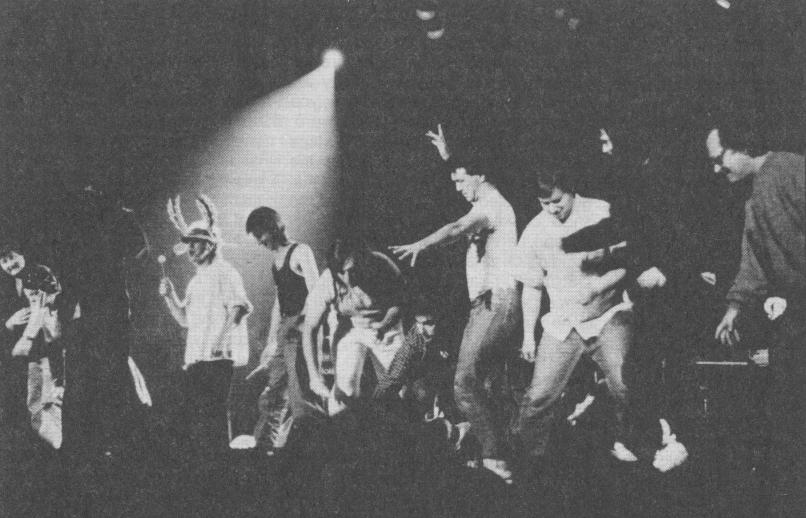
Audience Participation
2/14/88 Philadelphia, Penn.
Photo by Scott Yobp
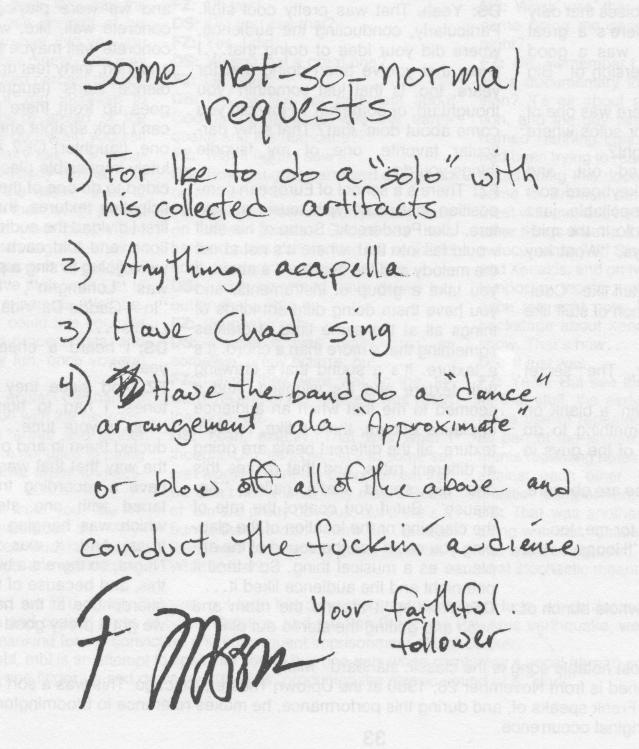
DS: Yeah. I imagine that the best place to be, to be able to hear that is front and center on the stage, it seems that all the sound would be directed toward that place.
FZ: Well, probably no. Probably the best place to hear it would be maybe thirty feet ahead of where I stand out over the audience up high. Then you get a better global picture of it, because where I stand, a lot of what I hear is coming out of the side-fill monitors and my own monitor box.
DS: I just wonder whether or not it would be a real, certainly I imagine it would be a challenge to try to set up you know, while a tour's happening, try to take a specific occasion of doing that experiment, and trying to get the optimum recording of it.
FZ: You can't because there's always one guy in the audience who doesn't want to, you know, he's gonna yell "Dinah-Moe Humm" no matter what happens. And that's part of reality.
DS: That's true.
FZ: Because a couple of times I tried to do that just to get a sample of it for the synclavier and you can't make the audience behave. You know, they're there for a good time, they're not there to record.
DS: Sure, and they sell beer in the lobby.
FZ: Yeah.
DS: What are the signals you use? I'm familiar with some of them.. Like I know that that essentially means "get ready." And that's the "high" sound. That's the "low" sound. What other ones do you have?
FZ: Well if I go like this, that's "play reggae." If I go like that it's "play ska."
DS: Right.
FZ: Um ... is eleven.
DS: Eleven, sure.
FZ: And ... is thirteen. And stuff like that.
DS: I've seen your "A" chord or...
FZ: Yeah, it goes "C" and you go "A".
DS: Do you do any other chords besides that? I've seen you do "C" and "A".
FZ: No.
DS: It seems that those are easy ones that the hand would accommodate.
EB: Mariachi?
FZ: Oh yeah, and this is "Weather Report."
DS: How do you do some of these other things I've heard, "Mr. Rogers"?
FZ: Oh God, what was the signal for Mr. Rogers? I point to my shoe.
DS: That's pretty funny stuff. OK, back to secret words ... shellfish.
FZ: Um... that was Paris.
DS: Yeah.
FZ: And um, somebody had gotten ill, from eating shellfish. And so, there had been some discussion about this is one of the things you don't want to do when you're on the road is go out and gorge yourself on raw oysters in places where the bacteria count is high in the water. Like you want to commit suicide? Eat oysters in Naples. Because the raw sewerage that's dumped into the...
DS: Right, yeah ... yeah. OK, we briefly mentioned "cornhole" from Mannheim. You said something about that, but I don't recall how that, what that was about.
FZ: I don't know how that one came up. I mean cornhole is one of those traditional stupid, uh ... uh, playground humor words. Playground psychotic words.
DS: You used it quite alot that particular evening.
FZ: Yeah. Well that's what the secret word is for. You just abuse it. How far can you take it? How many times can you stick in the wrong word in the middle of a song and literally change the meaning of the song?
DS: Do you think that doing that alienates many people in the audience who don't know what the fuck is going on?
FZ: Well I know on one occasion it gave us one of the worst reviews we ever got of a concert and it certainly baffled and alienated a large portion of the audience in Paris when in '82, or no '84, the secret word was "Danger Will Robinson." You know from Lost In Space?
DS: Yeah, we just saw a snatch of that on television this morning.
FZ: Well it's like the way Robbie the Robot's arms go, well they go like this. (laughter) They just flop around like that. And we were joking about that at the soundcheck and I remembered it and it cracked me up so much that through the whole show all I had to do is just a little of this and Ike was falling all over the place, (laughter) and we really had a great time with it on stage, but the French critics thought that it was just this horrible show.
DS: They didn't understand.
FZ: They had no idea what it was and so we were, to use one of the words made popular by Jane Fonda, we were excoriated for doing Lost In Space.
DS: Right. Alright I got one last one ... which is from Graz which is "hairpiece."
FZ: Oh, did you ever see that Cheech and Chong movie where they play these two Arab brothers?
EB: The Corsican Brothers?
FZ: No, not the Corsican Brothers. They play these two Arab guys.
RS: Hairpiece, I need a new hairpiece.
FZ: Yeah. That's what it was, that's right.
DS: So I'll have to see the movie to understand that.
RS: Wait. Before you go off the secret word, do you remember the second show in Rotterdam where it started off with you introducing the band and talked about how Ed Mann had screwed up the lick?
FZ: That's right.
RS: And then the secret word became about rehearsal.
FZ: Well the thing is that was the first show in the tour where the band really let me down. They really started to play wrong notes. Unexcusable wrong notes. And I started talking about, "What," you know "maybe we should rehearse more." And for two or three days on the tour everybody had their nose out of joint like I have no right to tell them that they're playing wrong notes, of course they were playing. And in Europe people listen to the notes. They're more interested in musically what you're doing. [To Jim Nagle as he is leaving] Have a nice holiday.
JN: It's six below in Chicago.
FZ: Well you're asking for it. You're going back there with fuckin' laryngitis. They're going to send you back in a casket draped with a flag. Be careful. Did you know what the CNN Report said? The coldest day of the century.
JN: When, yesterday?
FZ: Yeah. It's that fuckin' ozone layer.
JN: But I'll call tomorrow and see if Gail has that name. OK, goodbye. Nice to meet you, thanks.
EB, DS, RS: Goodbye, thanks, take care.
DS: OK. Did Harry Andronis ever get his equipment wet?
FZ: Oh yeah.
DS: Good for Harry. During a rehearsal in Boston you were fiddling around with a tune and I asked you what it was and you told me it was an R&B tune called "Diddley Daddy". Who was that done by?
FZ: Yeah, Bo Diddley.
DS: During "Torture Never Stops / Lonesome Cowboy Burt" quite often there were these references to Tom Petty being the "butt-ugliest human being known to rock and roll." Where did that come from?
FZ: That was a line that Ed threw in one night.
DS: Something that he made up?
FZ: Yeah, unless he got it from someplace else, but it wasn't my idea. That's Ed's comment.
DS: You described "I Left My Heart in San Francisco" as being one of the ugliest songs ever written. What makes that song ugly?
FZ: Oh, I'm just joking, that's not the ugliest. I think "Happy Birthday" is one of the ugliest songs ever written. (laughter) That was a comment from the Munich show, where we got the audience to sing along with it.
DS: I have this one as being from ... one of the ugliest, maybe it was from Munich where the audience...
FZ: Sang it.
DS: ... Actually liked it and you did it twice or they had them singing it...
FZ: Oh then that was ... one place where they really liked it, yeah. I can't remember what city that was, but in Munich I asked the audience to sing along and then I said "Ayee! That was ugly as fuck." No, "I think that was ugly as fuck." That's what it was.
DS: That was the "jazz" night?
FZ: Yeah.
DS: In Springfield and in Burlington you were poking fun at Eric because of his shoes. What's significant about Eric's shoes?
FZ: They're very, very large.
DS: What size are they Eric?
EB: Thirteen.
DS: Yeah, they are large, thirteens!
EB: Oh right, but I had lost them. I had left them at the hotel before that. That's what that was. I leave stuff all over the place.
DS: In Portland, something happened that brought on the song "Stainless the Maiden". Tell me again, because I've heard a cheezy tape of this so I have to use my imagination.
FZ: A girl walked up to the stage and handed us a Christian songbook. And so I thumbed through it and handed it to Bobby Martin to sight-read it. And
that's how "Stainless, the Maiden" got in the show.
DS: It's hard for me to imagine a Christian song called "Stainless the Maiden". Pretty bizarre.
FZ: Well, that's why it's in the show. (laughter) If you're gonna pick a Christian song how about "Stainless the Maiden", huh? (laughter)
DS: In Providence you told the audience that the local police there believe in the devil, that it said so on TV that evening. Do you remember what that news story was about? I assume it was a news story.
FZ: It was. I had done an interview prior to the show with some local television station and they're the ones who told me that they had a Satanism squad (laughter) or something related but with the police and Satanism. It's just ridiculous.
DS: That is ridiculous. Although your efforts to register voters was greatly successful, there were some problems. Such as the League of Women Voters' objections to the banner which said "Lick Bush In '88" and some other things. Can you tell us about some of the resistance that you met with in your efforts to do voter registration?
FZ: It was regional resistance. I mean one example was in Philadelphia, the Registrar of Voters for the area of the town where we were playing at the Tower Theater refused to send over voter registration slips because he said "we already have enough registered voters." He liked things the way they
were.
DS: Right, I remember that.
FZ: The other place we had troubles was Washington DC where the comment was made that "we don't know about his politics and so we're not going to send anyone over." And they withheld support. But we managed to get assistance from not the League of Women Voters there, but the Citizens' Action Group. And they sent registrars, and then in Detroit we couldn't register because of the weird laws that they have there. You'd have to have a registrar from every suburb. And all different forms and it would be just impossible to do it. In Chicago we couldn't do it because the registration had already closed. But just about everyplace else we did it. And we managed to register 11,000 people.
DS: All in all you felt it was pretty successful.
FZ: Better than none. I got other rock and rollers to do it at their shows. John Cougar Mellencamp did it. Sting did it. Earth, Wind and Fire said they were going to do it, but I don't know whether they ever did it.
DS: Do you have any plans for future voter registration drives or doing anything else? Certainly I would imagine for presidential campaign years, that there's a greater importance attached to that sort of thing.
FZ: I'll find something to do. You know, even talking about it helps.
DS: What about the show that was cancelled in Richmond and moved to Towson? They said that that was, they claimed, I read some newspaper accounts of that where they claimed that it was for logistical problems, some other band playing, or something like that.
FZ: No. Bullshit. The real thing was that was in the home territory of the PMRC and the word got out that we were going to play there and they got the school to cancel the gig. That's all it was.
DS: You think so?
FZ: Yeah. By the way did Jim Nagle tell you about the Honorary Doctoral Degree that I was supposed to receive from a Catholic university someplace back East? [29]
DS: No.
FZ: I was supposed to go there in March to receive this degree and they were going to play some of my music and they called back and cancelled. (laughter)
DS: Called back and went "woops."
FZ: Yeah. "Well we're not giving that degree this year." (laughter)
DS: OK, speaking about Towson, in that show something kind of peculiar happened havin' to do with Bob Rice giving somebody an enema. That kind of pissed you off.
FZ: Well, sure, because there was a female security guard who was hired to be part of the staff at the place and Bob Rice who was basically hired as a roadie decided to use this enema that was dangling on stage as a prop. Actually it was something that I didn't tell them to put on stage, but the alto sax player had it hanging off of his stand. Bob went up there, took this thing and he was trying to impress this girl security guard. And during the encore when the guards were lined up in front of the stage facing the audience, he sneaked down behind the barricade and jammed this nozzle up her ass. While right in the middle of this song, you know, and I think that is inexcusable and so I stopped the show and told him to apologize, and "Don't ever do it again."
DS: And then took on from there.
FZ: Sure.
DS: There are some good little musical inclusions that resulted from that too. Lyric mutations and such.
FZ: Yeah.
DS: What's a "Screaming Albanian Jizz-Weasel"?
FZ: Uh, well, that's probably (laughs) one of the things you make up right on the spot. (laughter) That was Hamburg.
DS: That was Hamburg. Tell us about the dinner in Barcelona and the raffle that came with it.
FZ: OK. Well the tour had been going on and there's all this strife in the band and the crew was edgy and all this stuff, and travel in Europe is really very rough for the crew. We had a day off in Barcelona prior to this television show that we were going to do. I decided to throw a party for the band and the crew, and I rented this restaurant and told the promoter there to arrange to get three prostitutes, and prostitutes are a very common thing in Barcelona. I said, "Get three prostitutes to come down to this dinner and we're going to have a raffle", that any members of the crew that would like to have the opportunity to get their machinery wet with one of these Barcelona hookers, that all they do is enter into the raffle. The girls came to the party, did a strip-tease and danced. They brought their own music and, this whole bunch of hoopla. It was a straightforward business deal. It was like a "rent-a-girl" business. And Marqueson the monitor mixer was one of the raffle contestants and he won a girl. And so the deal was that after the dinner the girls were going to go back to the hotel with the lucky winners. But what happened was, Marqueson's girl took off. After the dinner, you see, everyone left and they thought they were going to meet the girls back at the hotel, and I stayed around for a while at the restaurant. About the time I was leaving, Marqueson was returning in a cab, and he was nearly in tears because his prize was gone. (laughter) This led to a situation where the promoter, who had arranged this thing, assured me that everything was going to be, you know, a very smooth operation, became totally irate that he had been fucked over by the pimp who had supplied these girls, (laughter) and saw to it personally that Marqueson got his machinery taken care of. It took him an extra couple of hours, but Marqueson got taken care of, and so, all was right with the band and crew the next day for the television show. So, during the show, we're making jokes about the raffle, and Marqueson, and that kind of stuff.
DS: Alright. They did a video of that. I hear also that there was one made in Madrid. Is that right?
FZ: Yeah.
DS: Did you access tapes of that, and will we see any of that show?
FZ: TV3 from Barcelona owes me a real master tape. They gave me a master tape after the show, but it was fucked up. It won't play, and I still have yet to receive a real copy from Barcelona. All I've got is a VHS. The thing from Madrid was just a three-quarter [inch tape].
1. A reference to the lyrics of "Wind Up Workin' In A Gas Station".
2. This is a reference to a question that Eric facetiously asked Frank during the "questions from the audience" portion of "An Evening With Pierre Boulez and Frank Zappa" on May 23, 1989 at Schoenberg Hall, UCLA, Los Angeles.
3. May 28, 1988, Sporthalle, Linz, Austria.
4. Geraldo Rivera, jive-ass idiot television talk show host. 17
5. February 19, 1988, Orpheum Theater, Boston, at the end of "Advance Romance".
6. March 12, 1988, Memorial Auditorium, Burlington, Vermont. This happened as a result of Frank forgetting lyrics in "The Man From Utopia Meets Mary Lou" (medley).
7. February 10, 1988, Warner Theater, Washington, D.C.
8. February 14, 1988, Tower Theater, Upper Darby (Philadelphia), Pennsylvania.
9. February 9, 1988, (actually February 10, very early in the morning) CBS News Nightwatch, with Charlie Rose.
10. March 1, 1988, Frauenthal Auditorium, Muskegon, Michigan and March 4, 1988, Auditorium Theater, Chicago.
11. from the "Light Cavalry Overture" by Franz von Suppé.

12. from the "Hawaiian War Chant".
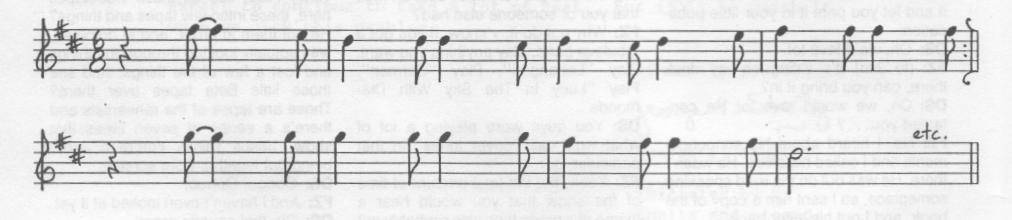
from the "Hawaiian War Chant" (as played by FZ).
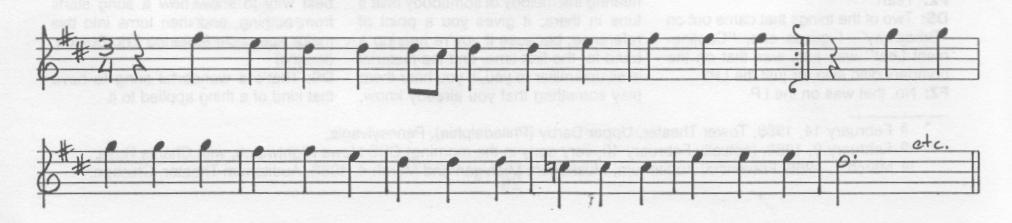
13. the "Circus Lick".

14. June 10, 1989, WUTC, Chattanooga, Tennessee, Frank Zappa Special with Ken Dryden.
15. Hannah And Her Sisters.
16. April 14, 1988, Sporthalle, Köln (Cologne), W. Germany; April 16, 1988, Brighton Centre, Brighton, England; April 24, 1988, Stadthalle, Bremen, W. Germany.
17. From a skit on December 11, 1976, NBC, Saturday Night Live appearance.
18. May 24, 1988, Martin Schleyer Halle, Stuttgart, W. Germany.
19. This is a mistaken reference to the military air show disaster at Rammstein Airbase near Mannheim, not Stuttgart.
20. This incident possibly happened on the 1980 world tour. Frank did not tour Europe in 1981.
21. May 25, 1988, Mozarthalle, Mannheim, W. Germanj:
22. May 26, 1988, Stadthalle, Fürth, W. Germany.
23. May 28, 1988, Sporthalle, Linz, Austria.
24. This permutation was performed only a few times at the beginning of the 1984 world tour.
25. Representing the PTL, Sandy Galaway put forth her conviction that Hurricane Hugo, which decimated parts of the West Indies and coastal areas of South Carolina, and the San Francisco Bay area earthquake, were God's way of punishing mankind for the conviction and subsequent imprisonment of Jim Bakker.
26. Mbl, mbl, mbl, mbl is an attempt to spell that sound that one gets when combining a vocal (throat) sound with the act of brushing one finger up and down over the lips, producing the classic sound of a"dork".
27. Erroll Garner's most notable song is the classic standard "Misty".
28. The tape mentioned is from November 28, 1980 at the Uptown Theater, Chicago. This was a sort of a re-creation of the event which Frank speaks of, and during this performance, he makes reference to Bloomington, Illinois, perhaps the site of the original occurrence.
29. Duquesne University in Pittsburgh.
Read by OCR software. If you spot errors, let me know afka (at) afka.net