Frank Zappa
By Jesse Nash
The Beat, August-September, 1988
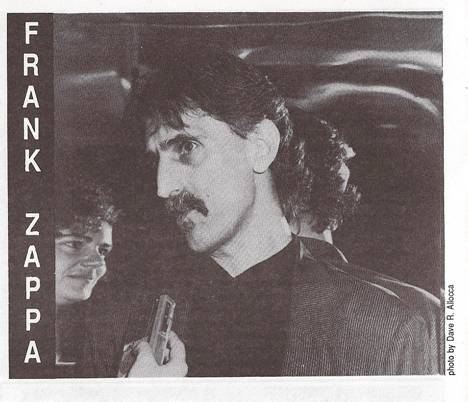 There are only a few of them around. Yeah, they make a lot of good music, but they also do a lot more. They care about the country they live in. They use their medium to deliver a message. Woody Guthrie sang his lungs out to call attention to the plight of the American laborer. Bob Dylan smelled something wrong with American society in the '60s and called attention to that scent that was clearly 'Blowin' In The Wind.'
Now, Frank Zappa has grabbed the horns of responsibility and trumpeted their message to a vast audience hinging on every note. He has nearly single-handedly defeated voter apathy in his youthful audience by registering thousands of fans at each of his concerts and urging them to make their voices heard in this presidential election year.
He has probably been most visible in recent years for his celebrated battles on behalf of the First Amendment rights for musicians that are beleaguered by the radical right wing organization of political wives billing themselves as the Parents Music Resource Center (PMRC).
He has testified before Congressional hearings and at music symposiums calling for non-censorship of free speech in records. He has battled members of the PMRC, including the wife of presidential candidate Al Gore of Tennessee, Tipper Gore, on numerous occasions in forums that have included national television news shows like Nightline.
He has put himself on the line for what he believes in. And, oh yeah, he continues to make great music. Still, his current music focuses on his struggles with the PMRC and contains references to quotes from such politicians as Senator Paula Hawkins of Florida, Senator Paul [Trible] of Virginia and Senator Ernest Hollings of South Carolina.
This year is an election year in the United States. Frank Zappa feels we should all take part in it.
ZAPPA: I took that stance because I was right. Look at this society today with political groups like the PMRC. This would have been unheard of in the sixties. So many people have conformed. I just saw it happening before anyone else.
BEAT: Now, you've been accused of promoting decadence through your lyrics...
ZAPPA: Nobody ever accused me of saying anything nasty. I've been left off every one of the lists of offensive musicians. However, John Denver is on the lists, as is Springsteen and Stevie Wonder.
BEAT: Why would they bother with someone like Stevie Wonder and not you?
ZAPPA: I have a feeling the fundamentalist groups wouldn't want to attack me. I think they are afraid of me. I think that out of all the people they had to choose from in the music business, I'm the one most likely to give them a hard time. That seems to be evident because 99 percent of the people listed kept their mouth shut.
BEAT: This issue has been one that you have been pursuing for a long time now. Does it agitate you that so many in the music business have kept quiet while Frank Zappa stands up and speaks his mind?
ZAPPA: No, because I do understand the reasons why most of the music industry has kept silent. For one thing, in order to argue with the moralists, you have to do a little homework, which means taking the time to establish the right reasons to come up with the proper arguments. I think that the interests of the music business is not particularly in that direction. Management has instructed their artists to keep quiet. There seems to be the attitude that if you keep quiet, the problem will go away by themselves. But, as you can see in most situations in life, problems do not just go away by themselves. You have to deal with the problem first.
BEAT: Do you think management will look stupid for being so lame on this subject? Or do you think they might get away with their attitude, 'Keep quiet and the problem will go away?'
ZAPPA: No, I think that the fundamentalists do not plan on slowing down their efforts. The PMRC will be in business for a long time. In an election year, all the politicians love the issue of pornography in one form or another so they can appear in public like a knight in shining armor and announce to the world, 'We will clean up this country!' It's 1988, but with guys like Gary Hart running for office claiming that his religion states we are all sinners, it is beginning to sound a little hypocritical.
BEAT: Do you feel that Americans are becoming more conservative than in the past? We are in an era where sexual promiscuity is no longer tolerated due to the ever increasing perils of the Aids Crisis. Is it possible that the so-called porn rock opposition movement is a result of all this?
ZAPPA: No. The people who believe that the issue of rock lyrics is more important than problems with our nation's poverty or with the deficit is in the minority. The PMRC received over 10,000 letters before the hearings and thought that was a lot. I happen to feel that 10,000 letters is a minimal response, but Ann Landers ran a letter in her column by a woman demanding warning labels on rock albums that received a response of over 20,000 letters with the response 90 - 1 AGAINST labeling.
The censorship movement is an orchestrated piece of business not just about rock n' roll lyrics. In San Antonio, an ordinance was created stating that the age of 13 was the minimum age for a healthful person to see a rock concert. A former psychiatrist for the U.S. Air Force made a study and determination. The city council and mayor agreed. This ordinance is a way to circumvent the First Amendment. There is a distinct possibility that because of the ruling in San Antonio, that other small-minded communities might follow suit. They might use this ordinance as a model.
BEAT: Do you feel the Republicans are responsible for this?
ZAPPA: The Republicans usually are responsible for breeding this brand of nonsense. They tend to enjoy using the white knight, anti-smut business as a strong component of their platform. I mean, you can't blame everything on the Republicans. Some of the most conscientious people in government today – Senator Lowell Weicker of Connecticut – are Republicans. There is a bad case of fringe-mentality going on in Washington D.C. these days, but you must give credit where credit is due. The fringe-mentality people are Republicans in name only. What bothers me most is the direction they are heading in – somewhere on the road to creating a theocracy in the United States. It's very disturbing!
BEAT: Let's move on to aspects of your career in music. You started out in high school with a band called The Blackouts.
ZAPPA: Yes, one of my more favorite musical inspirations.
BEAT: You studied music theory for just six months at Chaffey College in Alta Loma, California, and then in the early sixties you began performing with Don Van Vliet, better known as Captain Beefheart. How did this come about?
ZAPPA: We went to school together. Unfortunately, Don had to quit college due to some problems at home. We would get together and play at his house. We came up with some fucking great music during those days. People thought we were kind of weird but we were just keeping up with the times.
BEAT: In 1964 you started a band called The Soul Giants which evolved into The Muthers, then The Mothers, finally settling in with The Mothers of Invention. Why all the name changes?
ZAPPA: First of all, The Soul Giants had nothing to do with The Mothers of Invention. It was a separate band with different people. We went through so many changes because management felt no one would buy our records with the name being The Muthers with a U and what not. So we became The Mothers of Invention.
BEAT: I've read in certain tabloids that the late Lowell George was a brief member of The Mothers of Invention. How did this come about and what was it like to work with him?
ZAPPA: Lowell was a great friend of mine and one of the most talented people to ever grace the music industry. We became friends when Lowell joined the band. I was responsible for forming Little Feat. I introduced him to all the guys but because of my strong relationship at that time with Warner Brothers Records, I arranged his first record deal with the label. History was made.
BEAT: It became a disturbing practice for you to print the incorrect song lengths on the labels of your albums. What was your reason for this?
ZAPPA: Who the fuck told you that shit? That is a bunch of crap! Why would I want to do something like that? Seriously, where did you get that information?
BEAT: I read it in a music encyclopedia.
ZAPPA: Those assholes never get it right! I never talk to those idiots for dumb mistakes like that!
BEAT: Tell me about your relationship with your kids, Moon Unit and Dweezil. In 1982, Moon Unit came out with the song 'Valley Girl,' which virtually made a celebrity out of her overnight. How did that affect your father-daughter relationship with her?
ZAPPA: Well, at the time Moon Unit was in high school. She took a test at the age of 15 to graduate, and she passed. This was a good move because she had all her time to concentrate on one thing; it took the pressure off her a bit. But like any father with his kid, we go through the same normal everyday occurrences. Dweezil took the same test and passed. Being in the limelight is just as hard for a 15 year-old as it is for anyone older; it is the ability to handle the pressures that separate you, of course, from your ability to stay on top. I have always had a good rapport with my kids, so that helps as well.
BEAT: Do you feel that Frank Zappa might have been born in the wrong era? You have tremendous classical influences with Varèse. Do you feel you might have been more at home in that era than, let's say, today?
ZAPPA: No way. What would I have done without my Marshalls or my Seymour Duncan amps? I'm perfectly content to be in this time and place.
BEAT: Tell me about your current tour? What do you have in store for us?
ZAPPA: Well, that's a good question. I just came up with the perfect title for this tour. I call it, 'Broadway The Hard Way.' What makes this tour so interesting is that we are making available for all those who see my concerts to be able to register to vote. That's right! We should increase registration by as much as 250,000 to 300,000 voters. This is a very effective way of getting our younger generation to take part in the vote to elect our politicians. We have the option to vote for the members of our government, we have fought for hundreds of years for this right, while other countries do not have any rights at all, we should be grateful and use this opportunity to express our popular opinion. On this tour, I'm also bringing my recording studio. I have a mobile truck that goes on the road with me. We're going to record every concert and it looks as though there should be a live album called, 'Broadway The Hard Way,' later this year.
BEAT: Let's get into some questions about the technology you use. What kind of guitar do you play?
ZAPPA: A Fender Stratocaster.
BEAT: Amplifiers?
ZAPPA: I use Marshalls and Seymour Duncans.
BEAT: What is your preference in microphones?
ZAPPA: Sennheiser.
BEAT: Throughout your long and prolific career you have tested the limits of rock and popular music, formerly with unconventional songs, orchestrated music influenced by Varèse, such as your 'Jazz From Hell' record. Your music demands virtuosity by its interpreters. Your derisory attitudes toward society presaged the punk movement. Your awareness seems to be far greater than most musicians in this industry. What are your feelings about what I have just said?
ZAPPA: I don't feel that I am ahead of my time or more aware. I just speak my mind and express my feelings whether it be verbally or as an extension through my music. People have accused me of being weird or ahead of my time. I prefer to think of myself not so much ahead of my time but more able to keep in pace with it.
I will be around for a long, long time. As long as people care about the music they listen to, the government that we elect to office, etc., I will be here to inject my two cents. To quote one of my more commercial songs, 'I may be totally wrong but I'm a Dancin' Fool!' It ain't easy being Frank Zappa!
Another a little bit different version of this interview by Jesse Nash was published in Rockbill.
Source: slime.oofytv.set
Read by OCR software. If you spot errors, let me know afka (at) afka.net