The Zappa Affair
Kent Nagano, The Berkeley Symphony And Sinister Footwear
By Sarah Cahill
Option, March/April 1987
Kelly Johnson, the manager of the Berkeley Symphony, would rather not talk about the "Zappa Affair," which was one of the symphony's most exciting, and most damaging, productions. Johnson would like to forget what he calls the "nightmare of 1984" and concentrate on the very successful current season. It seems as if no one who had a part in the Zappa concerts wants to be reminded of the experience; one past board member says her "blood pressure goes up every time I think about It." Even now, several years after the Zappa extravaganza, people talk about it with hostility and anger.
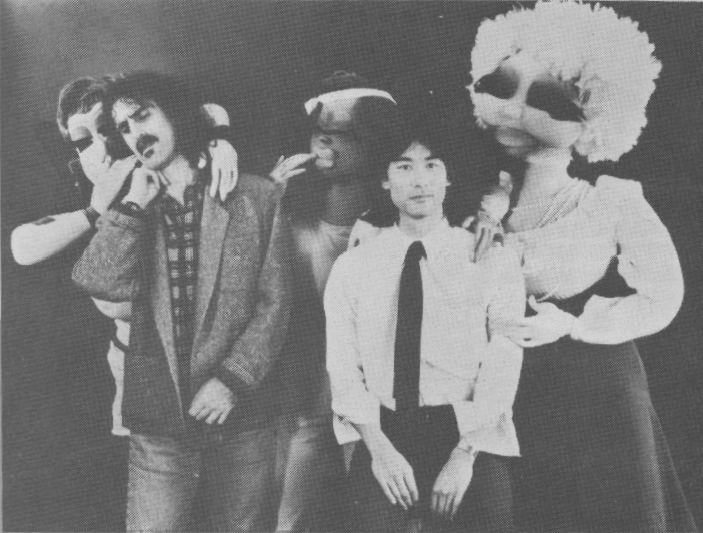 What went wrong? Why is it a sore point in the symphony's history? After all, the show was a big critical success. The way it combined theater and dance and larger-than-life puppets with Zappa's music produced "one of those rare times," said the Oakland Tribune, "when a wild new concept is fully realized." The San Francisco Examiner called it "an example of exciting and worthwhile theater." But while it was a dazzling and engaging production, It was also an expensive and disorganized one. What began innocently enough as an evening of Zappa's music, played by the Berkeley Symphony, was expanded into a multi-media performance, and the artistic visions of the people who planned it ended up being far too ambitious for the budget.
The Skaggs Foundation gave the symphony $20,000 for the Zappa project, but the grant hardly began to cover expenses. "I saw the budget go from $50,000 to $100,000 to $130,000," says Johnson, who had just assumed the position of manager and found that all the decisions had been made by the time he arrived. Among choreographers Tandy Beal and Joan Lazarus, designer John Gilkerson, conductor Kent Nagano, and Zappa himself, there were bound to be some personality clashes, which hampered the project. The Oakland Ballet was scheduled to perform, and pulled out halfway through the planning stages. After the show, bills were left unpaid, tempers were high, and the Berkeley Symphony was getting a bad reputation. No one could control the budget; the symphony was going hundreds of thousands of dollars into debt. Johnson describes his first few weeks on the job, and the mental strain of receiving nasty phone calls all day long from everyone involved: "I would come to work, get beaten up, and go home; come to work, get beaten up, and go home."
An outside observer, on the other hand, would say that the Berkeley Symphony's "Zappa Affair" was a real coup, and typical of the symphony's adventurous dedication to excellent performances of contemporary music. In its previous incarnation, as the Berkeley Promenade Orchestra, the group played standard informal concerts of well-known and well-worn repertoire. Kent Nagano, who took over as conductor in 1977, has trained and polished the orchestra so that now, he says, "We've accepted the responsibility to play contemporary music, which, relatively speaking, we play more than anybody else in the Bay Area, and we're not afraid of any type of repertoire. We've played the most difficult repertoire that exists."
The composer to whom Nagano and the symphony have the strongest ties is Olivier Messiaen; they performed the west coast premiere of his Des Canyons Aux Étoiles three years ago, and the composer himself has given his blessing to their renditions of several other works since then. Nagano stays open-minded and doesn't limit his program choices to fit within "classical" boundaries: besides those of Zappa, he has recently introduced works by Wendy Carlos (the acoustic version of her electronic Moonscapes) and Toru Takemitsu's Riverrun. In February the symphony will premiere Noosphere by the Grateful Dead's bass player, Phil Lesh.
Nagano has different strategies for approaching each composer who interests him. Messiaen piqued his curiosity when he couldn't follow one of the composer's dense scores. "It's always different," Nagano says. "I approached David Harrington of the Kronos Quartet to work with us, and we decided it would be fun to jointly commission a piece; and he suggested Wendy Carlos, whom I had never heard of before. That's how I met her, and it started a friendship that is long-lasting. I've worked a lot with Elliot Carter, and that's because I was assigned a piece of his to do with a different orchestra and that's how we met, and we became close friends afterwards. Olivier Messiaen was my own personal interest, and I used his music to help train the orchestra; he asked to be invited to come join us to help us prepare for some concerts, so I met him on his invitation. Some local composers, like John Adams, who's really great, I've known because he's a local figure and I've been aware of his music for a long time. It's always different."
Nagano came to see Frank Zappa backstage during a 1981 Zappa tour, and mentioned some pieces he had heard Zappa had been working on, which hadn't been performed. Zappa was reluctant to pull them out and rework them, but Nagano's perseverance apparently convinced him. Nagano calls Zappa's scores "phenomenal." The two started working together on the four pieces – Bob in Dacron/Sad Jane, Mo 'n Herb's Vacation, Sinister Footwear, and Pedro's Dowry – and soon afterwards Nagano led the London Symphony Orchestra for the recording. The Berkeley Symphony's "Zappa Affair" marked the first performance In the United States.
Nagano grew up in Morro Bay, California, and trained with Sarah Caldwell at the Boston Opera. His career has taken off in the few years since the "Zappa Affair." He was recognized as one of the world's top new conductors when he won the Seaver Conducting Award in 1985. While more and more jobs jet him around the world – to Paris for the Opera and Pierre Boulez's Ensemble Intercontemporain (he's Boulez's assistant), to London for the Symphony, to Boston, to Tokyo to help Seiji Ozawa inaugurate the new Suntory Hall, to Milan for his La Scala debut – he will tell you that his heart stays with the Berkeley Symphony.
If he's just saying that to be polite, the concerts don't show it: Nagano sticks to the same amount of rehearsals – twice as many as most orchestras have – and performances are, if anything, tighter, more refined, more exciting than those of a couple years ago. This is unlike the situation of many "resident" conductors who bounce around the globe, leaving their groups stranded; the only adverse effects of Nagano's extremely busy international conducting schedule seem to be the physical strain on him. He says he appreciates working with the Berkeley Symphony because he's able to try out new ideas and fresh approaches, especially with classics like Beethoven and Mahler symphonies; this is difficult with older, more established orchestras who have preconceived interpretations of standard works.
At the time of the Zappa concert, it was obvious that a brilliant imaginative conductor couldn't keep the symphony afloat by himself. It was financially foundering, and in between managers; no one knew quite how to give it a practical direction. Because of inadequate publicity a lot of Berkeley residents didn't even know the city had a symphony. The Zappa concert, which was meant to be a benefit, put the orchestra under an economic cloud. In the last year, however, a new leadership has turned things around: the combination of Nagano, Johnson, and a new board of directors has brought a real solidarity to the Berkeley Symphony that's never been there before, and is largely responsible for their recent success, which found the current season's opening concert in November sold out.
These changes don't mean that big extravagant productions like the "Zappa Affair" won't happen again. It just means that when they do, the people behind the scenes will get the same satisfaction out of it as the audience does. People who went to the Zappa concerts remember them as one of the symphony's best productions ever. Unfortunately, people who worked on the concerts still think of them as a painful episode. "Every year," remembers Nagano, "we'd hit some major financial crisis and it would send tremors through the orchestra. Now there's not so much of a change In the orchestra itself – every year we get a little stronger, we get a little better – but there's been a fantastic change in terms of the level of organization and the quality of administration."
Read by OCR software. If you spot errors, let me know afka (at) afka.net