Orchestral Maneuvers
By Bill Milkowski
Modern Recording & Music, August 1984
After 18 years of playing practically every concert hall and hockey rink in the free world, Frank Zappa was nearly ready to call it quits. Disgusted with the whole exhaustive prospect of touring and playing before legions of rowdy, potentially violent fans, Zappa decided to shelve his rock career in order to concentrate on other pursuits, namely, symphonic music.
Phase One of Zappa's new career began last year with the release of a digitally-recorded album of his ambitious contemporary symphonic pieces, performed in concert by the London Symphony Orchestra. That program was conducted by 31-year-old Kent Nagano, of the Berkeley and Oakland symphonies. The recording session was produced and engineered by Zappa for his own Barking Pumpkin label.
Phase Two occurred in February 1983, when Zappa shared the baton with maestro Jean-Louis LeRoux for a 100th anniversary celebration of the music of Edgar Varèse and Anton Webern, which was performed by the San Francisco Contemporary Music Players at the city's War Memorial Opera House.
Zappa's burgeoning interest in symphonic works continues. This past January, three original Zappa chamber compositions were performed by conductor Pierre Boulez's prized chamber orchestra, the Ensemble Intercontemporain, with Boulez himself conducting the proceedings at the Theatre De La Ville in Paris. An album on EMI Records is forthcoming.
Last spring, Nagano and his Berkeley Symphony presented the world premiere of Zappa's "Sinister Footwear," a ballet performed by the Tandy Beales Company and featuring the puppet creations of Ron Gilkerson.
And there's more. Zappa has been invited to guest conduct at the prestigious Magghio Musicale Fiorentino in Florence, Italy, and has also been asked to guest conduct for the Honolulu Symphony 1984/85 season and to conduct his own music and selections from Edgar Varèse at the University of Buffalo in 1985.
All this from the man who brought you such irreverent rock classics as "Don't Eat The Yellow Snow," "Dinah-Moe Humm," "Illinois Enema Bandit," "Half A Dozen Provocative Squats," "Help, I'm A Rock," "Saint Alfonzo's Pancake Breakfast," "My Guitar Wants To Kill Your Mamma" and the notorious "Stink Foot," to mention just a few in his discography of hundreds of recorded compositions.
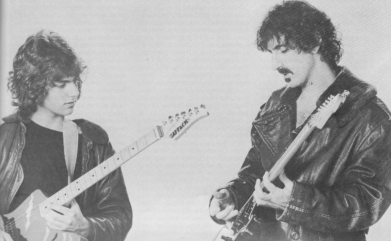
Zappa has not abandoned his rock career. He's just put it on the back burner for a while. This summer he plans to release Them Or Us, the 36th album of his career. Besides featuring his regular band of Steve Vai and Ray White on guitars, Chad Wackerman on drums, Bobby Martin and Tommy Mars on keyboards, and Scott Thunes on bass, it will be something of a family affair. His oldest son Dweezil will be making his debut with daddy, playing some insanely wicked wang-bar riffs on "Stevie's Spanking" and a reggae remake of "Sharleena," a love ballad that originally appeared on Zappa's Chunga's Revenge album. Daughter Moon Unit will also make an appearance on the new LP, offering up a Valley Girl rap for a mock aerobics tune called "Hoznia." And Zappa's youngest son Ahmet Rodin actually penned one of the tunes, "Frogs With Dirty Little Lips," which is a little ditty he dreamed up at the age of six and sang around the house every day. Johnny Guitar Watson also makes an appearance on the new album. Other tunes include "Baby Take Your Teeth Out," "In France," "He's So Gay," "Won Ton On" and "Planet Of My Dreams."
And as if that weren't enough... there's also a book in the making and a Broadway musical in the offing, a production called Thing Fish, which Zappa has been working on for some time now. While in New York recently, Zappa talked about his music, his career and where he's headed.
Modern Recording & Music: I understand that you had a harrowing experience in Palermo, Italy, the last date on the last rock tour you did. Was that something that turned you off to touring?
Frank Zappa: I would say so, yes. What happened in Palermo was... we were working in a soccer stadium, it was the last concert on the tour, and I had been looking forward to playing in Sicily because my father was born there. And that afternoon I had taken a drive over to his hometown, this horrible little village called Bartenicco. So I checked that out, you know, getting into the Sicilian vibe of it all. There's this Italian schmaltz connected with Sicily for all people of Italian extraction.
So anyway, I was in a pretty good mood after exploring these old haunts. I get to this gig, had a great sound check, I had written a song that afternoon and taught it to the guys in the band ... everything looked like it was going to be fine. We start the show and within 10 minutes of the beginning of the show there's this weird something going on, but you can't see the audience. It's totally black out there. They're a million miles away cause we're out in the middle of this soccer field. And I hear some disturbances. Suddenly, they got the army there and the police department and they're all fucking armed to the teeth. The next thing I know, the tear gas starts going off and guys are kneeling down with rifles, like mortars, shooting this tear gas into the stands. Bricks start flying. It turned into chaos. And we kept on playing through this. But it got so bad that we had to put wet rags on our faces to keep the tear gas out of our eyes. And we kept playing on and on.
Finally, the lights start going on and we see that the place is being emptied out. They're firing tear gas all over the place and they're clearing these people out of the stadium. We played for about an hour and a half during this thing. And we found out later that some kids had brought guns to this concert and the cops had guns and they were shooting at each other like cowboys and Indians. Meanwhile, we're trapped in the stadium downstairs, some gangs had broken into the tour bus, there's rocks flying all over the place and it's like a little war going on. And what the fuck for?! We go there to play some music and it turns into a situation where people are injured.
MR&M: And you lost money on that tour besides.
FZ: Oh, yeah. The complete tour was financially very problematic, to the tune of $160,000. So after that whole experience there I'm saying, "Look, I am 42 years old, I like music a lot. But I don't believe that subjecting yourself or the audience to that kind of potential abuse is something that you must have to do in order to make music. I think it's quite enough to make records. And I've got at least the next five records already on tape, 37 tunes ready to mix, with the last road band. And I'm not saying that I'm never going to go on stage again because I've done some conducting since that tour of Italy was over. But to go out there with an electric guitar and play rock 'n' roll music on a regular basis night after night in town after town ...I don't want to do that. I've done it ...20 years of it. It's enough.
MR&M: Would you agree that what did happen in Palermo is an extreme example of the potential for violence at any rock concert today?
FZ: Anyplace, but especially in Europe. There's a large amount of anti-American sentiment over there as a result of the actions of the present administration. It used to be that if you were an American, your name was mud. Now your name is shit. Because, if they see you on the street, you are the visible manifestation of everything they hate about a regime they don't understand, located someplace else, that threatens their country. There's so much distrust and distaste for American behavior and ideals right now. It's a bad time to tour.
MR&M: What about the American concert circuit?
FZ: American concerts are dangerous to do also because the Americans don't have any money to go out and buy tickets. So, the only things I'm really interested in doing on stage now are things with orchestras or chamber groups.
MR&M: You have no degrees, no mentor or no formal music training, yet you're composing this incredibly difficult music. How did you teach yourself?
FZ: I went to the library. It's free and it's there. And until they close down the public libraries in the United States, everybody has access to the same information. Just go and do it.
MR&M: So you were hungry for this sort of information at an early age?
FZ: Yeah, I started when I was about 14. I was writing symphonic pieces before I ever wrote a rock 'n' roll song.
MR&M: And throughout your career it's been trial-and-error with the various projects you've undertaken?
FZ: Yeah. I don't think I've mastered any of the techniques but I've gotten to a point where I'm severely competent. And in order to master the things that I've set out to master, the main thing that stands in my way is the budget to do it, because the stuff I'm working with is all expensive machinery and expensive personnel and things like that. I mean, I'm at the stage now where in order to do the things that I need to do, it requires resources beyond what I'm capable of providing for myself. Remember, it's my money that makes these things. I'm not funded by grants or foundations or anything. If I get a sales of a concert ticket, part of that money goes back into buying equipment and the airplane tickets for the next tour and paying the salaries of the people who go out. And the costs of making records keeps going up too. So I operate just like any other small business. The capital comes in to keep the business running so that people can consume it. I mean, I don't stick the money up my nose and I don't buy a yacht. It goes right back into the music. It's like converting the income I made from "Valley Girls" into this orchestra album. But I see no way in the future that I can continue funding such projects. This orchestra album is as much as I can spend, and it's kind of a dead-end project at that because we only pressed 6,000 copies of the album and it cost so much to do it that it's already a net loss as a project. So that gives me a number of problems for future projects.
MR&M: I understand you had a number of problems in getting this orchestral project together. What happened?
 FZ: Wanna know why we didn't do this thing in the United States? Besides the bad attitude we encountered, it was a money situation. We were originally going to record this with the Syracuse Orchestra with Christopher Keene conducting, and it was going to be premiered at Lincoln Center in New York City. We had made a deal with the Syracuse Orchestra and within a matter of days they managed to double the price. It started out at $150,000 for the whole project and then somebody in the orchestra union had found a whole bunch of extra rules that brought the cost up to $300,000. So I said no way.
MR&M: This project has gone through a lot of sidetracks along the way. You mentioned that at various times it was going to be done with the Krakow Symphony Orchestra, then the Mexico City Symphony, then Syracuse. How did you end up with the London Symphony Orchestra?
FZ: Well, as soon as we got this extortionary message from the Syracuse Orchestra we decided to try to contact a British orchestra. First we called the BBC Orchestra but they were booked solid for the next five years. Then we called the LSO and they said, "Well, we don't know whether we can do it because we're just finishing off a film score and the musicians have one week off before they have to do another film score." And since they get to vote on everything they want to do, they put it to the orchestra and the orchestra members chose to record my stuff rather than take a vacation. They went directly from Return Of The Jedi to my stuff to another film. We had just a certain number of days to do the whole thing, and they were rehearsing their butts off. We had 30 hours of rehearsal for one concert and three days to record.
MR&M: They probably didn't have to rehearse that much for Jedi.
FZ: Well, they didn't have to because it's more traditional notation. It's not that hard to read, no difficult counting involved.
MR&M: What were the problems you encountered with the Krakow and Mexico City orchestras?
FZ: I went to Mexico City and actually conducted their orchestra for a little while. They were very interested in doing the project, then after we had the rehearsal and we got down to what it would cost, the guy I dealt with added it up and wanted $400,000. He had somehow gotten a hold of what the scale would have been if I had done it in New York City. And there was no way that they were as good as the New York Philharmonic and no way that I was gonna give them $400,000... so I said, "Thank you, goodbye."
As far as the Krakow Orchestra goes, they had been after me for years and at one point last August, right at the end of a European tour, I was supposed to go from Sicily to Warsaw to start this project. It had all been set up at the beginning of the tour. Two weeks into the tour, martial law broke out in Poland and all this other crap was happening over there. So I said, "I don't think I want to take my recording truck into Poland next to the tanks. It's crazy to do that." So we passed.
MR&M: Can you tell me about the problems you encountered in dealing with the orchestra unions in America?
FZ: You have problems with the unions because of the way the union scale works and the cost per musician to do these projects and the further entanglement of union regulations that you have to wade through in order to do the project. That's only part of the problem. The other part of the problem is the attitude of the people on the board of directors of the various orchestras as to what they will or will not program. Then you have the economic constraints placed on the orchestral business in the United States by the concertgoers themselves. Concertgoers will only buy tickets to certain types of events because they haven't been educated to new music. Most concerts of orchestral or chamber music in the United States are devoted to regurgitation of artifacts left to us by dead people from another country. That's classical music in the United States. If you're not dead and you don't come from someplace else, then obviously you're no good and your music shouldn't be played. That pretty much sums up the attitude of the people who make the decisions as to what orchestras play. And part of that decision is based on how many tickets they can sell to the concert.
The economics of the business are totally different from what people think of in rock'n'roll. I'll give you an example: If by some strange coincidence you are a composer and an American orchestra wants to play your piece, something that you may have worked on for five years, in order to just get the parts copied for the orchestra it might cost you thousands of dollars. And do you know what you receive from the orchestra for playing your music? $300 to $500 for the rental of the materials to play it. That's how great the business is from a composer's point of view. The only time a composer has a chance to earn anything above and beyond that is if the piece gets recorded and he gets publishing royalties from those records. But those records don't sell in the huge quantities that rock records do, so the publishing royalties aren't that great. The other way composers stay alive in the United States is with grants or with teaching positions. But it's very difficult to see why anybody who is studying music now would ever want to become a composer. It's pretty much a dead-end street in the United States. And if you become a composer, you have to know in advance that what you're doing will probably never be played. The only person who will ever hear it is you, in your head.
MR&M: Why is that?
FZ: Because most symphony orchestras in the United States are simply doing what amounts to cover tunes of the greatest hits. Guys in orchestras have been playing Bach and Beethoven and Mozart and all that stuff since they were in the conservatory. They already know all the hits, so when a guest conductor comes to town, all he has to do is go out there, wave his stick and look romantic and it sounds perfect. It's like bar bands. Everybody knows how to play "Louie Louie." No problem. But if you hand them a piece of music they've never seen the likes of before, they'd have to learn it. So in a situation like that, if you want to try and get something brand new played, you're not going to get a good performance. For an orchestra to sound like a unit, playing something that is totally unfamiliar to them, it has to be rehearsed. So usually they won't touch a new piece because it's too much work, and also because the cost of rehearsal is so high.
For instance, some of the material I have written would take four weeks of rehearsal – that's eight hours a day, five days a week. In Europe you could get that, but in the United States you couldn't afford it. No way. And I've had offers from orchestras who want to play my music. They say they'll give it two days rehearsal, and they make it seem like they're doing me a favor. Two days? They're crazy!! I would rather not hear it played at all than to hear it played wrong. Then you have to sit there while the newspaper critics say how shitty it was when what they have heard is not what I wrote. If it's going to come out, I want somebody to hear what I wrote and I want it played correctly.
MR&M: I've heard stories about the unions being so strong in some American orchestras that they were able to keep musicians who were completely incompetent due to alcoholism and were just faking it on stage, hidden within the orchestra. I understand that these people can't be fired because they are under binding contracts, yet the London Symphony Orchestra has no contracts and forces players to maintain a high degree of competence or else get booted.
FZ: The London Symphony Orchestra owns itself, it's an associative orchestra. The members own the orchestra, they hire their own conductor, they run their own business and they share in the profits. Consequently, an average guy in the London Symphony Orchestra will play 90 recording sessions a year while the average guy in the Boston Symphony Orchestra, for example, will only do 17. See, the union scale in England is lower than in the United States so it costs you less to do a project with a British orchestra. And they're eager to do work, whereas the US orchestras want to raise their pay scales up to the point where it's so sky-high that they're really not doing very many recording sessions. So ultimately their gross at the end of the year is less than what the British orchestra is going to get. On top of that, the attitude of an American orchestra seems to be: the smaller the amount of work you do, the better it is. It's really a lazy mentality, and it's the same kind of mentality that exists in other unionized industries like the auto industry. I mean, it makes me laugh when people complain about, "Hey, Japan is kicking our ass!" Yeah, they're kicking our ass because the American workers are getting all these benefits and big prices per hour for doing work, and they don't care about their job. All the quality control is gone. Craftsmanship isn't a part of your life anymore, you just want to get as much as you can from the evil capitalist pig who owns the factory, you wanna rip off the management, give them the big hose job, go on strike all the time and then when the stuff that you don't do well on the assembly line turns out to be a lemon and people don't buy it anymore and the company has to shut down, you just cut your own throat.
MR&M: By not putting back in.
FZ: Right. I just think that things would be a lot better if you are productive if you have a job, if you put in the effort and you do more work without ever having to go on strike. Then your boss, as a gesture of fairness and recognition, should give you more money... but for doing more work, not because 100 guys say, "We won't work at all unless you give us more money!" Because what happens then is the boss says, "OK, you think you got my balls in a bear-trap? I'll do this: I'll give you more money, but I'm raising the cost of my product 20 percent above what it was and I'll wind up making more profit." So the worker goes home with one dollar more in his pocket but the thing he needs to buy on the street is now costing him two dollars more. And every time there is a strike, there is this effect. That's the economic spiral that happens. You want more money? There's no free lunch. The guy who owns the thing is not gonna take less profit. Believe me, he'll find a way to make more profit. And strikes have been so prevalent that the product keeps going up in cost, a little bit and a little bit ... and the next thing you know a jar of peanut butter costs five dollars!
MR&M: The Minneapolis Symphony went on strike earlier this year.
FZ: Yeah. I can just see it: "We will now withhold culture from the entire Minneapolis area until we get more pay for fewer concerts." More orchestras have this cold what-can-I-get-outta-this attitude today. The Chicago Symphony is an exception. But you have to recognize that the Chicago Symphony is generally regarded as the best in the world. They sound good and they play like they really mean it, whereas, most of the other orchestras in the United States are not really serious about doing it. I mean, just because you have a tuxedo on doesn't mean that you're into something. They wear tuxedoes in Las Vegas ya know.
Read by OCR software. If you spot errors, let me know afka (at) afka.net