Classical Zappa
Can rock music's zaniest social critic find peace and happiness with the London Symphony? Stay tuned.
By Barbara Zuck
Because he's coming to Columbus. Because someone had to do it. That should answer the obvious question, in case you thought a classical music critic was not the most likely person in Columbus to interview Frank Zappa. Aside from the letter Z and a certain similarity in hairstyle, the commonalities aren't exactly obvious.
Unless, that is, you've been following Zappa's career for the past few years. For one thing, he has given up touring as a rock-rhythm-and-blues-jazz musician / social commentator / buffoon, or whatever designation you put on him as a performer. Maybe just guitarist.
For another, his most recent album is made up of his own classical compositions recorded by the London Symphony Orchestra. Soon to be released is more of the same, this time for chamber orchestra.
Finally, Zappa will be keynote speaker at the American Society of University Composers 19th Annual Festival Conference, being held this week at the Ohio State University School of Music. He said that he found the whole idea of his speaking before university composers "preposterous." Nevertheless, he is doing it.
But, rock readers and Zappa followers, before you cower and slink away at the sight of the word "classical," consider this: The following interview covers a lot of ground, during which he manages to insult just about everybody. And, some people would argue that Zappa has always been a "classical" composer anyway, albeit camouflaged in a rock medium.
The day I was supposed to fly to California to meet Zappa at his home in North Hollywood was the day of the only blizzard in Columbus this winter. Planes from Columbus were not flying anywhere west. In the several days that followed, however, I talked with Zappa long distance four times, for a time span of about three hours.
In this job, you get to interview a lot of people in the entertainment field. But Zappa was different. In my experience, no other performer has uncomplainingly devoted so much time to a single newspaper story. Don't let Zappa's perverse wit fool you into thinking he doesn't care about society, music or life in general. He does. Maybe too much.
As for the content, Zappa's running commentary on society, music and life in general was fascinating, if a bit frightening. Engaging this man in conversation was sort of like embracing a porcupine – needles everywhere. Zappa's generally mean disposition (or does he just mean to sound mean?) is armed with a razor-sharp artillery of brilliant verbiage. The conversations sent me scurrying to the dictionary to see if the definition of "genius" is limited only to those who deal in pleasant subject matter. It isn't.
There are layers of meaning in Zappa's conversations, like in his bizarre song lyrics. You keep stripping them away, the way you peel an onion, but you're never quite sure when you've gotten to the center.
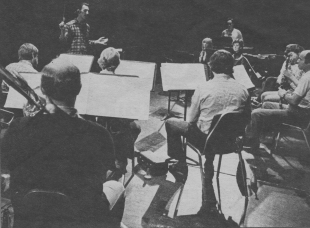
The interviews caught Zappa in the midst of several days of editing performances of his music played by the Ensemble Intercontemporain conducted by Pierre Boulez. He works at night. "It is a practicality with a house full of kids," he said. "We're on a 24hour computer, and my shift is in the middle of the night." Phone interviews began at 3 p.m. California time, shortly after he woke up.
Zappa has become a homebody, comparatively speaking, since he gave up touring two years ago. "I don't think there is a market in America for what I do," he said. "I refuse to put on a dog collar and go out onstage and jump around."
Zappa, who declares fatherhood "great," said that the only thing he really dislikes about having children is reading report cards: "It's boring."
And how do his kids like their names? "I think they all like them now, although sometimes they've had some problems with them. Moon (who gained renown for her part on the hit single Valley Girl) wanted to change her name to Beauty Heart. For a while, Ahmet wanted to be called Rick. And Diva is upset because she doesn't have a middle name. She picked one – Banana – but I think we may give it a while. Besides, no matter what they do to their first names, it's the last one that gets them in trouble."
The first interview was conducted the day after this year's Grammy winners were announced. "The night before the Grammys, I was interviewed on CBS. They edited my 12 minutes down to eight. Basically, what I said was, the Grammys are a farce. They wouldn't be so bad if the people who ran them wouldn't try to make them out to be something they aren't. They have nothing to do with merit. The real criteria are record sales or if the person is your friend. They have nothing to do with quality work in music in the United States, but they keep pretending it is something else, and that bothers me.
"Before any American gets any chance to participate in popular music, the music has to pass through three filters: It has to be OK'd by a cocaine-infested music executive, it has to be aesthetically pleasing to someone who is gay (I have nothing against gays, but their aesthetic is different), and it has to be proven fiscally prudent by an MBA. The net result is what we now get as entertainment."
Zappa, it must not be forgotten, is the creator of such notable achievements in questionable taste as Don't Eat the Yellow Snow and The Illinois Enema Bandit. He has built his own reputation on a certain amount of concert theatricality. Obnoxious concert theatricality. In fact, for much of his career he has been a kind of Lenny Bruce of music. Is Zappa turning serious in his old age? Is he becoming conservative? Or has he been funny because he's so serious?
"I've always been this way. There is a difference between conservative and common sense," he said, "and all it takes is common sense to see what is going on."
Zappa had some lifting insight into the world of classical music.
"Boulez had a number of problems conducting my music which he didn't expect. His musicians are highly trained virtuosos specializing in playing contemporary music. But my music is vastly different from most music they play. Several people or more are asked to play difficult rhythms together."
Zappa's music, both in the popular vein and classical, is rhythmically unconventional and free. It sounds more organized around speech patterns than around traditional meters.
"Now, having toured with bands," continued Zappa, "I know that rock musicians' pay scale is better than that of classical musicians. So you can get people to spend more time practicing individually. Because rock musicians are motivated by two factors, which they get after a concert: a paycheck, and (some sex) because they are in the band. It is part of the 'blue spotlight' syndrome.
"All my musicians played from memory. We'd rehearse six days a week, ten hours a day for six weeks. After that, they could play the music expressively, and the rhythms weren't scary.
"I started writing chamber music when I was 14. No one would play it. So I took up the guitar and said, what the ----, I'll make money and get (some sex)."
Zappa taught himself how to play the guitar. His two months of harmony at a junior college ("I was sent there from high school because I was sort of a juvenile delinquent") he did not find particularly helpful. His first forays into composition were brought about, actually, because he liked to draw.
"I saw some music and I liked the way it looked and set out to draw it. .,. My formal education is a little skimpy. What I know is mostly from reading books I got out of the library. But I think that's good, if you want to be a composer. If you do go to school, you end up picking up the habits of your teachers."
Zappa, who also plays some percussion and keyboards, discovered the music of Varèse at 15. The experimental French composer still is his idol.
 "Varèse's harmonic concept doesn't resemble anybody else's. He creates substances rather than chords. He uses chemical concepts. The type of tension his harmonies create are like isotopic combinations. Some stable. Some unstable – highly volatile and about to explode. It gets into the field of psychoacoustics, really.
"Take the interval of the third, for instance. When you hear it, it carries a message to your brain and produces uncontrollable emotional responses, some of which are predictable and some of which aren't understood yet. Varèse had the audacity to put these things down. The real thwarting and tweezing (of natural harmonic progressions) have only been done by Varèse and Webern."
After this discussion of the mechanics of music, I asked Zappa if he has different attitudes toward writing classical music and popular music.
"No. I get just as much satisfaction from writing a four-bar introduction . . . and a song as from anything that is into chemical blasphemy. This seems to baffle both the serious people and the rock people. I don't belong to either world."
The last sentence was delivered with a certain satisfaction. After talking with Zappa for a while, it becomes clear that he prides himself on being an outsider. It seems to be where he gets his strength. Remember Freak Out?
Mr. America, walk on by ...
Once you find that the way you lied
and all the crazy tricks you've tried
will not forestall the rising tide
of Hungry Freaks, Daddy . . .
the left behinds of the Great Society.
Zappa's indictments of various and sundry failings of the human condition are pointed, intelligent and vivid. He may be annoying, but he makes sense. Even that is annoying.
"I'm influenced positively and negatively. I've heard a lot of music I just despise."
Like the Beatles?
"I didn't hate them. I actually like two or three of their songs. I just thought they were ridiculous. What was so disgusting was the way they were consumed and merchandised. No music has succeeded in America unless it was accompanied by something to wear, something to dance or a hairdo. A phenomenon is not going to occur unless you can dress up to it.
"Punk is definitely in that category. Except it's worse because it is such a regurgitation – all that's already been done before. Punk is important in what it says about society today. We are in such bad shape that we are recycling fads. It is safe to recycle.
"The one thing about music is that the horribleness of it tells you much about the society in which it is written. Nothing in history really tells the truth. But the music doesn't lie."
So his social consciousness hasn't deserted him, now that – by hiring the London Symphony – he has officially entered classical-dom?
"If you mean 'do I still write songs about people being (jerks)?', then yes. What else is there to write about?"
Does his cynicism ever let up?
"No. I wish it would. But every time I turn on the TV I see something else to hate. I'm too sensitive."
There you have it, folks. In his own words, Frank Zappa is "too sensitive."
"Also, I don't do drugs, so there is no relief."
Did he ever do drugs?
"Nope. Another reason people don't like me is that I'm not a fun guy."
Zappa seemed to be anticipating his visit to Columbus and the ASUC convention kind of the way a piranha anticipates meeting baby fish.
"Composers should not be taught. The idea of composing is sort of like love on the radio. It creates a bunch of dreams that cannot be filled.
"It's the same with music. There is a line in my musical (not yet produced, but entitled Christmas in New Jersey) that goes, 'Your age is ugly and loveless.'
"The public doesn't want people to write (classical) music. You always have to beg to have it performed. The attitude is that all the real music has already been written. Do you remember when they almost closed the patent office because they thought everything already had been invented? Well, the patent office on music in the U.S. is closed. Writing music is a waste of time. . . . Gropius once said, 'No one should fear monotony.' Today in America, we are rapidly reaching the Gropius ideal."
Does Zappa believe there is a place for beauty in contemporary art?
"Beauty has a place in everything. But it's real hard to find these days. What constitutes beauty is subjective from individual to individual, of course. But just the idea of it is so outdated that it almost has reached the realm of myth: 'Did it ever exist?' "
So what does Zappa find beautiful?
"The arena used by composers is a piece of time. The problem to be solved is how to decorate that piece of time – what colors, how good is the plumbing, is there proper ventilation? When I see people solve that problem in an intelligent way, I find that beautiful. Music should be perceived as entertainment. That is why so-called modern music is a disaster. Because there is no entertainment in it."
Frank Zappa's scorn is relentless. It seems distributable to all occupations and aspects of American life (not quoted here, for obvious reasons, were his remarks about newspapers and music critics). It boils up out of his conversations the same way it overflows his songs. Clearly, this is a man not interested in making friends in the usual winning ways. Although, one senses that Zappa's omnipresent distaste might just be motivated by a passionate humanism.
An interesting thing is that Zappa's recorded classical music, so far, is lyricless. It sounds like Zappa music but without the nihilistic offensiveness. Some of it is even pretty.
What will happen to Zappa's music without its armor of cynicism? What will happen to Zappa? Could he actually become likable?
God – or Zappa – forbid. For an artist who thrives on negativism, that could be a disaster. Certainly Zappa will have to do something about that.
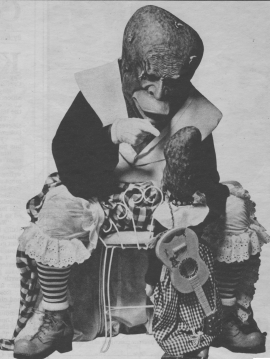 |
| This potato-head is a character from Zappa's musical Christmas in New Jersey. When will it be staged? "Not until someone gives me $5 million," said Zappa. |
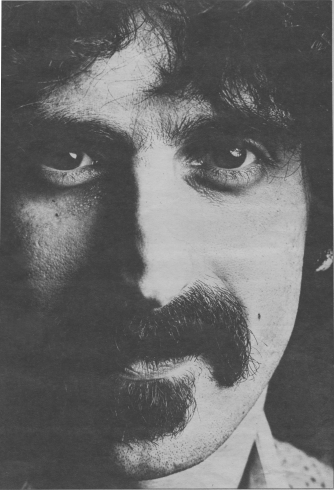 Zappa Stats
- Born – Francis Vincent Zappa; Dec. 21, 1940, in Baltimore
- Height – 6 feet
- Hair – "long and ugly"
- Family status – divorced once; married Gail Sloatman in 1967; four children: Moon Unit, 16; Dweezil, 14; Ahmet, 9; and Diva, 4
- Former employers – Nile Running Greeting Card Co.; Colliers Encyclopedia (door to door)
- Musical training – two months of harmony at Chaffey Junior College in 1959
- Albums – 35, including Freak Out, We're Only In It for the Money (satire on the Beatles), Lumpy Gravy, Burnt Weeny Sandwich, Weasels Ripped My Flesh, Over-Nite Sensation etc.
- Compositions – 203 songs, 91 instrumental works, 32 works for orchestra and choral groups, four ballets, two feature films and two TV specials
- Founder of – The Mothers of Invention (disbanded in 1969), DiscReet Records, Barking Pumpkin Records, Munchkin Music
- Hits, honors – Don't Eat the Yellow Snow, 1979; Valley Girl, 1982; Pop Musician of the Year by Downbeat magazine 1970, 1971, 1972
- Favorite orchestra – the Chicago Symphony
- Favorite pop group – none
- First performance – 1955 in San Diego as drummer in an R&B band; "I forgot my drum sticks."
- Favorite composers – 1. Edgar Varèse, 2. Anton Webern
- Unfavorite composers – 1. Mozart, 2. Beethoven, 3. "the ones everybody else loves"
- Favorite opera – Penderecki's The Devils of Loudon: "I liked the enema scene. "
- Favorite conductor – "Pierre Boulez gets my vote as king of craftsmanship. And he has no ego problems and isn't overly concerned about how he looks on the podium. ... This incredible eagerness of conductors to sell out on their looks is just a puny form of sex appeal."
- Favorite symphony – none
- Unfavorite symphony – Mendelssohn,'s Scotch Symphony
- Favorite food – "I'm fairly omniverous, but I'm not fond of onions and sushi only rates a C. I'll eat just about anything else. "
- Hobbies – none
- If I could be anyone else, I'd be – "absolutely no one. "
Read by OCR software. If you spot errors, let me know afka (at) afka.net