 NON-FOODS
Coming To Grips With Polyrhythms
By Frank Zappa
ON THE SONG "GEE I LIKE Your Pants," there are some unusual tempo changes within certain bars.
There are 27 sixty-fourth-notes in the space of three quarter notes.
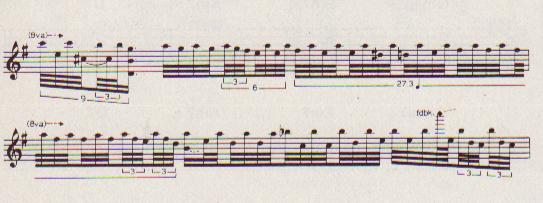
If you were handed a piece of music with such a grouping, how would you react?
I would say, "Hey, great!"
Wouldn't it pose a difficulty for you?
I'm sure it would. It's only a mystery hemiola, but the thing that's fascinating about it is that we end up right back on the beat. One, two, three, four, one – then it comes back on the beat of the second beat of the bar. Anybody can do that if they want to. It's just whether or not you're going to spend the time to learn how to do it. And then after you've done it, who do you impress with it? Do you play it for your girlfriend and say, "Hey, 27 over 3!" She'll say, "Big deal. Why?" When people hear it, they won't say that it sounds like 27 over 3, but they will know that it sounds different.
To what do you attribute most people's lack of understanding of musical complexities such as these?
Most people are only exposed to one spectrum of music. That's all they get to hear; that's all they get to learn. If you learn music in school, most of what they teach you is straight up and down. You know: One, two, three, four; one, two, three. It's all real square; it's all real boring. It's like this: In the realm of mathematics, there is something beyond adding and subtracting – it goes all the way out. And it's the same in music. The type of music that people are taught in schools, especially from the rhythmic standpoint, never gets beyond addition and multiplication. I don't think it ever gets beyond that at all. There's no algebra out there. There's certainly no physics, and there's no calculus or trigonometry. There's nothing interesting in musical rhythm that they teach you in school. Most academic situations tend to ignore this type of rhythmic approach – not just mine, but anybody's that's polyrhythmic. They ignore that approach because the great bulk of the repertoire that a graduate of a classical institution is going to play doesn't have to have any of that, so they concentrate on stuff that's going to be useful to them when they take jobs in orchestras and have to play Beethoven's Fifth for the rest of their lives. And so, consequently the performance of this type of music is really specialized. There are only a few people that can actually count it and do it.
But don't you think this is a little extreme?
No, it's not extreme at all. I think it's very natural. I think that what's happened is that the musical academic community is so reactionary. This type of music, to me, is natural and up-to-date. It's not advanced; it's just reasonably up-to-date. And I think that most other things are extremely retarded. Let's face it: One of the problems of contemporary music is the dissonance of the harmony. That is the thing that turns off most listeners. Rhythm never really bothered people. You can listen to African drums playing all kinds of polyrhythms and really enjoy it without understanding the culture or the reason why it's done. You can listen to other of types of rhythmic development so long as the harmonic and melodic content is somewhere near where your ear is accustomed to hearing things. You know, the more dissonant it gets – even quarter notes with dissonant chords on them are not very much fun to listen to, but if you have a diatonic setting or even a bitonal setting with complicated rhythmic stuff on it, there's no reason why that shouldn't be appealing to a wide range of people. People like rhythm. And the thing that makes the rhythm work is whether the people who are playing it are playing it right. There is such as thing as a quintuplet played in a bad way so that you don't really hear five in the space of whatever amount of notes it is taking the place of. And it doesn't impress you when you hear your quintuplets played stupidly. But a real good five over a real good four or a three sounds great. And when it lines up it makes another rhythm – it makes a rhythmic difference tone.
How can you illustrate this?
Well, draw 15 dots on a piece of paper:

Draw stems coming up from every fifth one on the top, and stems coming down from every third one on the bottom, and you'll see the effect of five over three:

Now look at what the combination of those rhythmic spacings are, and it generates another rhythm:

This is a lot like three over two – there's another rhythm that comes out when you play three over five. There's another rhythm that is created when you do anything over anything. If one guy is playing exactly the 4/4 of the bar and another guy is playing nine beats against that, you're going to get another rhythm. If one guy is playing the nine beats and person number two is not playing the four beats of the bar, that other rhythm is still implied. And that's the difference tone, the mystery note. You know that it's there: Your foot is tapping, even though the musician isn't playing the four beats; your foot is tapping in the basic time signature of the song. And there is a clock inside your body that's saying, "We're in 4/4." And somebody plays nine across it, and inside your body you hear the difference, and that's part of the excitement of that kind of rhythm. You know, it's the difference between what you hear and what you expect to hear that makes the excitement. Now, to the mundane side: If you're tapping your foot in 4/4, where's the get-off in that? It's a march; it's a polka. Whatever it is, it's not as interesting as hearing those other things against the assumed rhythm.
Read by OCR software. If you spot errors, let me know afka (at) afka.net