Record Review Interview: Frank Zappa
By Michael Davis
When I took over the rock editorship of this magazine a few months ago, I never dreamed I'd be spending part of Christmas eve with Frank Zappa, but that's the way it turned out. Frank had been down with the flu earlier in the week, and what with my deadlines and his rehearsals with his new band, it was the only time we could get together.
The interview took place in one of Frank's work rooms, surrounded by his piano, guitar, tape decks, massive speakers and boxes and boxes of tape. There was a neat little pile of soon-to-be-published compositions and some transcriptions of guitar solos on the piano bench. He proved to be on extremely gracious host; after the interview was over he played me five sides of upcoming material, and even got me a beer. I mean, would you play d.j. to a nosy journalist on Christmas eve?
The three sides of his new double album, Sheik Yerbouti, I heard were pretty impressive. Much of it is dense, energetic rock, and includes new versions of "Trying To Grow A Chin" and "Broken Hearts Are For Assholes", two casualties of the Lather / Warner Bros. legal hassles. But some of the jams on side four reminded me of some of Lifetime's most ferocious moments when Tony Williams and John McLaughlin were going at it – Franks new drummer is amazing!
The live New York tapes were also exciting, particularly the sections with L. Shankar, the Indian violinist who has been playing with McLaughlin the past few years, and who has recently joined Franks band. So a lot has been going on, but as he explained it to me, Frank Zappa is always a busy man.
How long has it been since Lather was completed?
Oh, a long time.
Could you bring us up to date on what you've been doing lately?
I just keep working all the time. The only time other people know about, what I do is when something is released, but I'm working all the time.
You must be prolific to just toss out a 4-record set at the same time someone would usually come up with one record.
Well, as you can see for yourself, there's no scarcity of tape. That's the tape from one tour right there.
You tape everything that you do live?
Yeah. We spent $10,000.00 on tape in New York alone. But I'd rather spend that $10,000.00 on tape than buy a new sports car.
Why do you do so much recording back in New York?
It's the best audience in the world. And the place where we usually work back there, The Palladium, is my favorite place to play. The acoustics are good and there's a big stage where you can do audience participation, and the people that come to the shows are there for a good time. It's very pleasant to work there. It's not like Los Angeles or London, my two unfavorite places to work.
Could you tell me who's in your new band?
By the time we do our next tour in Europe, which is starting in February, it'll be a ten-piece band. It's nine right now; we're adding the tenth guy when we get over there. There's Vince Colaiuta on drums, ---- Barrow [sorry, I missed his first name] on bass, Tommy Mars on keyboards, Peter Wolf on keyboards, Ed Mann on percussion, Denny Walley on slide and vocals, Warren Cuccurullo on guitar and vocals, and Ike Willis on guitar and vocals. And the tenth guy is a violinist named L. Shankar.
Will he be bringing an Indian thing to your band?
Well, I don't see how he can avoid it since he is kind of Indian, isn't he?
Okay, I mean, are you writing with him in mind, using any kind of eastern scales or whatever. How do you perceive him working in with what you're doing?
Well, that'll be a surprise for everybody. We've already recorded with him, live in New York, and the results from that are pretty good, and that's one of the reasons he was interested in joining the band.
You're using a lot of guitarists....
Four to be exact....
You're reasonably hot yourself; why do you need these other people?
Well, I don't play and sing at the same time, and I've been doing a lot of jumping around on the front of the stage, just holding the microphone and being a jerk, and people seem to like that. I like it too because I don't have anything to worry about except getting the words of the song across to the audience. It makes it easy to communicate with 'em if I don't have a piece of machinery on. I can walk right up to the edge of the stage and deal with 'em on a personal basis. And if I'm the only guitar player in the group, then you miss the sound of all that. But with four of 'em, hey... Actually, there's five potential guitar players because the bass player is also a good guitar player.
Are you trying to do anything specifically different with this band than you have with the others?
Um, no, we take it on a tour-by-tour basis. This band sounds real good to me, but there's no way to tell if they'll be together at the end of the tour. You take guys out on the road and some of 'em go berserk, and some of 'em forget their parts, and some of 'em get lazy. You never know who is gonna stick, or what is gonna happen the next time you go out. So we just take it one tour at a time.
How long have you been working it that way?
About four years. It's the best way to do it.
Are you able to find plenty of musicians who know your material, or is a lot of it written out?
A lot of it is written out. When you're teaching somebody a new song you have two ways to do it. You either give it to 'em on paper, or you hum it to 'em. Some of this stuff is pretty hard to hum, so you have to write it down. As far as finding musicians, there is a waiting list of people who want to get into the band. Always has been.
Yeah, one of the best credentials a musician could have is that he's been able to play your music and make it work.
I'm not looking for people who just want to come and get their credentials. It's not like teaching college, but there's a lot of people who approach it that way. They think, 'Well, I'll go tour with Zappa and then when I make my own album I can put a blurb in the ad, formerly with Zappa.' There's been so many groups that have gone on to add little blurbs like that and it's stupid. It doesn't really mean anything because if the guy was any good he'd still be in the band. That's the way I look at it. I mean, if they were really good, they'd still be here. Which is not to say that they're really bad, because they're not....
Was a lot of the new band on the Saturday Night Live thing you did?
Yes.
Are you attempting to move away from the image of you as a hot guitar player? On the Saturday Night Live gig you didn't even play one.
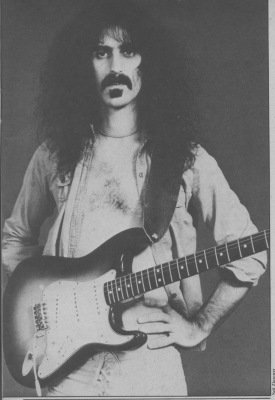 No. I still play guitar. You just have to take it album by album. I guarantee you there is some hot guitar on the album coming out in February.
A lot of the skits on Saturday Night Live had to do with your anti-drug thing, which is cool, but a lot of people out there still think you're the biggest freak in the world.
Well, I may be because I'm so normal. And as far as the skits on Saturday Night Live went, I had nothing to do with them because they wouldn't let me write anything.
They seemed to take some aspects of you and do some things around them.
No, it wasn't that way at all. When we talked about doing the show they said that they would be happy to have me write anything that I wanted. But in practice it didn't turn out that way.
Like for instance, one of the things I wanted to do was have the 1980 Presidential debates, where I debated Carter, with Aykroyd playing Carter. And I had this plan for fighting inflation. You just throw away the income tax and legalize all drugs and tax the use of the drugs based on your age bracket, and the drug you were using. They didn't want to do that because Franken and Davis, who are writers on the show, had this political skit that they wanted to do. And the reason their political had to go on the air that particular day was that they were campaigning for a friend of theirs. They were going to go back to wherever it is they're from to campaign for the friend immediately after the show. So there is a lot of political influence-peddling going on there.
I also happened to be sitting in the office when a phone call came in there. The secretary walks in and says, 'Lorne [Michaels], it's Warners Communications.' He takes the call and the gist of the call was, as he explained to everybody in the office afterwards, they said, 'We've got the governor. When do you want him?' Now, what does Warners Communications have to do with the governor of New York in the first place? In the second place, it was right around election time and they were trying to get the governor to do a guest spot on the show, and Lorne said he couldn't do it because if he did that he would have to give equal time to the other candidate. That's the kind of syndrome that's going on there now; now that their ratings are up they're into the political thing: Stinks.
Warner Bros. just sent me a test pressing of something called Sleep Dirt, most of which is instrumental stuff from Lather.
I might point out that that's not the name of the album. That's just a further violation of the original contract. They don't have the right to resequence, repackage or retitle anything that I delivered to them. The original title of that album, as delivered to them, was Hot Rats III. I presume that that's just another snide attempt to undermine the merchandising of it. If you saw an album sitting in the rack with the title Sleep Dirt on it, you probably wouldn't be too intrigued by it. Based on the job that they did on the cover of Studio Tan, they made it as unappealing as possible.
It's difficult to figure out what they figure at this point.
Well, they ain't doing me no favors; that's for sure. They think in terms of cost effectiveness. They have me pegged as a catalog artist. Just release it and leave it in the rack and after fifteen years, it'll still sell. And if they spend any extra money on advertising, they figure it's not really gonna do any good because who cares about Zappa's stuff? Just stick it in the racks and those twenty-five freaks out there who like that shit will go out and buy it no matter what it's packaged in.
Well, we both know that there's more than twenty-five freaks out there.
Warner Bros. doesn't. When the four albums were delivered to them, they would not even listen to 'em. Apparently, somebody had done this before – not delivered four albums – but in order to finish off a contract, had walked in with an album of the person singing, backed up with an acoustic guitar. They thought, 'What is this? Just Frank and a guitar?' They said that to me. And it was weeks before they could find time, or find somebody qualified to listen to the tapes and notice it was a very elaborate thing. And then they said stuff like, 'Well, what if we released these things all at once?' I said, 'Yeah, that would be a great idea.' They go, 'It would?'
They're so stupid about it. They should have released it all at once. It would have sold more units; it would have been a really exciting package. But no.
Were there any overdubs on the live material from Lather?
Of course. It varied from piece to piece. No overdubs on the orchestra stuff, except for the guitar solo on "Duke of Prunes". There's no way you can get a feedback sound, playing at that volume, and record an orchestra at the same time. It's a nice effect though; I love the idea of screaming feedback guitar backed up by a symphony orchestra.
Were there any legal hassles with "Punky's Whips"?
Oh, yeah; there were legal hassles. I have the release from Punky Meadows [of the group Angel] saying it's okay to put it out. Warner Bros. did not, so they panicked and decided not to put it out so, against the terms of the contract, they removed twelve minutes from the album, the song, "Punky's Whips".
And they also knocked out the mention of Punky in, uh....
"Titties And Beer".
So the release is to you, not to Warners?
Right. As a matter of fact, Herb Cohen offered to pay Punky Meadows a couple of thousand dollars to sign a release, but he wouldn't do it.
So if Warners can't use it, it might end up on a future thing of yours?
That's right. In fact, there's an even better version now, that we taped and filmed last year in New York at the Halloween show.
When the suit came down you couldn't get a judgement to keep them releasing it the way they are?
The suit hasn't come down yet. It hasn't gone to court.
You couldn't get a restraining order, though?
No.
If the lawsuit comes through, will you get the Lather tapes back?
Part of the contention is that the contract is void, and therefore all that stuff will go back to me.
And they will have to take their stuff off the market, and you can release it any way you see fit?
Yeah.
When you gave the 4-record thing to Warners, were you thinking of it as any kind of summing up of your career since there are all sorts of things on there?
You have to understand that at no point am I summing up my career. At any point in time I may be working in any one of the mediums that were on the Lather album. Although, right now I'm rehearsing the band, getting ready for this tour, and we're learning a wide range of material, I'm still working on orchestra stuff. And I'm working on a film, and I'm working on a lot of different things all at the same time. So, if that Lather album would have come out with all four records in it, it wouldn't have been like a summing up. It would have just been business as usual. I wish that I could release something like that a couple of times a year because there's that much stuff going on. But it's difficult.
Does your desire to do this mean that you want people to know that you're doing everything at once?
It's not to let everybody know that I'm doing everything at once. I don't care whether they know or not. The fact is that I get it done and I'd rather have it out into the world making music in the air in somebody else's house, than sitting on a reel of tape in my basement. I got a lot of good stuff here. I think there are a lot of people who would enjoy hearing it. And there's so much of it, why shouldn't it come out in two 4-record sets every year? There's that much of it that's good.
Do you think you'll be able to turn out that much stuff for the next twenty or thirty years?
 It depends what my budget is like because if there's one thing that can be said about recording, it doesn't get any cheaper every year. Studio costs have gone up incredibly in the last year.
Do you have a studio of your own?
I will by the end of the year.
Will that chop down those costs?
It'll help, but if you want to hear an orchestra, you have to go out and hire people to do that. Just having a studio doesn't help you with the cost of their salaries.
You don't think synthesizers will ever replace string sections?
It depends what kind of a sound you want. Only a buffoon would think a string synthesizer is gonna replace a string orchestra. You just can't do the same things. It's not just the string timbre, it's the different kinds of sounds you can make on stringed instruments. There are lots of different noises you can get out of a violin or a viola or a cello or a double bass. You start multiplying all the sound possibilities by all the people in the string section and you can see that there is no comparison between that potential and somebody playing a chord on a string box. All that gives you is a phasy kind of Farfisa grunt in the background. That's suitable for a lot of records because in Hollywood all they ever use strings for is to hold a chord in the background.
I don't think Bartok would use one....
If Bartok was alive, chances are he'd have to use one because no-one would give him a good budget to do what he was doing. The poor guy was in bad shape when he died; I can't see where his lot would have improved by sticking him into this particular year. But I do think Bartok would have enjoyed the Yamaha electric grand piano. It has one advantage – it's loud – and I think Bartok would have liked that.
Your new record company is being distributed by Mercury; what do you want out of them?
Well, the basic thing is the distribution. For the last several recording projects I've fronted the money out of my own pocket. I really don't need to rely on somebody else to give me the money to make the record, but proper distribution is very important. And a company that's gonna back up the album in terms of ads, television spots, tour support, that kind of stuff. CBS is gonna be our distributor in Europe and the rest of the world; Phonogram has us only for the United States and Canada.
Do you figure what you'll be doing in the future will have a better chance of getting airplay?
That depends on the taste of programmers. I think that what's on the record speaks for itself in terms of quality and listenability, but a lot of programmers probably wouldn't even take the time to listen to it just because of things that were released in the past that scared the shit out of them.
That's another thing the distributor should be good for, to try to help get some airplay on this stuff. By the time I've gone through cutting the album, the package, supervising the disc cutting and checking the test pressings, after that I'm done with it. I want somebody else to do it so I can go on to the next project. I don't want to go around with a box of records under my arm, acting like a cigarette girl.
When the Zappa In New York record came out I was working in a record store and I couldn't believe how people still reacted to the "naughty" words in it.
Well, this world is crawling with foolishness, isn't it?
In light of that, what about marketability?
Let's just put it this way. I do what I do. I like what I do and I'm going to continue to do what I do. Whatever it is.
Any other artists lined up for your label?
There's one artist and one group that I've talked to that I really like, but I'm not going to say any more about it until they're signed.
 I can't see you having the time to run around checking out other artists....
As a matter of fact, I did. I was in New York just recently and I spent a lot of time running around looking for groups.
What do you think you can do for them that they couldn't get elsewhere? Besides not getting stabbed in the back?
Well, that'll probably be a major part. The other thing is, they can call up the president of the company; it's not too much trouble to get through to him on the phone. Basically, what we have to offer here at Zappa Records is cutting through a lot of the normal bullshit that happens when you go to make a record deal. It's pretty straightforward. I have only a certain amount of money I can spend to make a record, and a certain amount of money I can spend on advances to the artists. Other than that, if the artist has something to say musically, it's his business. I just put it on to record and Phonogram distributes it.
But you make up your mind which acts you're going to sign.
Yeah. There's not gonna be that many, kind of a specialized thing.
I guess most of the things you put out on Straight and Bizarre are probably out of print by now.
Yeah, but if there hadn't been a Straight and Bizarre there wouldn't have ever been those kinds of records released. I didn't see Columbia rushing out to have a contract with Wild Man Fischer. Or Alice Cooper. Or the GTOs. Or Captain Beefheart.
And some of Tim Buckley's more interesting things.
Uh huh.
When can we expect more Frank Zappa stateside live?
I don't know because one of the things I'm trying to do for 1979 is to do a Broadway show, which is probably going to require rehearsals during the summer in order to open in the fall. So we're going to be in Europe 'til April. Then I've got some more studio work to do in April and May, and then around June start rehearsing for the Broadway thing.
Totally original Broadway show, or....
Yeah.
Can you give us any idea of what it looks like at this point?
It's pretty much planned, but I'm not going to say any more about it until we get closer to doing it. But I've always wanted to do one of those things and I think this should be about the time to do it. So if we do that, that should put a crimp in the U.S. tour. It just depends on how much physical work I can stand to do during the year because one suggestion has been made that I put two bands together, one to sit in New York and play the show, while I go off on the road to tour the United States. That has some advantages if I can stand the work.
One of the things I want to do with that show is make sure that the band that plays the music isn't sitting there reading it like all the rest of the Broadway show bands. I want people playing it who are in it just for that show, who are cast for the show so that they learn their stuff just like the band I take on the road, they know it absolutely cold and can play it expressively every night so the audience gets the most out of it. 'Cause I went to see a bunch of Broadway shows while I was back there, and the level of musicianship is not that good.
I remember reading a recent interview with you where you said that language is little more than refined grunts, and that. written language doesn't communicate very much.
Well, language can communicate certain things, but compared to what you can get across with a couple of good notes, language is pretty crude. There are a couple of good notes that you can play on a guitar that you can never describe in words. The reason I chose that as on example is that the guitar is a special thing to the American listening public. The timbre of a guitar does something, the whole idea of guitar as a way of life, the guitar gestalt is appreciated by the American public at large. There are a couple of notes that you can play on the guitar that convey vast meanings. They're whole panoramas of information that you just can't write. They give you on instant physical reaction. Wherever it hits, you'll see people's faces scrunch up and they start responding directly to it.
Like if you go watch people dance at a disco, a certain kind of beat or a certain kind of bass line produces instant physical results where they get that boogaloo jaw and that certain attitude – they become transformed as people. That's why I like music a lot better than written language. I think spoken language is serviceable in a musical context. But I'm really biased about that stuff.
How did you get exposed to all the modern jazz, classical, avant-garde things that go into your music?
I paid attention to everything. I didn't always like what I heard. You have to go out looking for it; it's like investigative reporting. Go to the library. I borrowed records from people and got things at school. I figured that if music was gonna be my life, I should get the finest education I could afford. So I went to the library.
Do libraries have much on jazz, though?
I got most of that off of records, but you'd be surprised what you can find in libraries. I was. I found some amazing books in dip-shit little libraries; even the library at school in Lancaster had some good' books. And the trend today is to include more records in the library; there are more records in the libraries today than when I was running around.
I remember you being quoted in the early days as saying something like, 'Don't bother going to school; go to the library and learn something.'
I would modify that today to say, 'If you want to get laid, go to school; if you want on education, go to the library.'
Or both.
Yeah. Mix and match.
It seems like now, in contrast with the early years of the Mothers, that you're not concerned with putting out a specific image. Did you feel you had to put out a bizarre image instead of the idea that all these various combinations of music are normal?
Well, I've always felt they were normal. I think that the way I view music is the same way I view life; not that I have this philosophy that has to be adopted by anybody, but you can see that life itself is rather variegated. It's a variety act; there's all kinds of stuff going on all the time. Things may get a little messy sometimes, but it hasn't stopped working yet.
And it's the same way with music. There is no reason why you shouldn't be able to have a rhythm and blues background with something really complex going on on top of it, and suddenly cut to a polka and come in three bars later with a bolero. That's normal to me, and continuous. To me, that's linear logic.
Okay, that's where you are now....
That's where I've always been.
But about the early Mothers....
In those days, what you had to compare it to was like Herman's Hermits, so I would seem a little weirder than I do now.
Yeah, but with the packaging of those records, it seemed like a self-consciously weird image was being thrown out there as well.
If you had to compete in the marketplace against people who were cute, and you weren't cute, what would you do? Try and be cute? No. You would say, 'Hey, this is what we look like.' Take a look at the cover of We're Only In It For The Money. The idea of people looking like that only being in it for the money was what I thought was a very good joke.
And at this point you don't need to do that because you've already gotten on audience?
I think most of 'em know who I am. Most of 'em don't know what I do, but they know my name.
Read by OCR software. If you spot errors, let me know afka (at) afka.net