Zappa: 'I AM a human being'
By Jane Elliot
Yes, the computerised freak image is wearing a little thin on the Big Z., he tells Jane Elliot in Adelaide, as his acclaimed antipodean tour closes
FRANK ZAPPA – self-appointed master of the bizarre, musical innovator, puppeteer and chief iconoclast, has, out of necessity, created his own light in the form of the Mothers of Invention.
Though battered and bruised somewhat in his time, the scars do not show as he sits in the lobby of the Hotel Australia, hair clean and long, eyes healthily alert; maintaining, as always, an aristocratic coolness.
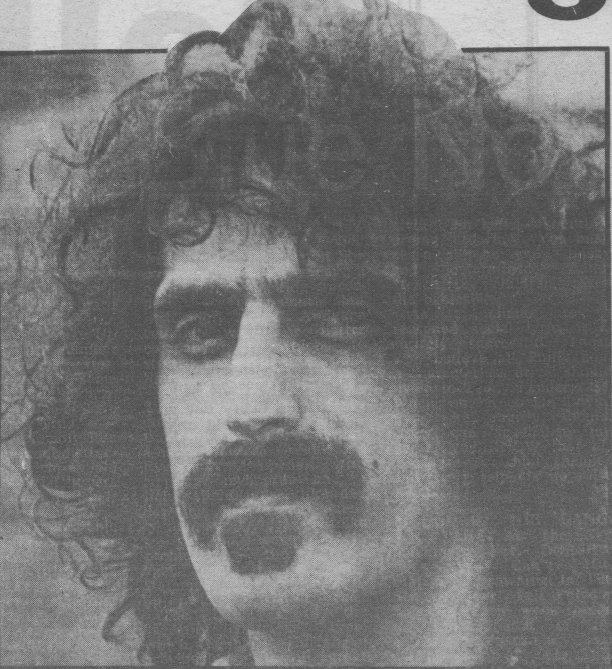 Dressed in the usual, gaudy Grand Wazoo fashion with yellow pants, sloppy cardigan and vermillion scarf knotted around the neck, and smoking incessantly, after only one hour of sleep Zappa is still amazingly honest, amiable and intelligent. He yearns, I think, to be treated as a man with ideas, not a media commodity or computerised freak, although he admits that it is perhaps this aspect that attracts his audience.
"It's very easy to presume that I'm not a human being," he says. "I've never been noted for my warmth and human qualities; they do exist, but, you know, they're just not the thing that would make people come to a concert. They come down to see some crazy person who's going to do something strange on stage."
Yet even when a Mothers audience comes, for whatever diverse reason, to see this "something strange on stage", Zappa ponders over the eternal dilemma of all artists. He's even written a song about it called "50/50": "Whatever I say, no matter how deeply felt my convictions are, 50 per cent of the chances are that they'll mean something to you and be useful for you to hear it, and 50 per cent of the chances are that it won't maybe make any difference whether I put my song together or not."
The media acted more as a restraining force upon Zappa's ideas than a potential vehicle for them. This has been particularly evident in his dealings with Australian television.
"You do a television interview and nine times out of ten the person who's talking to you has never heard of you, never heard your music, doesn't know anything about you. You're brought on the show by a publicist, and the guy, just before the show goes on, gets a three-page synopsis of maybe 20 interviews and some other crap that somebody has prepared for him. The person who's prepared it has never heard your records, the person who's prepared it doesn't know who you are – it's all mechanical.
Indifference is one thing, animosity quite another, as the Mothers seem to have painfully discovered throughout their career; the latest incident culminating in a court case rejoicing as "The Mothers of Invention v. The Royal Albert Hall", which arose from the Hall cancelling a 200 Motels concert at the last minute.
Why did they do this?
"Because they didn't like us! Now this is irrational because we'd already played the Albert Hall twice and suddenly, for some reason, they decided we shouldn't go in there again. When it was heard the judge's decision was this: 'You guys are right. They breached contract. You are right, you are not obscene. You are wrong because it's the Queen!"
Forces interacting with other forces are something that Zappa rightfully treats with gelignite care. "Television as a medium, the video medium, is a nice medium ... but the media is a mysterious force that is linked with the government and linked with large industry and other mysterious forces, like the church here in this country – all those things are definitely to be feared and to be observed cautiously because the medium is so powerful.
"The fact that there's a box in their home with somebody who can smile and look sincere and be telling you a load of s--- at the same time. There's definitely something to worry about in that people aren't trained or aren't aware how people in the media try to fool you.
Even on a recent television interview in Holland, supposedly one of the most liberal countries, Zappa talked about his song "Penis Dimension" only to cause a local avalanche of disapproving letters and telephone calls. This is why he sees rock 'n' roll music as the only modern medium free enough to expand and/or break through traditionally sacred concepts.
But this freedom lies within a highly-disciplined structure, much tighter than that employed by the earliest Mothers, whose real gift was for improvisation.
"But that was a different time and a different place. Today, if you want to travel around and be in the rock 'n' roll business, travelling with large amounts of equipment, playing large halls and using a lot of lights and so on and so forth, all those cues have to be co-ordinated and that requires more structure in the show, so we have a very structured show now.
"But inside of that framework, that structured framework that lets the light man know when to turn things on and off and the sound mixer know who's playing what, there's all these blank spaces for improvisation. Structure is not perceived as a sort of concrete monolith – it definitely has some longitude and latitude in the creative department."
With Zappa's talent for seeing through sham, it is easy to understand why "Lumpy Gravy" is his favourite album in terms of achieving an ideal, "because it's probably got more iconoclastic events on it – the word "iconoclast" deriving from some old language that means breaking images – you know, icon, an image – based on the fact that in the old days people used to go into orthodox churches and smash them up.
"Well, if you consider the process of making normal orchestra music, what they call classical, to be like an orthodox kind of church, and if you take the theory that composition is the art of organising audio events in time – the process of decorating time – that's the canvas that you're working on.
"And if you extend those boundaries to include spoken words, sound effects and other elements that people would think to be nonmusical, and if you structure those sound events along with sound events played by violins, and so on and so forth; and make one piece of music about it, that is an iconoclastic event."
The composer, supposedly, is obsolete. Everything has been done, and now the task lies in juxtaposing, synthesising and arranging. Zappa's personal indebtedness to the works of Stravinsky and Varèse is particularly evident on early Mothers albums such as "Freak Out," "Absolutely Free" and "Lumpy Gravy", but now Zappa thinks he's "incorporating everything that I ever heard that I liked – the same way anybody else who makes music makes it in the end to what he thinks is good."
The changing line up of the band has also, forced its development. "Style-wise it has to change because musicians are not technically universal."
But this continuing thematic and stylistic evolvement is often deceptive in that, "just because I don't repeat myself into redundancy is no reason to presume I don't feel the same way about those things I said in the Sixties.
The present line-up of Roy Estrada on bass, Andre Lewis on keyboards, Napoleon Murphy Brock on sax and Terry Bozzio on drums is unusually small by Zappa's standards, but musically large enough. Certainly, it gives Zappa "more time to play guitar."
Group members are chosen with meticulous care, and no contracts are ever exchanged. "Some people come into the group and stay for a while and say, 'Aha! I am now a star, I'm going to form my own band'.
"Then they disappear. Sometimes they come back two or three times 'cause once they get out they find that things are not as easy to do on the outside. Then there are other people I'll hire for the group, and I'll audition them and I'll say, 'all right, I think this musician is good,' but you take them on the road and you find they can't handle it.
"Like, for instance, there was a singer that I hired one time who did three days. The first day he was fantastic, the second day he started going down, and the third day he was in trouble. One day at a hotel he ran up a bar tab of $90 for himself. I didn't know he was an alcoholic before I put him in the band, so I sent him home right in the middle of the tour. You can't always tell."
Read by OCR software. If you spot errors, let me know afka (at) afka.net