What's A Mother To Do? Zappa's Decade In The Doghouse Is Over, But He's Still In That Doggie Bag
By Steve Weitzman
Francis Vincent Zappa, den mother of the traveling troupe known for ten years as the Mothers of Invention, eats a lot of meat. But on this particular afternoon, in a dark corner of the restaurant located in Buffalo's mid-town Holiday Inn, he was only able to gnaw through half of a cheeseburger before giving up. Physically, Frank was feeling poorly; a nagging flu had begun to affect his appetite and the prospect of regaining his health with three straight concerts to go before a day off, seemed mighty doubtful.
Tom Fowler, Frank's bass player, strolls into the dimly lit room and looks around a couple of times before spotting Zappa. Attired in a variety of lumpy gravy browns, Frank almost seemed like part of the woodwork.
"How ya feeling?" asks a concerned Fowler.
"I can't breathe," moans Frank softly, bringing visions of the strictly-from-commercial fur trapper to mind.
After nodding his head one way or the other to a few more questions, Frank pulls himself up from his table and shuffles to the front door of the motel. Peering out at the eighteen inches of snow that has come down in the past forty-eight hours, he tightens his scarf and begins to head for the tour bus which is scheduled to leave in a few minutes, bringing the Mothers to their sound check.
Immediately outside the Holiday Inn it becomes obvious that the fifty foot walk to the bus will be a chore. The constant twenty mile-per-hour winds make it appear to be snowing sideways. Everyone eventually takes their turn trudgin' through the tundra, the bus's doors open and close for the last time, and Curtis, Frank's personal driver, shifts into gear.
Leased from Celebrity Coach and distinguished only by the words "Go Big Red" on the back, this is the Mothers' means of transportation to gigs five hours or less apart (anything more and they fly). The front section has six red, crushed-velvet seats, three on each side of the bus, facing each other. The rear compartment, making up some three-fourth of the total length, resembles a train with upper and lower berths for sleeping. Three sections of two bunks each on a side, divided by a narrow aisle down the middle, it accommodates twelve horizontal bodies.
With red shag carpeting adorning the walls and the floor, and thick plush vinyl covering the ceiling, Big Red is virtually soundproof – and incredibly comfortable.
At the hall, Buffalo's hockey arena, Frank practically wears a path in the floor going from stage to sound platform back and forth, and back and forth again and again, leading his Mothers through a non-stop two-and-a-half hour sound check. It's nearly as cold inside the hall as out and Frank feels the chill.
"Arf," he says testing his vocal Monitor. "You can fuck a snowshoe tonight."
Flu or no flu, in the company of his band or especially when doing a show, Frank shines. Everything becomes secondary to the music. Tonight's concert is no exception.
After sincerely thanking the audience for braving the weather to see him, Zappa opens with "Stinkfoot," substituting "out through the tundra..." for the line "out through the night. .." The end of "Village of the Sun" finds Frank leading the band through a trail of calculated improvisation – eloquently dancing and gliding across the stage like some lead-footed ballerina submitting to the sways of the music. Every note, every action was ridiculously on the beam.
On the bus ride back to the Holiday Inn, Ruth Underwood, George Duke and Napoleon Murphy Brock shatter the serenity of the snowstorm's end with a three-way cackling contest. Ruth emerges as the undisputed winner. Frank watches the whole thing with a big grin on his face. Then, still feeling the effects of his flu, he clears his throat a few times, coughs up some phlegm – and swallows it.
Ruth looks at Frank in mock disgust and turns to Nappy. "Don't you hate it when people do that and swallow?" she asks.
Frank leans over to Ruth and grins again. "Only if you have to kiss 'em," he injects. "I'll tell you what," he adds menacingly, looking her straight in the eye, "next time – I'll spit it out."
"Oh no!" Ruth cries. "I know where it's gonna go. No dice!"
Everyone laughs heartily.
The next morning, after getting wake-up calls at seven, all six Mothers, road manager Marty Perellis, PR-man Dick Barber and the ten or so crew members make their way, one by one out to Big Red, waiting in the parking lot. By eight-thirty, everyone has boarded and is in various stages of slumber. Frank, his python boots (which have "Stink Foot" painted on the back and an "F" on one toe and a "Z" on the other) resting on the carpet at the rear of the bus, is stretched out on his back in one of the upper bunks. With his eyes clasped shut and a blanket pulled up and tucked nearly under his chin, it appears that Mr. Zappa is laid out for a bizarre last viewing.
Curtis scans his maps and pulls out for Ithaca.
That same afternoon, after checking into (where else?) another Holiday Inn, Frank sits in his Ithaca motel room putting the finishing touches on a piece called "Greggery Peccary." Piles of sheet music rest on the bed while he works with a composition pad on his desk. I am ushered into the room by Dick Barber. Frank has agreed to set aside time for an interview and begins to clear his desk.
How much privacy, I ask him for starters, does he expect from a writer on tour with him for a few days?
Realizing the powerful bartering position that question puts him in, he grins. "A hundred percent," he says breaking into a little laugh. "Oh I'll do interviews with you and you're welcome to watch everything that goes on but other than that," he says, directing my attention to "Greggery Peccary," "I've got plenty of work to do."
And work is what Frank Zappa is all about; he thrives on it, he lives for it. Some people work at their music; Frank Zappa is his music. Between composing in the afternoons, sound checks that run till dinner time and his two to three hour concerts in the evening, he still finds time to play his guitar. After eating dinner at whatever hall they play in – usually apart from the rest of the Mothers – "I sit in the room and play the guitar until it's time to go on ... for as long as I can get. Its relaxing."
As for his composing, he added, "I get a couple hours to do it before the sound check and then, after the show, I come back and do it again." And traveling by bus has its advantages, especially one as accommodating as Big Red.
"Ahh, it's so comfortable," Frank sighs. "I just go into a trance and wait till we get to the next town." The advantage, he explains, is that "if we weren't on the bus, I'd be sleeping right now instead of writing or doing an interview with you. It makes my schedule a little bit easier."
Zappa's responses during this previous interlude revealed a manner completely opposite from the bizarre psychological portrait one would tend to paint judging from his music. Here was a sedate, reserved human specimen, both articulate in expression and unwavering in tone of voice. And somehow he seemed in complete command of the proceedings – like a giant anchor holding steadfast. Surely it had something to do with his eyes.
This onstage-offstage split in personality is another facet of Frank Zappa and he readily admits to it.
"Sure," he explains. "You see, the guy you see onstage is Frank Zappa."
And who am I talking to now?
"You're talking to Frank Zappa."
Schizophrenic, huh?
"Absolutely schizophrenic. But it's self-inflicted schizophrenia. It's not that chump kind of schizophrenia."
Has it ever gotten out of control? Ever forgotten who you were and brought this Frank Zappa up onstage or taken the other one off?
"Only when I'm real tired. Sometimes this one here gets out there and as soon as he does, well, he knows that's not the place for him and the audience knows it too. Then the other one jumps up from behind the amplifier..."
The opposite wouldn't be too bad, though.
"Oh I've been crazy offstage many times."
It didn't take long to realize what that "something" about Frank Zappa was – his eyes were always looking directly into yours for the entire duration of every question and the length of time he spent answering. He never broke eye contact for one second! If from listening to his music there was any doubt about his sincerity, it vanished with one look. into his eyes. It was comforting and unnerving at the same time. You have to consciously fight the urge to just return his stare.
Doing just that, I asked him whether the original Phi Zappa Crappa posters received his authorization.
"Yeah," he says almost regretfully. "If it says 'Phi Zappa Crappa' it was one of the authorized ones. But by that time there were maybe ten other versions of the toilet poster out, from different sources that weren't authorized."
As for how he was approached, he explains, "First of all you have to realize that there is a fraternity called 'Phi Zappa Crappa' and they asked permission to use the poster. That's a fraternity at Santa Barbara State College. It was a new, instant, pop-art sort of fraternity."
Ever thought about how the public sees you? Or what they think about when they hear the name Frank Zappa or see it in print? I guess it comes down to an image. Ever cared?
"Well sure, I've considered all those possibilities."
Ever tried to change your image in one way or another?
"You can only do so much of that ...At one time I was a little bit concerned that I was being associated too much with the way people responded to that toilet poster, which I didn't have anything to do with."
You approved it; you authorized it...
"Well, I approved one. After it'd been on the market for three years..."
You thought it got overblown?
"Well, I don't see anything wrong about sitting on a toilet and having your picture taken, but when somebody takes that picture and uses it to make money on your name. .. Then you compound that with the public's attitude toward excretory processes pictured in a poster like that ... more people knew me for that poster than for my music. I said 'Well that's not fair.' So I said, 'I'm either going to do something drastic about it or just let it go' and I figured, well, 'kiss it off.' You can't really change the public's attitude about that."
Is that the last time you thought about an image?
"No. I think about an image every time someone in the audience says 'Freak me out Frank!' Because they come there expecting me to do all kinds of weird things."
So how does that make you feel about freaking them out?
"Oh I'll freak 'em out! In fact, some of them don't know how much they've been freaked out until months and months later when they think of what happened to them at the show, because a lot of the stuff we do is happening on a level that is not even perceived during the show. There's too much else going on – lights and other stuff. You don't really know what hits you until later, because what this band does onstage is so unique and is so different from anything else that's ever been presented by anybody, the audience, who is a rock 'n roll audience, who comes in there and sees it, there's no way they can really appreciate what's going on; what a mechanism like that is."
High praise indeed from a man who's seen "fifty or sixty" official Mothers come and go and has used around two hundred others on a one-shot deal basis. But Frank feels that, with his present band, "Our improvisation is so good that some people think that its all written down." Longevity is a factor, he added, but not the whole story:
"Any group that stays together for longer than a year has a tendency to discover enough about itself where it can improvise that way, especially if you gear it in that direction. But this band is especially good at it because the musicianship is real high. It's the highest grade of musicianship I think I've had. Imagination is good, sense of humor is good ... it's a real commando unit."
This commando unit includes Napoleon Murphy Brock on sax, flute and vocals, who Frank found "working in a bar in Hawaii. I went into a bar and there he was. I said, 'How would you like a job?' He had never heard of me or the Mothers before."
Ruth Underwood plays marimba and percussion for Frank and regretfully, he adds, "is planning to leave in January for personal reasons." Replacing her would be impossible, he feels, since "there's no other percussion player in the world who can do all the things she's doing now.
Because even if they could play the parts and memorize the vast amount of stuff that she knows, they're still not her. And she adds as much from her personality as she does from her musicianship."
She keeps the troupe in high spirits by her own outrageousness, laughs Frank. "What can you say? You get a nymphomaniac percussionist on a bus with X number other guys and it's pretty amusing."
Tom Fowler, brother of Zappa's ex-trombone player, Bruce, passed the audition for a bassist a couple years ago, and Chester Thompson, recommended by Marty Perellis, makes Frank's bottom funky. Keyboardist George Duke, who records solo albums for BASF has been with the Mothers for the better part of five years.
Six pieces total. The smallest group Zappa's had since the beginning when the Mothers were a four piece band. It seems that ten members, a lineup Frank used for several years running would give him greater freedom, but he says, "It's worse. For example," he explains, "you have ten guys out there and they're all good musicians; most of them are capable of playing solos. But, in order to make it sound like a band, you have to give them arrangements to play. That means you have to simultaneously give them things that they can play and challenge their imagination so that they'll keep being interested.
"Then you have to let everyone of them take a solo, and the results of that are often dubious because the audience doesn't want to hear ten guys in every song taking a solo. So it's hard. And if you tell them, 'No, no, we can't have everyone taking a solo on this,' they all go, 'Well I don't want to sit here and just play these background parts all night.' That's the way horn players are; they have that weird mentality.
"It seems like the more people you get in a band, the less they care about what it is. The fewer people you have in the band, the more they take an interest in it because it's their personality sticking out up there on stage and so they have a personal stake in what the show is."
Has there ever been any breaking in period for any perspective member of your band, in that, it was almost like a club, and that in order to be a Mother you had to, uhh ...?
"It's always been that way. It's always been the same problem. They have to be the right kind of person to live that kind of life. You have to have a certain kind of sense of humor to begin with and for another thing, you have to really like to work hard because there's no two ways about it – it's hard. It takes a lot of hours a day and we tour seven months a year and the rest of the time we're rehearsing, so it's a total commitment kind of thing. It takes me a long time to teach somebody how to play it and I don't want to go through all the trouble of teaching somebody how to play it unless I think there's a chance that they can stick."
As far as a sense of humor, what kind of things should a Mother think are funny?
"Well.. you start with everything and work your way down."
How much memory is involved in the actual playing of the music?
"Immense amounts of memory."
The "Be Bop Tango," for example, which is one of the most intricate things you've done so far ...
"Well it was written down for everybody, then you had to memorize the sheet music. After you memorized the sheet music you had to know enough about how the music worked to improvise on it."
How would you rate your memory?
"In some regards I have a photographic memory that stores information in three dimensions including quadrophonic sound and smell, and I can recall one hundred percent of what happened to me or whatever the event is. . . and in some areas I have the worst memory in the world. I can store a whole concept of something just like it was a block of steel as big as this building and all the details that are on it, but if somebody comes up to me, I can't remember their name. I remember the things I'm interested in, I guess, which is not to be offensive to the people whose names I forget. I have a real hard time with names. I don't remember phone numbers real good. Sometimes I can't remember the words to the songs."
How about notes?
"I don't think of notes when I play."
What do you think of when you're playing a tricky passage from something you've just written?
"Well, first of all, once I've written it, it doesn't belong to me anymore. It's as strange to me as it is to the person that I hand the music to because as soon as I do it, I forget about it. Then I have to learn my part just like they have to learn theirs. Everybody has to start from scratch. The only advantage I have is I know how it works, but as far as what the notes are, I look at my part on a piece of paper and I see that my hand has to go here and I have to do this and I have to do that. It's weird. I don't think of notes when I'm playing at all. I'm absolutely tone deaf. If George starts playing in some key, I can't tell what key he's in. And the only way I can find out what key he's in when he's improvising is by sneaking around on the guitar and hitting a couple of notes to find out what he's doing. Other people in the band have perfect pitch and they just hear it right away and say 'that's an A' and just start playing. But I can't do that."
Has memory, or the lack of it I should say, usually been the cause when you've made personnel changes, or the reason why they just weren't able to handle the music?
"I think it always comes down to the fact that they can't handle the music, but they can't handle it for different reasons. I had to let one guy go because he was just using too much dope and that caused him to chump his parts and he was just playing wrong notes. He was making the band sound less than what it should've sounded. Then there are other people that leave on their own free will for various reasons. They decide they're worth millions of dollars and suddenly decide they want to be stars on their own. I've had two occasions like that. There are other people that leave for personality problems like Ruth, who quit once before."
I've heard that you won't allow any of your band members or road crew to smoke grass or use any other kind of drugs. Specifically, what are your feelings concerning the use of drugs? (Zappa's drug history includes trying marijuana twice and a total abstinence from every other drug.)
"When a person is doing a job then the idea is, to do that job the best that he can do and so I've found from experience that anybody who is using drugs can't really perform what I ask him to do onstage, because they're just not there. Their minds just aren't on it. Drugs have a tendency to wreck your memory and they have a tendency to reduce your efficiency in certain areas that are very important to the music that we do. And the worst thing for memory is marijuana."
How about alcohol?
"I don't complain about that too much because I haven't seen that it affects their performance capabilities, except that George will sometimes get a little bit too loose on Mateus, but he's self-regulating. He's got more self-discipline than most of the members."
How about your smoking cigarettes? Winston should make a commercial out of you ...
"I would say that smoking cigarettes, the worst that that can do in a show is to slow me down at a point where I have to make a cue if I happen to be lighting a cigarette. I don't think that it chemically alters me to the point where it alters the way I play."
Your music seems to be getting funkier these days...
"A lot has to do with who's playing it. I can imagine it as funky as I want but if I can't get a funky player with a sense of humor, who wants to work hard, who wants to fill all those other requirements, then I can't play it funky."
Is that an especially hard combination to find?
"Well, the guys who are experts in the funk bag usually do not have much self discipline and that's what you need in this band. It's a very disciplined organization but I prefer to have the discipline imposed upon the musicians by themselves so that they think enough of being in the band that they'll take it upon themselves to be on time and to learn their parts and study – it's a lot like going to school. They practice in their rooms and they go over the music and they keep reviewing it even while they're out on the road. They work hard to do it. But most people playing blues are full of dope and falling all over the place. And I don't need those kind of musicians in the group. Now I've got some funky musicians in the group who meet all the requirements."
ith
With a new style of playing for Frank Zappa comes a new philosophy on stage. After a concert in March '73 in Philadelphia, Zappa stated: "If you get an audience that's in a hurry to be entertained, why, you just sort of run through your show. You don't give 'em the good stuff. You just grind it out for 'em."
This year, he contends, "I have a new policy. The policy is, I'm going out there and I'm going to have a good time and if the audience wants to have a good time, Hey! All Right! And if they don't want to have a good time, well, they missed it."
This new policy, Frank adds, has been going on for "about six months" and the reason is "mostly this band. This band is pretty much fun oriented. They can play good but they like to have a good time. As long as everybody up there's got the same idea about having a good time, I'm all for it. I'm having a much better time getting up there and doing what I like to do."
The direct result of this is that in 1973, Zappa toured "three or four months a year." Now it's up to seven.
Sharing a large portion of the lead vocals and generally contributing to the overall dementia of the Mothers' shows, recently, on these beefed up tours is Napoleon. Although the crazies who became the most celebrated of Zappa's lead vocalists were Howard Kaylan and Mark Volman, Frank has usually had someone else up front (except for his Hot Rats period) at all times to share the verbal atrocities with. The original sickie, though, was Ray Collins:
"He and I used to share the activities when we first started off," Zappa remembers, "but he quit and joined the group five times and when he was finally out, there was a question whether I was going to continue as a solo lead vocalist and I didn't think enough of my voice or my ability to carry that end of the show to really do it, so we went basically instrumental for a couple of years. And after that group broke up, I was looking around for some lead vocalist who could hold the show, you know, so I got Mark and Howard to do that and I acted as sort of a ringmaster for a circus that featured them.
"But I like the set up the way it is now because the people come down there to see me and a lot of them were disappointed if I was just standing there, introducing other performers to do their stuff."
Another reason for the departure of Kaylan and Volman, Zappa noted, came when Frank was attacked during a concert in Europe a few years ago. He was in the hospital for a month and in a wheel chair for nine more. He couldn't work and they earned their living by touring so he urged them to form another group.
With Nappy sharing the vocals, he adds, he doesn't feel as overpowered as with the two ex-Turtles. "That's what he's there for, but see, it's not a thing where I'm just going to turn it all over to somebody else. Now I'm more involved in the performance of the show where as before, I used to just sort of conduct it."
The old days, especially with Kaylan and Volman, were almost always lewd and pornographic, downright smutty onstage, in fact. Lust personified. But it was always perfectly acceptable live, and even possibly on some of the freer FM stations. Frank's recent entrance onto the AM airwaves though, has made everyone involved a little more aware than censorship still exists. Has it changed any from '64 to '74?
"Sure," notes Zappa. "How about 'Yellow Snow' on AM radio? A guy in Pittsburgh took 'Yellow Snow' and cut it down from ten minutes to three minutes and programmed it on 13Q the big AM rocker. Eventually ninety other stations picked it up and it went on the charts!"
What little offenses were left uncensored?
"It had dog doo on it ... and husky wee wee."
Isn't that pretty lame anyway, even for AM radio?
"As a matter of fact, it's a very controversial record because kids ten years old are calling up and requesting it as a novelty record and some stations won't play it because they think that doggy doo doo and husky wee wee is too avant for their station."
Dogs have long been one of Zappa's favorite subjects and on his last three albums he has injected the phrase "Here Fido." The explanation for this is more involved than it would seem. Frank says (and why shouldn't we believe him?) that "it's a parody of Wagner in the concept of the leit motif.
"A leit motif is a small fragment, a cell of music – it's not a theme, it's a partial chunk and Wagner would take a leit motif and sprinkle that motif all through the piece and it would have a nostalgic effect and conjure up in a psychological frame, certain responses. Like, for instance, if there's a leit motif for the girl who rides the swan and if there's a leit motif for the swan, when you're in the cave, if you have the motif for the swan sneaking around in the back of the music for the cave, it would imply to the listener that there's a swan in the cave, even though you don't see a swan in the cave.
"Or if you're in a castle and if the girl's notes come in in the castle and the swan is in chains, it would imply that perhaps the swan is lonely for the girl in the castle.
"Now on our records, the Fido that keeps popping up is like the swan, so the concept of the Fido superimposed on Situation A is one frame of reference and the Fido in Situation B has another dimension to it. Same old Fido, but he's evolved. And he's happening on another level and so, Fido pops up. But it's an abstract Fido. It ain't a dog. I've used the word dog so many times in so many records, the whole idea of a dog just. ..But it's got nothing to do with a dog. In fact, it doesn't have anything to do with anything. It might as well be a number. It could be a 14.
As attached to Fido as Zappa seems to be, the album that he considers to be his most powerful work of art is Fido-less. "My favorite album," states Frank, "is Lumpy Gravy."
Ironically though, it's the only one that's out of print.
"Of course," says Frank matter-of-factly.
Why?
"That's the way it goes."
Do you think the audience feels the same way about it?
"No. I don't think it was a very popular album, numbers-wise."
Why is it your favorite?
"It just is. I just think that it's got the most interesting things happening on it."
Why is it out of print?
"They can't sell it."
Don't they realize that you have the kind of catalogue that doesn't stop selling? And that if people get interested in your music and go back and buy your earlier albums they're not going to forget about Lumpy Gravy?
"Someone over there is too stupid to realize that." Could you change that?
"I wouldn't change it."
Why?
"First of all it's a crooked company (Verve). Second of all, they don't pay."
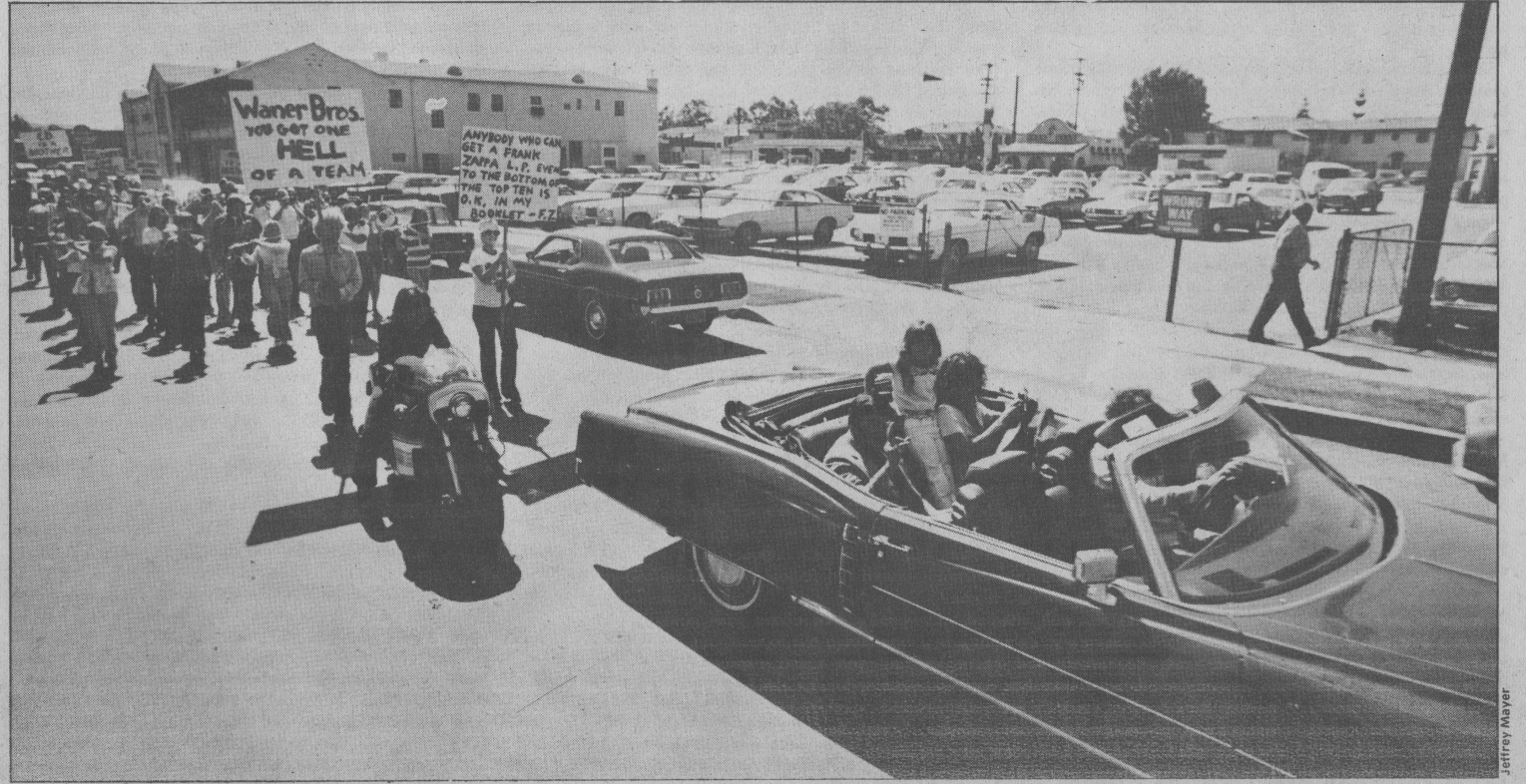
One company Zappa is finding that does pay is Warner Brothers. Earlier this year, Apostrophe (') vastly outsold any of his earlier efforts and finally checked in at number ten on Billboard's Hot 100 – a first for him. Frank was so moved by this, he hired a marching band to parade up and down the boulevard in front of Warner Bros. with a sign reading, "Anybody who can get Frank Zappa into even the bottom of the Top Ten is OK in my book." He signed it "F.Z."
Any reaction from the execs?
"They laughed," says Frank.
The success of Apostrophe ('), he adds, "was the reason they let me make the Roxy album a double. I don't think they would've let me do a double if Apostrophe (') hadn't been a big seller."
Also, Roxy/Elsewhere is the first double Zappa or Mothers since Freak Out, his first, that isn't a movie (Uncle Meat being somewhere in limbo since the filming has been completed, yet it sits in Frank's basement: "One of these days Uncle Meat will come out."). But it does include a mention of a movie-to-be.
"All that show was filmed " he explains. "I don't know if I'm going to release it but I filmed it and was crazy enough to pay for it. It could stand on its own though (as a concert film) because a lot of what's going on onstage is absolutely amazing to look at. That 'Be Bop Tango' thing is ridiculous. It's hilarious on film."
Film-wise, Zappa isn't quite ready to announce what will be coming out next. "I'm planning something for next year that'll make your eyebrows go up and down. And if your eyebrows don't go up and down when you see it, you don't have any eyebrows!"
Plans for his next recording sessions are a bit more upfront though. From December 5th through the 26th Frank will be at Caribou Studios in Colorado laying down the basic tracks for the next Mothers album ("hopefully a double Lp to be released in the Spring") plus the next Frank Zappa album. To clarify matters, a Mothers album consists of the orchestration that the group is at the time and a Frank Zappa album may include anyone Zappa has a desire to record with at the time.
One of the attractions Caribou has as a studio is the house piano – a Steinway that came from Columbia Records. "It's one of the best pianos in the world," Zappa notes, "and it used to be used for all the classical recordings. To me, that's what a piano is supposed to sound like.
"But I wouldn't go there just for the piano," he adds. "It has other advantages: You buy the studio for twenty-four hours a day and you go in whenever you want, you know. You just live at the place, stay there for a while and you get your work done."
"Greggery Peccary," the composition Frank was scoring at the outset of our interview is one piece slated for Caribou to be included on the next Mothers album. Started two years ago, Frank explains, "it's written for an orchestra. This band will play it but it's for all kinds of other instruments too." As for performing it, "It'd be very difficult because it's for a non-standard orchestra. It's for instruments that orchestras don't usually have – exotic woodwinds and things. It'd be expensive to do live. And it ain't gonna be cheap to record it either."
The story of "Greggery Peccary" concerns, naturally, a peccary, which is a pig with a white collar ..."a bold new breed which distinguishes itself by markings which resemble a wide tie directly below the collar ... Greggery invents the calendar making it possible for girls to take their pills on time and rent to be collected and also for people to find out how old they are ... Greggery gets chased through the short forest, hides in the mouth of Billy the Mountain ..."
Zappa calls it "a real tenuous narration."
Over the years, Frank has patronized a lot of animals ("Everybody needs a break, you know. A peccary is an endangered species – from a disease called rinderpest. It's something that eats the collar right off 'em.").
Has he given up on vegetables?
"I think I've said what needs to be said about vegetables," he adds with assurance.
The bus ride to the Ithaca sound check served to illustrate that once Zappa steps on board he assumes his alter self, becoming playful ... even rowdy, performing a variation of "Dinah-Moe Humm" on Ruth, demolishing a full box of kleenex tissues over her head in the process (to make her come, of course). And the show that night, in Ithaca College's gym, was particularly hot. Chester was smokin' in the traps – Frank in fact; was so impressed that he turned around at one point during the show and flashed Chester the OK hand signal.
Ruth was still buzzing after the show. "I wish we could go on in the beginning feeling like I do now," she said to Nappy excitedly. "Why not play four hours instead of two?" I asked her. "That's up to the boss," she shrugged.
Wake-up calls for the next excursion (Philadelphia) came at an unGodly 5:00 A.M.
(Whoever says rock 'n rollers have an easy life is sincerely screwed up.) The show, at the Philadelphia Spectrum, was even harder-hitting than Ithaca's; a two-hour-and-fifty-minute rock tour de force, Mothers of Invention style. Frank called it "just wonderful."
The following afternoon (a day off for the Mothers), during lunch in the main floor restaurant, Frank is recognized by a seemingly endless parade of high schoolers (autograph-seeking and snap-shooting) registered at the Inn for an education convention. He takes it all in stride, obligingly, signing and posing.
Dick Barber says that this is not unusual of the "new" Frank Zappa: "He's been in an incredibly good mood for the last three or four months now (partly due to his recent chart successes). In the past he would get into bad moods that sometimes lasted for a week straight."
But now Frank was smiling. He allowed one high-school girl to sit on his lap while her giggling companion snapped away on her brownie.
 Watching this scene out of the corner of her eye was a fifty year-old woman lunching next to Frank at the counter. She turned to him and said half-seriously, "Boy, I wish I were forty years younger so I could do that too."
That was all Frank had to hear. Breaking into a wider grin, he approached her from the back and struggled to raise her up by the armpits to drag her onto his lap. Her combined laughing and screaming and the ensuing fracas had all the other lunchers watching with glee. She finally put up too much of an embarrassed fight and Frank let her down.
"She looked like she wanted to have a good time," he laughed afterwards.
His final public appearance in Philadelphia though, came later that evening. With his spare time, Zappa decided out of curiosity to catch David Bowie's show at the Spectrum and then see Randy Newman at the Academy. After returning from the Spectrum, Frank was resting in his Academy box during intermission waiting for Newman to bring out his orchestra, when MC Steve Mortorano approached him.
"How would you like to go out and tell the kids not to smoke?" Zappa was asked.
"Sure," said Frank.
Mortorano walked out on stage first. "We have a special guest," he said, "who's here to deliver a message. Would you please welcome Doris Day."
Frank strolled out briskly and took the mike in his right hand. "Ladies and Gentlemen," spoketh Zappa, "I've come out here to make an announcement. Please do not smoke. If you want to smoke, go to the Spectrum and watch David Bowie."
Read by OCR software. If you spot errors, let me know afka (at) afka.net