Frank Zappa – Funny Mother
By Chris Lloyd
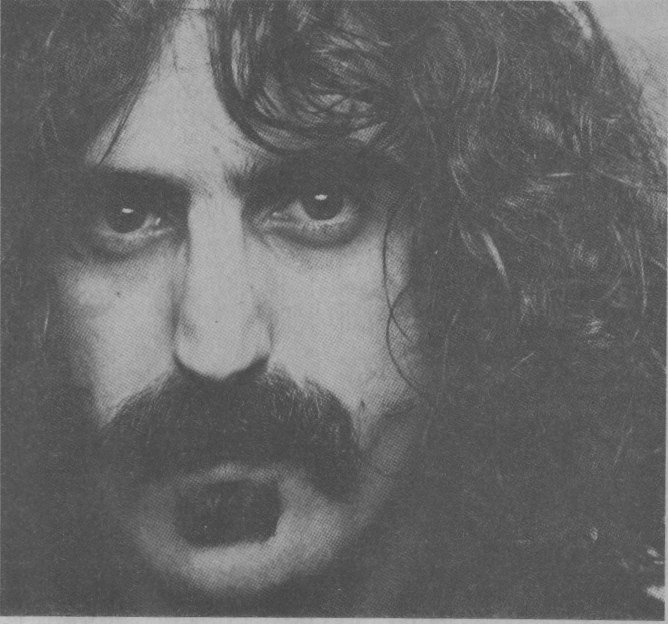
Ottawa: Frank Zappa flopped down onto a bench seat in the small change room, heaved one leg across the other and took a long drag on his cigarette.
His hair was tied back behind his head, highlighting the fatigue in his face. He looked exhausted.
Hardly surprising. He'd just laid down another gig on The Mothers' hectic North American tour. The same night he had to bus 150 miles to the airport so that the following day the band could fly to the next stop on the tour. When the travelling was done they were due to start filming a T.V. special. Then the touring would start all over again, in Europe.
And now there was me, wanting an interview.
But this was just one more thing he was prepared to take in his stride, and he seemed happy enough as he chatted with me about his humour.
"It's an anomaly," he smiled.
"Simmons has a very good sense of humour – one that leaks out." He was referring to Jeff Simmons, rhythm guitarist in the Mothers' touring lineup.
It soon became obvious that humor was one of the primary qualities he looked for when picking a band.
"It's at least as important as being able to play. Because if ya don't have a sense of humor ya can't play the music correctly, no matter how many of the right notes ya hit, ya still can't play correctly."
I was wondering if his zany and bizarre side was reserved for his songs and the public.
"Actually, I tone down quite a bit when I have to go out in public. Off-stage it's much worse," he chuckled.
As for toning down, hadn't I heard something about him reenacting Dinah-Moe Hum in public?
"No. It was a situation that happened in Australia when a girl requested that we act out Dinah-Moe Hum while the song was played on a cassette machine and I just announced to the audience that was listening that it's fun to try, but you'd be surprised how fast you have to go to make the events happen as fast as they're being described on record, ya know."
Dinah-Moe Hum is one of my favourite Zappaisms and as he obviously enjoyed rapping about it I thought I'd ask how he overcame the problem of censors, especially since the lyrics appeared in full on the sleeve of the "Over-Nite Sensation" album. After all, even The Stones wound up labelling Starfucker as StarStar" because the original title was considered unprintable.
 He tried sounding faintly indignant as he asked: "Well, what's wrong with Dinah-Moe Hum? I think it's a very wholesome, conservative sort of appraisal of what was really going on."
And with a sly look, he added: "I think The Stones get away with far more than we do – because they can afford it."
How about the lyrics of other songs which, although minus horny connotations, were just as crazy? What was his fixation with zircon encrusted tweezers on the same album? And Sears ponchos, which crop up again on "Apostrophe (')"?.
"Well ... I first discovered the zircon in nineteen ... fifty ... seven," (I was obviously in for an historical account) "when the piano player in the band I had in high school decided that in order to really play like Fats Domino he had to have the same amount of weight on his hand that Fats Domino had. 'Y'know, Fats had that big diamond ring on his finger. Well, Wimberly couldn't afford a diamond so he saw an ad in a comic book said he could get a zircon as big as yer fist for $10." Between laughter, he went on : "So the zircon has always seemed to me the symbol of complete cheapness."
The explanation for the ponchos wasn't so descriptive: "Well, ya know, clothing styles are something to think about all the time."
To me, "Apostrophe (')" seemed a logical continuation of "Over-Nite Sensation". What direction would the next album take?
"I've already got another album finished. It's ready for September. It's called "Zappa, Mothers, Roxy and Elsewhere". It's mostly a live album. Two-thirds of it was recorded at The Roxy in Los Angeles and some other tracks were recorded at The Auditorium Theatre in Chicago and at a gymnasium at Edinburgh, Pennsylvania."
He added that it would contain a lot of the material he was playing on his tour. The gig I'd been at smacked of nostalgia – a trip back to rock and roll.
Zappa was quick to explain: "The shows are completely different. Ya know, a different lineup. It's pretty much different every time. We have a lot of songs and we switch 'em around. So if we happen to do a show which contains a lot of rock and roll numbers you'll come up and say that I'm getting back into the Ruben and The Jets era."
At the same show, Zappa had taken it easy on vocals, leaving most of the singing to Napeoleon Murphy Brock.
He explained: "My guitar style is another anomaly. It's an extension of my humour and I'm just gettin' into playin' the guitar a little more now.
"So when we play instrumental things I like to construct vehicles that will give me the chance to play in the style I like to play in."
The vehicles in this case were Ruth Underwood on percussion, George Duke on keyboards, Chester Thompson behind the drums, bassist Tom Fowler, plus Jeff Simmons, and Napoleon on lead vocals and tenor sax.
He met Ruth in '67 when she recorded on the "Uncle Meat" album.
Tom Fowler is the brother of Bruce Fowler, who once played trombone with The Mothers. Frank told me how Tom had come to join them: "We had another bass player for a while and he couldn't cut it so I was looking for a bass player and Bruce said 'my brother can do it'. So he brought his brother in from Salt Lake City. And he did it."
He's worked with George on and off for five years, although he quit for two years to work with Cannonball.
Jeff was in the group before, touring with them for about a year. He split just before the filming of 200 Motels and came back to The Mothers around March.
 As for Napoleon, Zappa had met him in Hawaii. He recalled: "He was working in a club called The New Red Noodle. I went in there one night while I was on vacation and just happened to see him and I thought he was a really good performer and I asked him to join the group. He said he'd like to but he couldn't as he still had a seven-week contract at the bar. And so I said 'well, here's an honest musician', and after his contract ran out at the bar he came over and rehearsed with us and he's been in the band ever since. It's been about a year."
It seemed a small lineup in comparison to his albums and he explained: "The way it works is that if it's a Mothers' album the instrumentation consists of the group I'm touring with at the time the album was made. And if it's a Frank Zappa album it'll contain people who are not necessarily in the group. And that's why there are 24 on "Apostrophe (')" as compared to eight, or whatever it was, on "Over-Nite Sensation"."
Among the 24 had been Jack Bruce and Aynsley Dunbar and I'd assumed, cynic that I am, that Zappa was joining in the fad of having lists of impressive names on his album sleeves.
But no. "I like variety and I like all different kinds of music. Not every musician can play every style of music so if I want to do a song in a certain style I'll get people who are good for that style."
Some names had a habit of cropping up almost as if they were Zappa fixtures – Jean-Luc Ponty, Sugar Cane Harris and Ian and Ruth Underwood.
A thing of the past: "As a matter of fact I haven't worked with Ian for over a year and Jean-Luc has been out of the group for six or eight months. And Sugar Cane never did tour with us. He worked a couple of jobs in Los Angeles.
"Y'know, some of those people are good to use on record sometimes. But er ... they're not exactly what I want to build my future out of."
So who else would he like to work with? "Well, let's see ... I like Joe Farrell. I like the way he plays but I wouldn't go out of my way to make an album with him. I'd probably get in his way."
Was there anyone he would go out of his way to record with? – "No, not really." But after a second thought he quickly added : "Oh, wait a minute ... Howling Wolf."
As an Englishman recently arrived in Canada I was wondering how he felt about li'l ole Britain and going back there on his September tour.
"Well," he sighed, "sometimes it's fun and sometimes y'end up in hospital."
His last visit, when he was thrown off stage and busted a leg, was still fresh in his mind, although he added: "I've had a few laughs in England. Had a few weeps too. Ya win some, ya lose some but then it's six of one and half a dozen of the other."
The cliches stopped and he got back to rapping about the bum who jumped him on stage. The guy got a year's sentence and Zappa thought it was light. Understandable, since, although it was a clean break, Frank was in a wheel chair for nine months.
"It didn't heal. It refused to heal and they wanted to operate on it but I said 'No, just leave the cast on. It'll grow back'. And it grew back."
Another thing he didn't rate about England was the National Health Service – a pride of the English ("Bloody immigrants only come here for our National Health" is a favourite piece of British intolerance).
He said: "I spent a month in the hospital at the Harley Street clinic, which wasn't too bad. The first hospital I went to was the absolute pits. It was a regular public hospital. It was just ... eughhh ... I can still remembered how it smelled, folks."
And sounding as though the smell was still in his nostrils, he groaned: "It was really horrible.
"No, I don't reckon that your National Health is such a good deal. You get what ya pay for."
That subject dispensed with like a dirty swab, he got into the other matter in England – the ban by the Royal Albert Hall: "We're involved in a law suit with them still. Y'know what happens in the courts. They fart you off for three years and then somebody calls ya up and says 'You now have a court date. You appear.' When that happens I'll go over there."
I could imagine him in the witness box. It should be a gas. But as his impressions of England seemed far from favorable, I elected to get off that subject and asked him about the T.V. special.
"We're gonna film it as soon as we get back to Los Angeles," he said. But he wasn't giving away any clues as to what we could expect other than saying: "It'll be something you never saw before. That's all I'm gonna say. I don't wanna give away the surprise," he smiled.
A lot of people should be getting a chance to see the film. "As a matter of fact we had an offer from NBC but er ... it's better to put it into syndication because there are more non-network stations than there are network stations. You'll probably get the special anyway. It can be syndicated in Canada."
This will be his first filming since 200 Motels, which wasn't exactly a smash with the critics.
There was a touch of bitterness in his voice when he talked about the reviews, although he clearly wasn't discouraged.
It was his turn to review the critics: "You have to take into consideration who, and what, critics are. And what they do for a living. And the way in which they perform their function best. And the manner in which they keep their jobs the longest. And also the fact that most of them don't have a sense of humour at all. So ...
"If you don't have a sense of humour it's very difficult to confront what I do. It's a total non-compute if ya can't laugh – especially if ya can't laugh at yourself.
"So ... what can you expect from a critic?"
He seemed to feel better after that and went on: "But on the other hand, some of the places where you'd expect I would get horrible reviews I got excellent reviews.
"CBS Television in Los Angeles gave a fantastic review and ran part of the film along with the news. And the other place we got a good review was in Variety, y'know, the old time Hollywood newspaper. The guy loved it.
"In fact, I talked with him before the show and I thought he was really a jerk, y'know. He asked me stupid questions and I thought, y'know; 'You can't expect much from that' and when he went in and saw the picture he was laughing and rolling all over his chair. He loved it."
He appeared happier again after that recollection, and I asked what direction he thought his work and music would take him in the future.
"Gee ... I sure can't say." As an afterthought he added: "That's another one of my anomalies."
And on that final anomaly I thought I'd make my exit so he could get his bus.
Other version of this article appeared in Melody Maker as "Grand Mother".
Read by OCR software. If you spot errors, let me know afka (at) afka.net