The Aesthetics Of Freakery
By Mike Bourne
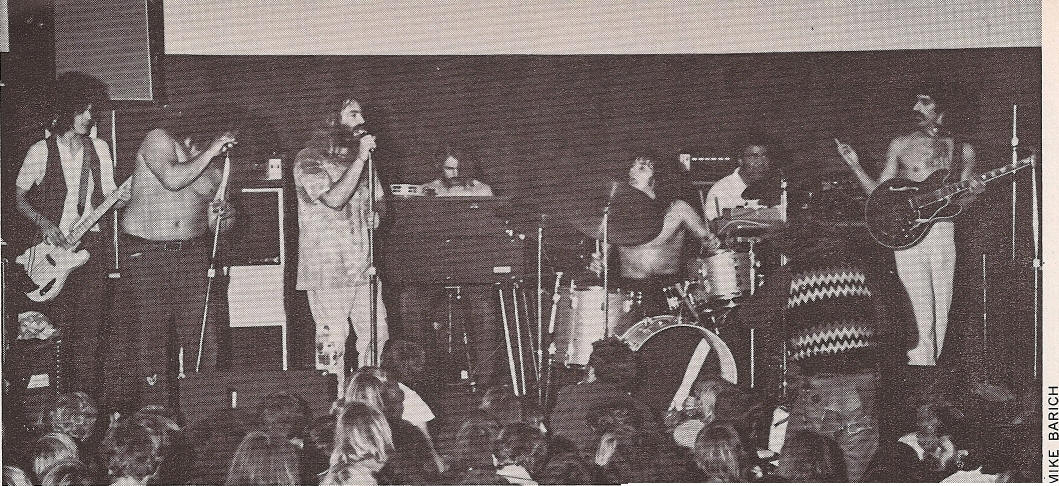
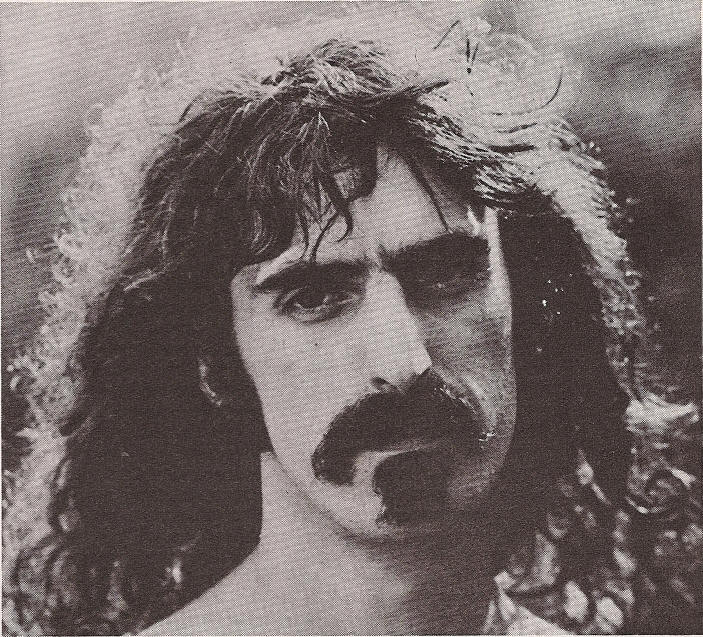 ON THE FOURTH OF JULY, Frank Zappa played the second of two Indianapolis concerts. At that time, the new Mothers of Invention revealed themselves surely the most consummately brilliant ensemble of musicians performing in the rock idiom: Ian Underwood, keyboards, tenor sax; George Duke, keyboards, ring modulator; Zappa, guitar; Jeff Simmons, bass, vocals; Aynsley Dunbar, drums; Howard Kaylan and Mark Volman, percussion, vocals. Yet Zappa proved himself, as he has consistently since his popular emergence, hardly the rock artist most may have expected, nor simply a "jazz/rock" artist or any other expressive amalgam, but a serious composer of contemporary music, whose bizarre wit and often quasi-perverse stage presence have perhaps prevented (for an audience stoned on image) the ready perception of the true genius in his art – which is certainly formidable. We spoke in the sterility of his Holiday Inn motel room.
M.B.: How does it feel to spend Independence Day in the heart of middle America?
F.Z.: Painless so far, except for the Holiday Inn scallops.
M.B.: According to the press, your group isn't supposed to be officially together.
F.Z.: Well, we were offered an extremely large amount of money to play a festival in England. I didn't think it would be such a bad idea.
M.B.: Is this another get-your-chops-together tour?
F.Z.: No, we already did that one. This group has been together for about four or five weeks. We rehearsed for about ten days before we went out on the road, and we've played San Antonio, Atlanta, a TV show in Holland, a festival in England, and then Ravinia. And that job last night was our sixth job with that instrumentation.
M.B.: You made this line about "most people wouldn't know good music if it came out and bit them on the ass" –
F.Z.: I didn't even say "good" music – I said "music".
M.B.: That poses the question of who is your audience to be. Who is it? Who do you want for an audience?
F.Z.: Who are they really? Well, judging from the letters we get, they're boys between the ages of 14 and 17, middle-class homes, with short hair, and not too rich, not too poor, not too weird, not too straight, just sort of middle Americans actually. We don't have a very strong following among what you would call your hippie fringe or your bomb-throwing leftists or extreme right. We've got pretty much a middle-of-the-road audience.
M.B.: Who would you want your audience to be?
F.Z.: I just wish there were more sort of middle-of-the-road people; then we'd have a bigger audience. The problem in the United States today is that everything is becoming so polarized. It's a constant pressure on everybody to choose up sides, to be either right or left, and to live your life according to some idiotic dogma that will allow you to be in the club.
M.B.: What about the degree of musical appreciation in your audience?
F.Z.: Well, I don't want the people to be different, you know. Let's put it this way: I would just as soon have those same people who were out there in that audience last night, with a little bit broader background by which to compute the musical events on stage. When we do things ... like the introduction to Call Any Vegetable is the opening part of Agon by Igor Stravinsky. Nobody recognizes that. We played it at that concert in Los Angeles with the Philharmonic – Zubin Mehta didn't recognize it! And we're playing it exactly off the score; we voiced it out, the exact same things that are on the page, there's nothing left out, just that it's being played by electric instruments. The only person that knew that we played Agon in L.A. was Lalo Schifrin. Nobody in the orchestra even recognized it.
M.B.: Do they not recognize it out of context or maybe can't see beyond –
F.Z.: No, it's more likely they've never heard Agon.
M.B.: The one aspect I noticed most about your performance was the great theatrical precision. The music has that precision as a score, but the dialogue is also that exact - like the moment in Call Any Vegetable where you say, "You and your little green buddies ... maintaining, your coolness together" –
F.Z.: Well, that's right off the record, that's the words to the song. That's not an improvised monologue.
M.B.: That's what I mean. I suspect many people assume that these are improvised adlib bits.
F.Z.: I don't think that, because judging from the response to the opening line of Call Any Vegetable, which is "This is a song about vegetables; they keep you regular, they're real good for you" – well, that's the automatic clue that we're now going to play Call Any Vegetable. Teen audiences respond strongest to material that they've already heard on record. And judging from the applause or whatever noises that are coming out of the audience, they already knew the song, which was recorded in 1967. You know, it's been out, so they had a chance to hear it and know what the thing is. And whether they like it or not, they respond to it because they remember it. It's like: somebody is gonna play something off their record! So you've got to compute that into their response, too, and you have to compute all their responses by that criteria. They'll respond best to things they've already heard at home, things that they've lived with already, things that are familiar, things that they believe they already understand and can make value judgments about. But when we play The Hunchback Duke, they don't say or do anything, in spite of the fact that 80% of the material in it appeared on the Burnt Weeny Sandwich album under the title of Little House I Used to Live In. And also the closing movement of The Hunchback Duke medley is Cruisin' for Burgers from the Uncle Meat album. So individually they might recognize those things when they hear them, if they heard the record. But if I say the name of the song is The Hunchback Duke, there's no response.
M.B.: Yeah, like when you got to the lines from Cruisin' for Burgers, that's when you got the ovation. But do you think the theatricality in the band obscures musical appreciation? Or do you feel this is what they really want to see?
F.Z.: Neither of those things. I think it's integral to the music. It's as integral as any piece by John Cage; like for instance, the one where he has the trombone player who wanders around stage and first blows his horn into a bucket of water, and then lies on his back under a piano and plays one note, and then gets up and pulls an apple out of the end of his horn and throws it. You know, it's part of the music. For instance, the point where we're just scratching on the strings of the guitar and the bass and doing all these poses around the stage: it's necessary that it be in there. It would be extremely dull during that section if we just stood there and went glonk, glonk, glonk.
M.B.: Dull visually, as far as a concert is concerned.
F.Z.: Well, on a record you can do certain things to it to enhance the sound. But to keep the momentum of the piece, we've tried it before without the movements, and it's always more effective, it carries better, if there's some physical movement to enhance that very sparse section, 'cause it's just a few little clicks and that.
M.B.: Do you think you're music can be as spontaneous as you would like it to be?
F.Z.: We're not doing spontaneous music to the extent the old Mothers group used to do it. I've more or less abandoned that until the audience got a chance to comprehend it. I mean, there were elements in what we did that were completely spontaneous, like at the point where I start conducting and breaking up the tunes; that's all 100% spontaneous, nobody knows where it's gonna go. I can stop the group or twist the time around or do anything I want, 'cause this group knows all the signals – but I'm just not doing it as much as I used to.
M.B.: Like the medley of "hits" seems as if a whole piece, orchestrated tightly from one song to the next, with a couple solos.
F.Z.: There's three guitar solos in the medley: in Wino, at the end of You Didn't Try to Call Me, and in the middle of Call Any Vegetable. And after that medley, we played King Kong, and in the middle the first solo is George Duke, and then I play one, and then Ian finishes it off on the sax, or depending on the atmosphere or how tired he is, we throw Aynsley in there and have him crank off a solo.
M.B.: And outside of those five or six solo moments, the rest is as if you're reading from a score.
F.Z.: That's right. We're playing set pieces ... that have never been given a good performance before, because now that we have Mark and Howie singing in the group, for the first time the melodic content of those songs can come out – 'cause I was never a good singer, and Ray Collins, at the time he was the lead singer, was not very fond of harmonizing with anybody else. So we couldn't get into any of the stuff that we're doing now: the three- and four-part vocals, which I enjoy doing. I don't mind singing those same songs over and over again. Of course, this is the first time that we've played that conglomeration. If I'd been doing it for four years, I might feel a little differently about it. But what we're gonna do for the next time we go out is to put together another package of tunes that's just as tight as the first medley, and so we have, say, three different shows to choose from. We don't have to do the same one every night. And it takes a lot to get it to the point where those things come off like that.
M.B.: You're missing your front line of saxes now.
F.Z.: Well, as a matter of fact, I could probably duplicate that with Mark and Howie and Ian, 'cause Mark and Howie both play clarinet. But I haven't had the time to put together a completely integrated musical thing, because we had ten days of rehearsals to learn a very difficult repertoire and lean mostly in the direction of vocals, 'cause that's what they do best. If the group stayed together for a longer period of time, I'd have them playing saxes and various percussion instruments and guitars and whatever. You know, we could have a "variety orchestra" or whatever you want to call it. I think it's enough for right now that they just sing those songs, 'cause they're not easy to sing.
M.B.: I asked you last night if you felt bad vibes, and you said you felt no vibes at all.
F.Z.: That's right.
M.B.: Can you put it down to lack of musical appreciation in the audience?
F.Z.: No, I didn't even consider that, because when I go out there on the stage, I'm not out there to scarf up the vibes from the Woodstock Nation or tune in on the groovy peace/ love. I want to play my guitar and I want to do my show, and that's it. And anything else is peripheral.
M.B.: Then you don't consciously seek any audience rapport?
F.Z.: Well, if it's there it's there. If it's not it's not. I don't want to go down and kiss somebody's ass to make them rapport with me.
M.B.: No, I'm asking are you playing for yourself more or for the audience?
F.Z.: I'll put it to you this way: I don't want what we do to be an unpleasant experience for anybody. I certainly don't want to bring them down by what we play, and I don't want to get myself off at the expense of the audience. But, you know, I don't think of the audience as the main thing when we go out there on the stage – they're there. I play just as hard in rehearsal as I do at the show.
M.B.: But it seemed that the times when you most went out to the audience were moments of subtle sarcasm or overt cynicism.
F.Z.: Well, that's the way I am off the stage, too. In fact, I wish that the audience would understand that by not giving them any special treatment, by not bending over backwards to do something on their behalf, they're being treated as adults, and being given the benefit of the doubt. You know, I think it's really pandering to the lowest common denominator in the audience to go out there and just ... I don't know how to describe it, what most groups do.
M.B.: Did you feel your performance of 200 Motels (with the L.A. Philharmonic) was a success?
F.Z.: Yeah, I felt it was, definitely. First of all, 14,000 people showed up by actual box office; that's the reports that I got. No press since that event has given an accurate accounting of what the box office was. They intended selling 11,000 tickets. That would have been 11,000 seats where everybody could have seen the stage, and 3,000 more people than they expected showed up. And those people, like some of them were press people, were sitting behind the orchestra. The orchestra in a place that big had to be amplified and the speakers are facing toward the far end. We were about 12 feet above the orchestra on a platform, and the only thing that I could hear was the percussion section, which was right at my feet. And we were amplified; not just our instrumental amps, but going out through a PA system, too. So anybody who was behind the projection line of those speakers, God knows what they heard. If it was anything like what I heard from where I was standing, it was somewhat incomplete. But at the end of the show, the people just went completely berserk. We got a five-minute standing ovation, and there were people out there who looked like they really dug it, you know, really heard it.
M.B.: How could you tell?
F.Z.: I saw a few faces. You can tell whether or not ... like, for instance, when they give you a standing ovation in a town like Indianapolis, it's probably because somebody wrote in Rolling Stone one time that at the Fillmore East somebody got a standing ovation. So they figure in order to be in when a rock-and-roll band comes to town, when they finish playing you stand up and clap. I really got that sort of impression from the audience.
M.B.: It's progressive also, like a third of the house standing for Coven last night, then maybe two-thirds for Jerry Hahn, and then you got everybody. You are the star of the show, ergo you get the full standing ovation.
F.Z.: Certainly ... protocol.
M.B.: There might have been some other difficulty relating, because many of the pieces they couldn't dance to.
F.Z.: Well, if they can't dance to it it's their own fault, because the stupidity of clinging to a dance form, where you have to do a specific pattern of steps, you know, the twist or the frug or the watusi, some dance with a name to it, I think it's a bad thing. It's against the natural way of dancing. If you want to dance, you just get up there and move your body around to whatever beat it happens to fall on; that's where it feels the best. But a lot of these kids are too embarrassed to even try it. The only place where they really get into that is L.A.
M.B.: When we discussed the response to 200 Motels last night, you made an allusion that it was a success "despite the critics."
 F.Z.: Well, I was talking about the ethics of the critics. For one thing, the main critic of Los Angeles, I don't think has ever given a positive review to anything that Zubin Mehta has ever done. It seems like, I think his name is Bernheimer, has just had a hard on for Zubin since he got to town. You know, no matter what he does, it's always written up as shit. And Zubin's quite a good conductor. I've seen him do ... well, I've attended maybe five of his concerts prior to the one he conducted with us. And I saw him do a boss version of Petrouchka at a matinee concert that I couldn't believe; they were really cookin' it! And it got maybe a little applause, 'cause it was an old lady audience, just back from the beauty shop – and stuff like that never gets reviewed. He did a version of The Miraculous Mandarin one night that was also just Top 40. he was really tearin' ass on it! And the orchestra has some good players in it – it has an especially nice percussion section, I think. And none of those things have ever gotten reviewed well by Bernheimer. And then the proof of Bernheimer's reviewing was the Pierre Boulez concert a week or so after our show. And he reviewed it thusly: that "at last the L.A. Philharmonic had played with precision" – as if Mehta was some sort of schlepp, and suddenly Boulez comes in and magically the orchestra is first rate. And that's not true, because, you know, Boulez is a very accurate conductor, but he didn't get the type of accuracy that was described in the newspaper article. Boulez was illuminating parts in the scores that I had never heard before, but as far as the orchestra playing together and really hitting it, no – 80 % of the time they weren't; nothing to warrant the review that it got.
M.B.: Is this ethics or just lame ears?
F.Z.: No, I think it's ethical. I think that there is probably some sort of personal conflict between that reviewer and the conductor of that orchestra – and the guy just said to himself, "I'm gonna get that sonofabitch." You know, I don't think the quality of the reviewing is honest.
M.B.: He's one example.
F.Z.: Well, I'll give you a better example: how about Time magazine? A week before the concert, they sent a writer, this guy named Tim Tyler; he came to my house and asked me a few questions about the thing. Then he says in front; "You're probably not gonna like what I write about your show." And I said; "Why is that?" And he said; "Well, they want me to cover it from the standpoint of I gotta find a musician in the orchestra that hates your music and we're gonna cover it from his point of view." What can you do? They come and tell you that in front, man! And so he scoured the orchestra trying to find somebody who really didn't like doing it – and he couldn't find anybody! So then he really started scraping around and trying to get somebody to say some bad shit about it. And he explained it to me this way: he said, figure the type of people who read Time magazine. It's a businessman and he doesn't like music anyway, but he's looking for something to chuckle over – as if the whole movie section of Time is for the edification of some guy who sells aluminum siding. And nobody who has any interest in the arts ever reads it, which is probably true. But he says the function of Time is not to do a musical review, because "we're not really qualified to review the music." And I didn't even see the article, but I'm sure that it didn't say anything at all about the music.
M.B.: Well, a lot that I've heard about the concert seems to erect a kind of legend of outrage, like that moment in Night At The Opera when Chico and Harpo tear up the overture. Like people will believe you had the violins blow bubbles, anything that sounds freaky or strange that people would respond, "Yeah, Zappa would do that!"
F.Z.: Well, I've got the scores here if you'd like to see them. And everything that those people were doing was all written into the score. You know, I didn't just say, "Okay, when you get done, you over here, you make an ass out of yourself this way, and you over there, you make an ass out of yourself that way." It was all part of the musical concept. And I think one chick wrote that at a certain point in the performance the brass section stood and tore their music up and threw it in the air, which was untrue. What happened there was, in the score it says, "horns stand, shuffle decks of cards." Well, in a normal acoustical environment, where you have some resonance to the room, if nothing else is playing and the horn section stands and goes brrapp like that with a deck of cards, it's a sound. But in a basketball arena, it doesn't make much sound at all. And they'd been doing it, but it just wasn't coming off. So, I didn't know it, but they had decided among themselves at that point they're gonna stand and throw the decks of cards all over the violas. And the viola players just went what?, 'cause all these cards were coming down on them. It was actually great, and I didn't mind them improvising on the score at all.
M.B.: That theatrical act is an improvisation on the score?
F.Z.: Right.
M.B.: Then you do compose in terms of theatrical elements in the music.
F.Z.: Absolutely.
M.B.: Have you felt your records were ever sufficiently reviewed?
F.Z.: Well, there have been some glaring exceptions to that. There have been about three really perceptive reviews that I've read about any of the work that I've been involved in, but they're spread out and they're usually in publications that never reach a mass audience. So our image is brought to the public by magazines and newspapers and such that reach the largest number of people, and that's where the worst reviewers are, in the larger publications. And so, what're you gonna do? The only place where we really get a decent break is in Europe, 'cause we do really pounds of press over there. Like we just got back, and I must have done 40 interviews in the time I was there. And those papers have large circulations, and it seemed the professionalism of the reviewers was right up there. They took the job seriously. Even though some of them were young kids, they were very thorough and they had their questions mapped out. And they took time to write down exactly what you said! There was one horrible exception to that which appeared in the largest British paper, the Daily Express, multi-million circulation – this guy was a little drunk when he was writing down my answers, and came up with some strange things. But in general, the pop trade papers like Melody Maker, things like that, and other newspapers I dealt with over there, guys were really serious about what they were doing.
M.B.: European critics are often characterized as cats incredibly sensitive to honesty in how well your music is what you intend it to be. American critics sometimes seem to write about personality more, or in some instances what they would rather your music be than what it is.
F.Z.: Well, in America there's two things that stand in the way. One, art in any shape or form is not a necessity to the American public. They really don't feel that it's an integral part of their life style. You know, it's just a diversionary facility, part of the general leisure time boom. It's always been advertised in the United States: well, art? – anybody can do it! Everybody's an artist, everybody's a singer, you can play the guitar, you can play the piano, so there's nothing special about a person who has an ability to do something specific, and who has devoted his life to doing that one thing. It's taken for granted, just like maybe the plumber could fix a car because they're both made out of metal and they both have tubes in them. So you've got that to overcome in the first place. The other thing is that because of the way the public views an artist in the United States, certain neurotic things creep into the personalities of the artists who live here – because you're isolated, and you're already viewed as something that came out from under a rock. And in many instances the people begin to act that role; this is especially true in jazz circles, I've noted. And that just serves to push the audience farther away from them. So when you come up against an interviewer who's looking for a story, who needs to serve a certain thing on assignment for his magazine or paper, then you haven't got a chance, 'cause he'll make you look like a buffoon, or he'll make you look like some sort of a creep, or whatever. They make you look that way; that's not the way you are!
M.B.: One of the strange aspects to revolutionary aesthetics is this idea that once the revolution comes, we will all begin to spontaneously create, because we're all essentially artists. Everyone has this creative essence that will be immediately exposed if the government changes.
F.Z.: Well, I think that everybody does have a creative essence about them, but they should realize that that essence exists in varying degrees from person to person and the emphasis of that essence shifts. Some people might be a little bit better expressing themselves in clay, for instance, or with fingerpaints, and definitely should not take up the saxophone.
M.B : Do you think you've had an influence more by your music or by your image?
F.Z.: Influence over what?
M.B.: Other artists.
F.Z.: I think we've definitely had an influence over other musical groups, obscure as the Mothers of Invention might have been, because I hear things now happening, especially in groups coming out of Europe, that would not have been possible if we hadn't taken the first step and said: you don't have to play 3-chord blues to make it sound like rock 'n roll, pop music can exist in time signatures other than 3 and 4, lyrics do not have to be about boy/girl situations. It's not enough to just say that in an interview and then have it published some place, and then some guy who's forming a group read it and say, "Yeah, maybe that's true, we don't have to play in 3/4." You have to do it on a record and say: look at that! – maybe you didn't sell a million, but that's how to do it. And we did it, we did all those things a long time ago, and now it's happening over there. We played in Germany two years ago ... there were a lot of local groups that come in the afternoon and do that gig, and I would say that 40% sounded like Side four of the Freak Out album.
M.B.: I responded to that, "The Return of the Son of Monster Magnet," like I first responded to Coltrane's Ascension. Like when I first heard it I wasn't ready for it, but then later, after experiencing the music more and more, I would go back to it, and it would by then sound even tame. But you've often been compared to Dada, especially more so in discussions of Captain Beefheart and other groups you manage. Do you feel this is a conscious element in your music – a kind of overt craziness?
F.Z.: Dada? Well, some people may find it hard to believe, but my music is a direct extension of my life style. And I try to keep it as closely related to the way I think when I'm offstage, no matter what the music is. In order for me to feel natural playing it, it has to be pretty close to the way I feel when I'm off the stage. That's too much of a jolt to have to manufacture something that would be overtly crazy and be anything other than that off the stage, and then go up there and suddenly turn it on – you know, it's cultural shock!
M.B.: Some Hoosier reading that might respond: "Oh wow, he likes to ball vegetables!"
F.Z.: Well, am I to be held to blame for the reading comprehension of somebody from Indiana?
***
M.B.: Are you only in it for the money?
F.Z.: No, and that's another criticism that I have of reviewers – because on the day that that album was released, the thing that escaped everybody was the fact that it was designed to show that the Beatles were only in it for the money, not that we were. If we were only in it for the money, we'd be doing something else! I mean, to look at that cover and to see the people on that cover and say that these guys are only in it for the money ... I thought that was the funniest thing we could have put together. But automatically everybody assumed that that was the exact truth, and nobody stopped to question for a minute the relationship between the Sgt. Pepper cover style and the title. You know, they never once questioned that the Beatles might be anything other than directly descended from heaven. And I personally felt for a long time that they were extremely plastic, and flat-out commercial.
M.B.: Well, the response was usually: "Oh, a parody of the Beatles cover!"
F.Z.: No – likely, they didn't even know it was a parody of the Beatles cover. I'd say 30% of the audience didn't know it was a parody of the Beatles cover.
M.B.: I doubt that. I think people are sharp enough to see something that blatant.
F.Z.: Do you? Even though it's inside out? Think about it. It would have been released the other way if the Beatles hadn't screwed it up. We had to get permission from them to put it out.
M.B.: When We're Only In It For The Money was re-issued censored, I recognized most of the cuts for being naughty words or such, like "Flower Power suckssuckssucks!", but I never could figure why that line from "Let's Make the Water Turn Black" was cut: the one "I still remember Mommy with her apron and her pad feeding all the boys at Ed's cafe!"
F.Z.: That was cut because some executive at MGM thought "pad" meant "sanitary napkin" and the image of Mommy feeding the boys a sanitary napkin was too much for him. Can you imagine where that guy's head was, to make that connection?
M.B.: Still, a lot of your lyrics evoke strange images for many people, some very startling, like on Concentration Moon about the cops shooting kids, which really takes on a new significance after Kent State.
F.Z.: You get a different perspective; that song was written in 1967.
M.B.: The lyrics in The Hunchback Duke about student leaders also indicates an attitude, a disfavorable one that most college kids most likely don't expect.
F.Z.: I don't like student leaders, because I don't think that they're really qualified leaders. I don't think they're offering their constituency anything that resembles wisdom or leadership, and serve only the same function as Chubby Checker showing you how to do the twist by putting a bath towel around his buns to give you the idea of how you're supposed to move. And I also see that the whole revolutionary trend this season is a fad that's similarly based to a dance craze or Flower Power or transcendental meditation. And as soon as something comes along to replace it, this will blow over, because the people who are actively involved in what they think is the revolution right now haven't the faintest idea what they're doing.
M.B.: Like what used to be called spring fever is now called politics.
F.Z.: It occurred to me the other day that the American public at the point when the peace negotiations were announced in Paris thought that was a great way: we'll negotiate and we'll bring about peace – and everybody sort of welcomed that. I'm surprised that that same sort of rational approach – I'm not saying that the peace talks ever could have been successful – but that the same sort of rational approach couldn't be applied to the domestic grievances of the people who have been abused by the government. You know, they haven't even really sought a way to bring their grievances to the attention of the people that might be able to do something about it. And they're also too lazy to take the steps that would be the most effective to correct these grievances – because a demonstration doesn't correct grievances! It only does two things: it polarizes the good guys from the bad guys, and that changes from whichever standpoint you want to look at it, as to who's good and who's bad, and it only serves to notify the other party that you're pissed off about something. But it doesn't correct the situation! And I think that everybody's been notified already; you know, everybody's got the idea. So now the thing to do is change it. If you can't go directly to the government and say: look here, we're the majority, these people under 25, and we've got some needs that aren't being taken care of, and we don't like this and we don't like that, do something about it – if you can't take the direct approach, then you have to do something a little bit more incognito. One of the things that I've been advocating all along is called "Slot Power," where a lot of the hippie girls, who are now, say, some of the ones in Chicago who joined the Weathermen and help make Molotov cocktails – they would be better off going into an uptown bar with a different set of clothes on and picking up executives and industrialists, and maybe eventually marrying these people and exerting a profound influence on the lives of the men who actually have control of the material things in the United States, and just sort of by inference and pressure from another direction could cause a great deal of things to change.
M.B.: That's not your basic working-through-the-system ideal.
F.Z.: But it's still a lot tidier than going out and blowing things up. And the other way is – and it's an especially effective tactic in the Midwest where you have a lot of small towns – if you think you really know where it's at, and you're a long-haired kid, you know, and you really got the best interests of the United States at heart, and you're really patriotic and you really want to change things, what you do is you get some of your buddies together and you go to a small town and you cut your hair, and as soon as you're old enough to vote, you just take it over! And this has been done a couple places on the West Coast. You get your own sheriff, and you get your own mayor, and your own city council, and then you've got a town. But, see, there's a lot of these kids that know deep down that if that ever happened, they would be forced to accept the responsibilities of actually running that town. And then what do you do? They're not ready for that!
M.B.: There's an impatience about that, also.
F.Z.: But impatience is irrelevant, man. You can't be impatient about something that's this – up, that took this long to get up, hundreds of years – and you're not gonna undo it with one demonstration! To me that's a result of television: television has shortened your interest span and led you to seek out things like instant TV dinners. I know it's worked on me, definitely. I can't wait two seconds to get something to eat if I'm hungry. Somebody could offer me the greatest meal in the world if I waited two hours, and if I'm starving to death I'll eat a peanut butter sandwich. You know, that's exactly the way it is, and it's the same with those kids. They think, you know: "We'll just go out there and we'll stand around in the street and we'll scream and somebody will squirt us with gas, and then we'll have a revolution!"
M.B.: "And we'll wear our scars like medals!"
F.Z.: Yeah, that's right.
M.B.: I notice in both theater and in music this kind of impatience, an inability to wait and appreciate what is happening, wanting it to be over, to have already experienced it without having to expend too much time.
F.Z.: You want it to be over so you can clap.
M.B.: So you can file it.
F.Z.: "I heard that solo the other night. I heard that guy play 27 choruses of Lady Is a Tramp!"
M.B.: "And I applauded like I never applauded before!"
F.Z.: "Yeah, he was heavy!"
M.B.: Are you a fatalist, then? Do you think there's a chance to get out of it all, a chance to educate the public, a chance to –
F.Z.: Yes. 50-50 ... that's optimism!
M.B.: A kid asked me to ask you "what possessed you" to pose for that poster sitting on a toilet.
F.Z.: Okay, it went like this: I had no idea there was ever gonna be a poster. That picture was taken in a toilet in the Royal Garden Hotel in London and it was part of a publicity campaign for our first appearance in England. And so, the guy that took it just decided to make a poster out of it. And due to the copyright laws in England, the photographer owns the photographs. Here, the photographer owns the photograph, but he doesn't own the right for your image on it unless you give him a release. There they don't need a release, so he took the thing and went out and made a poster out of it. Well, it pissed me off, and I couldn't do anything about it, because they had a whole bunch of them on the market. And it's probably one of the best-selling posters of all time, although I haven't seen any money at all from it. It's bootlegged all over the place; somebody makes a poster of it, somebody else'll take a photograph of that poster and print up his own. There are two or three different varieties of it that are circulating all over Europe.
M.B.: Do you get hecklers much?
F.Z.: Oh yeah, they're heckling because it's fashionable to heckle the Mothers of Invention, because they know I'll say something back to them. We really don't get into too much audience abuse anymore. In the early days, when what we were doing was so far removed from everyday experience – you know, what you said about Freak Out, it was weird for its time. When we first started performing things on stage, there was quite a bit of hostility from the audience, but we weren't gonna let that wither our presentation. So we'd just give it back to them on a psychological level. Now outside of bashing someone's head in in the audience, what can you do to them for revenge?
Have you heard the Chicago Art Ensemble? They played at a festival we did – in a tent, where people were sleeping in sleeping bags all around the place. And they had magnesium flares on stage! We've never done anything dangerous like that.
M.B.: Did you sit on stage for a half hour purposefully tuning up a long time and then go up and say: "Now you know what aggravation is!"?
F.Z.: Nope. I'll tell you one that I heard. A kid from the Flock came over to me and said: "Is it true about the gross-out concert at the Fillmore East? " And I said: "What're you talking about? " And he said: "Well, I heard that you said you'd give a thousand dollars to anybody in the audience who could outgross you." And I said: "Oh really, then what happened? " And he said: "Well, this kid came up on stage and he took a crap right on the amplifier!" And I said: "Yeah, well, then what did I do? " And he said: "Well, you shit on the amplifier and you stuck your finger in it and then you stuck it in your mouth! Is it true?" And I said: "No, it's not true!" And he said: "Aw, I was so proud of you!" And I've heard about five different stories in that same vein circulating around, about gross-outs.
M.B.: The myth of the outrageous!
F.Z.: Yeah.
M.B.: Who do you listen to?
F.Z.: I mostly listen to orchestra music. I've been listening to Debussy and Ravel lately, Honegger, generally Stravinsky, Varèse.
M.B.: This is my pet question –
F.Z.: Well, let's have it, then!
M.B.: What could you conjecture as a legacy of yourself?
F.Z.: A legacy of myself ? What would I like to leave?
M.B.: What you'll be remembered for ... something more than an infamous poster.
F.Z.: I think that's about all I have to look forward to, actually – the poster and rumors about me sticking my finger in my mouth on the stage of the Fillmore East, and saying "that's aggravation!"
Source: slime.oofytv.set
Read by OCR software. If you spot errors, let me know afka (at) afka.net