Grandson Of Ives
By John Ramsey Campbell
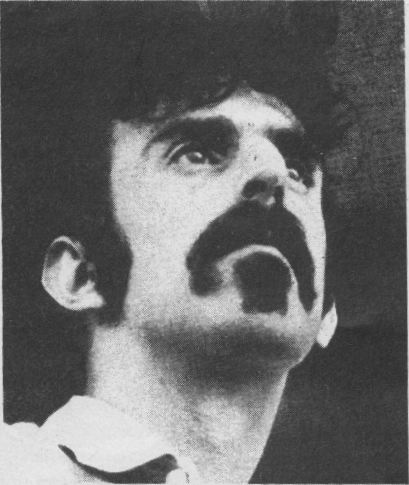 So I arrived at the Palace Theatre, Manchester, [1] with a Radio Merseyside tape-recorder (which wasn't in fact: all theirs were in use: I borrowed it for the weekend). "Radio Merseyside," I told the manager of the Palace. "See the general manager," he said. "Go round the corner, " said the general manager, "and tell them at the stage-door", I went round the corner, past a trippie who tripped by smiling terribly, and through a moist garage to the backstage. Someone with a London accent demanded my press-card. "I'm from BBC", I said. For some reason this convinced him, "come back at 7.15", he said, invoking a gnarled gnome from his office, a basinless privy behind the stage door. "Let him in", he told the gnome. I came back at 7.15. "I had this reporter from a big London newspaper", the gnome told me. "Hadn't got previous permission. I sent him packing. I said it's my bloody theatre" IT IS EXPRESSLY FORBIDDEN TO BRING DOGS INTO THE DRESSING-ROOMS. "Every tuppeny-ha'penny newspaper sends a man down", said the gnome. "You must have heard of us they say. Well, I haven't, and that's that. PERFORMERS MUST NOT GIVE CHARITY WITHOUT THE EXPRESS PERMISSION OF THE MANAGEMENT. "Who's that?" a new face shouted from the wings, pointing at me. "He can't come in here". "BBC", I said. "You'll have to have permission", he bawled. All of which may explain, if not excuse, the fact that of the ten-minute interview I did with Zappa not one word adhered to the tape. I suspect that the microphone wasn't switched on. So here, as near as I can reproduce it four hours later, is what happened:
I found Frank Zappa sitting with a beer on the stage-door steps, wearing a rubber band on the tail of his hair, slacks, a blue T-shirt numbered 68. Though obviously exhausted, he was immediately welcoming; he beckoned me on and made for his dressing-room, past one of the Mothers playing atonal piano music (the real thing, not a joke), and lay on the bed in what I appeared to be a dwarf's hotel-room. "Ramsey? Well, you've got a strong handshake, anyway".
How had the audience responded?
Reasonably.
What sort of audience were they aiming for, since Zappa's compositions surely attacked most potential audiences – the We're only in it for the money principle?
Zappa didn't like that – it was interpreting the record in terms of the title. If they were really only in it for the money they'd be playing teenybopper music.
Were there intentional Beatles parodies on that record?
Yes, of course – but nobody seemed to have noticed the duel Sergeant Pepper and Stones drag cover reference on the sleeve.
Did Zappa see himself composing orchestral music in ten years?
He already was – it was simply being played by less than a full orchestra. "Electronic chamber music", he called it. He'd been composing woodwind trios for a while now. He was dismayed by the lack of interest on the part of modern "serious" composers in electronic instruments.
I vaguely mentioned Messiaen.
Yes, yes, but there's more to it than that: electric piano, electric flute, electric etc. "Serious" composers weren't aware of the electric experiments current in pop.
Had Stockhausen ever heard the Beatles?
He'd heard them, I told him and he didn't like them. Zappa wasn't surprised; neither was I, really.
I felt that the verbal interludes in Lumpy Gravy were integral to the work.
Certainly they were: in fact they were intended as music, not as "conversation" and were scored as carefully as the orchestral sequences.
Reuben and the Jets?
An affectionate parody, yes, something they wanted to do, but even here there were experiments in the orchestration and stereo recording.
Mothermania?
Not as commercial and independent of Zappa as we thought: many of the songs are alternative versions, better mixed, and the version of Mother People includes the censored verse: Zappa slipped it in when Verve asked him to choose the tracks, and nobody bothered to listen to the compilation until it was released.
Now about the film, Uncle Meat?
Still awaiting completion on receipt of $30,000. However, the double album of the same name offers the soundtrack, built to demonstrate the talents of Gardner, Sherwood and Underwood: soprano Nelcy Walker sings along to produce a Jeanette MacDonald-Nelson Eddy effect. (My experience of the record is that it demonstrates their instrumental agility with great power, but still not fully). Incidently, Zappa's fond of science fiction: see the script of the film, which is reasonably avant-garde sf.
Speaking of films, didn't Antonioni want the Mothers to appear in Zabriskie Point?
So it seems, and Godard wanted them to record a soundtrack for one of his films: but Zappa never heard more than rumours from either. Well, that's Antonioni and Godard.
At that point someone appeared with a piece of apple pie: Zappa ate as much as he could and flung away the rind. He recounted the story of Crazy Joey, whose life story is on tape but unfortunately pronounced through toothless gums: who couldn't talk to anyone until one day he made up songs on the way to school and without more ado sang them to surrounding classmates. "They" still weren't his friends,'"'said Zappa, "but at least their attention was caught". His mother had him certified. He emerged, a little mad, and began work in his grandfather's brassiere factory. A girl persuaded him to sing. He sang. His mother had him certified again. He went mad. And all at once I understood Zappa's preoccupation with "freaks" as against children of convention in whatever form. Anyone who can describe this absurd tragedy as seriously as Zappa did is a profound humanist. [2]
 And how was the concert? Closer to jazz than pop; closer to "serious" music than jazz, and intricately played without anyone treading on anyone else's toes. Toward the end, the Mothers gave a trio for electric flute, flugelhorn and clarinet astringent, lyrical, rhythmically inventive, a little Stravinsky but a great deal of Zappa. Yes, they play from scores, in case anyone still needs to be told that they're musicians,.. There's a theatrical quality about the act which reminds me of Berio (Sequenza for solo trombone and so on). Zappa conducts, points reprovingly at members of the group, excites them to a sometimes terrifying pitch, makes masturbatory gestures, eats candy and says "This is the slimiest piece of candy I ever had my mouth round – the filling looks like it comes from who knows". During a performance of Mozart's C Minor concerto without orchestra, he wanders off-stage and returns to cohere the group's self-assertion. His dictatorial gestures during a piece for electronic piano and two percussion batteries strongly recall those of the singer in Berio's Circles. But most of the concert is full-scale inspired ensemble improvisation, reaching a level of intensity which synthesizes the visionary moments of Varèse and free-form jazz. Rock-based, yes, but one might as legitimately object to Stravinsky's jazz-based works. In fact the rock basis maintains a traditional coherence within which Zappa can explore freely. Indeed, Zappa seems to be trying for a synthesis of several arts: theatre, music, dance – at least until the Palace manager heard about it. No actors, no dancing, no crosstalk: this was a concert, singing and instrumentals only. "If you want to interview someone you should interview him", Zappa told me, grimacing. Yet at the end of the concert they exploded a flash-bomb on stage – an appropriate symbol. Zappa seems certain to find new ways to break through tradition and convention – and unlike the desperate avant-garde, he's likely to find something valid beyond.
1. Charles Ulrich: It took six months to get the article into print. The Palace Theatre gig was June 1, 1969.
2. Charles Ulrich: Sounds like FZ was talking about Wild Man Fischer and the interviewer didn't remember his name.
Read by OCR software. If you spot errors, let me know afka (at) afka.net